
-
Why Only Universal Truths Stay Fresh: Dharmic Wisdom to Beat Information Fatigue

Modern life delivers endless information yet little renewal. Dharmic wisdom explains why: knowledge not grounded in universal truth quickly grows stale, while insights rooted in satya, ṛta, and dharma remain evergreen. Drawing on Hinduism alongside Buddhism, Jainism, and Sikhism, this reflection highlights how compassion, non-violence, and service keep knowledge alive and transformative. It offers practical…
-
Unbreakable Resolutions: Dhruva’s Determination and Sattvic Discipline for the New Year

New Year commitments flourish when intention becomes unbreakable resolve. Drawing on Srila Prabhupada’s reference to Dhruva Maharaja, this reflection clarifies the difference between desire and commitment through the lens of the gunas: tamas stalls at dreams, while sattva sustains disciplined action. It offers a practical, dharma-aligned framework for resolutionsclear purpose, small daily practices like japa…
-
Mindful Relationships and Sacred Detachment: Dharmic Wisdom for Freedom in Fleeting Bonds

This essay explores how mindful relationships and sacred detachment create freedom without diminishing love. Drawing on the Bhagavad Gita, Buddhist insight on impermanence, Jain aparigraha, and Sikh seva, it presents a unified dharmic framework for connection without possession. Readers gain practical methodsreceive, revere, releasegrounded in mindfulness, gratitude, and compassionate boundaries. The approach enhances emotional resilience,…
-
Why Humans Hurt Each Other: Dharmic Wisdom on Violence, Ahimsa, and Inner Healing

Human violence has evolved from survival struggles to conflicts over identity and ideology. Dharmic wisdomacross Hinduism, Buddhism, Jainism, and Sikhismoffers a rigorous, compassionate framework to reduce harm without denying responsibility. Concepts such as dharma-yuddha, ahimsa, and Anekantavada set ethical constraints, cultivate pluralism, and challenge absolutist thinking. Psychological insights into krodha, lobha, and moha pair with…
-
Timeless Vedic Discipline: Living Below Your Means for True Wealth and Inner Freedom

Living below one’s means is presented as a disciplined, dharmic path to true wealth, rooted in Vedic wisdom and reinforced across Buddhism, Jainism, and Sikhism. The post explains how artha flourishes under dharma, reframing wealth as stewardship rather than accumulation. It outlines practical stepsethical earning, mindful spending, consistent saving, and regular givingthat build both financial…
-
Magnanimous Devotion: How Exemplary Bhakti Inspires and Unites Dharmic Traditions

A magnanimous devotee, praised throughout the Bhakti Tradition and Hindu scriptures, is described as purifying, inspiring, and transformative in the lives of others. Even brief association with saintly personssadhu-sangaoften catalyzes ethical clarity, devotion, and renewed purpose. Comparable ideals appear across Buddhism, Jainism, and Sikhism, underscoring unity in spiritual diversity. The “ornaments” of the devoteehumility, compassion,…
-
Bhakti Beyond Reason: When the Bhagavad-gita Unites Head and Heart in Devotion to Krishna

Bhakti becomes transformative when the head’s clarity and the heart’s devotion work together. The Bhagavad-gita serves as a trustworthy map for this integration, revealing Krishna as the source of all attractiveness (10.08, 10.41). With that insight, choosing devotion does not mean losing joy; it means connecting with its origin. Through bhakti-yogakirtan, japa, and sevapractitioners often…
-
Two Transformative Encounters with the Bhagavad Gita: Polish Youth and a Coventry Minister

Two real-world encounters reveal the Bhagavad Gita’s cross-cultural appeal and its role in advancing interfaith dialogue. In Coventry, a councillor and Corinthian Minister named Christinemarried to a Hindu Punjabi and fluent in Hindifinds ethical guidance in the Gita for civic service and compassionate leadership. A Polish incident involving three boys who took copies of the…
-
Keep Flowing: Hinduism’s River Wisdom on Non-Attachment and the Path to Liberation

This reflection explores how Hindu philosophy uses the river as a powerful metaphor for non-attachment and ethical action. It explains how Karma Yoga and vairāgya cultivate calm purpose without suppressing responsibility or emotion. The teaching aligns with the Dharmic unity of Jainism’s aparigraha, Buddhism’s non-grasping, and Sikhism’s seva and acceptance of hukam. Readers discover practical…
-
Sincere Offerings, Infinite Grace: How a Single Bilva or Tulasi Leaf Delights the Divine

Many devoted practitioners sometimes feel prayers go unanswered, yet such moments often invite deeper sincerity and steadiness in practice. In the bhakti tradition, intention outweighs opulenceBhagavad Gita 9.26 affirms that even a leaf, flower, fruit, or water offered with devotion is lovingly accepted. The Bilva leaf for Shiva and the Tulasi leaf for Vishnu/Krishna exemplify…
-
Knowledge as Liberation: Srila Prabhupada’s Guidance on the Guru–Shishya Path for Seekers
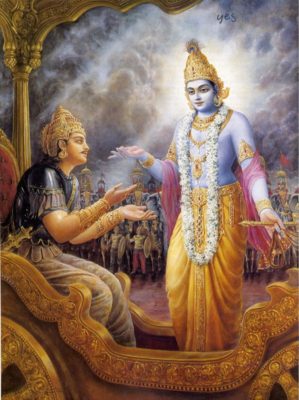
Srila Prabhupada’s early New York talks highlight a timeless discipline for acquiring liberating knowledge: humility, sincere inquiry, and service. The Bhagavad-gita (4.34) presents a rigorous path where a self-realized guide imparts truth grounded in direct realization, not opinion. This guru–shishya model balances faith with reason, ensuring inquiry refines understanding and service turns knowledge into practice.…
-
Cutting the Tree for Fruit: Hindu Dharma’s Warningand a Path to Climate Responsibility

This reflection explains how the Hindu metaphor of cutting down the tree to get the fruit exposes the dangers of short-term gains and guides long-term responsibility. It situates the teaching within ancient scriptures like the Bhagavad Gita and aligns it with environmental ethics and climate action. The piece highlights shared values across Hinduism, Buddhism, Jainism,…
-
Make Krishna-katha a Daily Joy: Practical Insights from Srimad Bhagavatam 10.1.8–13

This presentation on Srimad Bhagavatam 10.1.8–13 by H.H. Hanumat Presaka Swami demonstrates how Krishna-katha can become a daily joy even within busy, modern schedules. Grounded in the Bhagavad-gita, it shows how ordinary experiencestasting water, seeing sunlight, or noticing strength and beautycan serve as contemplative cues for remembrance. Emphasizing “tailor-made” practice, it endorses diverse, temperament-sensitive methods…
-
Prevent the Ripple: Dharmic Wisdom on Mindful Action, Karma, Ahimsa, and Non‑Emergence

This essay explores a unifying Dharmic insight: what has not yet emerged is easiest to prevent. Drawing on Hindu philosophy and the Bhagavad Gita, it explains how mindful intention, disciplined attention, and skillful action avert harm at its source. The discussion highlights parallel teachings in Buddhism (Right Effort and Mindfulness), Jainism (ahimsa and pratikraman with…
-
Two Energies, One Choice: Transforming Daily Life through Krsna’s Material and Spiritual Power

Krsna’s two energiesmaterial and spiritualcan be engaged through intention, much like electricity directed to different purposes. The living entity, as marginal potency, continually chooses between self-centered exploitation and selfless service. This framework aligns with Buddhist, Jain, Sikh, and Hindu teachings, highlighting a shared dharmic path from craving to compassion. Practical disciplines such as study of…
-
Beyond Sattva, Rajas, Tamas: A Transformative Path to the Pure Self and Dharmic Unity

This essay explores how the three gunassattva, rajas, and tamasbind experience and how dharmic traditions point beyond them to a liberating awareness. It clarifies Hindu perspectives on Atman and moksha while drawing resonant parallels with nirvana in Buddhism, kevala jñāna in Jainism, and Naam-centered living in Sikhism. Readers gain a clear, practical map grounded in…
-
Narayana Mantra at Life’s Final Breath: How Last Thoughts Shape Destiny and Peace

This reflection explains why chanting the Narayana Mantra, Om Namo Narayanaya, is revered at life’s final breath in Hindu beliefs. It clarifies how the mind’s last impressions align with karma and reincarnation, echoing Bhagavad Gita teachings on the power of final consciousness. Practical, compassionate guidelines are offered for creating a calm environment, choosing suitable modes…
-
Mahabharat Stories: 10 Iconic Moments That Shaped Dharma, Destiny, and the Kurukshetra War

This academically grounded overview presents ten iconic moments from the Mahabharata that continue to shape ethical thought, leadership, and social harmony. It explores Dyutakrida and the dignity of justice, Bhishma’s vow and the cost of rigid duty, and Krishna’s Udyoga Parva diplomacy as a model of principled peace. The Bhagavad Gita reframes action through svadharma…
-
See the World Anew: Krishna’s Test of Duryodhana and Yudhishthira on Perception and Dharma

A classic teaching from the Mahabharata tradition, guided by Sri Krishna’s wisdom, shows how perception shapes reality. In the story, Duryodhana sees faults everywhere while Yudhisthira discerns redeeming qualities in all, revealing the inner lens each brings to the world. Read alongside the Bhagavad Gita’s discipline of equanimity (samatva), the lesson becomes a method for…
-
Breaking the Illusion of Attachment: A Dharmic Perspective on Samsara and Family Love

Attachment to the body and to loved ones is natural, yet it often fuels anxiety and illusion. Dharmic traditions teach a unifying remedy: refine love through non-attachment while fulfilling responsibilities with compassion. Hindu philosophy, echoed by Buddhism, Jainism, and Sikhism, encourages care without possessiveness and action without clinging to outcomes. The Bhagavad Gita clarifies this…