
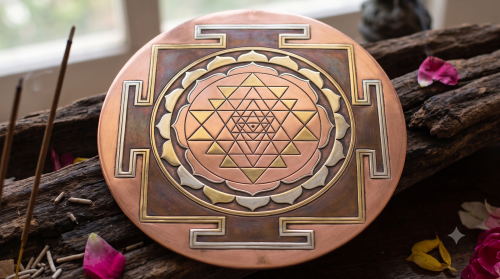
The Sri Yantra is more than a sacred geometric image: within Sri Vidya, it provides an ordered way to contemplate divine power in its many expressions and its ultimate unity. The available source material offers one important organizing claim, but not the detailed catalogue its title appears to promise.
This guide explains what Hindu Pad reports, how the nine-layer structure can be understood, and why readers should not treat the brief source excerpt as a complete ritual manual.
What the source establishes
According to Hindu Pad, the standard Sri Vidya ritual tradition recognizes exactly 98 primary goddesses, described as Shaktis or Yoginis, across the nine avaranas of the Sri Yantra. The source cites Navavarana Puja as an example of this ritual framework and places Goddess Lalita Tripura Sundari at its center.
The supplied excerpt does not name the 98 goddesses, assign them individually to particular layers, or provide mantras and worship procedures. Reconstructing such a list from outside material would therefore go beyond the evidence available here. The reliable takeaway is the reported number, the ninefold arrangement, and the central place of Lalita Tripura Sundari.
Many Shaktis arranged around one divine center
An avarana is an enclosure or layer. In the scheme described by the source, the nine avaranas organize numerous divine manifestations around a single supreme center. The 98 Shaktis should consequently be understood as members of an integrated sacred order, not as unrelated or competing deities.
This relationship between multiplicity and unity is especially important for understanding Hindu worship. Shakta traditions possess their own theology and disciplines, while remaining part of a wider Hindu civilization in which different forms of the Divine, lineages, and methods of practice can inhabit a shared sacred world. The Sri Yantra makes that principle visible through ordered geometry: distinction is preserved, yet every enclosure remains oriented toward the center.
Why the missing names and placements matter
A numerical summary can introduce the Sri Chakra, but it cannot replace the knowledge required for formal worship. In a living ritual tradition, names, placements, sequence, pronunciation, visualization, and lineage-specific instructions may all carry significance. A bare total of goddesses does not explain how those elements fit together.
Readers should therefore distinguish between a conceptual overview and practical ritual guidance. The Hindu Pad excerpt supports the former. Anyone seeking to perform Navavarana Puja or study the complete arrangement should consult a qualified teacher and materials recognized within the relevant sampradaya rather than improvising from an incomplete online summary.
Key takeaways
- Hindu Pad reports 98 primary Shaktis or Yoginis in the standard Sri Vidya arrangement.
- These goddesses are mapped across nine avaranas of the Sri Yantra.
- Lalita Tripura Sundari occupies the supreme central position in the reported scheme.
- The supplied excerpt does not contain the individual names, placements, mantras, or ritual sequence.
- The structure expresses diversity ordered around a unifying divine center.
A distinctly Shakta expression of a wider Dharmic insight
The Sri Yantra belongs specifically to Hindu Shakta tradition and should not be detached from that identity. At the same time, its disciplined movement from differentiated forms toward an integrating center can be appreciated alongside a broader Dharmic respect for sustained practice, ethical refinement, contemplation, and transmitted wisdom.
Hindu, Buddhist, Jain, and Sikh traditions are not interchangeable, and their teachings about divinity and liberation differ. Their shared civilizational space nevertheless demonstrates that spiritual depth need not demand uniformity. Preserving each tradition’s distinct voice while recognizing this common commitment to disciplined transformation offers a sound basis for Dharmic unity.
The responsible next step is deeper study through complete sources and authentic guidance, allowing the Sri Yantra’s sacred order to be approached with both intellectual honesty and reverence.
Inspired by this post on Hindu Pad.
