
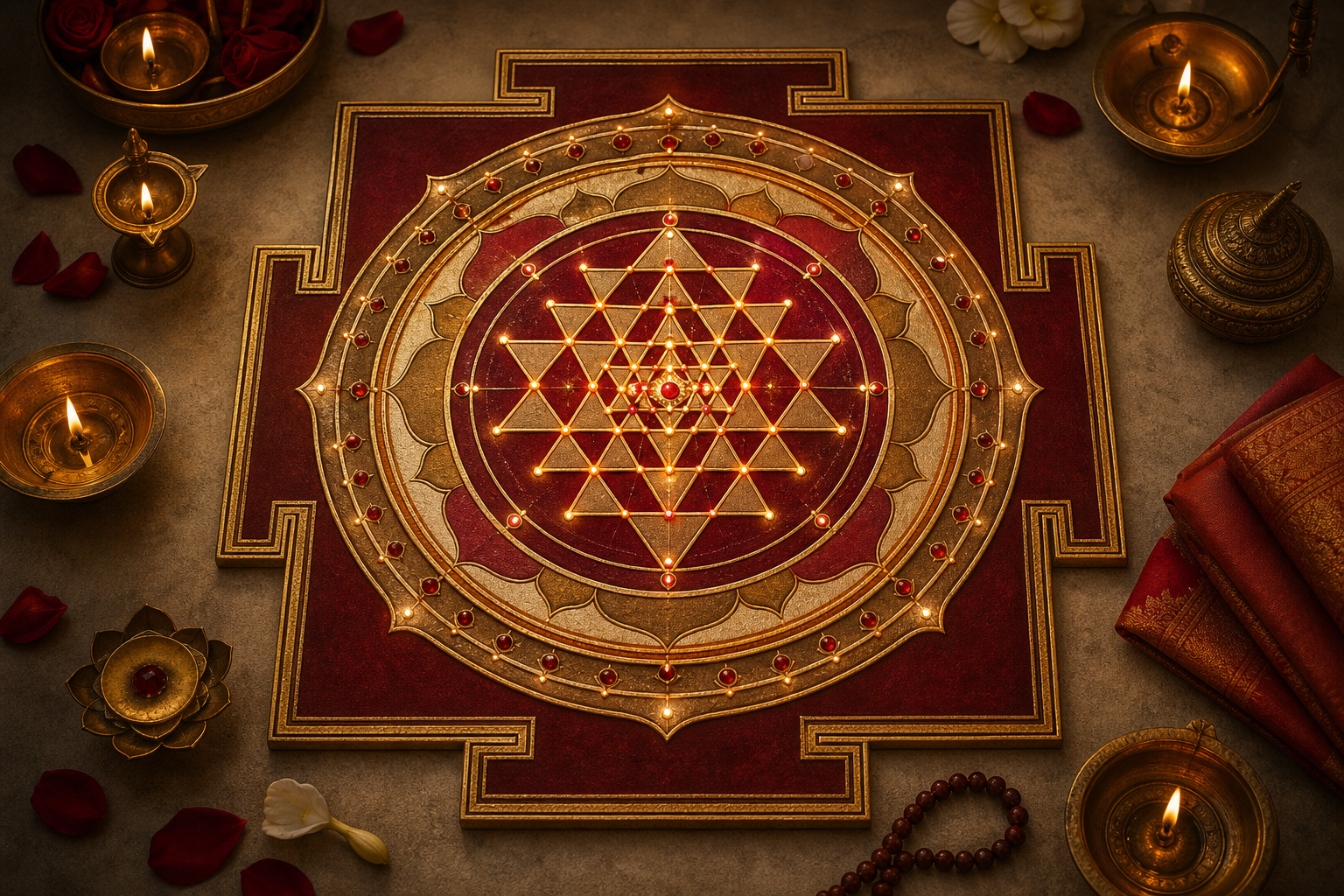
The Sri Yantra presents divine plurality as an ordered sacred whole. Its surrounding enclosures, associated goddesses and central point belong together, guiding attention toward Goddess Lalita Tripura Sundari rather than functioning as disconnected symbols.
This guide explains what the available Hindu Pad excerpt establishes about that structure, what an avarana means, and why a bare list of names cannot replace the ritual context of Sri Vidya.
Key takeaways
- Hindu Pad reports that the standard Sri Vidya ritual arrangement contains 98 primary goddesses, described as Shaktis or Yoginis.
- These goddesses are mapped across the Sri Yantra’s nine avaranas, or sacred enclosures.
- The entire arrangement is centered on Lalita Tripura Sundari as the supreme deity.
- The supplied excerpt does not include the promised enumeration, so a complete layer-by-layer list cannot be reconstructed from it responsibly.
How an avarana gives the yantra its ritual order
A yantra is a geometric support for worship and contemplation, not merely a decorative pattern. In this setting, an avarana is an enclosure or layer within the sacred design. The nine avaranas therefore provide an ordered framework through which the powers associated with the Sri Yantra can be contemplated and worshipped.
The movement through layered space also helps explain why the center matters. The geometry gathers many forms and functions into a single orientation. Rather than asking readers to choose between divine unity and divine multiplicity, the Sri Yantra allows both to be perceived together: numerous expressions of Shakti are held within a design directed toward the supreme Goddess.
What the brief source establishes about the goddesses
According to Hindu Pad, standard Sri Vidya ritual practice, including the Navavarana Puja, maps exactly 98 primary goddesses across the nine layers. The source identifies these divine figures as Shaktis or Yoginis and places Lalita Tripura Sundari at the center of the complete arrangement.
That is a structural claim, not a complete liturgical guide. The available feed text ends before supplying the names, their sequence or their distribution among the individual avaranas. Adding those missing details from memory would risk blending separate textual or lineage presentations. The responsible conclusion is therefore limited but clear: the reported enumeration belongs to an integrated ritual map whose center is Lalita Tripura Sundari.
Many divine powers, one sacred center
The structure offers a characteristically Dharmic way of understanding diversity. Different powers need not imply a fragmented sacred reality; they can express distinct dimensions of an underlying unity. Within Sri Vidya, the names and placements of the Yoginis and Shaktis gain meaning through their relationship to the whole yantra and its presiding Goddess.
A wider Dharmic affinity can be recognized without erasing doctrinal differences. Hindu, Buddhist, Jain and Sikh traditions employ distinct forms of worship, meditation, remembrance and ethical discipline, yet each offers ways to draw human attention away from disorder and toward a more integrated spiritual life. The Sri Yantra remains specifically a Sri Vidya inheritance, while its union of disciplined structure and inward orientation can inspire respectful solidarity among Dharmic communities.
How to approach a goddess list responsibly
A diagram or online list can provide orientation, but ritual use calls for greater care. Readers should check the names, order, pronunciation and worship instructions against a reliable text or teacher associated with the relevant sampradaya. Where a lineage expects initiation or guided instruction, a summary should not be treated as a substitute.
This care also protects Hindu cultural continuity. Treating the Sri Yantra only as attractive geometry detaches it from the theology, discipline and living tradition that give it meaning. Future study is best directed toward the nine avaranas as a coherent path of worship, with every associated power understood in relation to Lalita Tripura Sundari at the center.
Inspired by this post on Hindu Pad.
