
Shravan 2026 does not have one universal run of Gregorian dates. North Indian Purnimanta calendars place the month from late July into August, while Amanta calendars used in several western and southern regions place it from mid-August into September. The observances are connected by the same lunar cycle, even when their printed dates differ.
Reading the calendars together reveals a coherent devotional season: recurring weekday pujas cultivate particular virtues, Chandra Darshan marks visible lunar renewal, and the Kanwar Yatra turns the offering of water to Shiva into an extended pilgrimage. The practical task is to identify the correct regional calendar before selecting dates or ritual details.
Why Shravan 2026 has two valid date ranges
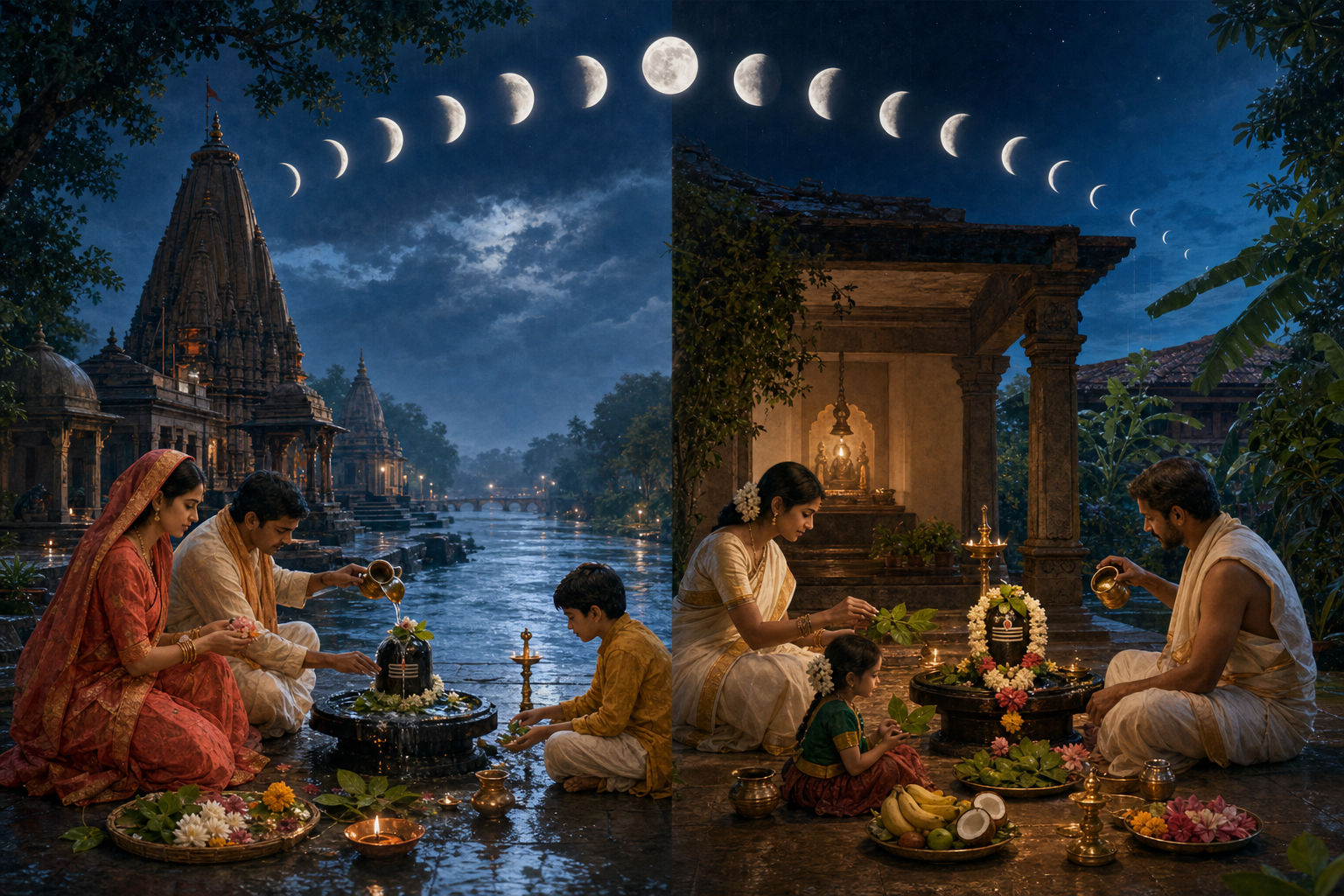
The Shravan Shanivar guide, Shravan Guruvar guide and Budh Pujan guide all report the same central distinction. In the North Indian Purnimanta system, Shravan runs from 30 July through 28 August 2026. In the Amanta or Amavasyanta reckoning used in Maharashtra and Gujarat, among other regions, it runs from 13 August through 11 September.
Purnimanta months end at Purnima and place Krishna Paksha before Shukla Paksha within the named month. Amanta months end at Amavasya and place Shukla Paksha before Krishna Paksha. They organize the same lunar phases differently; neither is a correction of the other. Their shared portion of Shravan explains why several August observances appear in both schedules.
| Weekly observance | North Indian Purnimanta dates | Amanta dates |
|---|---|---|
| Budh Pujan, Wednesday | 5, 12, 19 and 26 August | 19 and 26 August; 2 and 9 September |
| Shravan Guruvar, Thursday | 30 July; 6, 13, 20 and 27 August | 13, 20 and 27 August; 3 and 10 September |
| Shravan Shanivar, Saturday | 1, 8, 15 and 22 August | 15, 22 and 29 August; 5 September |
These schedules are reported respectively by the Budh Pujan, Guruvar and Shanivar source articles. The Wednesday calendar needs one extra qualification: the Budh Pujan article also records 12 August in a supplied Amanta schedule because Shravan reportedly begins late that night in commonly consulted Maharashtra almanacs. It nevertheless identifies 19 August as the first unambiguous Wednesday under conventional sunrise-based reckoning. A family should include 12 August only when its own almanac or temple expressly recognizes that transition.
A panchanga evaluates more than a civil date. Tithi, weekday, local sunrise and the applicable observance rule can all affect the result. Because timings vary by longitude, latitude and time zone, a date printed for India should not simply be transferred to Toronto, London, Sydney or another location. The sources consistently recommend using a reputable panchanga or temple calendar calculated for the place where worship will occur.
Weekday pujas create a rhythm of learning, service and responsibility
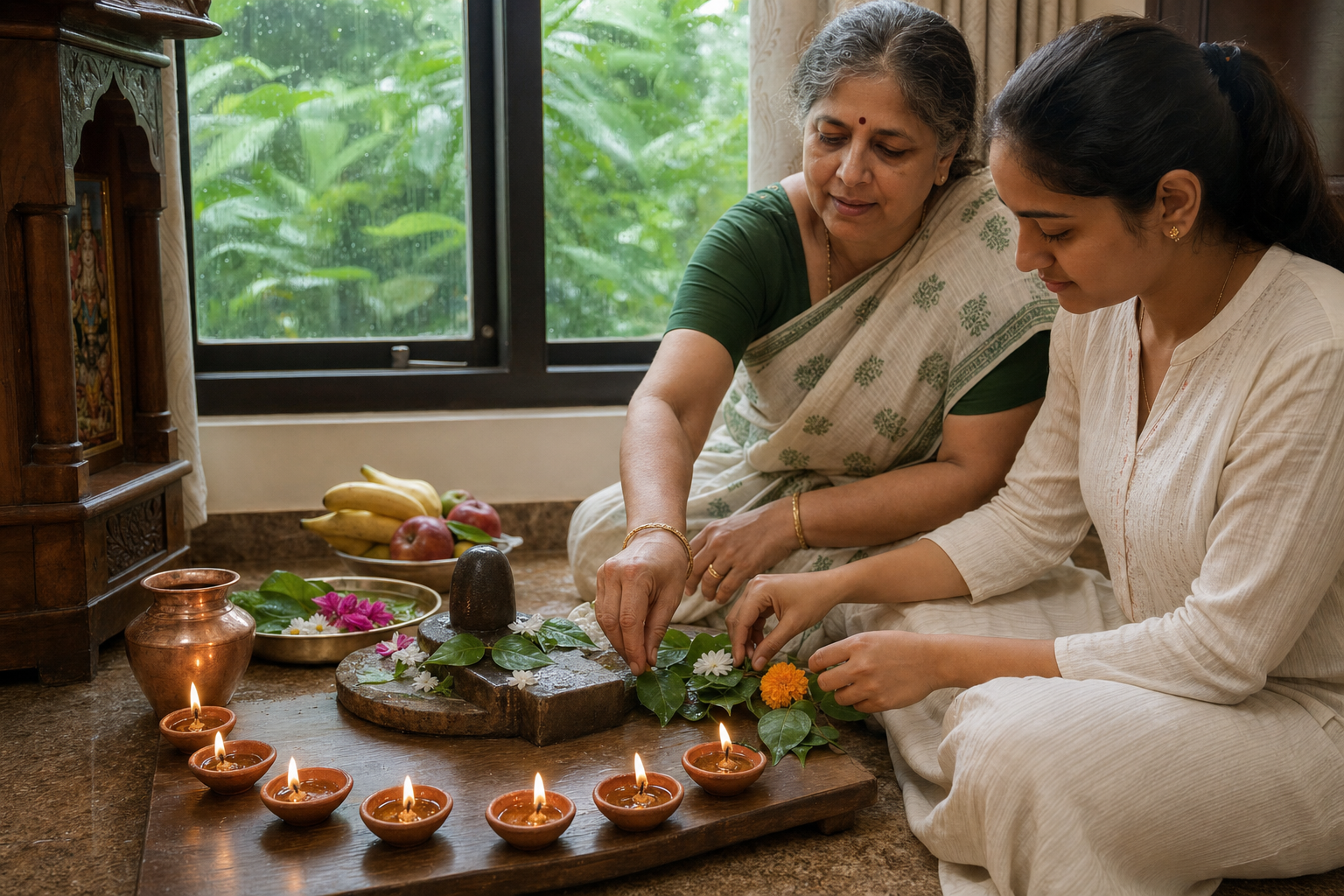
The weekday articles show that Shravan is not only a sequence of major festivals. It can be practiced as a recurring cycle in which each day directs attention toward a different form of worship and conduct. The associations vary among regions and lineages, so the pattern should be treated as a devotional framework rather than a compulsory national program.
Wednesday Budh Pujan is dedicated to Budha, the Navagraha figure corresponding to Mercury in Hindu religious and astrological nomenclature. The Budh Pujan article connects the observance with intellect, language, memory, calculation, diplomacy and sound judgment. It also cautions that Budha is distinct from Gautama Buddha. Green gram, leaves, flowers or cloth may appear in contemporary practice, but no costly material or gemstone is required. A modest observance can instead emphasize careful speech, conscientious study and honest communication.
Thursday shifts the focus to Brihaspati or Guru. The Guruvar article presents Brihaspati as Devaguru and as a figure associated with sacred utterance, counsel and the disciplined transmission of knowledge. In Navagraha practice, Brihaspati corresponds to Jupiter, although the devotional identity is broader than the physical planet. Study, gratitude toward legitimate teachers and the ethical use of knowledge can therefore carry as much meaning as an elaborate offering.
Saturday accommodates several established paths. According to the Shanivar article, households may worship Hanuman, Shani Bhagavan or Venkateswara, also known as Balaji, according to regional and family custom. Hanuman devotion can center on courage, restraint and service; Shani worship can prompt reflection on time, consequences, duties and the treatment of vulnerable people; and Balaji worship can emphasize surrender and grace. Their coexistence illustrates devotional plurality rather than a requirement to merge the deities into one theological explanation.
Across all three days, the strongest common element is sankalpa expressed through conduct. A lamp, water, flowers, fruit, mantra, stotra or scriptural reading may support the puja, but the sources repeatedly resist transactional promises. Learning without humility, ritual without responsibility and fasting without consideration for health or duty would miss the ethical direction shared by these observances.
Chandra Darshan adds an evening observance of renewal
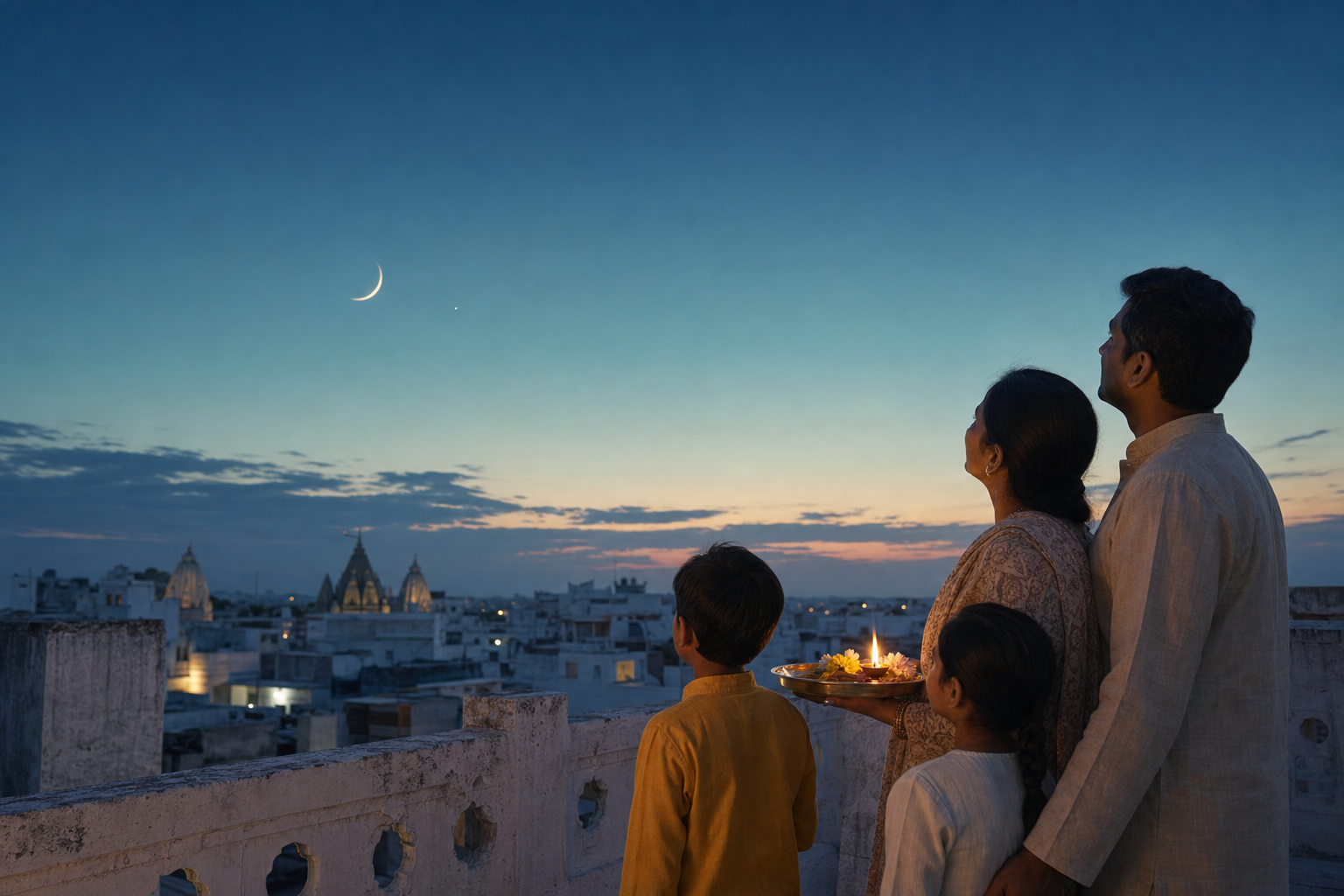
The Chandra Darshan guide reports Friday, 14 August 2026 as the India-oriented date for the first practical sighting of the waxing crescent after Amavasya. It describes a household observance that may include fasting, a lamp, arghya, mantra recitation, charity, and worship of Chandra, Shiva, Gauri or Ganesha according to sampradaya. None of those accompanying deity traditions is presented as universally mandatory.
Chandra Darshan should not be confused with the astronomical instant of the new Moon. The source explains that the devotional sighting occurs later, when a thin reflected arc can be seen low over the western horizon after sunset. It reports that the crescent on 13 August would have been extremely slender and difficult to locate, while conditions on 14 August made a practical sighting more plausible.
Even on the same civil date, the useful interval is local. The source gives approximate windows of 7:02 p.m. to 8:01 p.m. for New Delhi and 7:07 p.m. to 8:16 p.m. for Thane. Those examples demonstrate why a national time cannot govern every household: sunset, moonset, haze, monsoon clouds and the visible horizon all matter. Observers should look west or west-northwest only after the Sun has fully set and should follow a local panchanga rather than treating either example as a universal muhurta.
Within Shravan, the crescent also connects lunar renewal with Shiva’s image as Chandrashekhara, the bearer of the Moon. The occasion need not compete with weekday vratas or abhisheka. Its concise scale makes it a complementary evening practice, especially for a household unable to conduct a more elaborate rite.
Kanwar pilgrimage carries the water offering into sacred geography
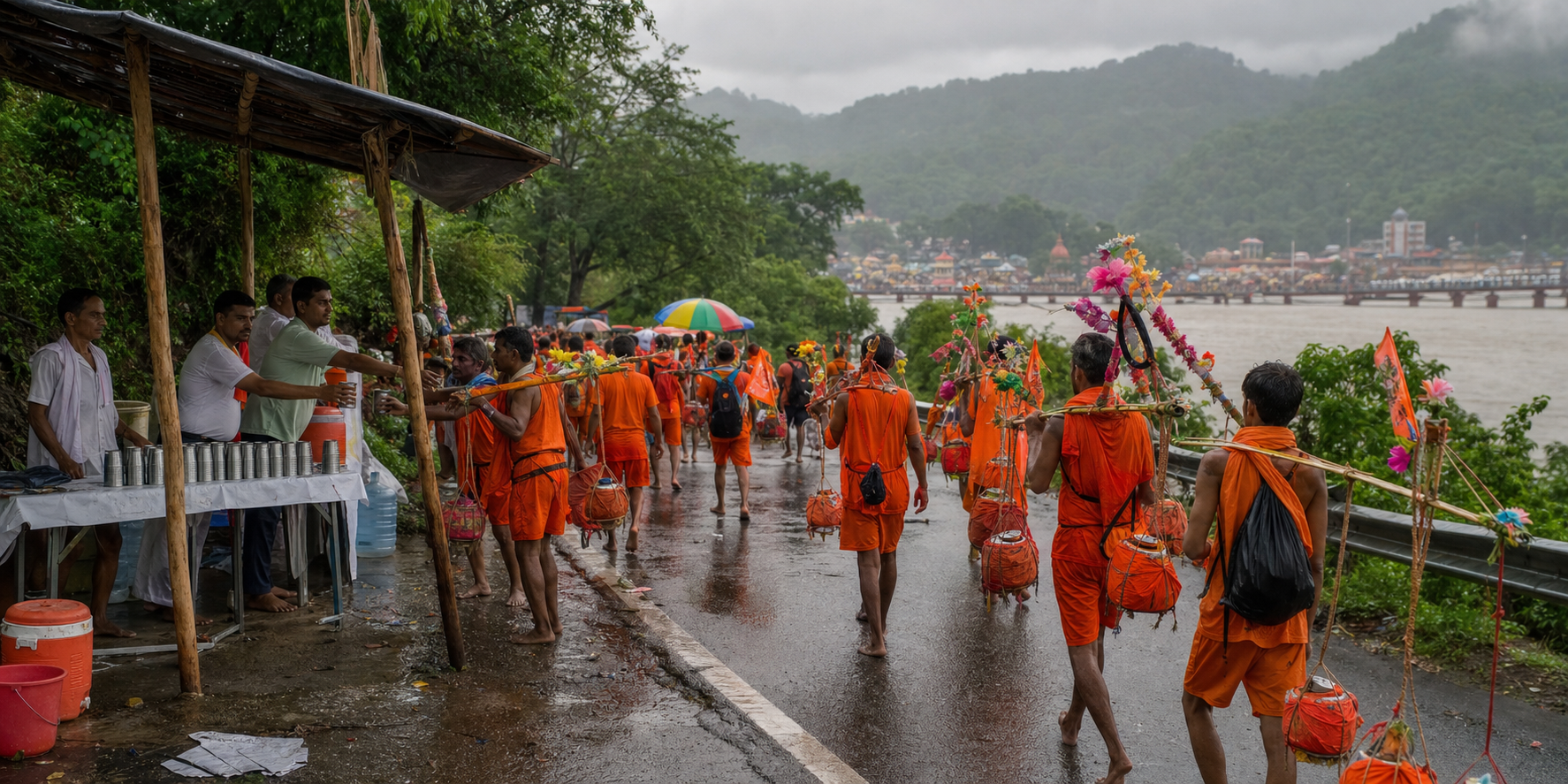
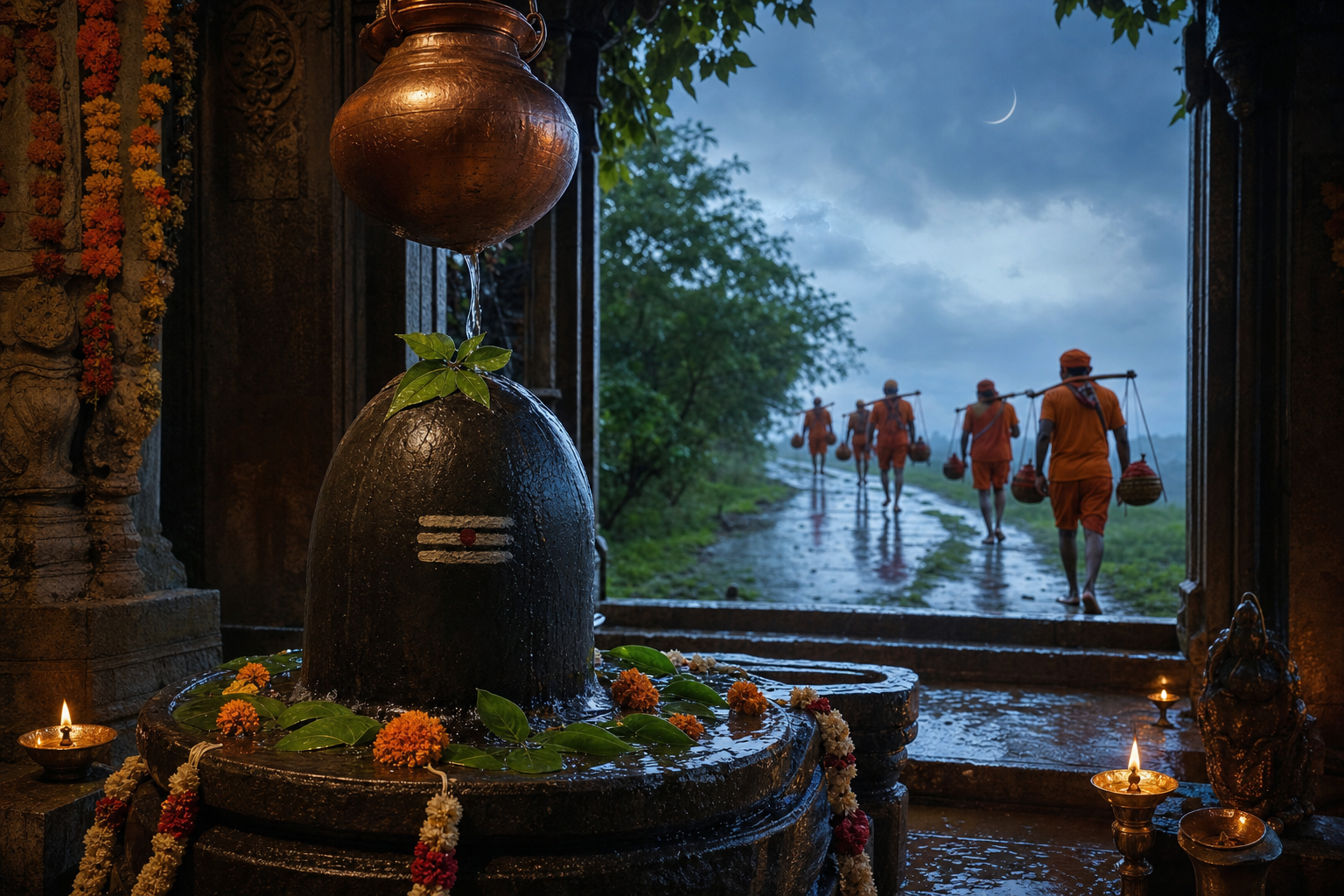
Household puja concentrates sacred time in one place; the Sultanganj-to-Deoghar Kanwar Yatra gives the same season a geographic path. The Kanwar Yatra article explains the practice through three linked ideas: water is used for Shiva abhisheka, the Ganga has a particularly close sacred association with Shiva, and Shravan is widely devoted to Shiva worship.
The article reports that Kanwariyas collect Gangajal at Sultanganj in Bihar and carry it on foot to Baba Baidyanath Dham at Deoghar in Jharkhand, where the linga is revered as one of the twelve Jyotirlingas. Government descriptions cited by that source place Sultanganj about 105 kilometres from Babadham or describe the walked route as approximately 109 kilometres. The article treats these figures as compatible variations arising from different ghats, routes, diversions and measurement endpoints.
Sultanganj has added significance because the Ganga flows northward there, a condition known as Uttarvahini, and because the town is associated with Ajgaibinath and Shiva devotion. The kanwar itself combines ritual symbolism with practical load balancing: vessels hang from opposite ends of a flexible pole so that the water can be carried more steadily. The physical effort makes the final jalabhishek the completion of a sustained vow rather than an isolated pouring of water.
The source reports customary disciplines such as protecting the vessels, eating simple vegetarian food, abstaining from intoxicants, walking barefoot and keeping the kanwar from touching bare ground by using stands. It also stresses that practices differ among groups, families and gurus. Prospective pilgrims should therefore obtain current route and temple instructions instead of assuming that every visible custom applies universally.
The pilgrimage also clarifies the wider meaning of Shravan abhisheka. Monsoon water evokes cooling, renewal and life, while devotional accounts connect the offering with the Ganga’s descent through Shiva’s matted locks and with Shiva’s compassionate containment of Halahala during Samudra Manthana. The route turns those inherited narratives into disciplined movement, protected water and a final offering.
Key takeaways for planning Shravan 2026
- Select the household’s Purnimanta or Amanta calendar before marking any weekday vrata; the two Shravan ranges overlap but are not interchangeable.
- Use the shared August dates where convenient, but do not assume that an overlapping date eliminates local sunrise or tithi considerations.
- Treat 12 August as a transitional Amanta Budh Pujan date and include it only when the chosen Maharashtra calendar, temple or family tradition expressly does so.
- For Chandra Darshan on the reported India-oriented date of 14 August, verify local sunset and moonset and seek the crescent above an unobstructed western horizon.
- Choose weekday pujas by sampradaya and capacity, allowing ethical discipline, study, service and accountability to guide the use of ritual materials.
- For the Kanwar Yatra, follow the rules of the route, pilgrimage group and Baidyanath temple rather than extending household practices into public or temple spaces without authorization.
With the applicable calendar identified in advance, households can prepare for the common August window while leaving final timings to a location-specific panchanga. That approach preserves regional continuity and gives each observance room to develop as a deliberate practice rather than a crowded list of dates.
References
- DharmaRenaissance Blog — Shravan Shanivar 2026: Essential Dates, Puja Traditions and a Meaningful Vrat Guide
- DharmaRenaissance Blog — Shravan Guruvar Puja 2026: Essential Dates, Meaning and Brihaspati Ritual Guide
- DharmaRenaissance Blog — Chandra Darshan in Shravan 2026: Sacred Moon Sighting, Puja and Complete Guide
- DharmaRenaissance Blog — Budh Pujan in Shravan 2026: Essential Wednesday Dates, Vidhi and Deeper Meaning
- DharmaRenaissance Blog — Why Kanwariyas Carry Gangajal to Deoghar: The Powerful Story of Shravan