

You open two Hindu calendars and find the same vrata on different civil dates. One follows your family’s region, another follows a temple in Bharat, and a third gives a different fasting or parana time. Which one should you trust?
Don’t search for one universal date detached from place and tradition. First identify what defines the observance: a solar transit, lunar month, paksha, tithi, nakshatra, or a combination of these. Then use one panchangam calculated for your location and apply its rules consistently. That small change turns a confusing festival list into a workable sacred calendar.
A sacred date is a coordinate, not just a numbered square
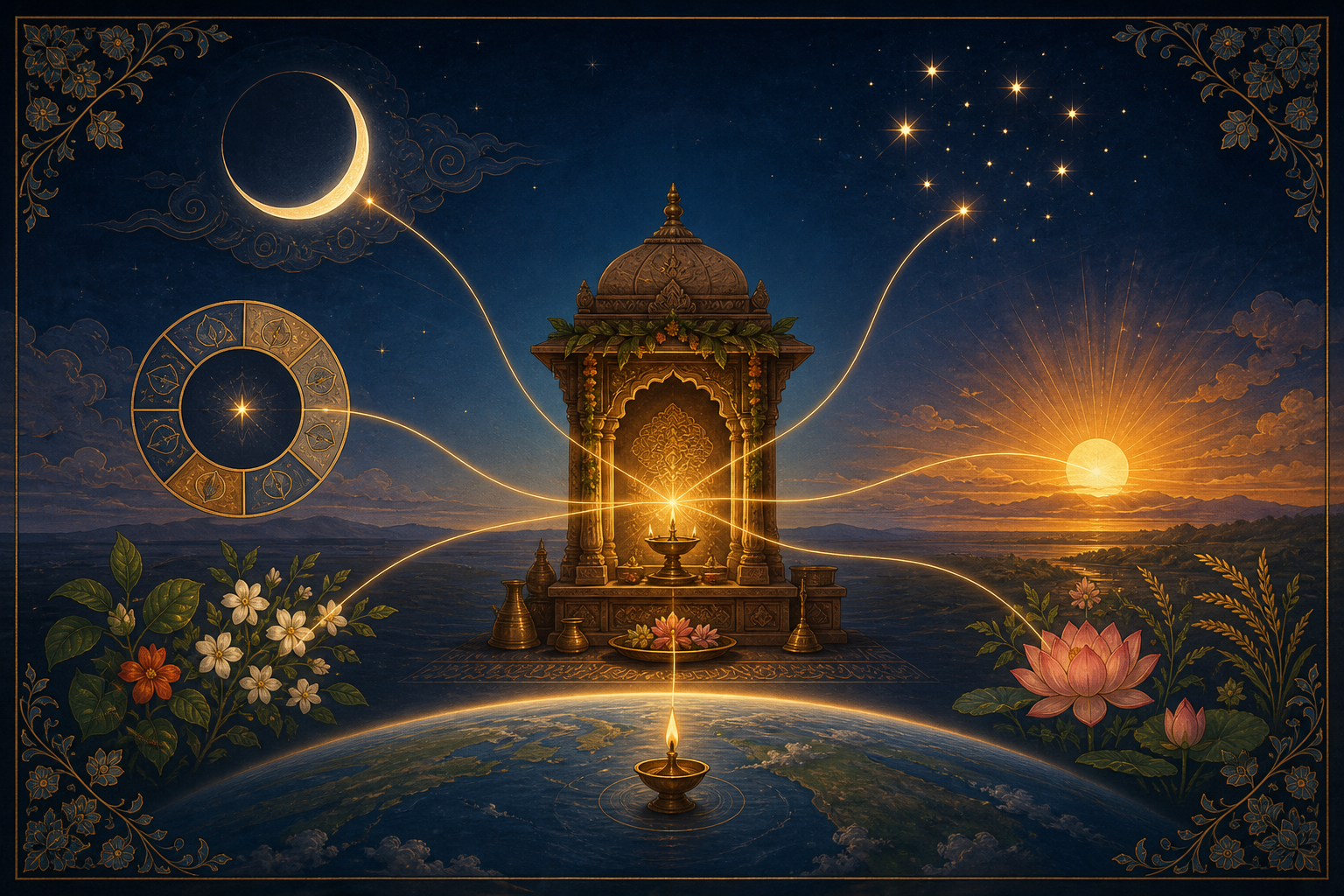
A civil calendar gives every day a fixed number. Hindu calendars do something more layered. They locate a day within movements of the Sun and Moon, divisions of the lunar cycle, stellar markers, regional months, and rules tied to sunrise or another relevant part of the day. Different observances use different layers, so their civil dates move from year to year.
- Solar month: A regional month may be defined by the Sun’s movement through a zodiacal sign. Kerala’s Dhanu Masam corresponds to the solar passage through Dhanu and ends with the transition into Makaram.
- Lunar month and paksha: A lunar month is divided into waxing and waning halves. Kartik Ekadashi is observed on the Ekadashi of Kartik’s Shukla Paksha, the waxing half.
- Tithi: A tithi is a lunar-day division rather than a fixed midnight-to-midnight civil day. Ekadashi and Pournami are tithi-based designations.
- Nakshatra: Some observances are associated with a particular lunar mansion. Malayalam temple and household calendars frequently use nakshatra timing alongside the solar month.
- Local application: Location, sunrise, and the rule for which portion of a tithi must prevail can affect the civil date or ritual window.
The 2025 calendar illustrates these distinctions cleanly. In Kerala, Dhanu Masam extended from 16 December 2025 through 14 January 2026. That was a solar-month interval, not a single lunar festival. Within a different calendrical frame, Kartik Shukla Ekadashi fell on 1 November 2025, while Kartika Pournami and Bhakteshwara Vratham fell on 5 November in most regional panchangams.
The names themselves tell you what to check. “Dhanu Masam” points toward a regional solar month. “Kartik Shukla Ekadashi” supplies a lunar month, paksha, and tithi. “Kartika Pournami” points to the full-moon tithi. Record that calendrical identity beside the civil date. “Kartik Shukla Ekadashi — 1 November 2025” is more useful than “festival on 1 November,” because it preserves the reason for the date.
This also explains why two calendars can differ without either being careless. They may be calculated for different locations, follow different regional conventions, or apply a tithi rule differently. The right first question is therefore not “Which date appears most often?” It is “Which calendrical rule and community am I following?”
Why a sankalpa reaches from this morning into cosmic time

The panchangam locates the observance. The sankalpa locates you within it. Recited at the beginning of a puja, yajna, or vrata, a sankalpa states an intention while placing the act in time and space. It prevents worship from becoming an activity performed vaguely “sometime today.”
Traditional sankalpa language can move through several scales at once. It locates the ritual in the second half of Brahma’s life, in Shri Shwetavaraha Kalpa and Vaivasvata Manvantara, and in the first quarter of the twenty-eighth Kali Yuga. The human act is momentary, but its timestamp belongs to a far larger order.
The scale is deliberate. Satya, Treta, Dvapara, and Kali together form a Mahayuga of 4,320,000 years. One thousand Mahayugas form a 4.32-billion-year Kalpa, described as a day of Brahma; an equal night brings the day-night cycle to 8.64 billion years. A lifetime of Brahma extends to approximately 311 trillion years. The point for a practitioner is not to perform mental arithmetic during puja. It is to remember that a personal desire, family concern, or single day of fasting sits inside a reality much larger than the individual ego.
You can apply that principle even if you don’t yet know a complete Sanskrit sankalpa. Before beginning, write a plain sentence naming the observance, your intention, your location, and the discipline you are undertaking. If your family or temple uses an inherited Sanskrit form, retain it and learn what its time-and-place phrases mean. Don’t copy a complete formula blindly from a household in another region; the portions identifying place and calendrical moment may need to change.
Precision and humility belong together here. Calendar precision keeps the observance anchored in tradition. Cosmic scale keeps precision from turning into spiritual vanity or anxiety over minor imperfections.
A seasonal vrata is a complete discipline, not merely a fast
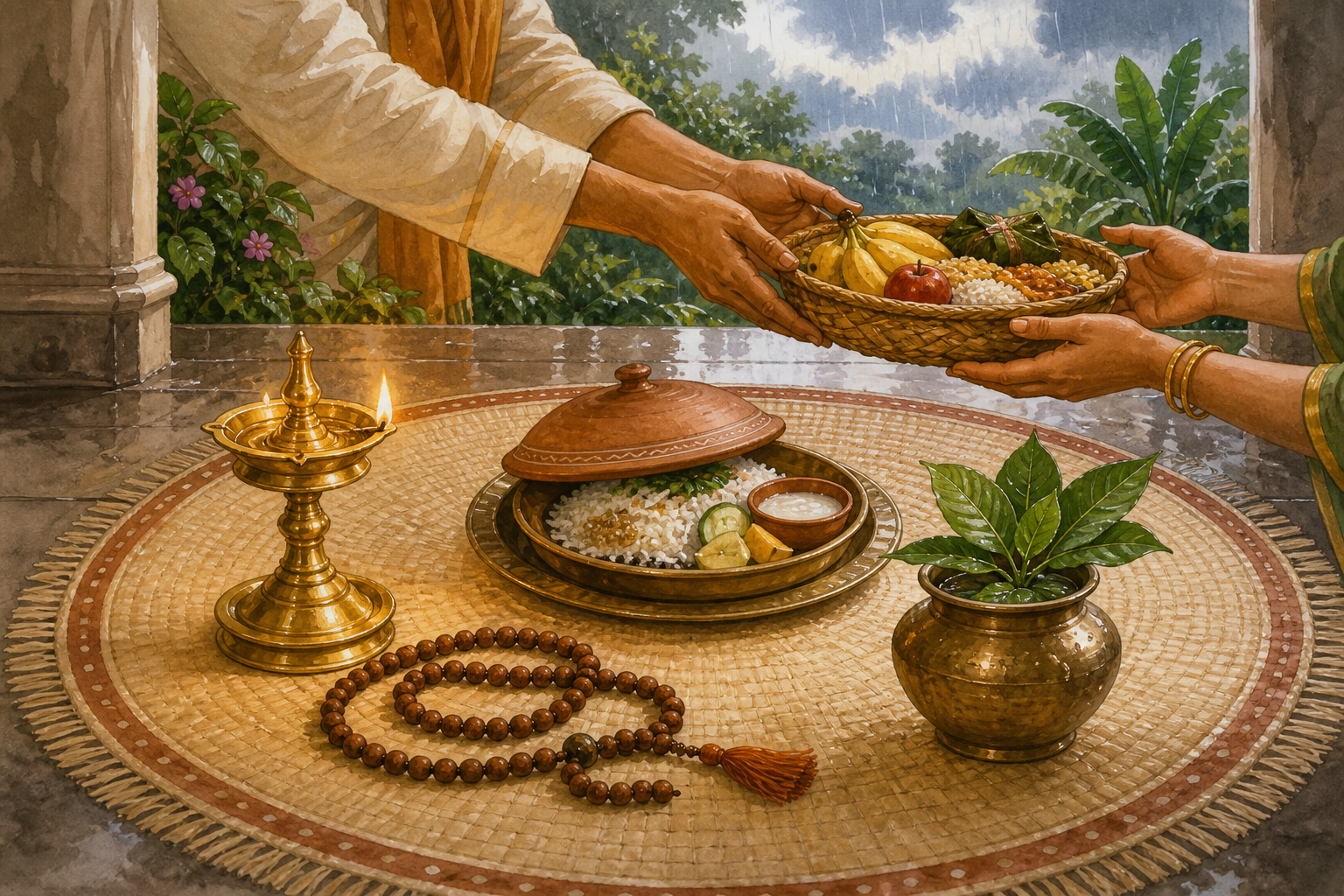
People often reduce vrata to a question about permitted food. Food discipline can matter, but it is only one part of the vow. A well-formed vrata joins intention, restraint, worship, remembrance, generosity, and a defined completion. Remove those connections and fasting can become an isolated test of endurance.
- Sankalpa: State what you are undertaking and why.
- Restraint: Simplify food, speech, entertainment, sleep, or another habit relevant to the observance.
- Upasana: Give the saved time and attention to puja, japa, stotra, dhyana, or temple darshan.
- Offering: Use the forms proper to the deity and tradition, such as lamps, flowers, naivedyam, Tulsi worship, bilva leaves, or abhishekam.
- Dana and seva: Turn inward discipline outward through generosity or useful service.
- Completion: Conclude the vow at the prescribed time, offer gratitude, distribute prasada where appropriate, and observe parana correctly when the vrata requires it.
Bhakteshwara Vratham shows how these parts can work together. Its Kartika Pournami observance may include a pre-dawn bath, a fast or simple sattvic food, Shiva worship at home or in a temple, abhishekam of the Shivalinga, bilva leaves, “Om Namah Shivaya,” lamps, dana, and an evening conclusion. Its regional prominence in Andhra Pradesh, Telangana, and parts of Karnataka does not turn every local custom into a universal requirement. It shows how one vow develops a coherent regional form around Shiva bhakti.
Dev Uthani or Prabodini Ekadashi has a different centre. It marks Vishnu’s awakening from the Yoga nidra associated with Chaturmas. Vishnu Sahasranama, passages from the Bhagavad Gita, Tulsi worship, lamps, deepa-dana, temple darshan, and service all fit that devotional orientation. The fast is then broken through Dwadashi parana calculated from the local sunrise and tithi. The ending is part of the vrata, not an administrative detail added after the sacred portion.
Dhanu Masam demonstrates the longer seasonal rhythm. Kerala households and temples use the month for early-morning prayer, temple visits, lamps, music, and disciplined observance. The Sabarimala Mandala period culminates during Dhanu, while Thiruvathira brings Shiva-Parvati devotion, fasting or sattvic food, family-centred prayer, and Thiruvathirakali into the season. A month creates continuity: repeated practice matters more than a burst of intensity on one festival day.
Use these examples to identify structure, not to mix every custom into one ceremony. Ask which deity, sacred event, ethical discipline, and completion rule belong to your vrata. Then practise those elements consistently. More ritual items do not automatically produce a deeper vow.
Self-restraint, ahimsa, contemplation, and service also resonate across Buddhism, Jainism, and Sikhism. That shared moral vocabulary is worth recognizing, but it doesn’t make distinct calendars, theologies, or ritual forms interchangeable. Dharmic unity becomes stronger when resemblance is acknowledged without erasing difference.
Build a calendar entry you can actually observe
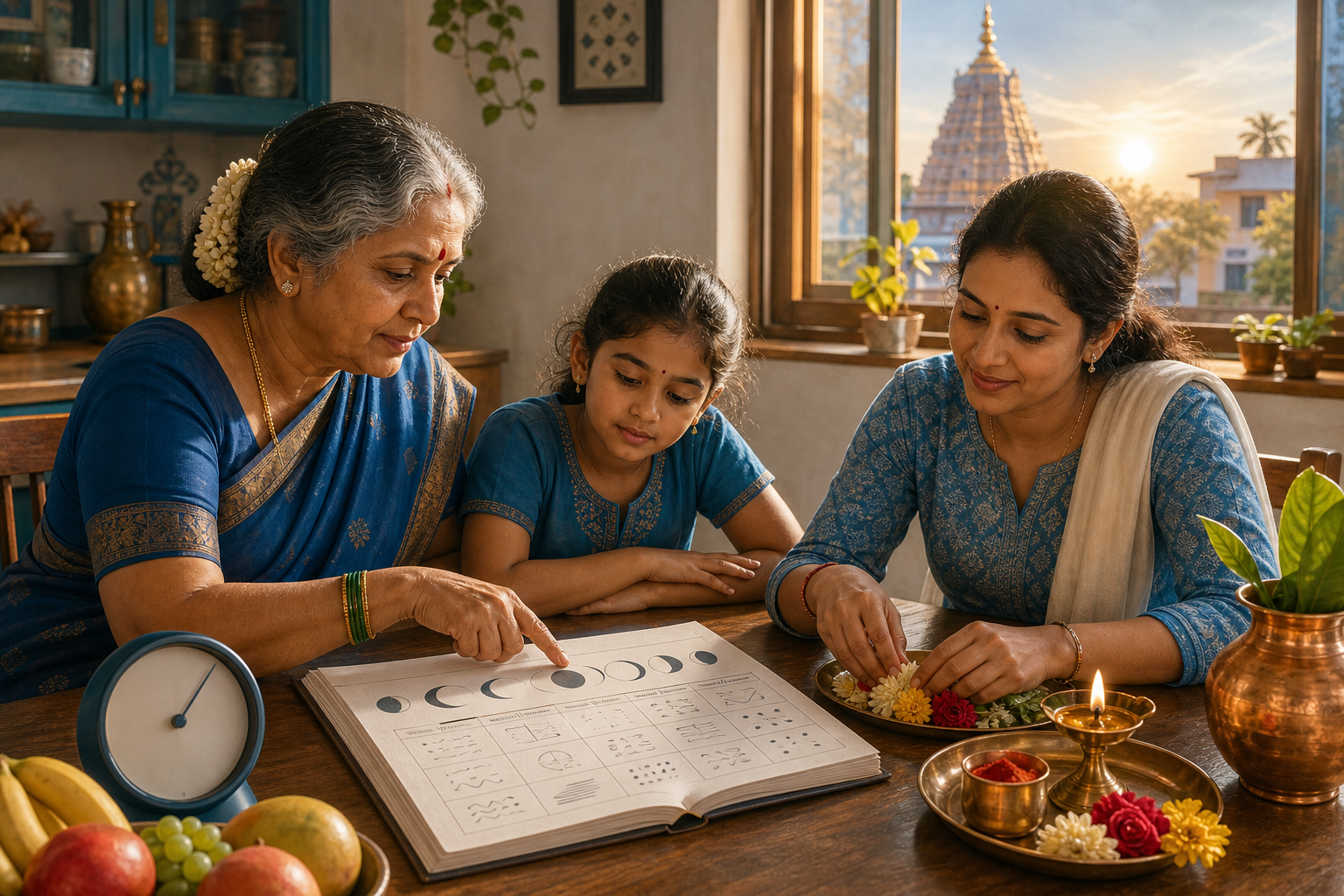
A festival notification tells you that a day exists. It rarely gives you enough information to keep the vrata properly. For each observance you intend to follow, make one complete entry using the steps below.
- Name the tradition you are following. Start with your family practice, sampradaya, regional convention, or temple community. This establishes which rules and customs should control the entry.
- Set the calculation location. Use a panchangam prepared for the place where you will observe the vrata. If you live outside Bharat, don’t combine a date calculated for an Indian temple with sunrise or parana information calculated for your own city.
- Write the calendrical trigger. Record “Dhanu solar month,” “Kartik Shukla Ekadashi,” “Kartika Pournami,” or the relevant nakshatra rather than storing only the civil date.
- Separate the day from its ritual windows. Note when the fast begins, the preferred puja or darshan period, and when it ends. For an Ekadashi vrata, add Dwadashi parana to the calendar at the same time you add Ekadashi.
- Define a minimum complete observance. Decide in advance what you can sustain: for example, sattvic food, a set period of japa, one stotra, evening deepa, and one act of dana or seva. Treat extra practices as additions, not as conditions that can make the entire vrata collapse when the day becomes busy.
- Coordinate with the people involved. Check temple schedules, meal arrangements, work obligations, and the needs of other household members before the day begins. A family vrata becomes needlessly difficult when one person assumes everyone else knows the fasting and parana plan.
- Choose a safe and responsible form. If fasting could affect a health condition or medication schedule, use a moderated observance and seek appropriate medical guidance rather than treating physical harm as a spiritual achievement. Clay lamps, natural wicks, restrained offerings, and minimal waste can keep the material side of worship aligned with stewardship.
When two panchangams disagree
Don’t average the dates or select whichever one is more convenient. Compare the assumptions behind them:
- Are both calculated for the same city and time zone?
- Are they identifying the same tithi, paksha, lunar month, solar month, or nakshatra?
- Do they follow the same regional or sampradaya convention?
- Are you comparing the vrata day with its parana day by mistake?
- Does your family or participating temple consistently follow one of them?
Location matters especially outside India, where a lunar-date conversion can move an observance by one civil day. Once you identify the convention that governs your practice, follow that calendar’s date, ritual window, and completion rule as one coherent set. Mixing calculations from several systems creates more error than choosing one recognized local panchangam and using it consistently.
Key takeaways
- A Hindu sacred date may be controlled by a solar transit, lunar month, paksha, tithi, nakshatra, location, or several of these together.
- Write the calendrical identity beside the civil date so you know why the observance falls when it does.
- Use one panchangam calculated for your location and aligned with your family, sampradaya, or temple tradition.
- A vrata should connect sankalpa, restraint, worship, remembrance, dana or seva, and a deliberate completion.
- Schedule parana and other concluding actions when you first schedule the vrata; they are part of the observance.
- Shared values across Dharmic traditions can be honoured without treating their distinct ritual forms as interchangeable.
Before your next vrata, write five lines: its calendrical trigger, local civil date, sankalpa, core discipline, and completion or parana time. That compact record will do more for a steady sacred life than a crowded calendar of festival names you haven’t prepared to observe.
References
- DharmaRenaissance Blog — Discover Dhanu Masam 2025–2026: Essential Malayalam Calendar Dates, Rituals, and Festivals
- DharmaRenaissance Blog — Discover Bhakteshwara Vratham 2025: The Complete Kartika Pournami Guide to Lord Shiva Worship
- DharmaRenaissance Blog — Complete Guide to Kartik Ekadashi 2025 (Dev Uthani): Discover Significance, Fasting, and Rituals
- Varnam — Discover the Essential Cosmic Timeline: Yugas, Kalpas, and the Sankalpa Mantra Today
