
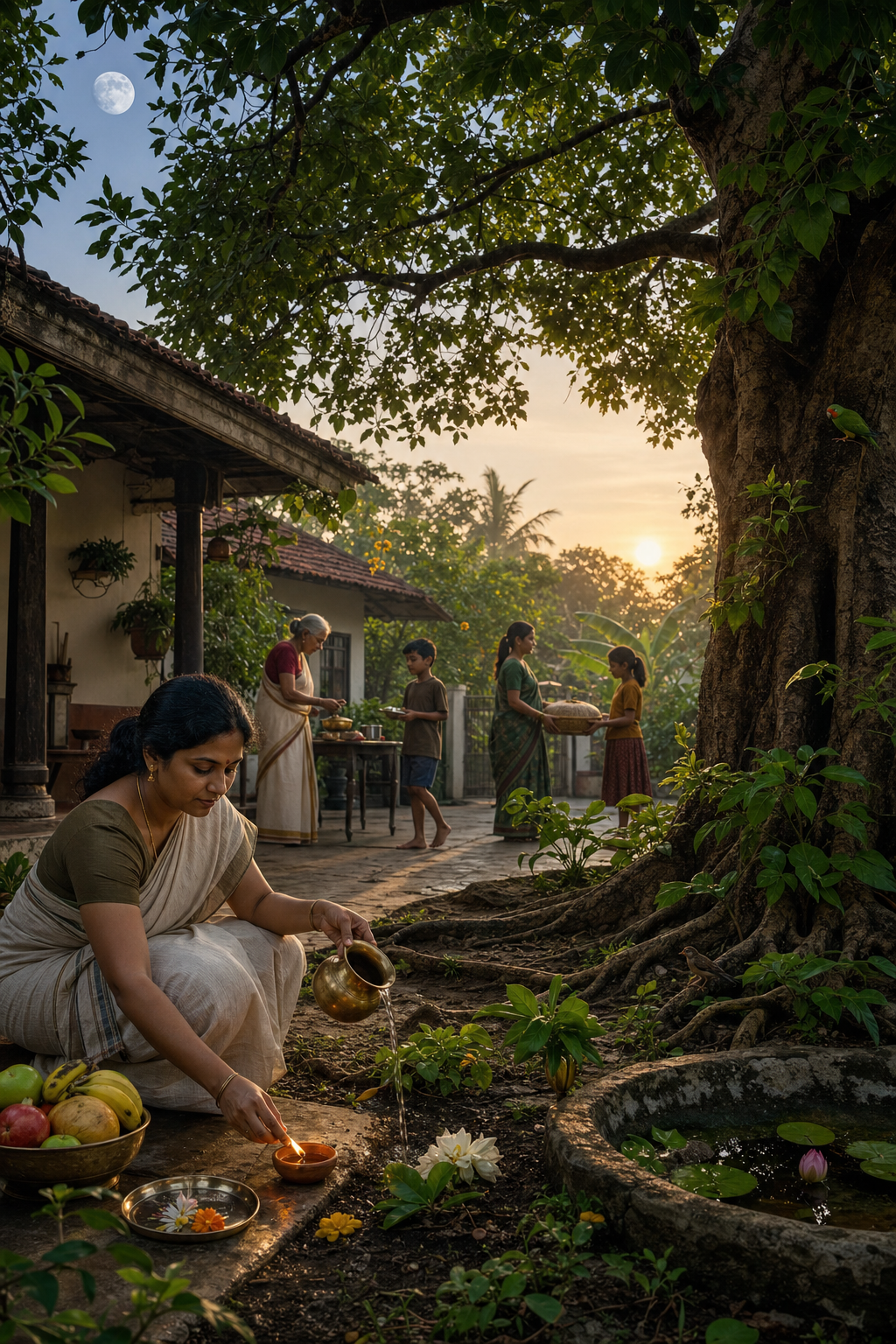
You may already light the lamp, recite the mantra, visit the temple, or arrange the festival meal. The harder question comes afterward: how do you keep the rite from becoming one beautiful morning followed by an unchanged year?
A Dharmic rite of renewal works when it reconnects three things that modern life pulls apart: the order you observe in the cosmos, the order you establish within yourself, and the care you extend to the living world. Sacred trees, seasonal thresholds, household worship, food, and giving belong to one discipline because each asks you to receive abundance without becoming careless with it.
Sacred nature is a relationship, not a backdrop
A tree beside a shrine can be treated as scenery, ritual inventory, or living presence. Only the third approach changes your conduct. If you call a tree sacred but compact its roots, nail signs into its trunk, leave plastic offerings beneath it, or light an open flame under its canopy, the word “sacred” has been separated from dharma.
The Vedic idea of ṛta names an intelligible order that exceeds individual preference. Dharma brings the question closer: what conduct sustains that order here and now? The answer is not confined to doctrine. It appears in the restraint with which you gather leaves, the seasonal food you place on the altar, the support you give another person, and the condition in which you leave a grove after worship.
This is why a sacred tree can function as a living altar. Its symbolism directs the mind, but its life also imposes obligations. Shade must not be answered with injury. Fruitfulness must not be answered with waste. Longevity must not be admired while the root zone is slowly destroyed. Reverence becomes credible through reciprocity.
Hindu, Buddhist, Jain, and Sikh traditions do not collapse into one theology of nature. Their doctrines, sacred histories, and ritual forms remain distinct. Yet the Bodhi tree associated with the Buddha’s awakening, tree-centered Jain teaching settings, sacred Ber trees at historic gurdwaras, and the many Hindu forms of tree worship reveal a recognizably Dharmic habit: spiritual life repeatedly returns to living places rather than treating the nonhuman world as spiritually empty.
Key takeaways
- Cosmic order becomes practical when an observed threshold changes your conduct, not merely your calendar.
- A sacred tree is both a contemplative aid and a recipient of protection; worship without stewardship is incomplete.
- A ritual display should join light, nourishment, self-examination, lawful prosperity, and generosity.
- Choose trees according to local ecology, lineage, and the kind of practice you intend to sustain.
- Do not confuse traditional descriptions of subtle energy with scientific proof; shade, cooling, airflow, sound, and symbolism already give you sound reasons to practise near trees.
Read cosmic order on three connected scales

The sky gives you a threshold
Seasonal rites begin with attention to time. Vishu offers a precise example. It is observed around the Sun’s entrance into sidereal Mesha, the beginning of the Malayalam solar month of Medam. That is not the same as the modern tropical equinox, which now falls in March because the tropical and sidereal reference systems have diverged through precession. The exact assignment of the festival day can also depend on whether the solar ingress occurs before or after local sunrise.
This distinction matters because sacred time is not whatever date happens to circulate online. If you are keeping Vishu formally, use the appropriate local panchanga or community almanac rather than substituting a vague idea of “spring.” The same solar transition is marked through different regional observances, including Vaisakhi, Puthandu, Pohela Boishakh, Bohag Bihu, and Pana Sankranti, but those festivals should not be treated as interchangeable. Vaisakhi, for instance, carries its own historic importance in the Sikh commemoration of the Khalsa.
The practical principle is simple: begin renewal by receiving a threshold you did not invent. The movement of the Sun, the arrival of a season, and the ripening of local produce remind you that time is larger than mood. You may feel prepared or unprepared; the threshold still asks for a response.
The household turns that threshold into vision
The Vishukkani makes the first sight of the new cycle deliberate. A lamp, grain and fruit, yellow konna blossoms, a mirror, coins or gold, and a murti or sacred text are arranged the previous evening. At dawn, the household encounters light, nourishment, beauty, self-reflection, material capability, and divine orientation in a single field of vision. The arrangement is not a promise that looking at wealth will magically produce wealth. It is a demand to see prosperity within an ethical order.
If you observe Vishu, preserve the rite’s inherited name and form as faithfully as your circumstances allow. Diaspora households can use locally available seasonal fruits and flowers when a traditional item cannot be obtained. If Vishu is not your tradition, do not relabel a generic altar as a Vishukkani. Learn from its discipline instead: prepare the threshold in advance, let right seeing precede action, and include a symbol that asks what you will do with what you receive.
The mirror is especially demanding. It places you among the objects of the first sight. You are not standing outside abundance as its consumer; you are part of the moral arrangement. Ask one concrete question while looking into it: “Which habit in this household is out of order?” Name something observable, such as wasted food, neglected prayer, careless spending, unresolved duty, or indifference to a shared place.
The habitat tests whether the vision was sincere
A grove brings the rite out of the house. In Tantric practice, a Pañchavatī is an auspicious cluster of sacred trees established or sought for sustained sādhanā. Enumerations vary, but a commonly used grouping is Aśvattha or Peepal, Nyagrodha or Banyan, Bilva, Nimba or Neem, and Āmalakī or Indian gooseberry. Such a grove can cool the body, soften harsh light, shape airflow, create a gentle soundscape, support wildlife, and give repeated practice a stable place.
These observable conditions matter. A shaded canopy lowers radiant heat and makes stillness easier to sustain. Moving leaves provide sound and motion that can hold attention lightly without demanding it. A familiar tree also gives practice continuity: you return to the same place and notice changes in season, growth, moisture, birds, insects, and your own mind.
Traditional lineages may describe particular trees as producing distinct subtle or energetic fields. Receive those descriptions within their proper contemplative and lineage context. They are not a licence to manufacture scientific claims. Peepal, for example, is a C3 plant; its value for practice does not depend on the popular claim that it releases exceptional oxygen at night. Its generous daytime shade, photosynthesis, cooling, moving leaves, symbolism, and long association with awakening are sufficient reasons to honour it.
Choose a sacred tree by practice, place, and duty
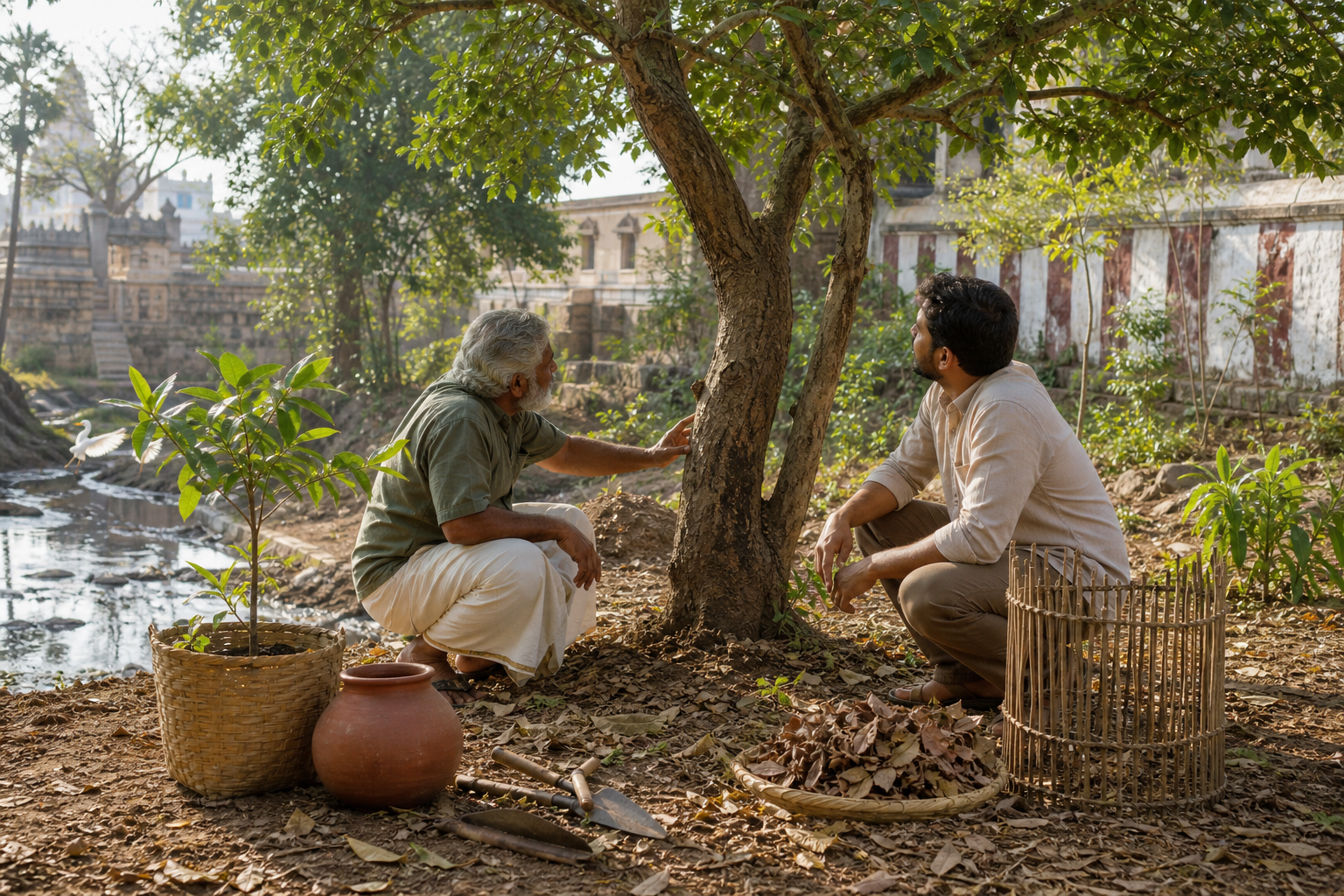
The most famous species is not automatically the right tree for your courtyard, climate, or sādhanā. Start with local suitability. Then consider lineage and contemplative purpose. The following map is functional, not absolute; regional lists may substitute Udumbara or Aśoka, and a teacher’s instruction should take precedence over a generalized scheme.
| Tree | Contemplative orientation | Practice it can support | Duty created by choosing it |
|---|---|---|---|
| Aśvattha or Peepal | Lucidity, compassion, and awakened attention | Breath awareness and mantra-japa in a bright but settled state | Protect the root zone and value its real habitat benefits without repeating the nocturnal-oxygen myth |
| Nyagrodha or Banyan | Stability, endurance, and shelter | Longer japa or seated practice when restlessness is the main obstacle | Allow for its vast crown and aerial roots; do not force a large tree into an unsuitable domestic space |
| Bilva | Śaiva and Śākta devotion, ardour held in balance | Mantra and visualization that require alertness without agitation | Take leaves sparingly and avoid treating ritual demand as permission to strip the tree |
| Nimba or Neem | Purification, discernment, and clear boundaries | Practice during periods of lethargy or scattered attention | Honour the living tree rather than reducing it to a supply of medicinal or ritual material |
| Āmalakī or Indian gooseberry | Restoration, longevity, and gentle clarity | Healing-oriented japa or quiet sitting after familiar breath practice | Choose a locally suitable cultivar and let nourishment lead to care, not excessive harvesting |
If you have access to a mature tree but cannot plant, adopt the place through regular care that the landholder permits. Remove non-biodegradable litter, keep heavy foot traffic away from exposed roots, and sit on a simple plant-based mat. Do not nail devotional objects into the trunk. Do not burn synthetic incense or place an open lamp beneath the canopy. A tree does not become more sacred by being made less safe.
If you are planting, think in years rather than in the coming festival alone. Check the mature size, root behaviour, water needs, spacing, and fitness for the local ecosystem. A traditional five-tree list is not a command to plant every species in every climate. Where a named species would be invasive, chronically unhealthy, or destructive to a small structure, choose ecological responsibility and seek a locally appropriate form of observance. Fidelity to dharma cannot require foreseeable damage.
Build a renewal rite that joins vision to conduct
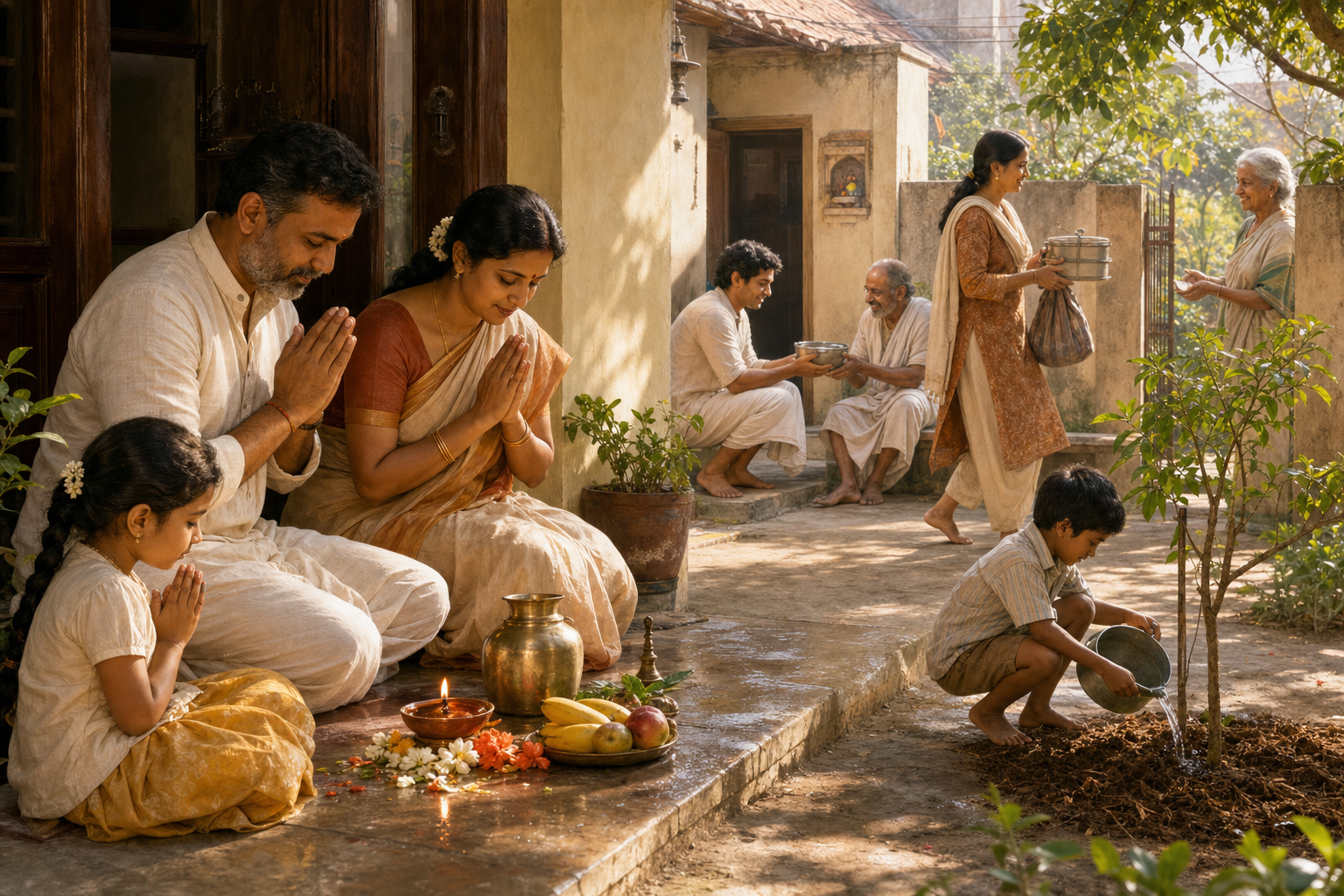
You do not need an elaborate private ceremony. You need a sequence in which every symbol produces a corresponding duty. Use the inherited form of your own tradition where one exists. The steps below provide a practical framework for connecting household worship, contemplation, generosity, and ecological care.
- Identify the actual threshold. For a calendrical observance, confirm the day through the appropriate local almanac. For a family renewal that is not tied to a named festival, state that honestly rather than borrowing a festival identity.
- Prepare before the threshold arrives. Clean the altar and practice place the previous evening. Select a reusable vessel, a stable plant-based seat, and seasonal materials. Preparation prevents the dawn rite from becoming hurried consumption.
- Arrange a field of right seeing. Bring together light, nourishment, reflection, lawful resources, and sacred orientation. A lamp, local grain or fruit, a mirror, a coin, and a murti or text can carry these meanings. Keep the lamp attended and indoors if the outdoor setting creates a fire risk.
- Receive before you speak. At dawn, look quietly before beginning requests or predictions. Let the first question be about order: what has been given, what has been neglected, and what must now be brought back into alignment?
- Continue beneath or near a living tree. Choose a clean, undisturbed place at dawn or late afternoon. Face east or northeast if that belongs to your practice. Settle through a familiar prayer, natural breath awareness, or mantra-japa. Advanced prāṇāyāma and specialized Tantric procedures belong under qualified instruction.
- Make one verifiable saṅkalpa. Replace “I will respect nature” with a duty you can recognize as completed: protect one root zone from compaction, stop leaving synthetic offerings, establish a watering plan, use seasonal produce for the feast, or restore a regular period of tree-side practice.
- Join auspiciousness to giving. Vishukkaineettam expresses this link during Vishu through the giving of money or useful items by elders. In another setting, choose an appropriate act of dāna or practical support. Give something that increases another person’s capability rather than treating generosity as decorative sentiment.
- Return after the festival. Inspect the altar materials, the tree, and the promise you made. Compost suitable organic remnants, remove everything else, and schedule the next act of care. The return visit is where renewal becomes discipline.
The meal can carry the same structure. A Vishu sadhya balances sweet, sour, salty, bitter, pungent, and astringent tastes. The point is not that every experience becomes pleasant. The meal trains a more mature expectation: a whole life contains contrasting rasas, and dharma asks you to meet them without losing measure. Use in-season produce, cook in quantities the household can honour, and let abundance be visible in hospitality rather than waste.
Keep renewal from turning into consumption
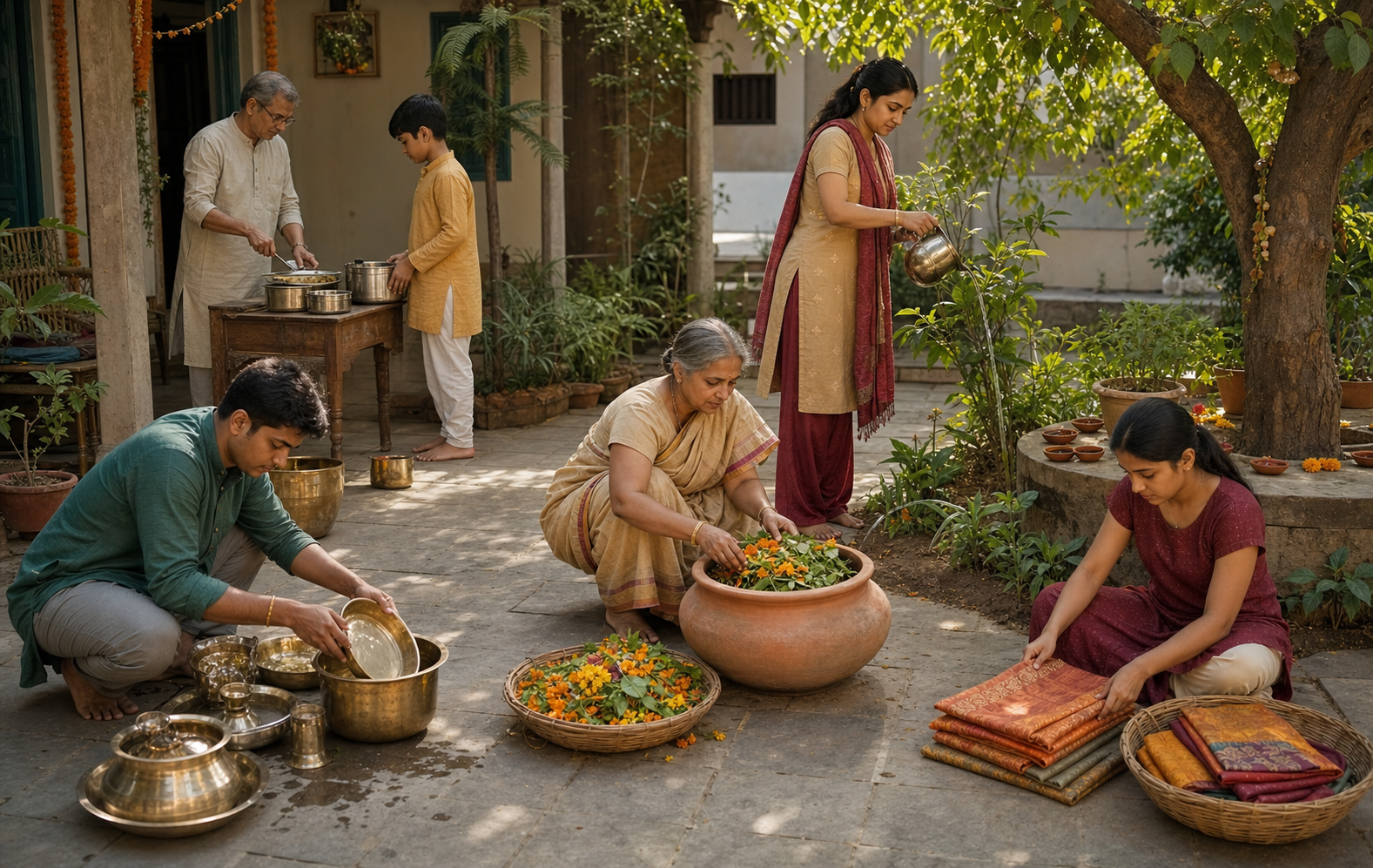
Festival markets make it easy to buy the appearance of renewal. New cloth, flowers, vessels, food, lamps, and fireworks can all have a legitimate place. The problem begins when acquisition becomes the main proof that the rite occurred. You can detect that drift through a few direct tests.
- If the display is abundant but nobody is supported, restore giving. Auspicious wealth is meant to circulate through duty, family care, artisans, farmers, temple communities, and those who need material help.
- If the tree receives offerings but not protection, restore stewardship. Remove plastic, prevent root compaction, avoid trunk injury, and stop unsafe flames before adding another garland.
- If imported decoration replaces the season, restore locality. Use available fruits, grains, flowers, and reusable vessels. A diaspora adaptation can remain faithful to the rite’s moral structure without pretending that every Kerala species is locally available.
- If a scientific-sounding claim is doing the work of faith, restore honesty. You do not need false claims about night-time oxygen or an antimicrobial “aura” to justify reverence. Distinguish botanical properties, traditional medicinal use, sensory experience, and subtle-body interpretation instead of blending them into one assertion.
- If the vow cannot be observed, restore precision. “Live in harmony” is an aspiration. “Do not nail signs into the Peepal, and check its root zone after each gathering” is a practice.
- If celebration burdens the habitat, restore restraint. Prefer biodegradable materials, reusable lamps and vessels, seasonal foodways, and safer approaches to fireworks and fire.
This discipline does not make the festival joyless. It protects joy from contradiction. The lamp can still glow, the table can still be generous, children can still receive gifts, and the sacred tree can still gather a community. Restraint simply ensures that the celebration does not damage the conditions that made celebration possible.
Begin at the next threshold, then return
At your next dawn observance, place one living obligation beside the lamp. Write down the tree, place, person, or household habit that will receive your care, and decide what completion will look like. Then return after the flowers have faded and do the work.
That return is the hinge between ceremony and renewal. When the first sight changes the next action, when prosperity leads to giving, and when reverence leaves a tree healthier rather than burdened, cosmic order is no longer an idea you admire. It has entered the way you live.
References
- DharmaRenaissance Blog — Five Sacred Trees of Tantra: Living Altars for Deep Meditation and Inner Awakening
- HinduPad — Vishu in Kerala: The Astronomical New Year, Sacred Vishukkani, Sadhya, and Dharmic Harmony