

You have a Vedic injunction before you, a teacher’s explanation in your ears, and an objection on your screen. All three may sound confident. Mimamsa asks the question that must come first: by what means could this claim become knowledge at all?
The answer gives you a practical discipline. Instead of treating faith and reason as rivals, you assign each claim to the means capable of disclosing it, accept only what that means establishes, and remain alert to anything that could defeat the cognition.
Begin with the six routes by which something can be known
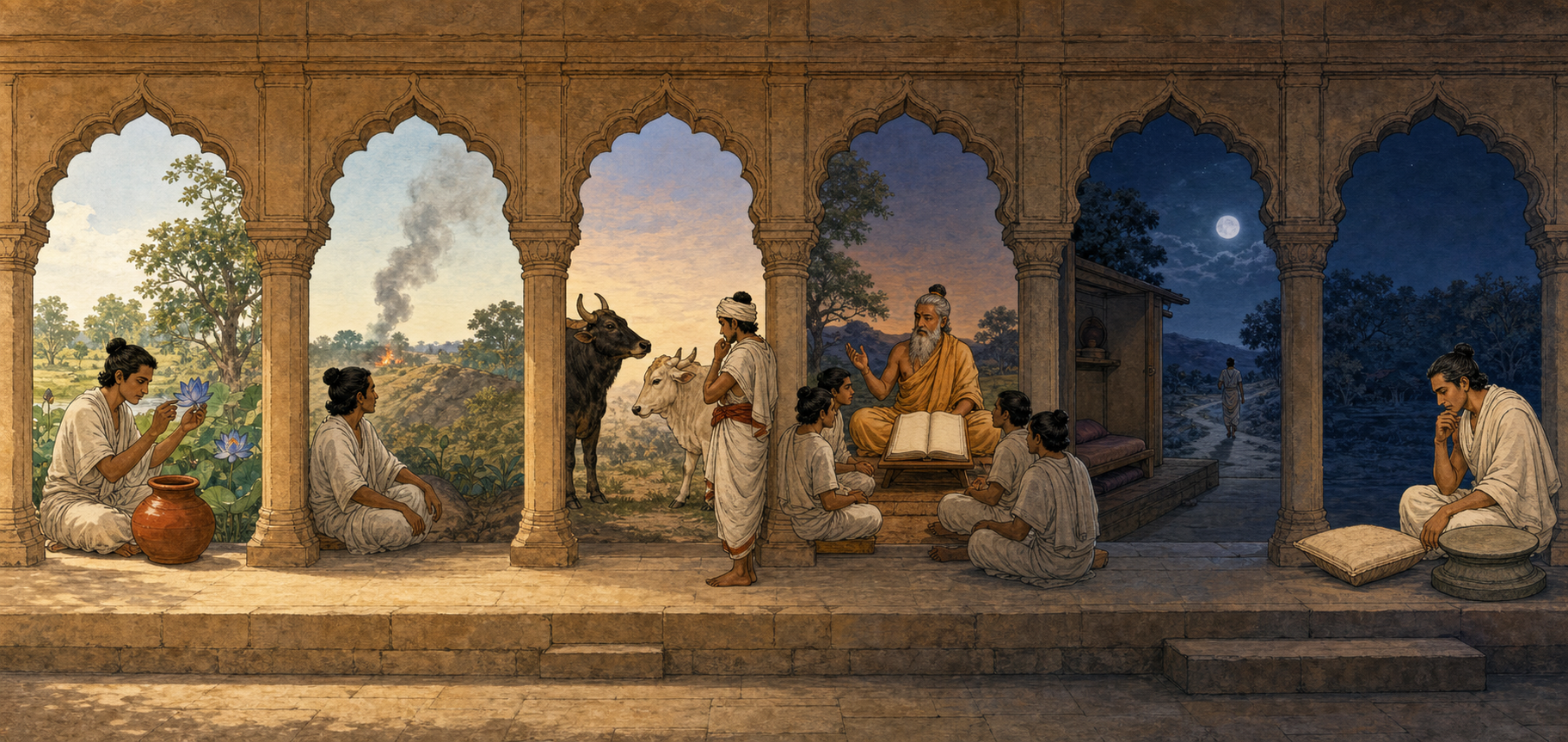
A pramana is not a doctrine, conclusion, or personal feeling. It is a means by which valid cognition arises. Keeping four related terms apart prevents much confusion: the pramatr is the knower, the prameya is the object known, the prama is the valid cognition, and the pramana is the knowledge-producing route.
This means that your first question should not be whether a statement sounds traditional, rational, or inspiring. Ask what kind of statement it is and which pramana could establish it. A perceptible object, an inferred consequence, an absence, and a Vedic obligation do not all submit to the same test.
| Pramana | What it can disclose | The question to ask |
|---|---|---|
| Pratyaksha, perception | An object or quality present to properly functioning perception | Is the object available under conditions in which it could actually be perceived? |
| Anumana, inference | An unperceived conclusion warranted by a known sign and an established relation | Is the relation between the evidence and conclusion dependable, or merely assumed? |
| Upamana, comparison | Knowledge gained by recognizing a relevant similarity between something described and something encountered | Is the shared feature the one that matters for identification? |
| Arthapatti, postulation | A fact that must be supplied because established facts would otherwise remain inexplicable | Is this posit genuinely necessary, or only one plausible explanation among several? |
| Anupalabdhi, non-cognition | The absence of an expected object when conditions are suitable for apprehending it | If the object were present, should it have been cognized here and now? |
| Shabda, testimony | Knowledge communicated by trustworthy human testimony, or by Vedic testimony in its proper domain | Does this speaker or textual authority have the competence and standing to disclose this kind of fact? |
The Bhatṭa school associated with Kumarila Bhatṭa accepts all six. The Prabhakara school accepts five, declining to treat anupalabdhi as an independent pramana and accounting for absence-knowledge through other means. Both schools accept arthapatti and uphold the intrinsic validity of cognition.
This disagreement is not about whether you can know that a pot is absent. It concerns how that knowledge arises. That is a useful model for reading Indian philosophy: two schools may accept the same ordinary cognition while disagreeing about which epistemic instrument produced it. State the school before stating its list.
Intrinsic validity is a starting presumption, not blind belief

Mimamsa is known for svatah-pramanyavada, the view that cognition carries a presumption of validity intrinsically. A cognition does not need a second cognition to certify it before it can function as knowledge. If every act of knowing required another certificate, that certificate would require a further certificate, and the process would never begin.
The crucial qualification is badha, defeat. A cognition is accepted as valid unless a later cognition defeats it. Nyaya places greater emphasis on validity being established externally, while both major Mimamsa schools defend the intrinsic presumption, though they differ over details of how error and invalidity become known.
Intrinsic validity therefore does not mean that every impression, memory, interpretation, or forwarded claim is true. It tells you where inquiry begins, not where scrutiny ends. Confidence is psychological; validity is epistemic. A person may feel completely certain while relying on poor perception, a broken inference, or an incompetent speaker.
Use this five-step audit whenever a claim matters:
- State the cognition without embellishment. Write what is supposedly known, not the conclusion you hope to reach.
- Name the proposed pramana. Decide whether the claim rests on perception, inference, comparison, necessary postulation, non-cognition, or testimony.
- Check its enabling conditions. Perception needs suitable conditions; inference needs a warranted relation; comparison needs a relevant similarity; testimony needs competence and reliable communication.
- Look for badha. Ask whether a clearer perception, stronger inference, better-attested testimony, or contradiction from the same authoritative domain defeats the cognition.
- Limit the conclusion to what the pramana yields. Do not turn one perception into a universal law, a competent expert into an authority on every subject, or a plausible explanation into a necessary one.
Suppose you do not see a lamp in a well-lit, unobstructed room. A Bhatṭa analysis may treat that suitable non-cognition as knowledge of the lamp’s absence. If the room is dark, the same failure to see proves nothing because the enabling condition is missing. The difference lies not in how strongly you feel the absence, but in whether the relevant pramana could operate.
Shabda must be matched to the domain of the claim

Much confusion about testimony begins by treating every utterance as epistemically equal. Mimamsa distinguishes Vaidika-shabda, Vedic testimony, from laukika-shabda, trustworthy human testimony. They do not derive their authority in the same way, and neither gives you permission to accept every statement wearing the appearance of tradition.
In worldly matters, a reliable speaker is an apta: someone with relevant competence, honesty, and the intention to communicate truth. A skilled grammarian may be an apta concerning Sanskrit grammar without thereby becoming an authority on medicine, astronomy, or ritual performance. Authority remains attached to a domain.
Before accepting laukika testimony, check five things:
- Competence: Does the person know this particular subject, rather than merely possessing prestige elsewhere?
- Truthfulness: Is there reason to regard the communication as honest?
- Intention: Is the person trying to inform you accurately, or persuading, entertaining, provoking, or selling?
- Transmission: Did the words reach you intact, with attribution and context preserved?
- Corroboration: Where perception or inference can check the testimony, do they support it or defeat it?
A Sanskrit sentence circulating without a textual location does not become Vaidika-shabda merely because it sounds ancient. First establish what text it belongs to, whether the wording has been transmitted correctly, what surrounds it, and whether it is an injunction, explanation, praise, narrative, or another kind of statement.
Vedic testimony has a different foundation. Mimamsa regards the Vedas as apaurusheya: authorless and beginningless, rather than compositions originating in a fallible human intention. Its theory treats phonemes as eternal types manifested in recitation. This account supports the Veda’s distinctive authority concerning dharma, which is not available to ordinary perception.
That domain restriction matters. Perception can disclose a visible act, and inference can establish consequences where a dependable relation is known. Neither, by itself, can reveal that a particular act ought to be performed for an unseen result. Mimamsa therefore assigns Vedic injunctions an indispensable role in knowing dharma. This does not turn scripture into a substitute instrument for every empirical question; it identifies a subject that empirical instruments alone cannot disclose.
Correctly identifying Vedic words is still not enough. You must interpret sentences as parts of a coherent whole. The six interpretive indicators known as shad-linga provide a disciplined reading sequence:
- Opening and conclusion, upakrama-upasamhara: Check how the passage frames and completes its subject.
- Repetition, abhyasa: Notice what the passage deliberately returns to.
- Novelty, apurvata: Identify what the passage uniquely teaches rather than what is already available elsewhere.
- Result, phala: Determine the fruit or consequence attached to the teaching or action.
- Commendatory explanation, arthavada: Distinguish praise, censure, narrative, or explanation that supports an injunction from the injunction itself.
- Reasoned support, upapatti: Examine the reasoning that makes the proposed interpretation coherent.
These indicators give you an antidote to quotation mining. If your reading depends on ignoring the opening, conclusion, repeated theme, stated result, or immediate rationale, it is probably too fragile to guide action.
Internal disagreement also reaches sentence meaning. The Bhatṭa theory of abhihitanvaya holds that words first convey their individual meanings and are then syntactically connected. The Prabhakara theory of anvitabhidhana holds that words communicate meanings already connected within the sentence. Both accounts are attempts to explain how precise, action-guiding meaning arises. When an argument hinges on one isolated word while disregarding its syntactic relation, this debate tells you exactly where to slow down.
Arthapatti applies only when explanation becomes necessary

Arthapatti is easy to imitate badly. It is not a license to fill gaps with whatever story seems clever. It arises when separately established facts cannot stand together intelligibly unless an unperceived condition is admitted.
The classical case concerns Devadatta. He is known to be stout, and it is also established that he does not eat during the day. No perception has disclosed nocturnal eating. Yet eating at night is postulated because, given the established facts, the situation would otherwise be inexplicable. The governing condition is anyatha-anupapatti: impossibility of accounting for the known facts otherwise.
Drishtarthapatti begins with something perceptually established. If Devadatta is alive and is not in the house, his being outside is supplied as the required fact. Shrutarthapatti begins with what has been communicated verbally and supplies an unstated condition needed to make the statement coherent. In either form, the posit answers a specific anomaly; it does not float free of established premises.
Apply this necessity test before calling your reasoning arthapatti:
- Secure every premise independently. If one of the supposedly established facts is only hearsay or conjecture, repair that weakness first.
- State the anomaly precisely. Show why the known facts cannot be reconciled as they stand.
- List live alternatives. Do not hide an ordinary explanation simply because another is more interesting.
- Choose the smallest sufficient posit. Supply only what resolves the anomaly, without attaching additional motives, causes, or consequences.
- Keep the conclusion open to defeat. New perception or testimony may remove the anomaly or replace the posit.
If two or more explanations remain compatible with the facts, you do not yet have arthapatti in its strict Mimamsa sense. You have competing hypotheses. Label them accordingly. This single distinction prevents postulation from degenerating into kalpana, unconstrained invention.
Do not confuse postulation with three neighbouring operations
- Anumana establishes a conclusion through a known relation. Nyaya thinkers reconstruct arthapatti as inference, but Mimamsakas answer that the required universal relation, vyapti, has not been established through repeated cases. What generates the cognition is the otherwise-inexplicable anomaly itself.
- Lakshana adjusts meaning when primary signification does not fit. A village described as being on the Ganga is understood as being on its bank. This is a semantic adjustment, not the discovery of a positively existing hidden condition.
- Anupalabdhi discloses absence. Arthapatti supplies a positive fact required for coherence. Knowing that a pot is absent and postulating that Devadatta eats at night are therefore different epistemic acts.
The Vedic application becomes especially important when an enjoined act and a remote promised result must be understood together. Apurva names the unseen efficacy connecting correctly performed ritual with its later fruit. Vedic shabda discloses the action-result relation, while postulation articulates the otherwise-unseen link that preserves its causal coherence. Apurva is not permission to invent invisible mechanisms wherever evidence is inconvenient; its use is constrained by Vedic injunction, hermeneutic context, and explanatory need.
The independence of arthapatti remains a school-specific position. Nyaya and the Buddhist pramana traditions associated with Dignaga and Dharmakirti generally absorb this kind of reasoning into inference. Advaita Vedanta often joins Mimamsa in recognizing postulation distinctly, while Jaina many-sided analysis warns against treating one perspective as exhaustive before alternatives have been examined. The shared concern is disciplined coherence, not a single taxonomy accepted by every Dharmic school.
Key takeaways for testing a knowledge claim
- A pramana is the route that produces knowledge, not the claim or tradition you want to defend.
- Begin with a presumption of validity, then actively check for badha rather than confusing initial acceptance with permanent certainty.
- Match the instrument to the object: perception for perceptible particulars, inference for warranted consequences, and Vedic shabda for dharma beyond empirical disclosure.
- Treat human testimony as domain-bound. Expertise, honesty, truthful intention, intact transmission, and available corroboration all matter.
- Call a posit arthapatti only when the established facts require it and rival explanations have been ruled out.
- Preserve school labels. Bhatṭa Mimamsa accepts anupalabdhi independently; Prabhakara Mimamsa does not, and Nyaya contests the independence of arthapatti.
The next time you meet a serious claim, write down five items: the exact cognition, its proposed pramana, the conditions that let that pramana operate, any possible defeater, and the narrowest justified conclusion. If you cannot fill one of those places, pause before believing or repeating the claim. That pause is not indecision. It is Mimamsa’s discipline of making knowledge answer for how it became known.
References
- DharmaRenaissance Blog – Unlocking the Hidden in Hindu Philosophy: Arthapatti and the Power of Postulation in Mimamsa
- DharmaRenaissance Blog – Shabda Pramana in Mimamsa: The Timeless Power of Vedic Testimony for Truth and Dharma