
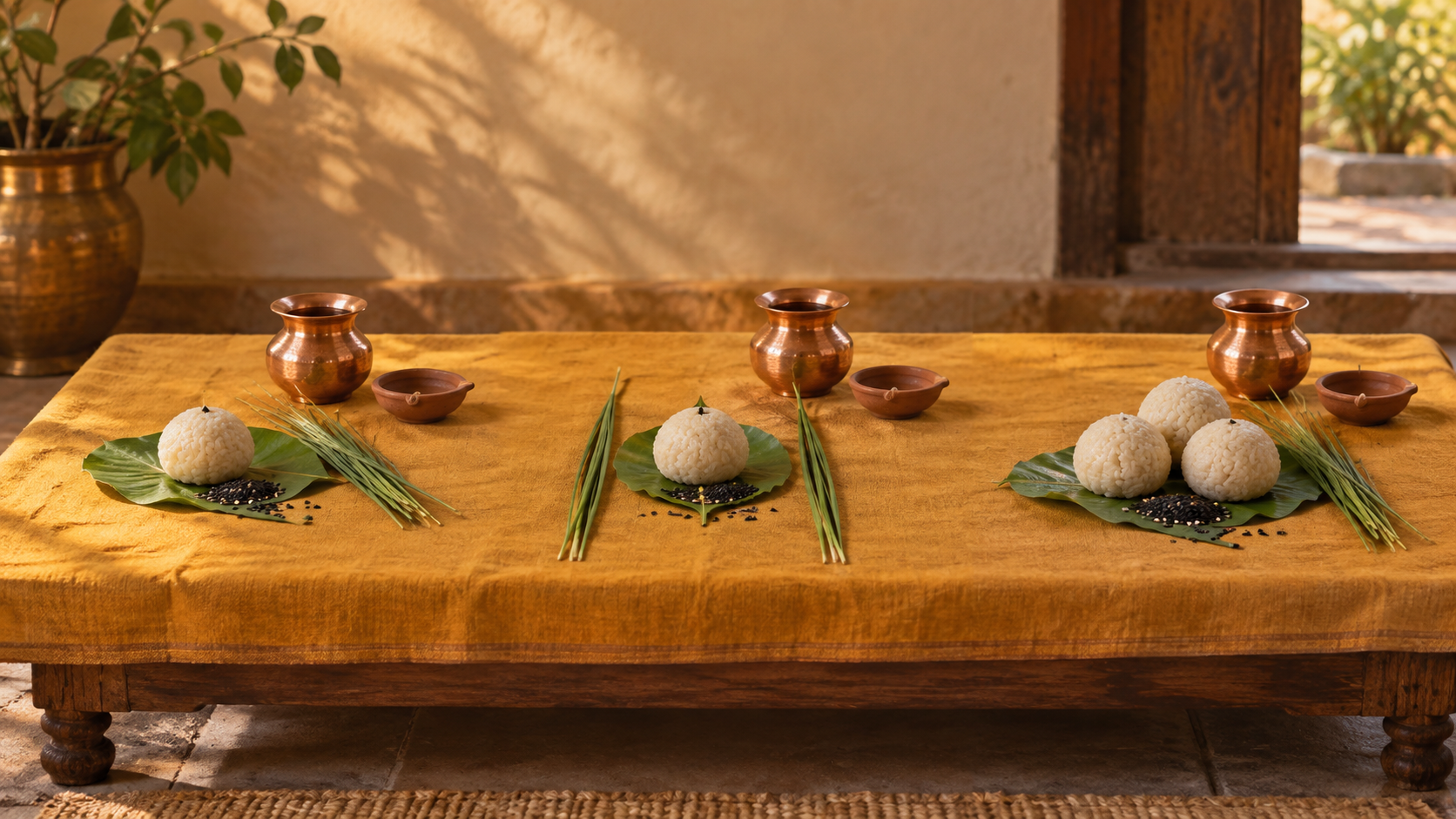
If your family has recently faced a death, three Sanskrit terms may appear in conversations with priests and relatives: Parvana, Ekoddishta, and Sapindikarana. They can sound like competing names for the same ceremony. They are not. Each answers a different ritual question: Is the offering directed to one recently departed person, does it mark that person’s incorporation among the ancestors, or is it addressed to the ancestral group?
Knowing that distinction won’t replace the guidance of the acharya or purohita who knows your family’s tradition. It will, however, help you ask the right questions, avoid arranging the wrong rite, and understand what your family is being called upon to do.
The shortest accurate distinction

Hindu death rites proceed from a particular understanding of life and obligation. The body is left behind, but the atma continues its journey. The departed is understood to pass through a transitional condition described as preta before entering the order of the pitrs. Shraddha sustains the family’s dharmic responsibility during and after that transition.
In this context, preta is a technical ritual term. It should not be reduced to the frightening popular image conveyed by the English word ghost. It identifies the departed in an intermediate status. Pitr likewise does not mean merely any dead person; it identifies an ancestor received within the continuing ancestral order.
| Rite | Primary ritual focus | What distinguishes it |
|---|---|---|
| Ekoddishta Shraddha | One specifically designated departed person | The offering is individual in its address and belongs to the period in which the departed is treated separately from the established ancestral group. |
| Sapindikarana Shraddha | The departed person’s transition into the ancestral order | It marks incorporation rather than continued separate treatment. |
| Parvana Shraddha | The pitrs as an ancestral group | It is collective in scope and belongs to the family’s continuing observance of its ancestors. |
A useful way to remember the sequence is: Ekoddishta addresses the individual, Sapindikarana marks a change in that individual’s ritual relationship to the lineage, and Parvana addresses the ancestral order collectively. These are distinctions of purpose, not rankings of importance.
Ekoddishta keeps the recently departed person in view
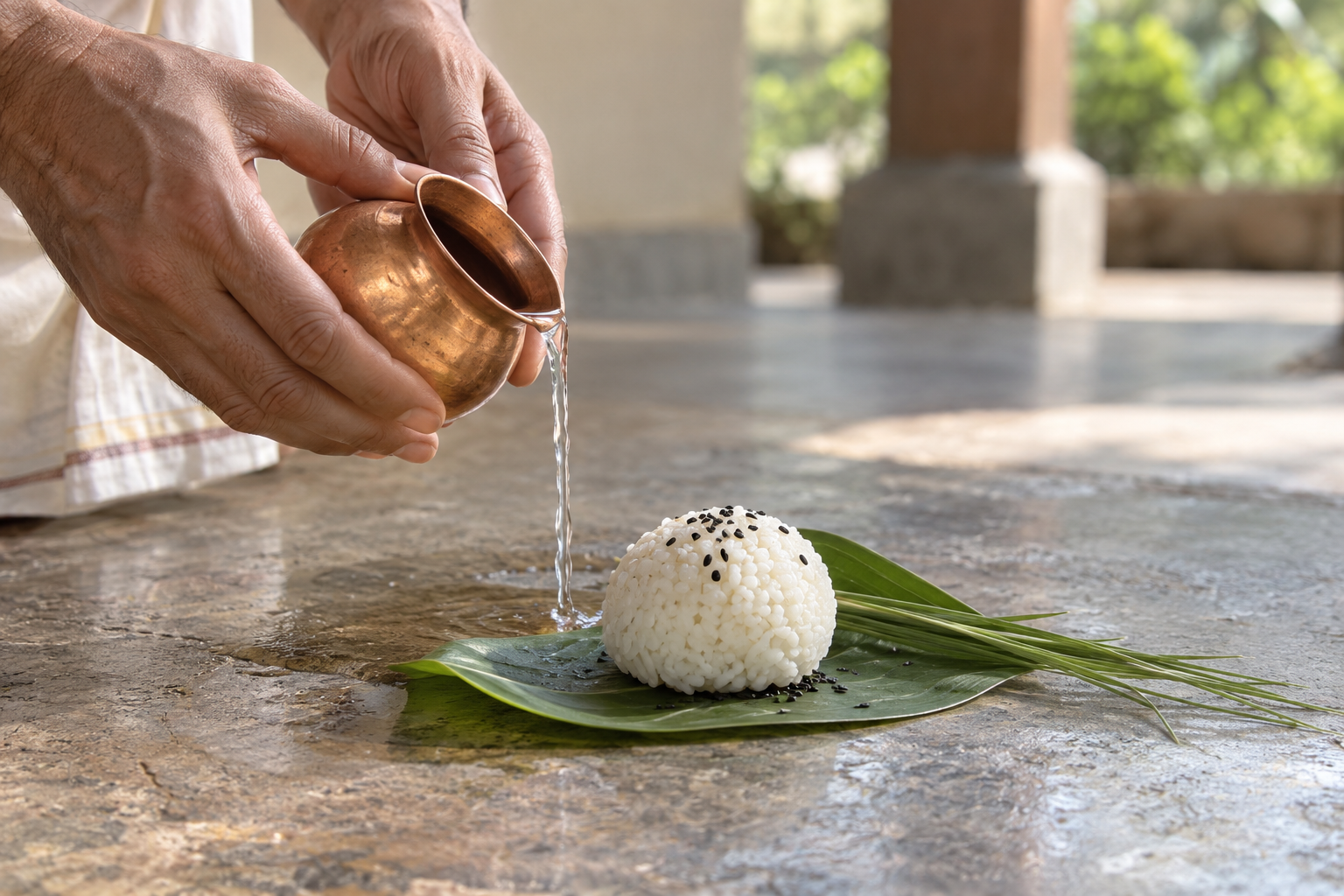
Ekoddishta means that the rite is directed toward one specified person. Its defining feature is not simply that a name is spoken. The entire ritual intention is concentrated on that departed person rather than on the lineage’s pitrs collectively.
This makes Ekoddishta especially important to understand when several kinds of Shraddha are being discussed together. A general ancestral observance cannot automatically be assumed to perform the same function. The identity of the recipient is part of the rite itself.
If you are arranging the ceremony, don’t ask only, “Are we doing Shraddha?” Ask, “Is this Ekoddishta for the recently departed, or is it a collective ancestral rite?” That one question can reveal whether everyone is planning the same observance.
The individualized character of Ekoddishta also expresses a humane truth. Hindu dharma does not treat death as an instant erasure of relationship. The family continues its duty to the person who has died, but that duty is now carried through remembrance, ritual intention, and offerings rather than through ordinary bodily care.
That does not mean the family should improvise the form from the meaning. Shraddha is performed within inherited disciplines. Mantras, ritual roles, sequence, and required arrangements can vary by Vedic affiliation, sampradaya, region, and family custom. Preserve the clear principle—one specifically designated departed person—while allowing the qualified officiant to determine the correct procedure.
Sapindikarana is the threshold, not another memorial offering

Sapindikarana is best understood as a rite of incorporation. The recently departed person, previously addressed separately, is ritually joined to the family’s ancestral order. It therefore changes how the person is situated within subsequent Shraddha observance.
This is why Sapindikarana should not be described merely as “one more Shraddha.” Its significance lies in transition. Before it, the departed is the distinct focus of rites proper to the preta condition. Through Sapindikarana, the ritual relationship is reconfigured: the departed is no longer approached only as an isolated recent death but as belonging among the pitrs of the lineage.
The word sapinda carries ideas of kinship, ritual connection, and participation in a shared ancestral body. You do not need to force that rich term into a single English equivalent. For practical purposes, remember what the rite accomplishes: it connects the departed with the ancestors rather than continuing indefinite separate treatment.
Families often become confused when they hear different claims about when Sapindikarana should occur. The safe response is not to select a timetable from whichever explanation appears first online. Timing and procedure are precisely where inherited traditions can differ. Tell the officiant which earlier rites were actually completed, which were missed or remain uncertain, and which family tradition you follow. Do not conceal a gap out of embarrassment; that information may change what is prescribed.
If two priests give different instructions, first determine whether they are applying different regional, Vedic, or sampradaya conventions. A variation is not automatically an error. Ask each priest to identify the tradition governing the recommendation and to explain the ritual status of the departed before and after the proposed ceremony. That question gets beneath competing dates and exposes the underlying logic.
Parvana places one loss within the larger ancestral lineage
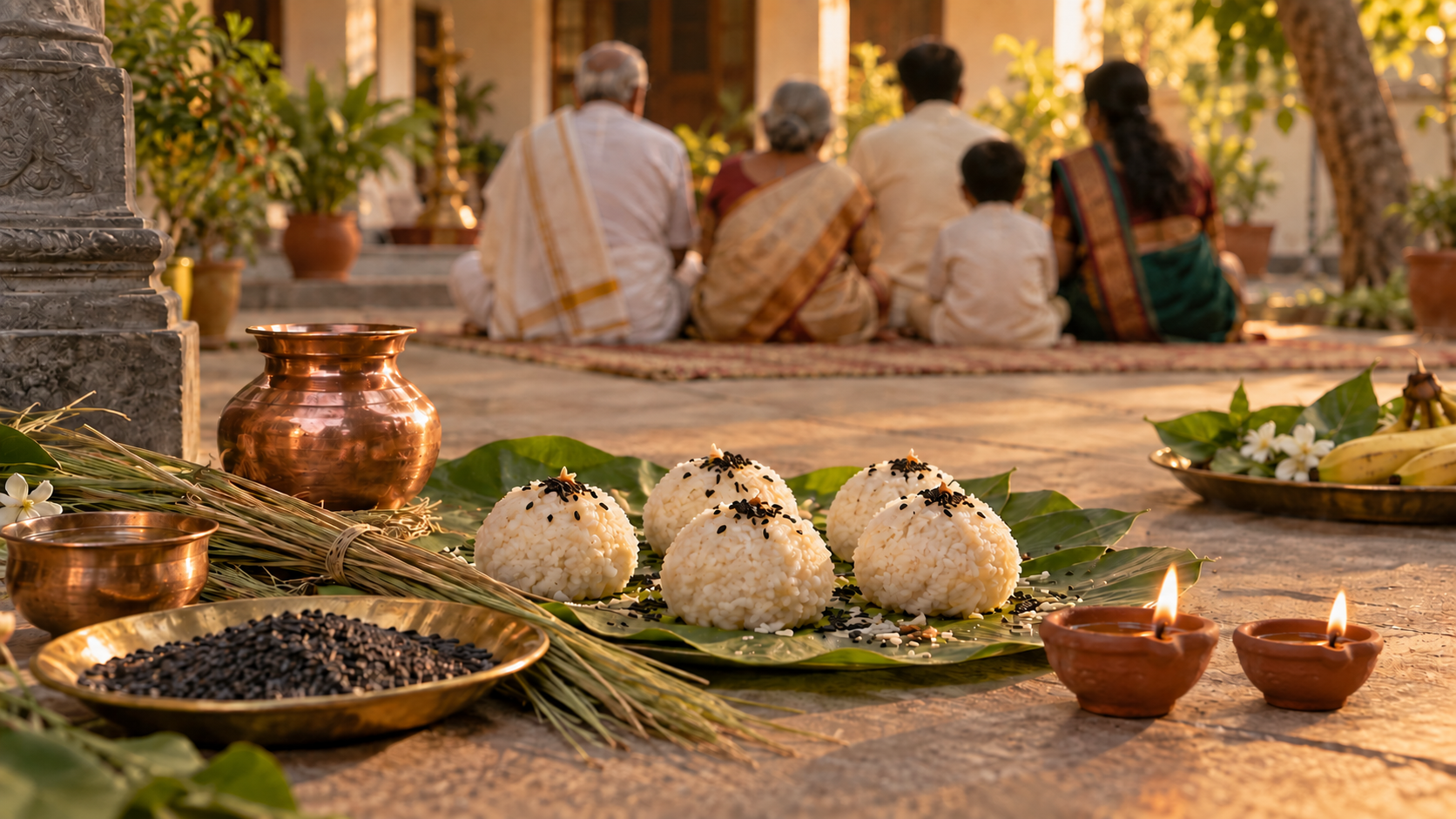
Parvana Shraddha is collective in orientation. Rather than singling out one person in the manner of Ekoddishta, it addresses the pitrs as an ancestral group. It belongs to the family’s continuing relationship with those who came before, not only to the immediate period following a death.
This distinction prevents a common mistake: assuming that all Shraddha rites are interchangeable because they involve remembrance and offerings. A rite for one recent departure and a rite for the ancestral collectivity may share a broad dharmic purpose, yet their ritual addressees are different. Intention alone does not erase that difference.
Parvana also widens the family’s field of attention. Grief naturally fixes the mind on the person who has just died. The collective ancestral rite locates that loss within a lineage extending beyond immediate memory. The family is not beginning a relationship with the pitrs from nothing; it is receiving another generation into an already existing chain of obligation and gratitude.
This is one reason accurate family memory matters. Names, relationships, gotra information, and knowledge of the family’s customary practice should be preserved before the eldest relatives who hold them are gone. If some information is unknown, say that plainly to the officiant rather than inventing a detail. The applicable tradition can then govern how incomplete knowledge is handled.
How to prepare without confusing ritual purpose and procedure
Your first task is not to master every mantra. It is to establish which rite is required and give the officiant an accurate account of the family situation. Use the following preparation sequence.
- Name the purpose. Ask whether the proposed rite is for one recently departed person, for incorporation into the ancestral order, or for the pitrs collectively. Request the Sanskrit name as well as the local name.
- Identify the governing tradition. Tell the officiant your family’s sampradaya, Vedic or regional affiliation if known, customary language, place of origin, and any established household practice. If you do not know these, say so.
- Report what has already occurred. Provide a factual account of the rites performed since the death. Include uncertainties and interruptions. Sapindikarana in particular cannot be planned intelligently if the earlier ritual status is unclear.
- Confirm the karta. Ask who will carry the principal ritual responsibility under your family’s tradition. Do not assume that a rule heard from another community applies unchanged to yours.
- Verify the person or ancestral group being invoked. Prepare the departed person’s name, relationship, and known lineage information. For a collective observance, ask which ancestors are included under the prescribed procedure.
- Request a written preparation list. Obtain the required arrangements, materials, participants, dietary expectations, and schedule directly from the officiant. Local availability may affect preparation, but it should not silently redefine the rite.
- Resolve disagreements before the ceremony. If relatives use the three terms loosely, write down the final decision: the name of the rite, its recipient, its purpose, and the tradition being followed. This is far easier than settling a conceptual dispute while the ceremony is underway.
Families living away from their ancestral region should be especially careful about labels. A local priest may use a familiar regional term that your relatives use differently. Describe the intended ritual function instead of relying on the label alone: “This is for one recently departed person,” “This is the incorporation rite,” or “This is the collective offering to the pitrs.” Clear function survives differences in vocabulary.
You should also separate three questions that families often collapse into one: What does this rite mean? Which tradition governs us? What can be arranged under our present circumstances? Meaning explains the rite, tradition determines its authorized form, and circumstances shape the practical planning. Difficulty arranging an item or gathering relatives does not by itself turn one kind of Shraddha into another.
Approach the officiant as the custodian of a living ritual discipline, but remain an attentive participant. You are entitled to ask whom the rite addresses, what transition it marks, and which family details are needed. Understanding does not diminish Shraddha. It helps ensure that shraddha—sincerity, reverence, and faithful attention—is joined to correct action.
Key takeaways
- Ekoddishta is individual: it is directed to one specifically designated departed person.
- Sapindikarana is transitional: it marks the departed person’s incorporation into the ancestral order.
- Parvana is collective: it addresses the pitrs as an ancestral group within continuing family observance.
- The rites are related but not interchangeable: recipient, ritual status, and purpose determine which one is being performed.
- Exact procedure is tradition-dependent: confirm your family’s practice, the rites already completed, the karta, and the intended recipient with a qualified acharya or purohita.
- Unknown details should remain honestly unknown: give the officiant the facts you have rather than filling gaps with guesses.
Before you commit to a date or gather materials, write one sentence stating what the ceremony is meant to accomplish. Then ask the officiant to confirm both the rite’s name and the tradition governing it. That small act of clarity can keep a sacred family duty aligned with its actual purpose.
References

Leave a Reply
You must be logged in to post a comment.