
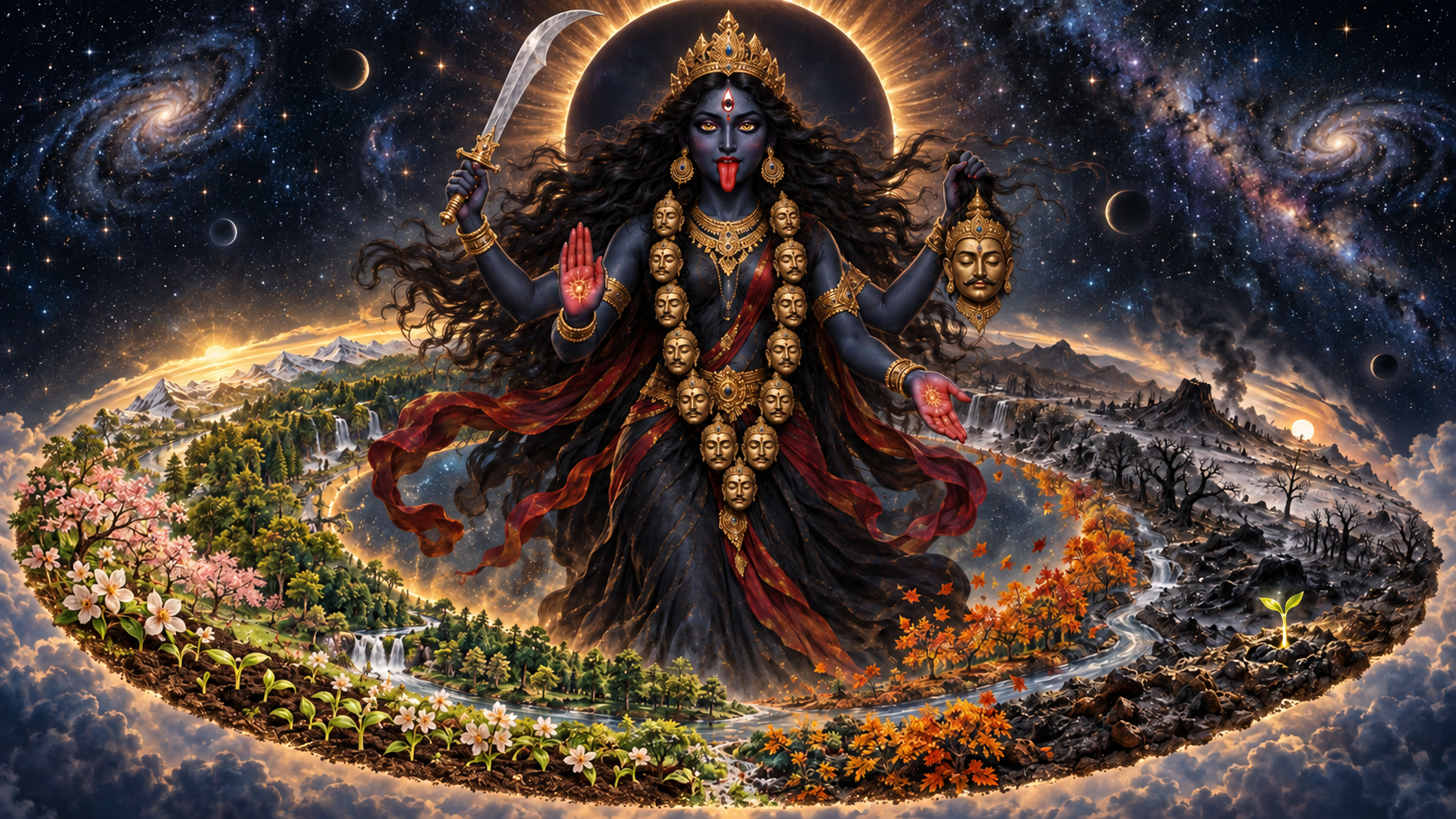
If Kali’s fierce form unsettles you, don’t rush past that reaction. It reveals the assumption that makes her difficult to understand: we tend to treat destruction as the opposite of divinity.
Kali becomes clearer when you see an ending as one movement within a larger cosmic rhythm. She does not represent senseless ruin. She confronts you with time, impermanence and the dissolution through which creation remains possible.
Begin with the whole cycle, not its most frightening moment

A linear picture of time gives the universe a beginning, a one-way history and a final end. From that perspective, destruction looks like an absolute defeat. Hindu cosmological thought offers another frame: existence repeatedly arises, continues, dissolves and arises in new forms. The universe is better understood as a rhythm than as an object travelling toward permanent extinction.
Within this vision, Kali stands at the heart of the cosmic cycle as supreme Shakti. Her connection with dissolution cannot be separated from the power of manifestation itself. The force by which forms disappear belongs to the same sacred reality through which forms appear.
Use four movements as your basic reading key:
- Arising: a form, world, identity or condition comes into being.
- Continuity: that form is sustained long enough to fulfil its place within the larger order.
- Dissolution: the form reaches its limit and can no longer remain as it was.
- Renewal: the ending creates the conditions in which another form can arise.
None of these movements makes sense in isolation. Creation without dissolution would eventually mean endless accumulation, with no room for transformation. Dissolution without creation would be mere emptiness. Kali embodies the difficult movement that prevents the cosmic process from becoming frozen.
This does not mean every personal loss is quickly replaced or that grief should be dismissed as an illusion. The cosmic cycle explains why endings belong within reality; it does not make a bereavement, broken relationship or vanished way of life painless. Use the teaching to understand loss, not to silence the person enduring it.
Kali reveals what time does to every form
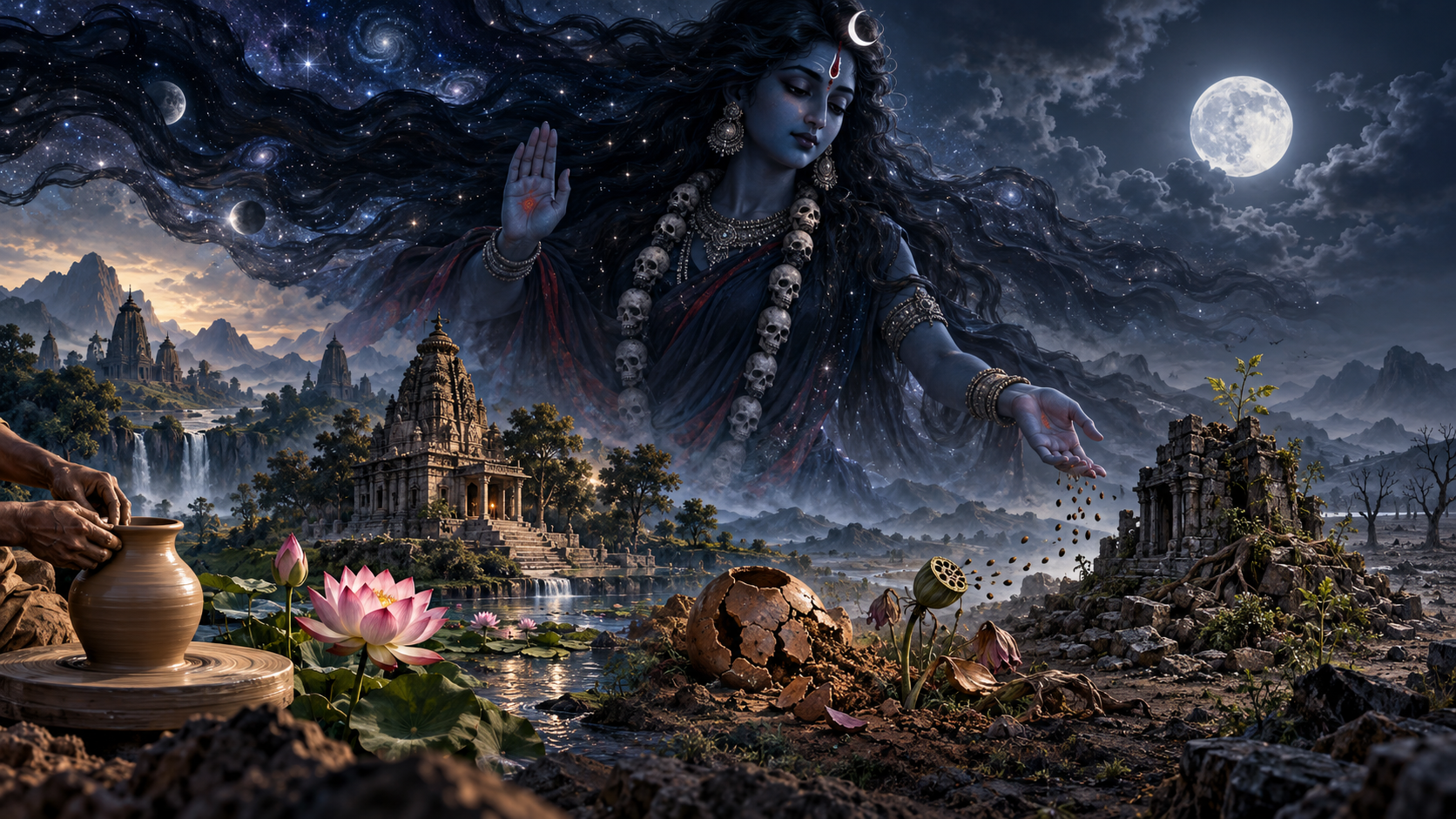
We often imagine time as a neutral background measured by clocks and calendars. Kali presents a more demanding truth. Time does not merely count the duration of things. It brings every conditioned form to its boundary.
A body changes. An achievement loses its hold. An institution outlives its purpose. Even a vast cosmic order does not possess an independent guarantee of permanence. Kali exposes the mistake of treating a temporary form as though it could secure itself forever.
That is why her fierceness need not be read as malice. The terror belongs partly to our attachment. We want the familiar form to remain, while time reveals that no form can make that demand successfully. Kali does not flatter this desire. She places the limit before us without disguise.
There is also an important distinction between cosmic dissolution and adharma. Dissolution describes what happens to conditioned forms within the cycle of existence. Adharma concerns conduct that violates moral or sacred order. Confusing the two produces opposite errors: calling Kali evil because she is associated with endings, or treating any violent act as sacred merely because it destroys. Neither interpretation holds.
When you encounter the claim that Kali is simply a goddess of destruction, ask two questions. Does the explanation place destruction inside the complete movement of creation and renewal? Does it distinguish divine dissolution from human cruelty? If the answer to either is no, the description is incomplete.
How to read Kali’s fierce imagery without mistaking her for evil
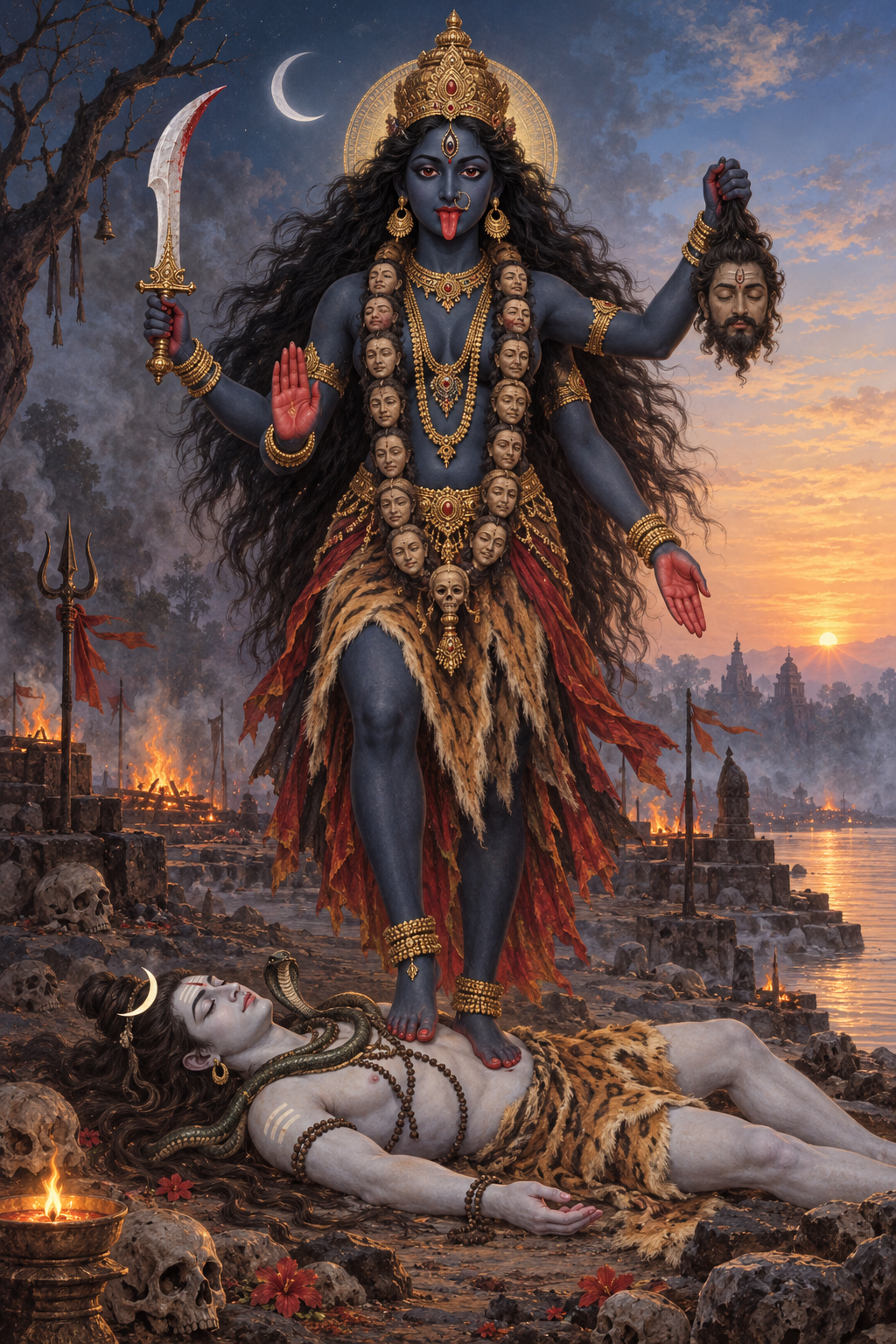
An isolated image can be misleading. If you read a fierce divine form as though it were an ordinary portrait, frightening elements appear to describe a frightening personality. Sacred imagery works differently. It gives visible form to realities that are otherwise difficult to face directly.
Apply these four lenses whenever you study a representation of Kali:
- Identity: begin from the fact that Kali is Devi, not a demon accidentally admitted into Hindu worship.
- Function: ask what the image communicates about time, mortality, attachment and the limits of embodied form.
- Cosmic setting: place dissolution back within the cycle. The image may concentrate on an ending without claiming that ending is the whole of reality.
- Devotional relationship: remember that a devotee may approach a fierce form as Mother, refuge or liberating power. Visual severity and spiritual hostility are not the same thing.
This method protects you from two shallow readings. The first turns Kali into an exotic monster because it judges appearance without theology. The second softens her until she becomes a vague symbol of personal confidence. Both remove the challenge she presents. Her form asks you to look at the mortality of everything you use to define yourself.
Interpretations can vary across Hindu communities, texts and lineages. A symbolic explanation should therefore state its context rather than claiming that every feature always has one fixed meaning. When you visit a temple or learn from a particular tradition, let that tradition explain its own iconography and practice.
Turn the cosmic cycle into an honest spiritual practice

You do not need to pretend that ordinary inconvenience is cosmic dissolution. Nor should Kali be reduced to a slogan about embracing change. A useful contemplation begins by noticing the cycle already operating in your life without claiming that every change is desirable.
Try this four-part reflection at the end of a week. It is a study exercise, not a prescribed ritual:
- Name what arose. Write down one new obligation, relationship, idea or condition that entered your life.
- Name what you are sustaining. Identify what deserves continued attention because it still serves dharma, responsibility or genuine care.
- Name what has reached its limit. Choose one habit, assumption or role whose form is no longer truthful. Do not confuse discomfort alone with a command to abandon a duty.
- Leave room after the ending. Resist filling every vacancy immediately. Renewal is not the same as hurried replacement.
The third step is usually the hardest because attachment can imitate responsibility. Ask whether you are preserving something because it remains worthy or because its ending would disturb your identity. Kali’s symbolism is especially useful at that boundary. She does not tell you to destroy what is difficult; she asks you to stop demanding permanence from what is conditioned.
The fourth step matters just as much. Modern self-help often treats every ending as an opportunity that must be made productive at once. The cosmic cycle is more patient. Dissolution has its own integrity. Some forms must finish before the shape of renewal is visible.
If you undertake devotional practice, keep this intellectual reflection subordinate to the discipline of the tradition you follow. Symbolic analysis can clarify what you are seeing, but it does not replace mantra, puja, initiation, temple practice or guidance where a lineage requires them.
Key takeaways
- Kali’s association with dissolution makes sense only within the full cycle of arising, continuity, ending and renewal.
- Her fierceness reveals the power of time and the impermanence of every conditioned form; it does not make her a figure of senseless evil.
- Cosmic dissolution and adharma are different categories. The sacred place of dissolution does not justify human cruelty.
- Read Kali’s imagery through divine identity, symbolic function, cosmic context and devotional relationship rather than appearance alone.
- In personal reflection, ask what genuinely deserves preservation and what you are maintaining only from attachment.
The next time Kali’s form troubles you, stay with the discomfort long enough to ask what you expected the divine to protect you from. If the answer is time, change or mortality, you have reached the threshold of her teaching.
References

Leave a Reply
You must be logged in to post a comment.