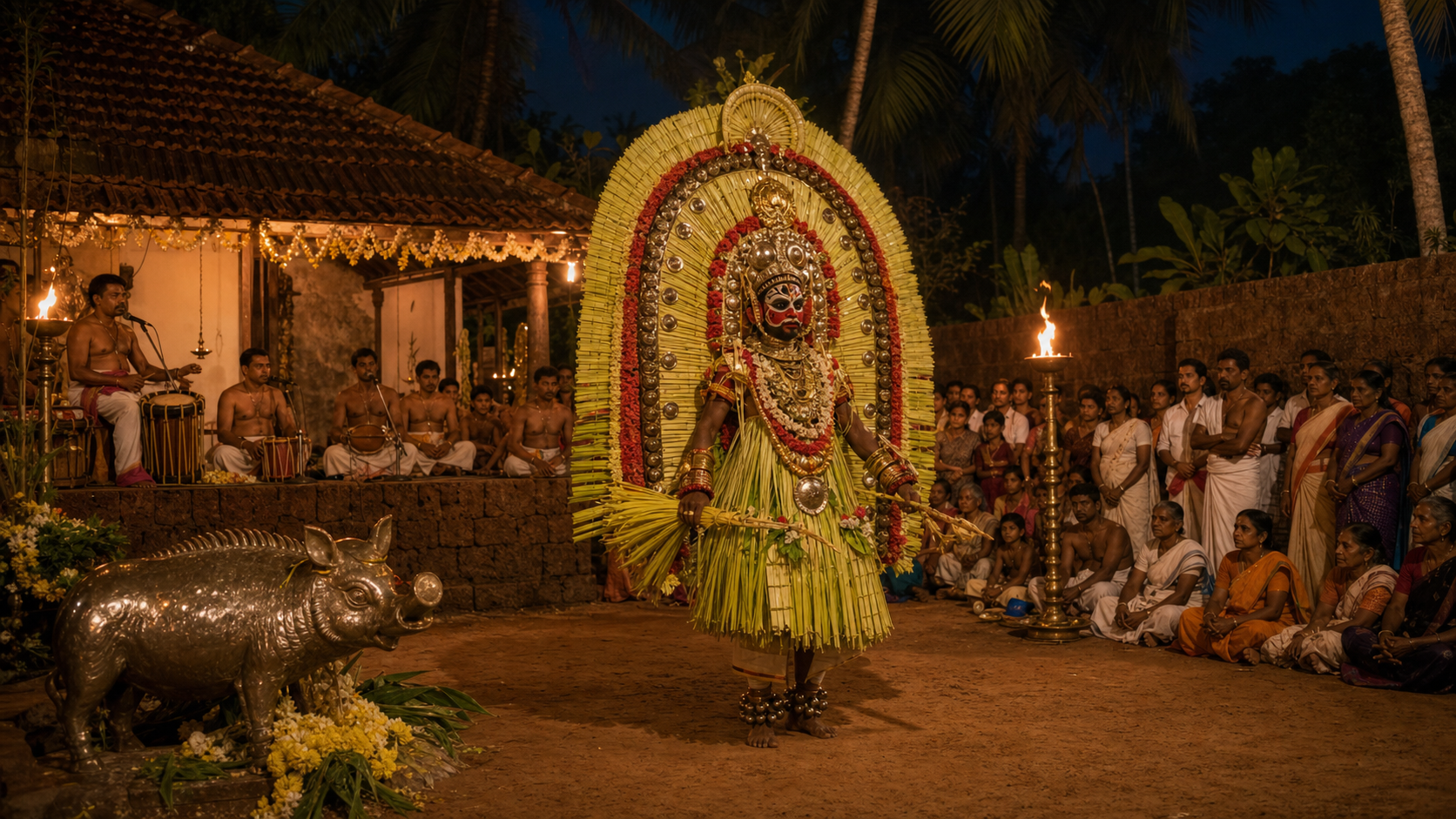
If cinema or a short video introduced you to Panjurli, you may be trying to decide what you actually witnessed. Was it worship, spirit possession, sacred theatre, a village court, or a festival? The most accurate answer is that several of those dimensions meet in one ritual world, but they aren’t interchangeable.
Panjurli is a protective boar daiva revered across the Tulu-speaking belt of Dakshina Kannada, Udupi, and parts of Kasaragod. Bhuta Kola, also called Daiva Kola, is a ceremonial setting in which that guardian becomes present to a community through inherited narrative, music, regalia, trance, blessing, and judgment. If you keep the guardian, the ritual, the performer, and the community distinct, the tradition becomes much easier to understand without reducing it to spectacle.
Key takeaways: five distinctions to keep clear
- Panjurli is the daiva; Bhuta Kola is the ritual encounter. One names the guardian being, while the other names the ceremonial form through which a daiva is invoked and encountered.
- The boar form isn’t a decorative mascot. It places Panjurli at the meeting point of forest and field, wild life and cultivation, danger and protection.
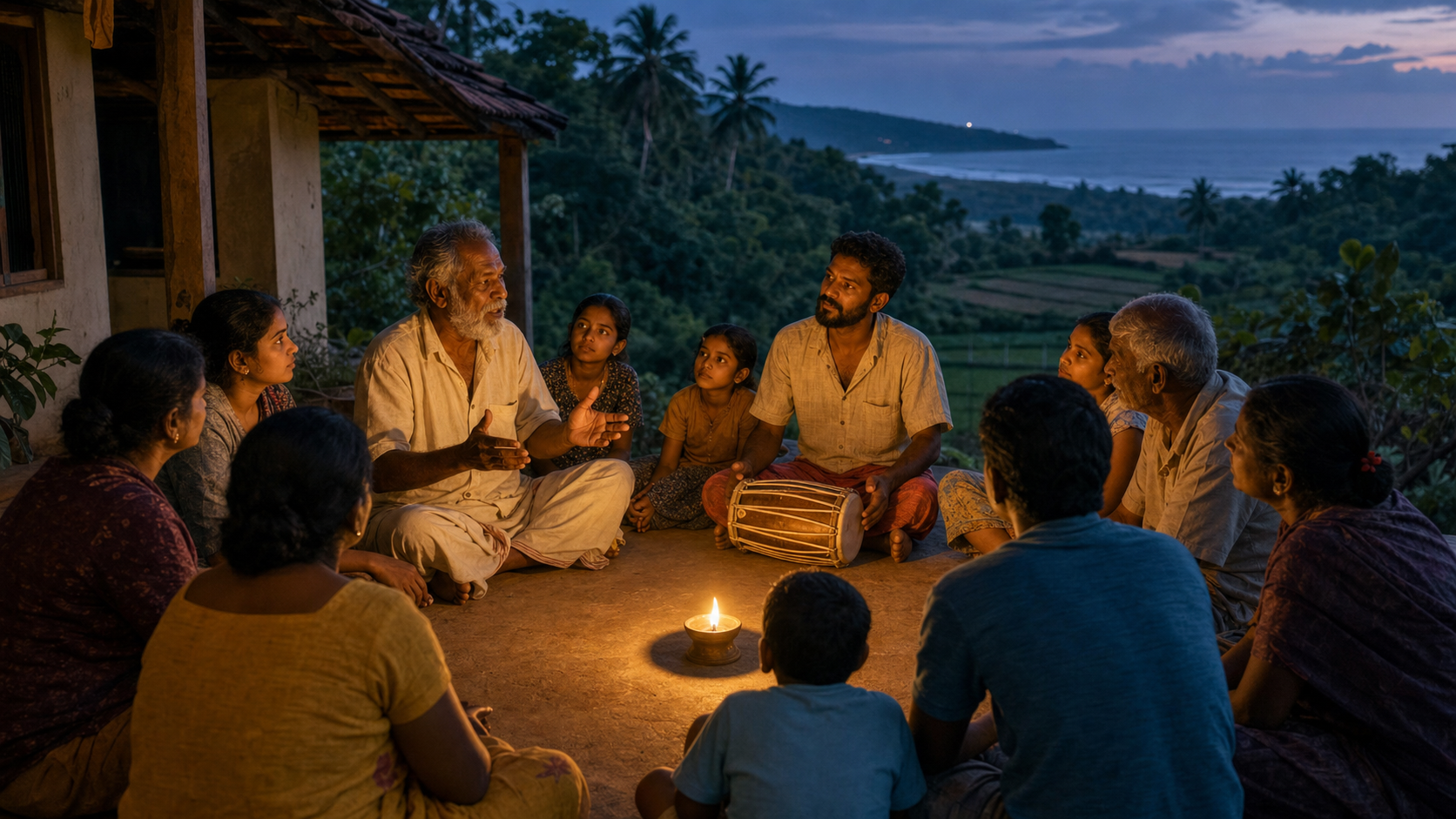
- A paddana isn’t background music. The Tulu oral narrative establishes the daiva’s origin, journeys, covenants, territory, and obligations.
- The ritual performer isn’t merely portraying a character. A trained member of a custodial lineage prepares to serve as the daiva’s medium, and the regalia belongs to that sacred transformation.
- Daiva-neeti isn’t a statutory court judgment. Its force is moral and communal, especially in disputes involving truth, restitution, land, inheritance, and cooperation.
The English word “spirit” can obscure more than it explains. It may suggest a ghost, an evil being, or something cut off from religion. None of those assumptions should be imported automatically. In this setting, daiva is the more useful word: an honored guardian with a recognized seat, inherited relationships, ritual obligations, and authority within a particular community.
The same care applies to the word “performance.” Bhuta Kola unquestionably has accomplished movement, music, costume, and visual drama. Yet its purpose isn’t exhausted by artistic display. For worshippers, the aesthetic form enables a sacred encounter. Calling it only a dance discards the very claim around which the ceremony is organized.
The origin stories ask what protection requires
You may hear more than one account of Panjurli’s beginning. That variation isn’t a defect that needs to be repaired with a single synthetic timeline. Oral sacred narratives carry the memory and obligations of the communities that transmit them, so the right question is often not “Which plot is the official one?” but “What relationship does this telling establish?”
In one well-known pattern, a spirited boar disturbs Parvati’s garden in Kailasa. Destruction isn’t the final answer. Shiva and Parvati instead send the boar into the mortal world with a duty to protect beings and uphold order. The movement from disruption to guardianship matters: unruly force is redirected into responsibility rather than merely annihilated.
Another pattern begins with a royal hunt and a boar that is wronged. Its awakened presence is eventually installed as a village protector. Here the moral movement runs from injury to recognition. A being subjected to violence isn’t erased from memory; the community acknowledges its power and establishes a continuing relationship with it.
The Kailasa descent and wronged-boar traditions converge around compassion and restored balance. Both make the cultivated world answerable to what lies beyond its fences. A field can be protected without treating the forest as an enemy, and social order can be restored without pretending that an injury never happened.
When you listen to a paddana, notice three things. First, identify the original breach: a disturbance, a wrong, or a broken relationship. Second, watch how destructive power is transformed into guardianship. Third, listen for the covenant that follows – who maintains the daiva’s place, what conduct the daiva protects, and which land or lineage enters the relationship. Those questions reveal more than an argument over which variant came first.
How to read the night-long ritual without reducing it to a show
A Panjurli Kola brings several forms of knowledge into the same night. Its meaning isn’t stored in one speech, one object, or one dramatic moment. It emerges through the relationship among paddana, performer, musicians, regalia, shrine, sponsoring community, and oracular encounter.
Begin with the paddana. Sung or recited in Tulu, it carries the daiva’s origin, movements, earlier interventions, agreements, and associations with particular people and places. It works as a ritual charter: it explains why Panjurli has standing here, why a family or hamlet owes particular duties, and what rightful conduct looks like. If you hear only melody, you miss the ceremony’s archive of memory, ecology, and ethics.
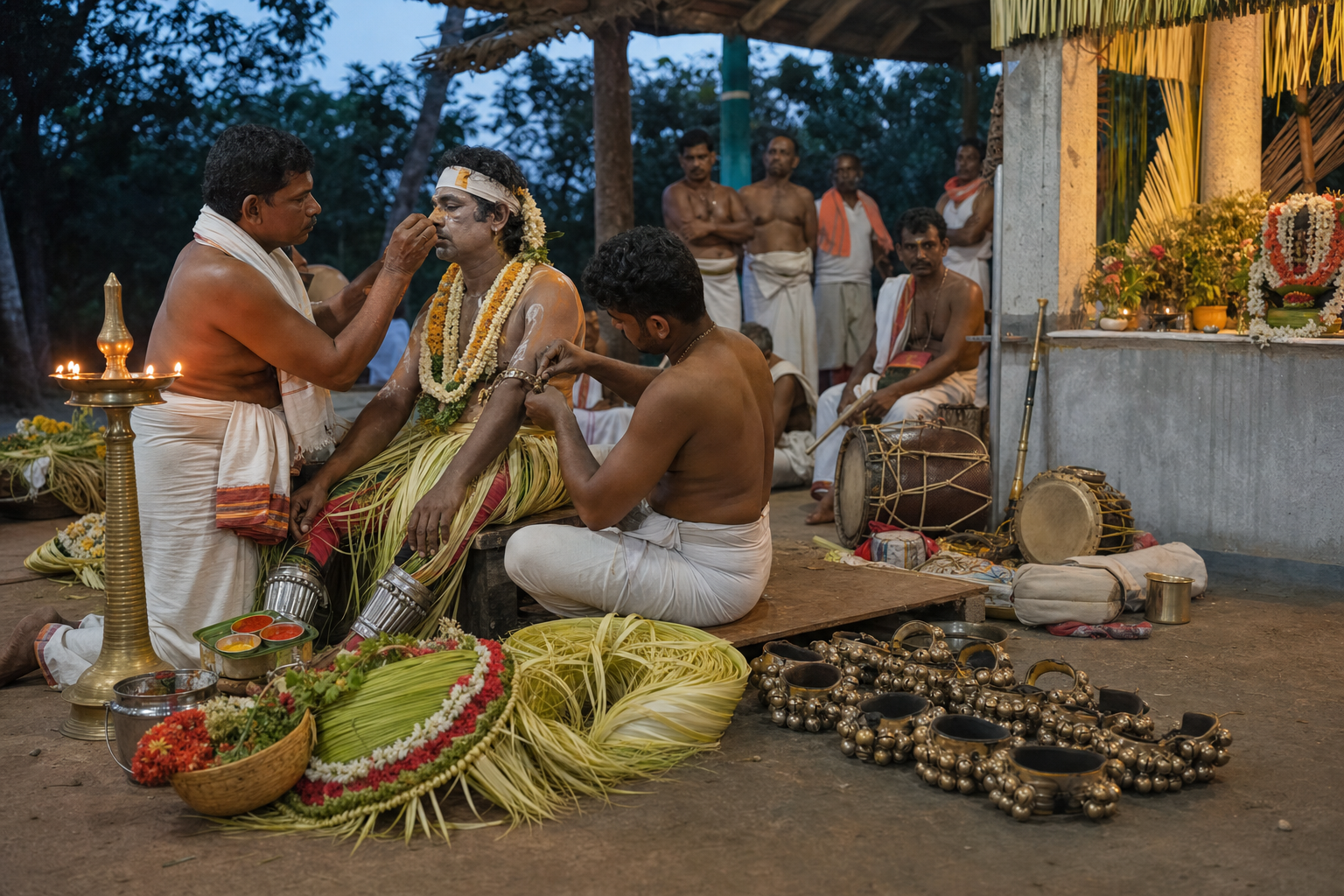
Then notice who bears the ritual role. Performers from Parava, Nalike, and Pambada lineages undertake disciplined preparation before assuming the Panjurli alankara. Lineage isn’t an incidental biographical detail. It locates ritual knowledge, technique, responsibility, and continuity in communities that have preserved them. Admiring the visible ceremony while ignoring its custodians reverses the proper order of attention.
The regalia also communicates before any oracle speaks. A boar-like visage and stylized tusks identify Panjurli. Layered cloth, metal ornaments, ankle and waist bells, mirrors, and protective blades build a visual language around the performer. The bells make footwork audible; the weapons signal guardianship; the full alankara marks a passage from an ordinary social presence to the visible seat of the daiva. It should be read as ritual equipment, not costume available for detached imitation.
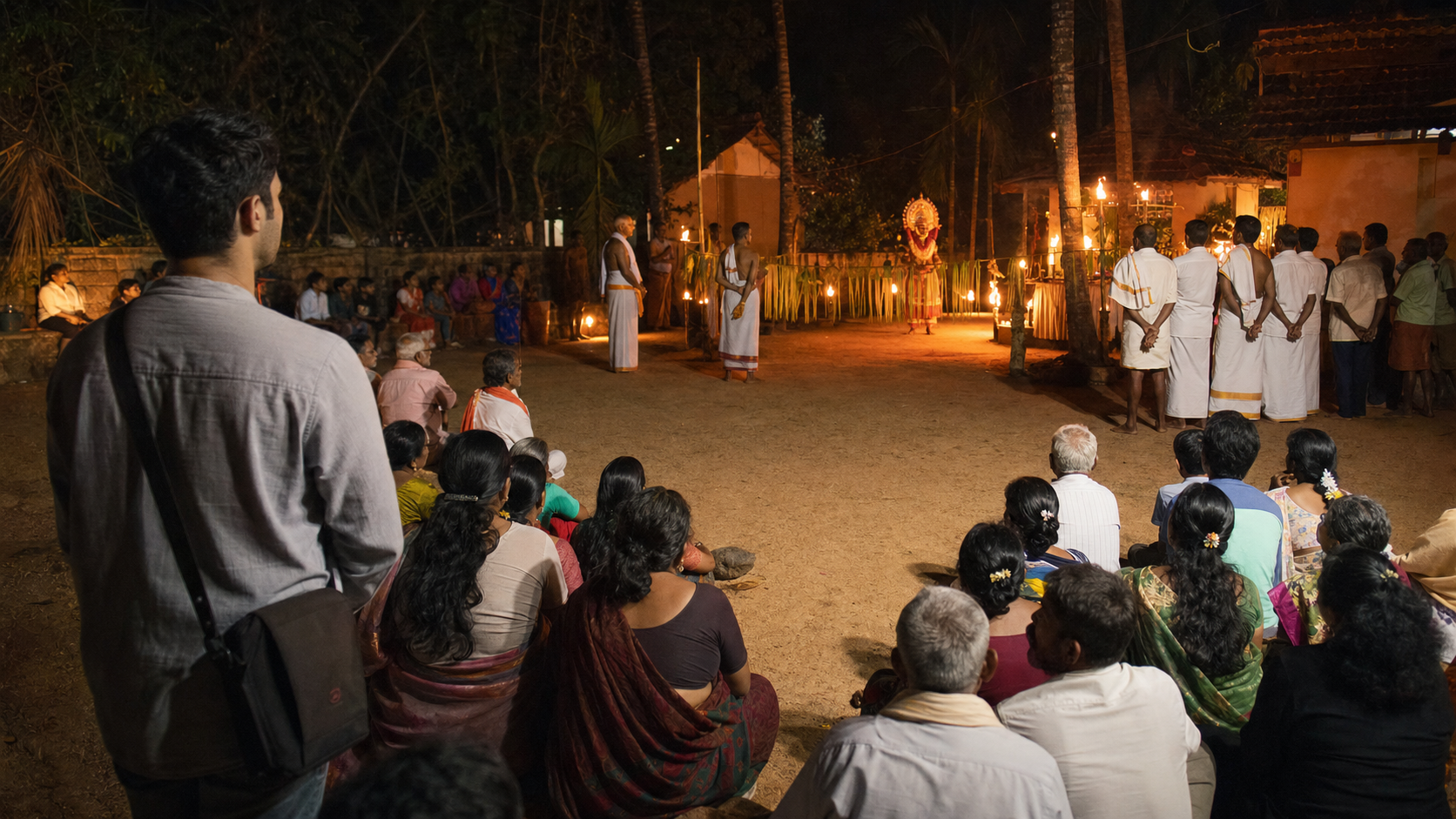
Drums, wind instruments, repeated movement, oil-torch light, and sustained attention create the ceremonial environment in which trance occurs. The crucial change is relational: the assembled community no longer addresses the performer as though watching an actor. The daiva is approached, heard, and answered. Blessings may be given, conduct questioned, grievances heard, and disputes considered.
This is why recording the most visually striking minute rarely communicates the whole event. A clip can preserve a leap, a flame, or an imposing headpiece, yet omit the paddana that established identity, the obligations surrounding the shrine, and the quiet in which a petitioner is heard. When you encounter an isolated image, ask what came before the frame and what communal exchange followed it.
Land, lineage, and justice form one covenant
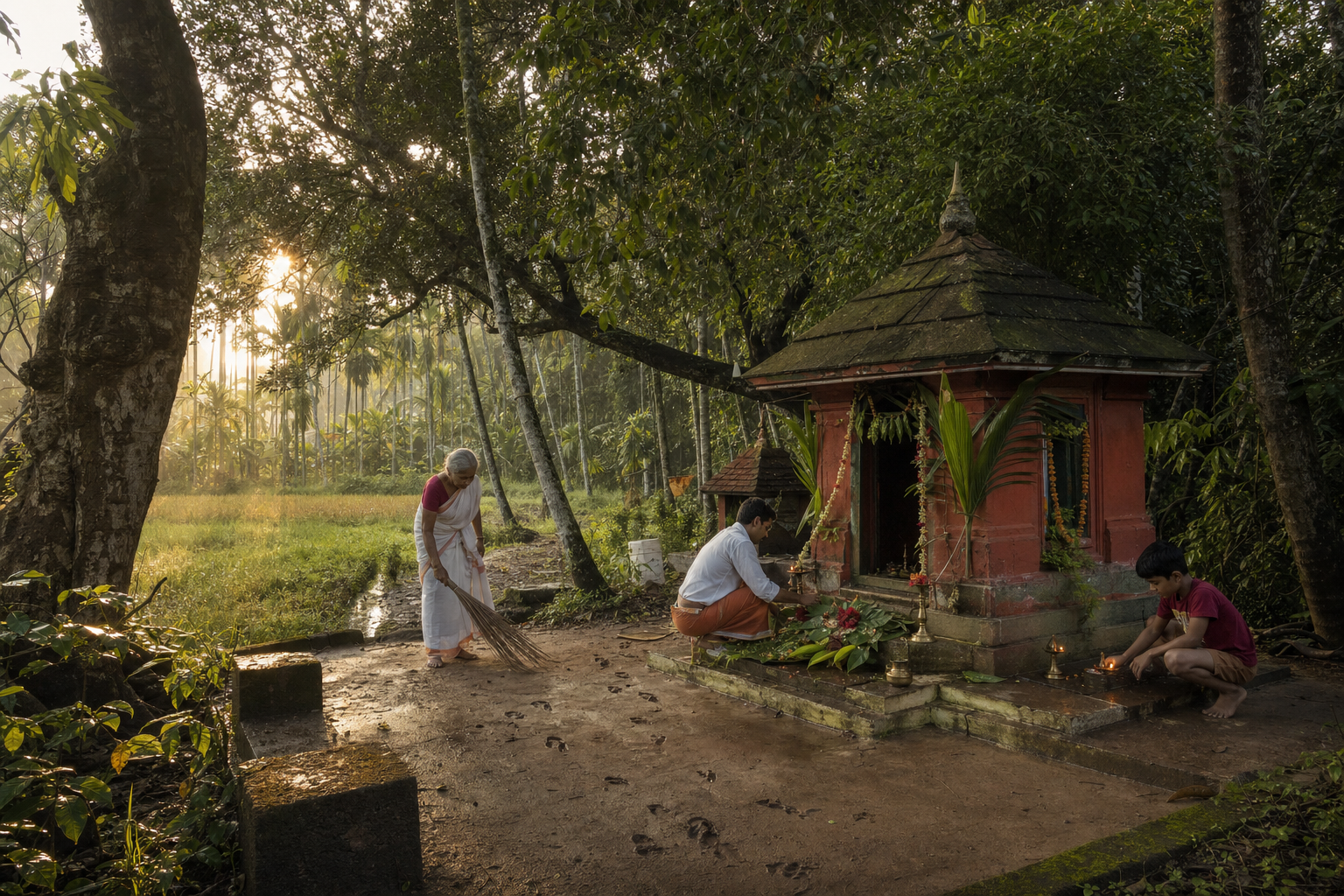
Panjurli’s guardianship becomes concrete in the geography of Tulunadu. The daiva is associated with fields, forest margins, water, village boundaries, households, and sacred places. Panjurli may be seated in a moola-sthana, often connected with a sacred grove, or honored in a community daivasthana. Numerous families also revere Panjurli through lineage ties and accept duties toward the shrine and its rites.
Those duties make devotion reciprocal rather than merely petitionary. A family or community sponsors the kola, maintains the sacred precinct, remembers the paddana, and passes ritual obligations onward. Panjurli, in turn, guards the people and territory bound to that relationship. The question isn’t only “What will the daiva give us?” It is also “What must we preserve so this covenant remains intact?”
The agricultural calendar reinforces the point. Kola observances cluster around moments such as post-sowing, the approach of harvest, and the period after the monsoon. Paddy, arecanut, coconut, soil fertility, water sources, and household well-being belong to the same moral landscape. Thanksgiving and vows acknowledge that cultivation depends on conditions no household creates by itself.
The boar guardian is therefore not a contradiction at the edge of cultivated land. Panjurli embodies the difficult boundary itself. Agriculture needs protection, but protection doesn’t require declaring everything wild to be outside dharma. The guardian restrains disorder while reminding cultivators that the living landscape can’t be reduced to private possession.
That understanding of territory leads directly to justice. During kola, the daiva may hear disputes, demand truthful speech, receive oaths, and issue daiva-neeti. Such rulings can address land, inheritance, and failures of cooperation, with an emphasis on restraint and restitution rather than coercive punishment. They aren’t decrees of the statutory legal system, but their moral authority can help a community settle tensions because the parties stand before a guardian whose legitimacy they share.
If you witness such a proceeding, don’t treat it as improvised entertainment or as an invitation to assess strangers’ private affairs. Watch the ethical mechanism instead: attention is given, conduct is named, truth is demanded, and a damaged relationship is directed toward repair. The sacred and civic dimensions aren’t separated as neatly as a modern institutional vocabulary might expect.
Comparison should illuminate Panjurli, not replace Panjurli
The wider Dharmic world offers useful points of recognition. The protective boar may recall Varaha rescuing Bhudevi. Varahi presents fierce maternal protection, while Vajra Varahi carries liberative power in Vajrayana Buddhism. Shaiva traditions honor ganas and bhairavas as guardians of place, and Jain sacred worlds include protective yakshas and yakshinis.
These are family resemblances, not permission to collapse distinct traditions into one identity. Panjurli belongs to a specifically Tulu network of paddanas, shrines, custodial lineages, agricultural relationships, and local covenants. Saying “Panjurli is simply Varaha” may feel like inclusion, but it erases precisely what the comparison should help you appreciate: Dharmic civilization can sustain shared patterns without requiring every local form to lose its own name and history.
How to attend a Panjurli Kola with informed respect
Ask the host before making plans
Find out who is conducting the kola – a daivasthana, village body, or sponsoring family – and ask whether visitors are welcome. Confirm where you should sit or stand, whether an offering is appropriate, and whether photography or video is permitted. Local instruction outranks assumptions formed from a film, tourism page, or another shrine’s practice.
Follow the boundaries of the ritual space
Sacred groves, shrine areas, preparation spaces, and the performer’s path may not all be open to spectators. Stay where the organizers place you. Don’t touch the regalia, weapons, ornaments, shrine objects, or offerings, and don’t obstruct the performer or musicians to obtain a better image. A clear camera angle isn’t worth crossing a boundary whose meaning you don’t know.
Put the phone away when the daiva listens
The quiet exchange between the daiva and a petitioner may carry more religious weight than the most dramatic movement of the night. Don’t use flash, push a camera toward someone’s face, or record a family dispute without explicit permission. If the daiva addresses you, follow the cues of the custodians and answer without turning the moment into a performance for others.
Describe only what you can identify
Not every elaborately dressed ritual performer represents Panjurli, and not every daiva has the same paddana, iconography, temperament, or relationship to a community. If you share an image, confirm the daiva’s name and the place with the host. Preserve that context in the caption rather than using a generic label such as “Indian folk dance” or identifying every daiva through a cinematic reference.
Keep dramatization separate from liturgy
Popular cinema has made Daiva Kola visible far beyond Tulunadu, and that visibility can lead people toward serious learning. It doesn’t make a film scene a ritual manual. Don’t imitate possession, wear copied alankara for casual content, or assume that visual resemblance grants ritual authority. The tradition remains in the hands of the communities that maintain its shrines, paddanas, lineages, and obligations.
If you plan to attend, your next step is simple: contact the local host, learn which daiva is being honored, and ask what visitors need to know. Once there, watch beyond the fire and regalia. Notice who remembers the narrative, who maintains the sacred place, what wrong is being repaired, and what promise binds people to land. That is where Panjurli’s guardianship becomes intelligible as lived dharma.