
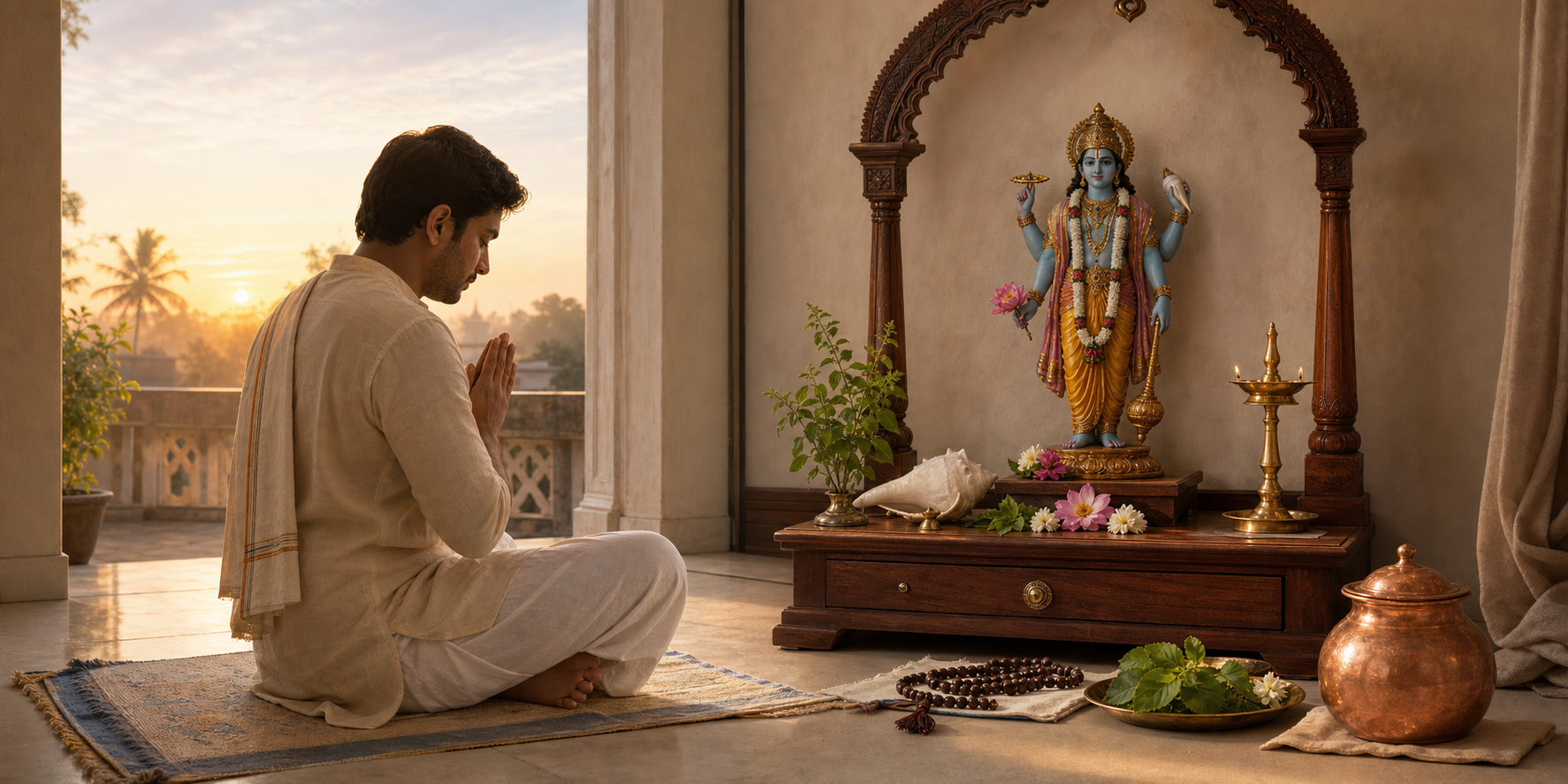
If you are planning Bhim Ekadashi around work, family duties and the heat of Jyeshtha, make one decision before anything else: will you undertake the full waterless vow, or a modified observance that your body can safely sustain? The calendar matters, but that choice determines how you should prepare.
In India, Nirjala Ekadashi falls on Thursday, June 25, 2026. It is also known as Bhim Ekadashi, Bhimseni Ekadashi, Bhimsen Ekadashi and Pandava Ekadashi. A strict nirjala vrata means neither food nor water from the beginning of the Ekadashi fast until the permitted Parana on Dwadashi. It is a demanding act of Vishnu-bhakti, not a test you must pass at the cost of your health.
Fix the date by your sunrise, not by an Indian clock
For most devotees in India, the observance date is Thursday, June 25, 2026, during Jyeshtha Shukla Ekadashi. Parana follows on Friday, June 26, after sunrise and within the locally prescribed Dwadashi window.
A tithi is a lunar phase determined by the changing angular relationship of the Sun and Moon. It does not begin and end at civil midnight. Ekadashi is the eleventh tithi, with each tithi covering approximately 12 degrees of solar-lunar separation. That is why a date or Parana time calculated for Delhi, Mumbai or Varanasi cannot simply be copied by someone living in Toronto, London, Singapore or Sydney.
The practical rule is straightforward: use a Panchang calculated for the city where you will actually observe the vrata. Confirm three items before putting the date in your calendar:
- Whether Ekadashi prevails at your local sunrise.
- Whether your Smarta or Vaishnava calendar assigns the observance to a different civil day because of tithi overlap or viddha rules.
- The local Dwadashi Parana period, including when Hari Vasara ends.
Hari Vasara is the first quarter of Dwadashi. The fast is ordinarily broken after this segment has passed, not immediately when the clock crosses midnight and not automatically at sunrise. If Dwadashi is unusually short, the available interval can become narrow; a dependable local Panchang or your sampradaya’s temple calendar should settle the timing.
Smarta and Vaishnava observance dates can occasionally differ because their rules for avoiding an unsuitable tithi overlap are not identical. Most Indian calendars converge on June 25 in 2026, but consistency with your own lineage is more useful than switching between calendars to obtain a preferred date or a longer Parana window.
Choose a vow your body can keep without harm
Nirjala literally identifies the defining austerity: no water. That makes this vrata categorically more severe than an ordinary fruit-based or grain-free Ekadashi. A healthy adult considering it should be able to remain in a cool environment, avoid strenuous work and respond immediately if signs of physical distress appear. If you are unsure whether fluid deprivation is safe for you, seek medical advice before making the sankalpa.
Children, elderly people, pregnant or nursing individuals, and people with diabetes, kidney disease, cardiovascular concerns or another medically significant condition should not attempt a strict waterless fast. Anyone whose clinician has advised regular fluids, food or timed medication should follow that advice. A vrata does not override necessary care.
A modified observance can include fruit, milk, light sattvic food or adequate water, depending on your needs. You can pair that restraint with additional japa, scripture reading, dana and seva. This preserves the direction of the day—self-mastery, remembrance and compassion—even when the full physical austerity is inappropriate.
Do not decide in advance that you will ignore warning signs for the sake of completing the vow. Dizziness, palpitations and unusual or excessive fatigue are reasons to end the fast safely. Drink water and obtain medical help if symptoms are severe, worsen or do not settle. Breaking a fast because your body is in distress is not a defeat of dharma; refusing necessary care turns a discipline intended for purification into preventable harm.
Your honest sankalpa matters here. Do not publicly promise a nirjala vrata if health, outdoor work or caregiving responsibilities make it unrealistic. State the form you can actually keep: strict nirjala if it is safe, or a clearly defined phalahara or hydrated vrata if it is not. Steadiness is more meaningful than an ambitious declaration followed by secrecy, guilt or injury.
A practical Dashami-to-Dwadashi observance plan

The easiest way to avoid confusion on Ekadashi morning is to settle your food, schedule, worship materials, charity and Parana time on Dashami. Use this sequence as a household plan, adapting the devotional details to your family tradition.
- Prepare on Dashami, Wednesday, June 24 in India. Eat simple sattvic food and avoid turning the day before a fast into a feast. Many devotees take one light meal, ideally before sunset, and reduce stimulants. Confirm your local Ekadashi and Parana timings, clear unnecessary physical work from the next day, and decide whether your vow will be nirjala or modified.
- Begin Ekadashi with cleanliness and a precise sankalpa. Bathe, wear clean clothing and sit before Vishnu or one of his avatar forms. Your sankalpa can plainly name the tithi, the form of fast you are undertaking and your intention to direct it toward Vishnu-bhakti, self-restraint and the welfare of beings. It does not need to become an elaborate performance.
- Offer a simple Vishnu puja. Light a lamp and offer flowers, Tulsi leaves, incense and a sattvic naivedya according to your custom. If you are keeping nirjala, the offered food is not consumed during the fast. Simplicity helps: a small puja performed attentively is preferable to a complicated arrangement that leaves no time for remembrance.
- Give the day a devotional structure. Recite Vishnu Sahasranama, chant “Om Namo Narayanaya,” read a portion of the Bhagavad Gita, join kirtan or keep periods of quiet japa. Choose a realistic count or block of time before the day begins. Otherwise hunger and thirst can occupy every empty hour while the spiritual purpose is gradually displaced.
- Reduce heat and exertion. Stay in shade or a cool indoor setting, avoid unnecessary travel and do not schedule strenuous exercise or outdoor labor. Nirjala Ekadashi is not the day to prove that you can maintain an ordinary high-output routine without water. Quiet work, prayer, reading and gentle household duties better support the vrata.
- Join austerity to dana. Arrange jal-daan, contribute an earthen water pot, support a drinking-water service, or give food, clothing, a fan or an umbrella where it will genuinely relieve summer hardship. If you plan a public water service, organize its supplies and volunteers before Ekadashi so your own fast does not make you responsible for strenuous work in the heat.
- Treat a night vigil as optional discipline. Some devotees extend japa, kirtan or reading into the night. A partial or full vigil can deepen the observance when your health and circumstances allow it, but lack of sleep should not be added merely to make an already severe fast appear more impressive.
- Perform Parana on Dwadashi. On Friday, June 26 in India, wait for the valid local period after sunrise and after Hari Vasara. Complete a brief remembrance of Vishnu, then end the waterless vow by sipping water. Honor Tulsi according to your custom and follow with a small, easily digestible sattvic meal rather than a heavy feast. Ann-daan after Parana can extend the vrata’s discipline into nourishment for others.
If family members are observing at different levels, say so openly. One person may keep nirjala, another may take water, and a child may participate through puja, japa and service without fasting. A household does not become spiritually divided because its members have different physical capacities. Shared worship and honest restraint are a sounder basis for unity than forcing everyone into the same austerity.
Bhima’s vrata is about concentrated sincerity, not spiritual arithmetic
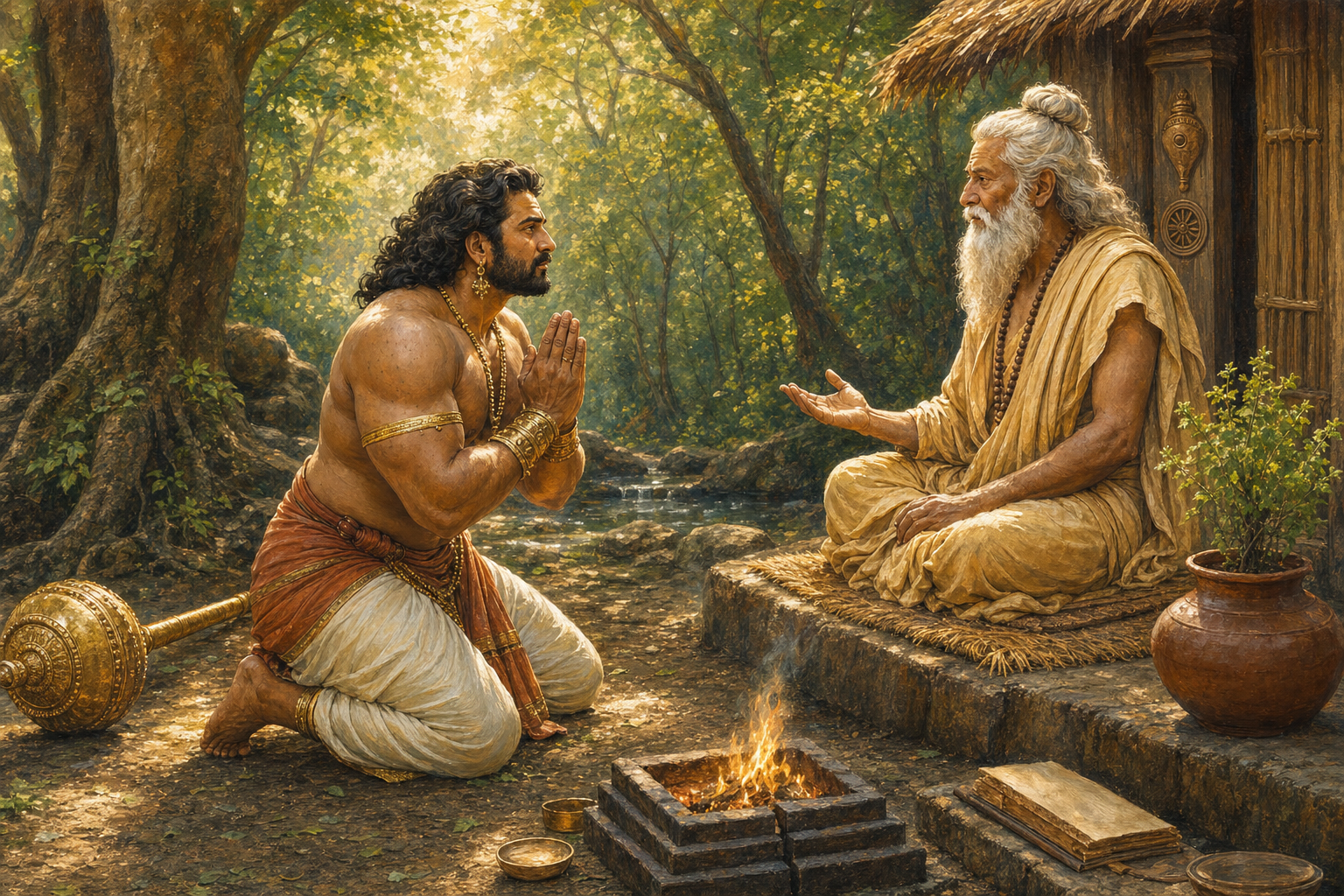
The traditional katha explains the names Bhim, Bhimseni and Pandava Ekadashi. Bhima possessed extraordinary physical strength and a formidable appetite, yet he found it difficult to maintain every Ekadashi fast through the year. He was therefore directed toward one uncompromising observance on Jyeshtha Shukla Ekadashi: a fast without food or water, kept with unwavering devotion to Vishnu.
The Brahma Vaivarta Purana is associated with the promise that sincere observance of this vrata brings the spiritual fruit attributed to all the Ekadashis of the year. This is a devotional statement about vrata-phala, not a measurable transaction in which one difficult day purchases permission to neglect dharma for the rest of the year. Bhima’s difficulty was answered with concentrated discipline, not with an effortless loophole.
That distinction changes how you keep the day. If the fast consists only of waiting irritably for Parana, the stomach may remain empty while the habits the vrata is meant to refine remain untouched. Upavasa is traditionally understood as drawing near to the Divine. Hunger and thirst become reminders to return to nama-japa, gratitude and restraint in speech. The bodily rule supports that inward movement; it is not the whole movement.
Nirjala also places water at the center of moral attention. The devotee voluntarily encounters thirst for a limited period, while many people face heat and scarcity without choosing either. Jal-daan turns that awareness into relief for another person. A waterless fast accompanied by wasteful water use or indifference to someone else’s thirst misses one of the day’s clearest ethical opportunities.
This movement from restraint to compassion is recognizably Dharmic beyond one ritual form. Buddhist Uposatha emphasizes precepts, meditation and simplicity; Jain poshadha joins austerity to ahimsa and purification; Sikh simran and seva place disciplined remembrance in the service of others, while the chabeel tradition offers cooling water during the summer. These practices are not interchangeable, but they show a shared moral pattern: self-mastery should make us more attentive to living beings, not more proud of ourselves.
Key takeaways for Nirjala Ekadashi 2026
- In India, observe Bhim or Nirjala Ekadashi on Thursday, June 25, 2026.
- If you live outside India, verify the date and Parana interval with a Panchang calculated for your location; Indian clock times are not portable across time zones.
- A strict nirjala vow excludes both food and water. Phalahara or a hydrated sattvic observance is the appropriate alternative when a waterless fast would be unsafe.
- Children, elderly people, pregnant or nursing individuals, and people with diabetes, kidney disease, cardiovascular concerns or conflicting medical instructions should not undertake nirjala fasting.
- Prepare on Dashami, keep Vishnu puja and japa central on Ekadashi, and arrange jal-daan or another concrete form of seva.
- Break the fast on Dwadashi after sunrise, after Hari Vasara and within your local Parana window. Begin with water and then take light sattvic food.
Mark June 25 now, but do not stop at marking the date. Find the correct Panchang for your location, record the June 26 Parana window, choose a medically responsible form of the vow, and arrange one act of water or food charity before Dashami. Those four decisions will let you enter the day with clarity instead of improvising under physical strain.
References
- DharmaRenaissance Blog — Bhim Ekadashi 2026 (Nirjala): Powerful Pandava Vrat, Date, Puja Vidhi, Parana & Significance
- DharmaRenaissance Blog — Nirjala Ekadashi 2026: Ultimate Waterless Fast—Date, Vrat Vidhi, Katha, Parana Rules