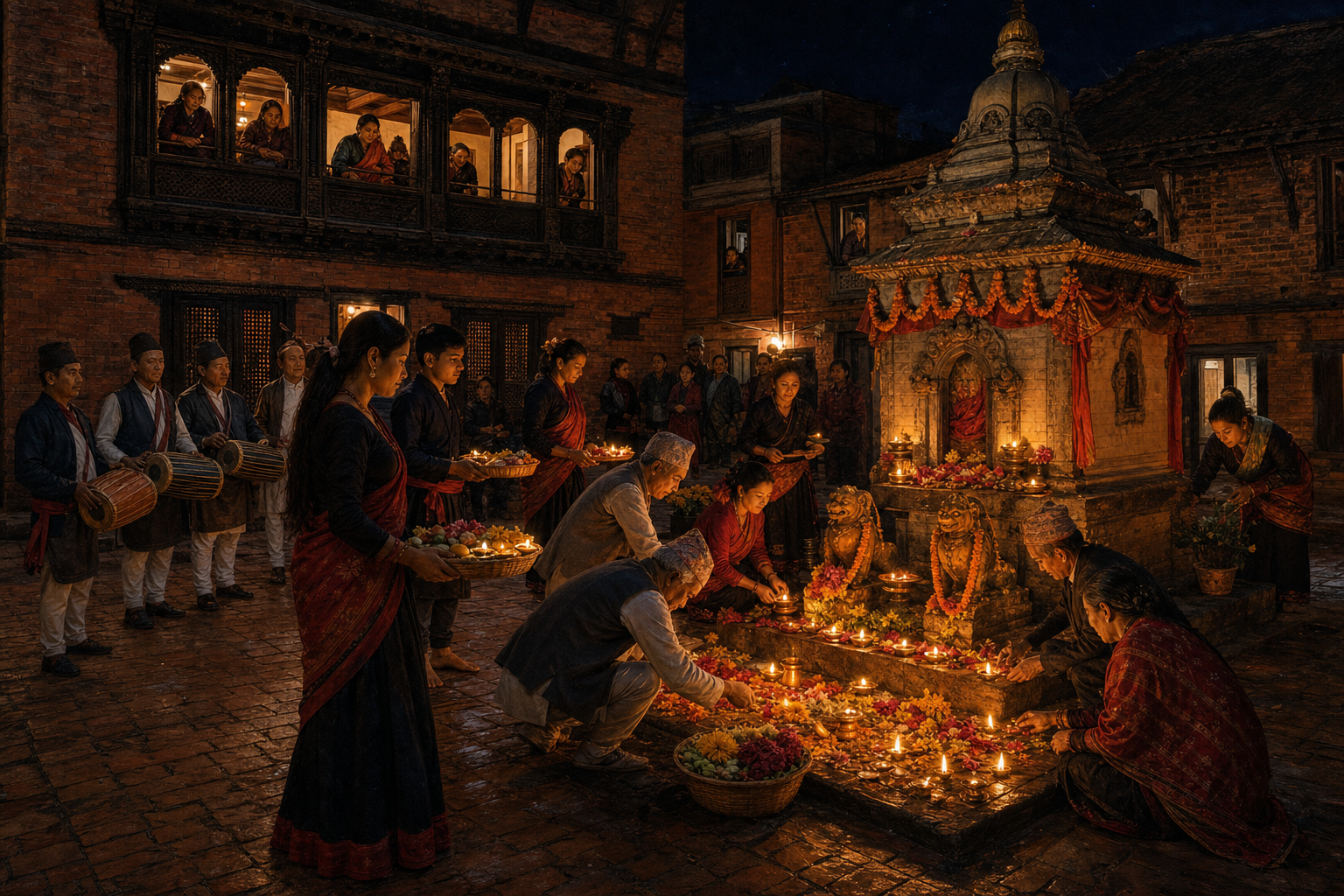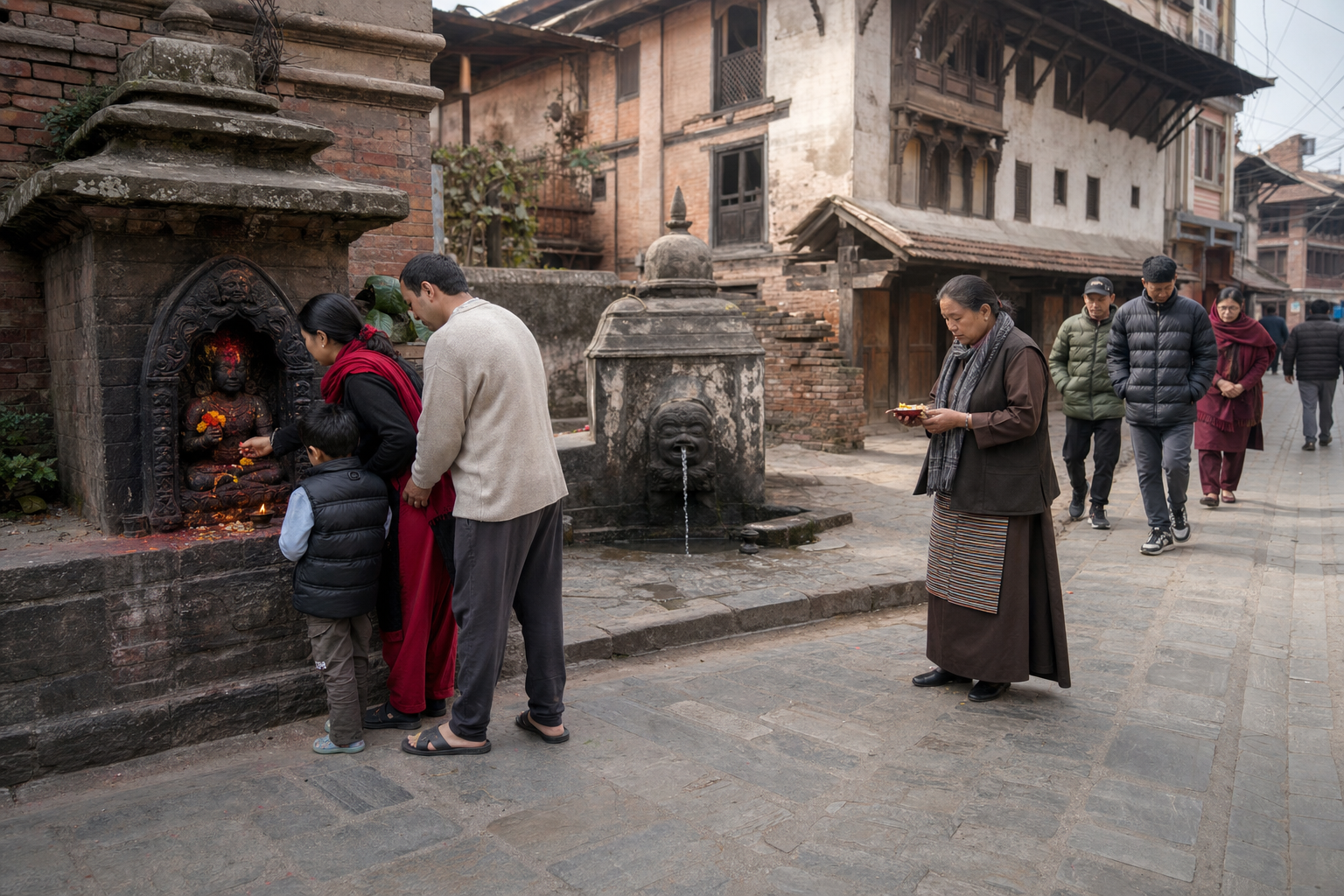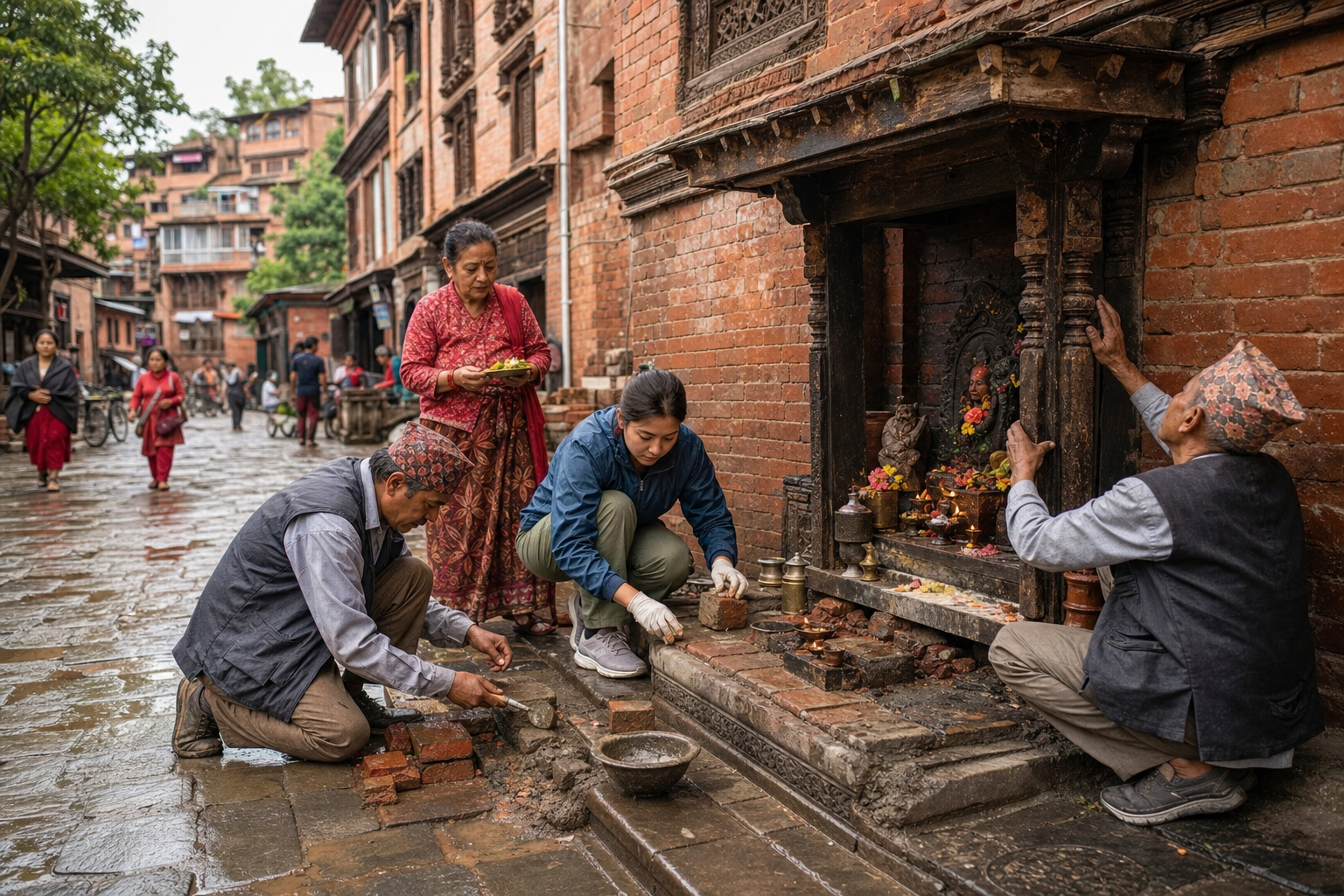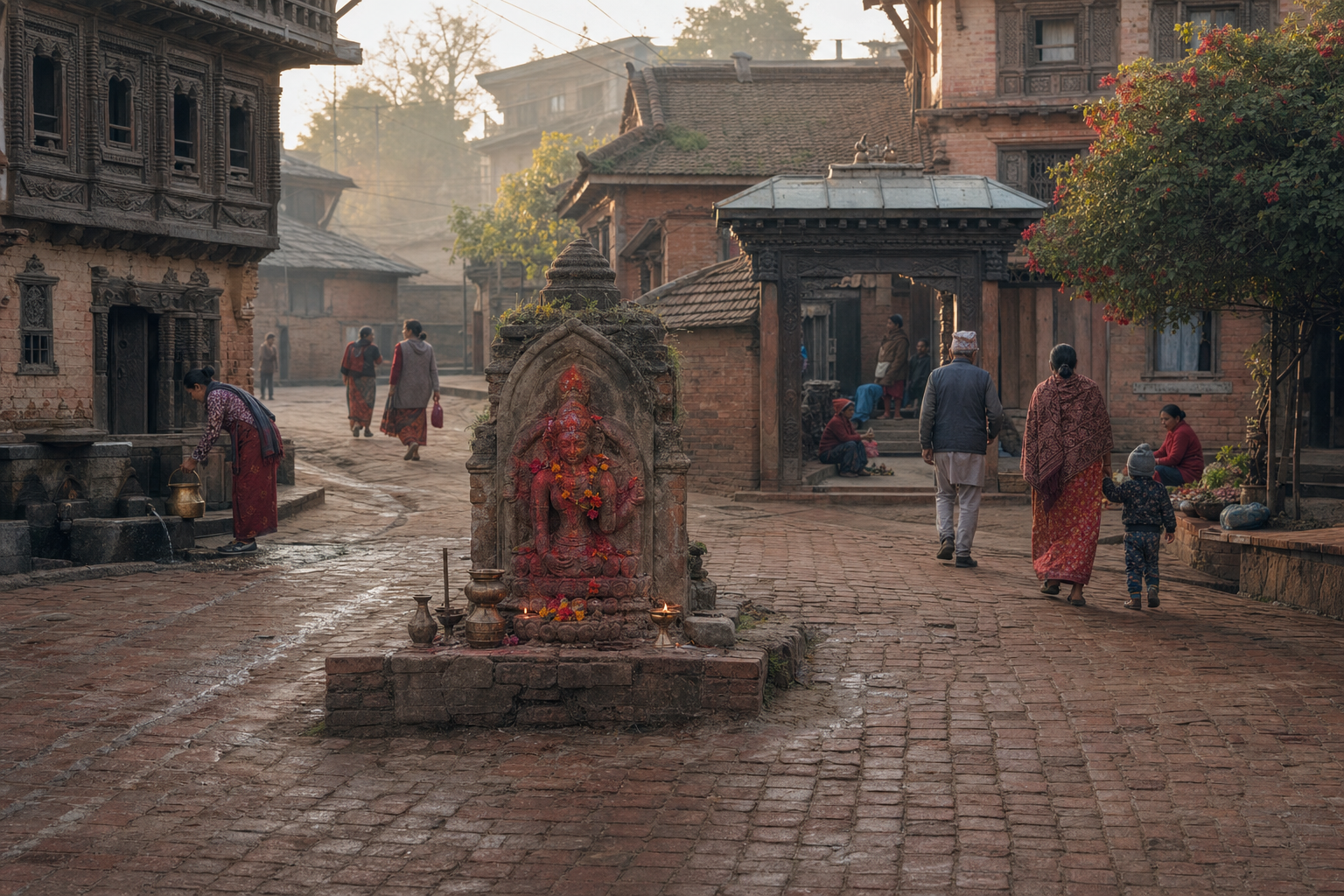
In the Kathmandu Valley, Ajima Dhyo is best understood not as a single monument or goddess image, but as a living system of maternal protection. Shrines, household observances, masked performance, lineage memory and neighborhood institutions work together to place sacred guardianship inside everyday Newar life.
This synthesis explains how those elements reinforce one another and why the tradition cannot be reduced to either temple worship or abstract Tantric theology. Because the supplied material contains one DharmaRenaissance article, named sites and specific practices below are attributed to that account rather than presented as independently corroborated reporting.
Key takeaways
- Ajima means grandmother and Dyo or Dyaḥ means deity, expressing a guardian relationship that is familial as well as sacred.
- Ajima shrines reportedly help organize the Valley as a protective landscape, especially at gates, crossroads, water sources, courtyards and settlement boundaries.
- Protection operates at several connected levels: the household and lineage, the neighborhood, and the wider city or pilgrimage circuit.
- Hindu Shakta and Newar Buddhist Tantric communities can share sacred spaces and civic rhythms without treating their theological identities as interchangeable.
- Guthis, ritual specialists, performers and household participants sustain the tradition while communities negotiate ethical reform and urban change.
A guardian relationship rather than a single goddess type
The kinship language in Ajima Dhyo provides the clearest entry into the tradition. The source translates Ajima as grandmother and Dyo as deity. Grandmotherhood evokes proximity, inherited memory and care, yet these goddesses are not portrayed as merely gentle. Their protection can require fierce boundary-keeping, the defeat of dangers and the restoration of order.
The source associates many Ajimas with the Aṣṭamātṛkā, or Eight Mothers, and with forms of the Navadurga. That connection places local guardians within broader Shakta cosmologies, but it does not erase their Newar identities. Local names, particular shrines, neighborhood obligations and inherited ritual roles remain decisive. Ajima Dhyo is therefore a class of related guardian presences rather than a claim that every local goddess is identical.
The reported material forms reinforce this range. An Ajima may be present through a stone covered with red sindūr or through a developed metal or stone icon housed in a dyo-chhen. Some images communicate a benign mood, while others bear swords, tridents, skull-cups or distinctive features such as Vārāhī’s boar face. Within the source’s interpretation, these attributes signify powers such as cutting delusion, confronting impurity and defending thresholds.
This variation matters because it shifts attention away from judging a shrine by visual grandeur. An aniconic roadside stone can carry intense local significance, while an elaborate icon may participate in a larger civic or pilgrimage network. Presence is established through place, repeated worship and communal recognition as much as through representational form.
Sacred geography turns protection into civic structure
The source presents the Valley as a protective mandala whose sacred nodes coincide with vulnerable or transitional spaces. Ajima shrines are reported at gates, perimeters, crossroads and water sources: places where people, resources and possible dangers pass between domains. Protection is thus spatially organized rather than confined inside a central sanctuary.
Three scales can be distinguished within that account. At the intimate scale, household and lineage observances connect divine guardianship with fertility, health and life-cycle transitions. The article places Digu dya altars, often located near agricultural margins or neighborhood thresholds, in this familial register and notes offerings connected with occasions such as naming, first-feeding and marriage. This should not be read as making every Digu dya simply another name for Ajima; the source instead shows how lineage and maternal-guardian traditions can occupy a connected field of obligation.
At neighborhood scale, courtyard deities and local god-houses anchor shared memory. The frequent association of Ajima with Bhairava and Gaṇeśa creates what the source describes as a protective grammar: fierce guardianship, boundary enforcement and the removal of obstacles work in concert. Responsibility for a shrine can consequently bind households through schedules, offerings, maintenance and festival duties.
At the wider civic scale, major sites connect local devotion to regional Shakta geography. The article identifies Guhyeśvarī beside Paśupatināth as a Śakti Pīṭha, Bhadrakālī in central Kathmandu as Lumarhi Ajima in local usage, and Dakṣiṇkālī south of the city as another fierce protective center. It also describes pilgrimage patterns joining prominent temples with neighborhood Ajimas and Mātṛkā pīṭhas. The resulting map is not simply a collection of destinations; it links domestic belonging, urban boundaries and translocal sacred power.
Ritual authority crosses communities without dissolving differences
The source characterizes Ajima worship as Tantric in method and communal in organization. It reports the use of mantra, mudrā and nyāsa alongside offerings such as lamps, flowers, rice and incense. Consecrated liquor appears in some Shakta settings, while substitution is also reported where households or guthis respond to present-day ethical or legal concerns. These details show that Tantric identity rests not on one sensationalized substance but on a larger discipline of consecration, embodiment and relationship to sacred power.
Ritual labor is also distributed. According to the article, Rajopādhyāya Brahmins officiate at important Shakta sites including Guhyeśvarī, while Newar Buddhist Vajrācāryas serve Vajrayāna goddess temples and may participate in some shared civic rites. This is better described as coordinated plurality than as a merger. Communities can participate in overlapping sacred geography while retaining different initiatory lineages, interpretations and ritual responsibilities.
The article’s Buddhist examples clarify that distinction. Hariti Ajima at Swayambhū and the Vajrayoginī temples associated with Sankhu and the Pharping area share a vocabulary of maternal guardianship and Tantric practice with Hindu Shakta settings. Newar Buddhist participation in civic and familial rhythms does not, on the source’s account, turn Hariti, Vajrayoginī and every Hindu Ajima into interchangeable figures. The important connection lies in a shared culture of protection expressed through distinct religious frames.
This arrangement helps explain the tradition’s resilience. No single institution must carry every function. Priests preserve specialized rites, households maintain recurrent devotion, neighborhoods coordinate collective obligations, and different religious communities meet through selected civic practices. Continuity emerges from this network rather than from uniformity.
Performance, guthi stewardship and ethical adaptation sustain continuity
Festivals make the guardian network visible in time as well as space. The source describes Mohani, the Newar observance of Navarātri within Daśain, as a period of progressive goddess veneration involving households and guilds. Khadga-pūjā, the consecration of the sword, and bali offerings place protective power within a disciplined ritual calendar rather than treating fierceness as uncontrolled violence.
In Bhaktapur, the reported Navadurga masked troupe carries this principle into movement. Dance, theatre, music and itinerant blessing allow the goddess to circulate through the community. Sacred presence is therefore not limited to a fixed image: trained bodies, masks and inherited dramaturgy temporarily become vehicles through which protection enters the civic calendar.
Guthis provide much of the institutional continuity described by the source. Their responsibilities can include endowments, lamps, music, offerings, repairs, calendrical knowledge, costumes and the transmission of ritual roles. Women are reported as especially important in daily offerings and festival preparation. Together, these forms of participation show that heritage survives through recurring work, not merely through admiration for old objects.
Adaptation is part of that work. The article reports that some communities use symbolic, vegetarian or fruit substitutes for bali, including gourds and coconuts, and frames these choices as efforts to retain ritual meaning while giving greater weight to non-violence. Such changes should not automatically be described as either abandonment or timeless custom. They are negotiations over which elements carry a rite’s essential purpose and which means can be revised.
Urbanization presents a parallel test. Small roadside shrines and courtyards must coexist with traffic, tourism, construction and changing building requirements. Visitors and researchers can reduce pressure by recognizing that these are active places of worship: the source recommends obtaining permission for photography, observing local expectations concerning leather items and approaching neighborhood sites with restraint. Future stewardship will depend on preserving not only icons and buildings, but also access, ritual knowledge and the community relationships that make a guardian shrine living rather than merely historic.