

You may have encountered a many-hooded serpent above a deity, celebrated Naga Panchami at home, or wondered why an old grove should remain untouched when the surrounding land is needed. The question beneath all three situations is the same: what does it mean to honor the Nagas in a way that changes how you treat the living world?
Naga tradition offers a demanding answer. Reverence is not exhausted by an image or an offering. It becomes credible through restraint: protecting water and soil, respecting dangerous life without trying to possess it, preserving places where other beings can remain beyond constant human interference, and refusing to turn injury into indiscriminate destruction.
Begin with the right distinction: a Naga is more than a snake
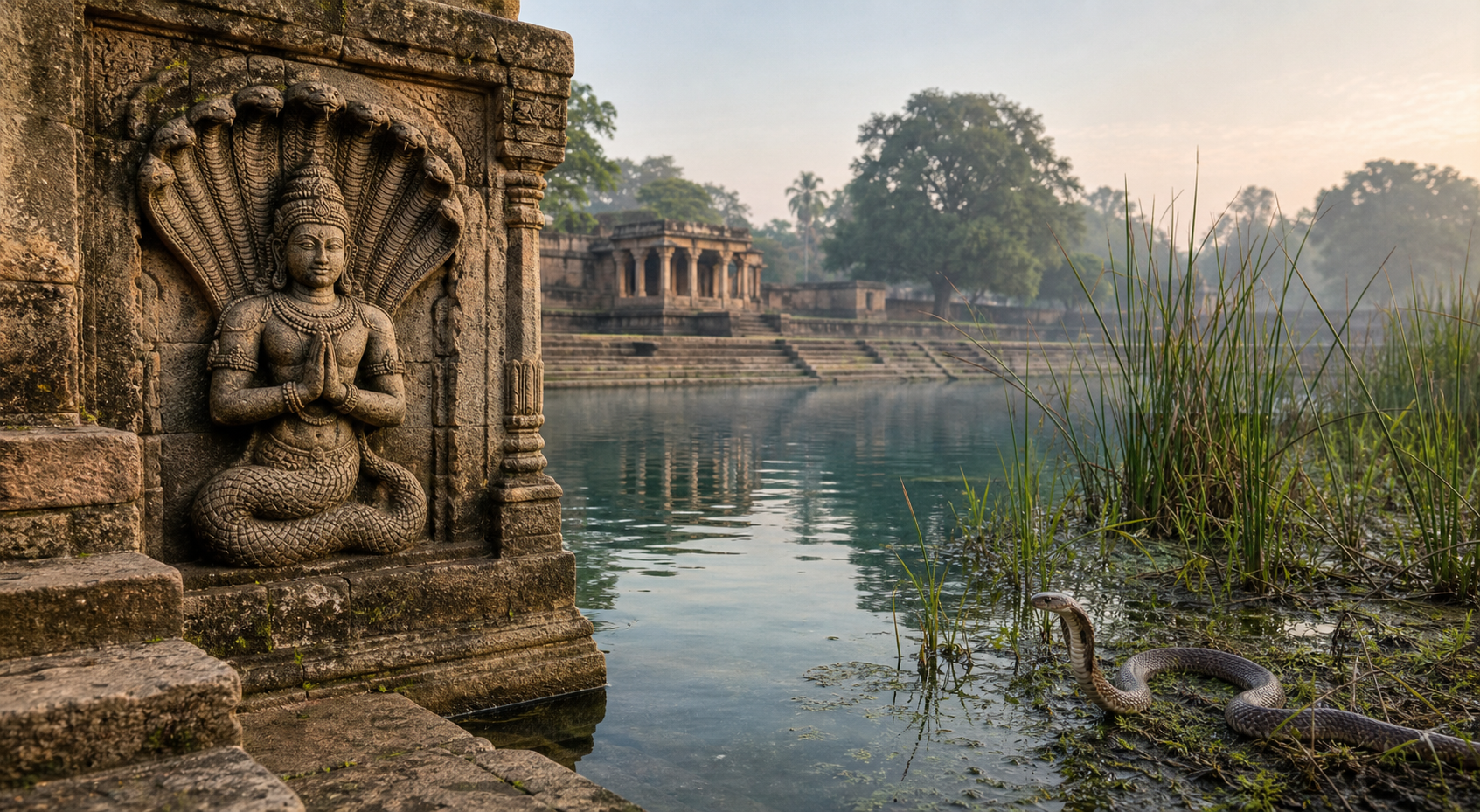
A Naga is not simply the Dharmic name for a biological snake, nor are the Nagas one serpent deity under many regional names. Hindu traditions describe them as a plural class of semi-divine beings with their own rulers, families, domains and moral personalities. They inhabit watery and subterranean realms, guard treasures, influence fertility and rainfall, and appear at the boundaries of forests, rivers, fields and settlements.
Keep three related but distinct levels in view whenever you interpret a Naga practice:
- The living animal: a snake with its own habitat, defensive behavior and place in an ecosystem. It requires distance and humane treatment, not forced ritual participation.
- The sacred being: a Naga or Nagini encountered through mythology, iconography, worship and local sacred memory. This being cannot be reduced to zoology.
- The covenant: the obligations a community accepts toward a grove, spring, field boundary, shrine, lineage or ritual calendar under Naga guardianship.
This distinction prevents two common errors. One is to dismiss Naga worship as fear of snakes dressed in religious language. The other is to romanticize every encounter with a wild snake as an invitation to approach, feed or handle it. Dharmic reverence can hold theological meaning and ecological responsibility together without confusing them.
The best-known Naga figures show how broad the category is. Ananta or Adi Sesha supports the cosmic order and becomes Vishnu’s couch between cycles of creation. Vasuki serves as the churning rope in the Samudra Manthana, linking devas and asuras in a perilous common undertaking. Takshaka is a king capable of lethal retribution, while Ulupi enters the social and ethical world of the Mahabharata through her marriage to Arjuna. These are not interchangeable versions of a harmless nature mascot. They express stability, alliance, sovereignty, kinship, danger and consequence.
Iconography makes those functions visible. A Naga may appear as a serpent, a human-serpent figure, or a human form sheltered by several hoods. The multi-hooded canopy signifies vigilance, sovereignty and protection. When you see it above a deity, Tirthankara, Buddha or devotee, notice the action before naming the symbol: the serpent is sheltering someone. Sacred power is being shown as guardianship.
Read the great serpent stories as disciplines of restraint
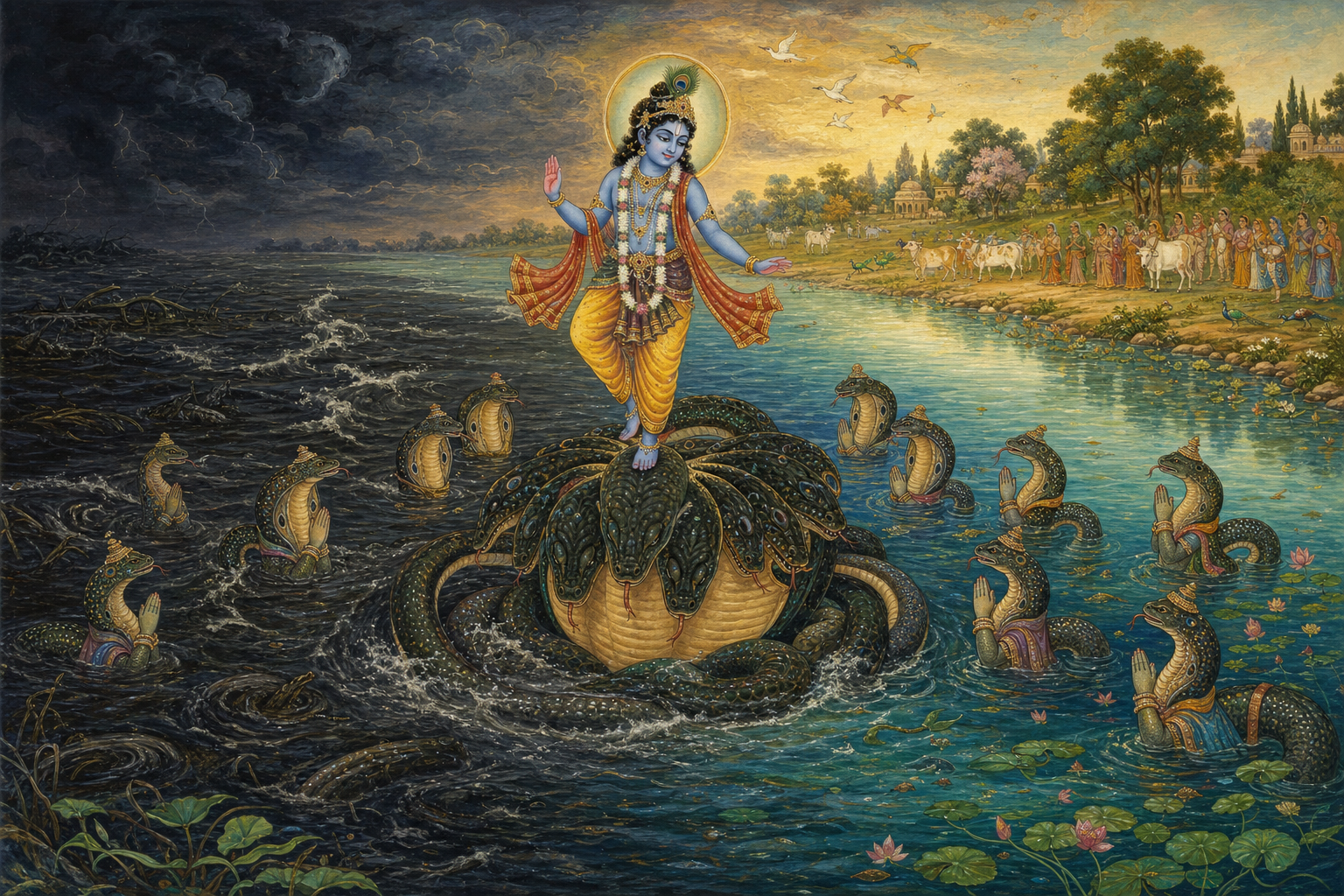
The sharpest ethical lesson appears in the Mahabharata’s Sarpa Satra. King Janamejaya begins a vast snake sacrifice to avenge Takshaka’s killing of his father, Parikshit. The rite does not remain a measured judgment upon one offender; it becomes an attempt to destroy an entire class of beings. The sage Astika intervenes and brings it to an end. The decisive Dharmic movement is therefore not from danger to extermination, but from vengeance to proportion, mediation and restored order.
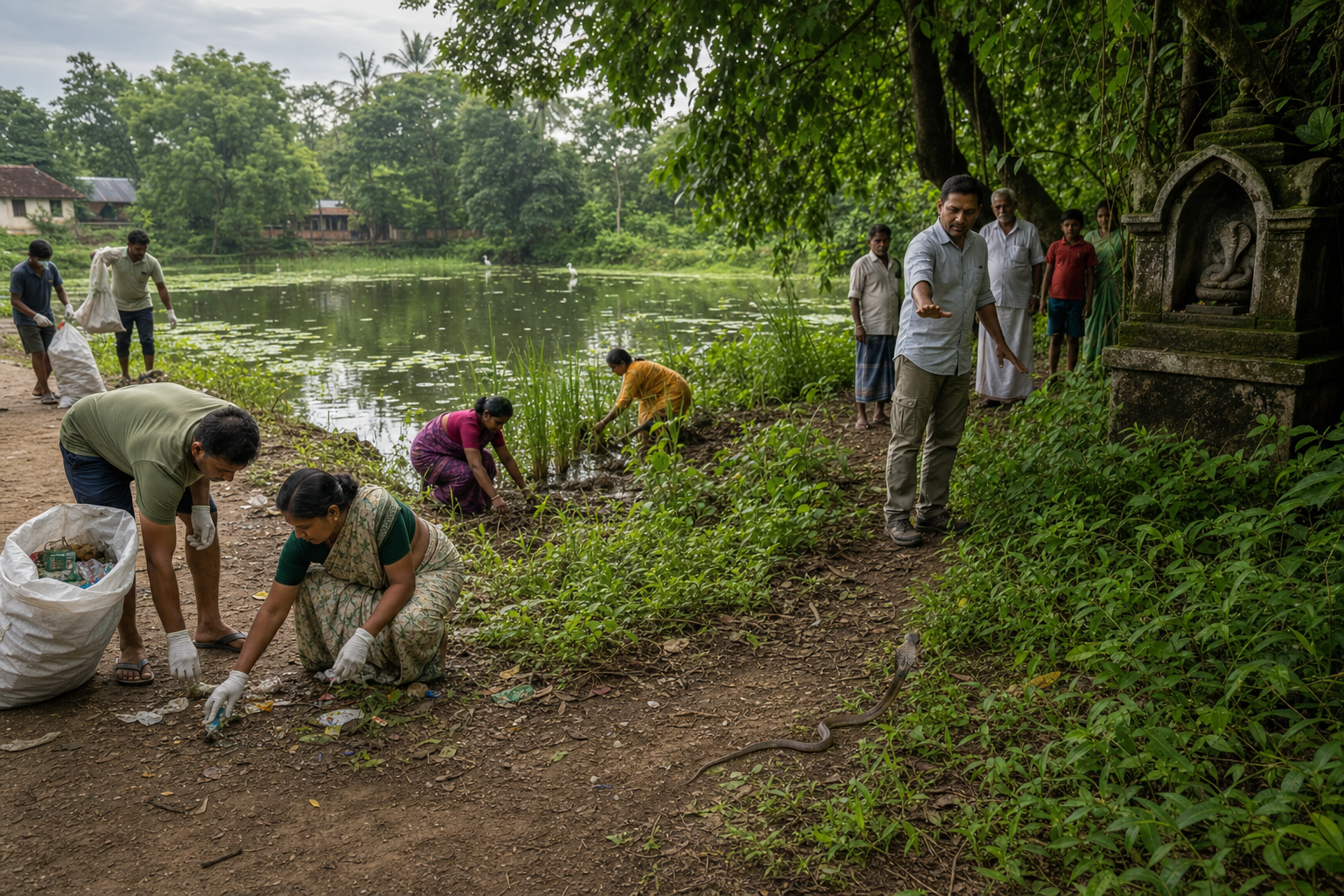
That distinction is immediately useful. Fear can justify protection, but it does not automatically justify annihilation. A dangerous snake near a dwelling may require trained removal. That situation does not make the destruction of every snake, burrow or nearby habitat righteous. The Sarpa Satra warns you to identify the actual danger, limit the response and leave room for reconciliation.
The Khandava forest episode poses a harder problem. Agni seeks to consume the forest, Indra resists because of his alliance with Takshaka, and Krishna and Arjuna enable the burning despite repeated opposition. Some beings escape, including Ashvasena, Takshaka’s son. The episode resists a comforting division between virtuous civilization and wicked wilderness. Cosmic purpose, political alliance, heroic action, displaced life and lasting consequence occupy the same moral field.
At Mannarasala in Kerala, local sacred memory answers that fire with refuge. Displaced serpents are remembered as finding protection in the humid southwest, and the grove becomes a place where human beings renew obligations toward the Nagas. This should be read carefully. The connection is a local sthala-purana and ritual memory, not a documented migration account that can be verified through early inscriptions. Reliable epigraphic anchors for the grove’s earliest history remain sparse. Its truth-claim is primarily theological and ethical: destruction creates a debt, and a community can answer that debt through long-term care.
When you encounter a serpent legend, ask four questions rather than stopping at whether it is literally historical:
<!– wp:list {