

If you encountered Mahodari in a temple calendar or a list of Tamil month-goddesses, you may be wondering what the name asks of you. Is Mahodari an independent deity, a form of Devi for Aadi, or the focus of a particular ritual?
The calendar supplies the essential context. Mahodari is the Devi associated with Aadi in a Tamil Shaiva tradition that places each of the twelve Tamil months under a particular feminine divinity. Once you keep that relationship in view, you can approach Mahodari without forcing the tradition into a generic list of goddesses or inventing details that belong to a specific lineage.
Read Mahodari’s name inside the sacred calendar
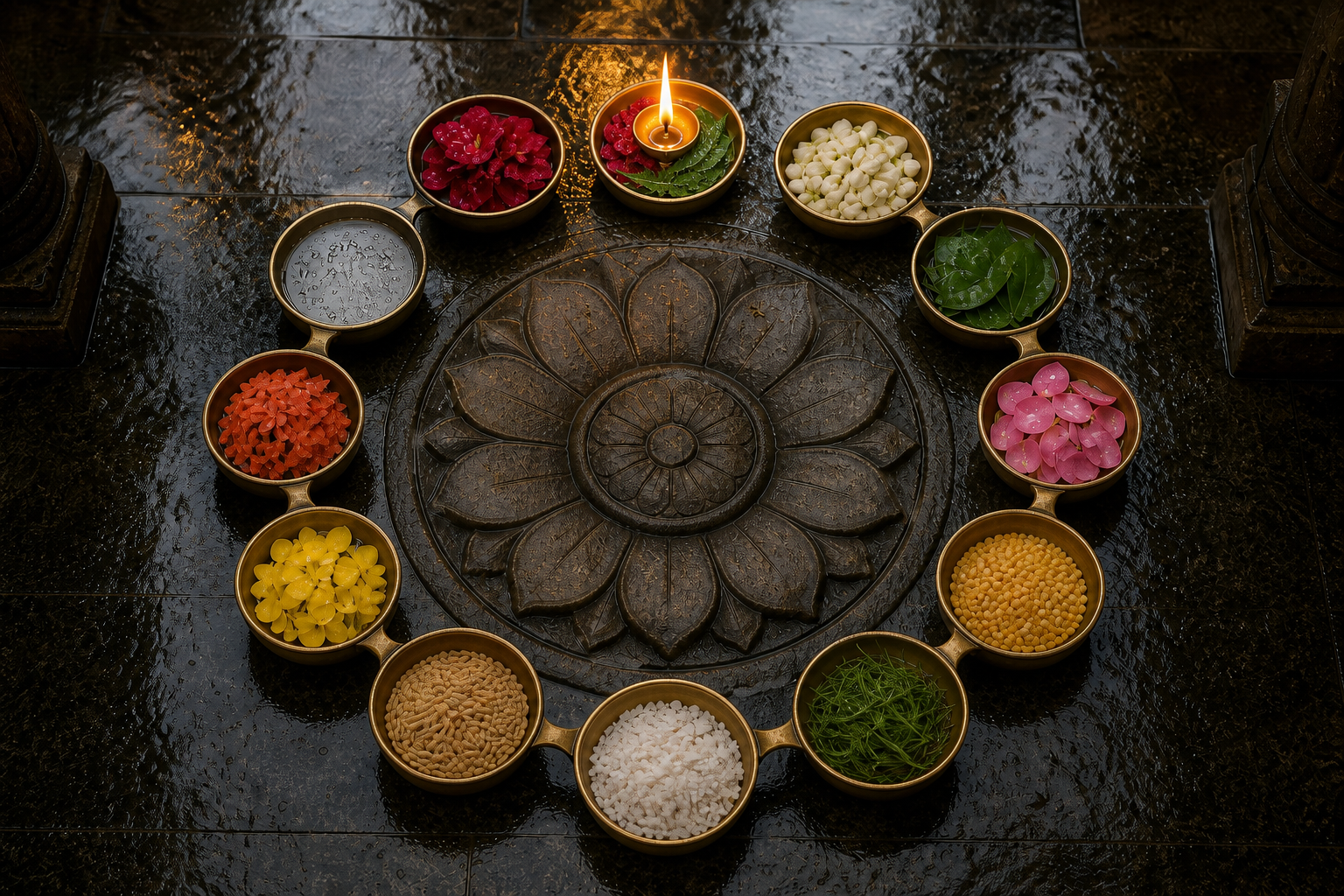
Dvadasa means twelve, masa means month, and Devis is the plural of Devi. The Dvadasa Masa Devis are therefore the twelve month-goddesses. In this Tamil Shaiva ordering of time, each of the twelve Tamil months, or masamkal, is governed by a specific Devi. Mahodari belongs to Aadi.
That statement has a precise scope. It describes a Tamil Shaiva tradition; it need not be presented as a calendar followed identically by every Hindu community. Hindu traditions often preserve sacred knowledge through regional languages, temple customs, family lineages, and distinct calendrical systems. Local particularity is not a defect that must be erased before a practice can be understood as Dharmic.
Nor should the word “governed” be reduced to celestial administration. Its practical meaning is that a month is not treated as spiritually empty time. A particular form of divine feminine presence gives that portion of the year its devotional focus. For Aadi, that focus is Mahodari.
If you need to explain the tradition in one sentence, use this: the Dvadasa Masa Devis reveal the year as twelve recurring encounters with Devi, and Mahodari is the encounter associated with Aadi.
The symbolism begins with time, not with an image

People often begin with iconography: How many arms does Mahodari have? Which objects does she carry? What is her vehicle? Those are legitimate questions when a temple image, dhyana description, ritual manual, or lineage teaching supplies the answers. The name alone, however, does not authorize you to reconstruct them.
The dependable symbolism begins one step earlier. The twelvefold cycle treats time itself as sacred and feminine. This gives you several concrete ways to understand what the tradition is doing:
- Sacred time: The month is more than a box around appointments. It becomes a period in which you remember a particular presence of Devi.
- Ordered plurality: Twelve names need not imply twelve competing powers. The cycle allows divine feminine reality to be approached through distinct monthly forms without erasing their relationship.
- Recurrence: A month returns each year. Devotion therefore becomes rhythmic rather than dependent only on rare or dramatic occasions.
- Attention: Naming the presiding Devi prevents the months from passing as interchangeable units. Aadi becomes recognizable through Mahodari.
- Continuity: The complete cycle links one month to the next. You are invited to see the year as an ongoing sacred order, not as a collection of disconnected festival dates.
This is why Mahodari should not be studied only as an isolated name. Her place within Aadi is part of her meaning. Remove the calendrical relationship, and you remove the feature that makes her relevant to the Dvadasa Masa Devis.
This distinction also protects you from a common online error. A modern illustration may be beautiful, but beauty is not proof of traditional iconography. Before treating an image as Mahodari’s established form, ask where its attributes came from: a temple tradition, a textual description, a recognized teacher, or merely the artist’s imagination. If no lineage-specific basis is given, receive it as devotional art rather than as definitive iconographic evidence.
A responsible way to include Mahodari in your practice

You do not need to choose between ignoring Mahodari and immediately attempting a specialized ritual. Recognition, contemplation, and formal worship are different levels of engagement. Move from one to the next only as your knowledge becomes reliable.
- Confirm the context. Record the basic relationship accurately: Mahodari is associated with Aadi within the Dvadasa Masa Devi tradition of Tamil Shaivism. Do not detach the name from that setting.
- Use the correct calendar. When Aadi approaches, consult a current Tamil panchangam or a calendar issued by the temple or community whose observance you follow. Do not rely on a memorized Gregorian date range when planning a specific observance.
- Ask what your lineage actually preserves. A family elder, temple priest, or qualified teacher may know whether the tradition includes a particular image, mantra, stotra, offering, or procedure. Ask for the practice and its basis together.
- Do not assemble a ritual from similar-sounding deity names. A shared or similar name does not prove that two forms have the same mantra, iconography, or worship method. Where initiation or an Agamic temple procedure is involved, follow the authorized instruction rather than improvising.
- Keep ordinary devotion distinct from claimed tradition. If your established practice already includes a simple form of Devi remembrance, you may contemplate Mahodari’s association with Aadi within that practice when your tradition permits it. Describe this honestly as personal remembrance unless you have received a specific Mahodari observance.
- Build the twelve-month record slowly. Create a page with columns for Tamil month, presiding Devi, local spelling, temple or teacher confirming the association, known iconographic details, and authorized observance. Enter Mahodari under Aadi. Leave the other entries blank until you can verify them; an honest blank is better than a complete but unreliable chart.
You can also use Aadi for a modest personal reflection that makes no claim to inherited ritual. At the beginning of the month, write Mahodari’s name on your calendar and note one question: “How would I live differently if this month were received as sacred rather than merely spent?” At the end of Aadi, record one concrete answer. This does not replace puja or lineage instruction. It trains the attention that a sacred calendar demands.
Avoid the shortcuts that distort the tradition
The first shortcut is universalizing a regional tradition. Saying “all Hindus worship Mahodari in Aadi” goes beyond the information the calendrical relationship gives us. Say instead that Mahodari presides over Aadi in the relevant Tamil Shaiva tradition. Precision shows respect; it does not diminish the tradition.
The second is treating the twelve Devis as a ranking. A calendar establishes sequence, not superiority. Aadi’s position tells you when Mahodari comes into devotional focus, not that she is higher or lower than the Devi of another month.
The third is assuming that a month-goddess excludes familiar forms of Devi. A calendrical association identifies a focus within a particular sacred scheme. It does not, by itself, cancel a family’s established ishta-devata, kula-devata, temple commitments, or daily worship.
The fourth is translating a name and then building a theology from the translation alone. Sanskrit names can carry suggestive meanings, but etymology is not a substitute for a transmitted account of form, function, or ritual. Begin with what is secure: Mahodari, Aadi, and the twelvefold monthly cycle. Add further claims only when a trustworthy tradition supports them.
The fifth is copying a complete online list without checking spelling, order, or lineage. If two lists differ, do not silently combine them. Preserve each version with its temple, region, or teaching context until you know why the difference exists. A tradition remains intelligible when its relationships are kept intact.
Key takeaways
- Mahodari is the Devi associated with Aadi in a Tamil Shaiva tradition of twelve month-goddesses.
- The Dvadasa Masa Devis make the calendar itself a field of devotion, giving each Tamil month a distinct feminine presence.
- Mahodari’s place in Aadi is essential context; do not study the name as though it were detached from the monthly cycle.
- Do not invent her arms, weapons, vehicle, mantra, or ritual from the name alone. Seek a temple, textual, family, or lineage basis.
- Use a current Tamil panchangam for Aadi and keep personal contemplation clearly distinct from a formally transmitted observance.
- Build your knowledge of all twelve Devis gradually, recording where each identification and practice was confirmed.
When Aadi next appears on your calendar, begin with one accurate act: write Mahodari’s name beside the month and confirm how your own temple or sampradaya understands her. That small discipline turns curiosity into rooted knowledge and lets the sacred year reveal itself without forcing certainty where tradition has not yet been received.
References
