

You may have seen Manusmriti pushed into party warfare and wondered what, exactly, you are being asked to defend or condemn. The useful question is not which camp can produce the harsher label. It is whether the disputed words concern a passage, a historical claim, a modern political programme, or Hindu people as a whole.
In the exchange reported on 25 August 2026, Assam Chief Minister Himanta Biswa Sarma attacked Rahul Gandhi over the controversy and called him a "Hindu baiter." That label tells you Sarma’s judgement. It does not, by itself, establish Rahul Gandhi’s exact words, their context, or whether their target was a text, a political use of that text, or Hindus collectively. Those distinctions should determine your verdict.
Separate the textual, historical and identity claims

Political controversy works by compressing several propositions into one emotionally charged signal. Slow the argument down before you accept or reject it. In a Manusmriti dispute, at least three different claims may be in play:
- A textual claim: a particular passage says something objectionable, defensible or misunderstood.
- A historical claim: the text influenced social practice, law, hierarchy or political thought in a particular place and period.
- An identity claim: the text represents Hinduism as a whole, or present-day Hindus bear collective responsibility for everything attributed to it.
A speaker may have evidence for one claim and none for the others. A genuine verse does not automatically prove that every Hindu accepted it, that it governed every community, or that it defines Hindu life now. Equally, the diversity of Hindu traditions does not make every uncomfortable passage or historical question disappear.
When you encounter a clip from this row, write down its main proposition in one sentence. If your sentence changes from "Rahul criticised a prescription" to "Rahul attacked Hindus" without additional evidence, an identity claim has been inserted into the argument. If it changes from "Sarma alleged anti-Hindu intent" to "anti-Hindu intent was proved," a political accusation has been converted into a fact.
Manusmriti is part of Hindu history, not the whole of Dharma

Manusmriti belongs to the smriti and Dharmaśāstra traditions. In the conventional Hindu distinction, smriti is not the same category as shruti. Hindu traditions also do not operate through one church, one compulsory creed or one book that every Hindu must interpret identically.
This makes two common slogans equally inadequate. "Manusmriti is Hinduism" reduces a vast civilisational inheritance to one prescriptive text. "Manusmriti has nothing to do with Hindu thought or history" avoids the harder work of examining what the text contains, how it was interpreted and what authority different communities gave it.
A serious response therefore begins with the actual passage. Ask for the chapter and verse, the Sanskrit text when available, the edition, the translator and the surrounding argument. Translation choices can affect meaning, while surrounding context can clarify the scope of a rule or statement. Context is necessary evidence; it is not a magic device that makes every difficulty harmless.
After establishing the wording, ask three separate questions. What did the passage prescribe? What role, if any, did it have in a particular historical setting? Why should that prescription bind, describe or morally implicate Hindus now? A person who answers only the first question has not automatically answered the other two.
An anti-Hindu charge must be demonstrated, not repeated

Sarma’s phrase is an allegation about Rahul Gandhi’s intent and political conduct. It may eventually be supported or contradicted by the complete statement, but repetition cannot substitute for that statement. Use a consistent burden of proof:
| Claim being tested | Minimum evidence needed | What does not settle it |
|---|---|---|
| Rahul Gandhi attacked Hindus as a community | His complete words showing that Hindus, rather than only a text, practice or political symbol, were the target | An opponent’s characterisation of his motive |
| Rahul Gandhi made a particular claim about Manusmriti | The full statement, with its setting and the words immediately surrounding the disputed claim | A cropped clip, paraphrase or quotation card |
| A cited passage supports the political claim | A traceable chapter and verse, a named edition or translation, and enough context to identify its subject | An unattributed English sentence presented as timeless Hindu doctrine |
| A response refuted the original argument | Direct engagement with its textual, historical or political premise | A forceful label, even when the label appeals to your own side |
Apply this standard symmetrically. If Rahul Gandhi’s complete words express contempt for Hindus as people, name the prejudice and show the words. If he criticised a passage or its political use, answer that claim rather than enlarging its target. If Sarma supplied a substantive rebuttal, evaluate the rebuttal. If only the label is available, do not mistake rhetorical certainty for proof.
Use this five-step test before sharing the controversy
You do not need to become a Sanskrit jurist before forming any political judgement. You do need enough discipline to keep a party narrative from making the judgement for you.
- Locate the primary statement. Find the full video, transcript, speech or social-media statement. Trace reposted clips back to the earliest available version. If the primary material is unavailable, say that your conclusion is provisional.
- Copy the exact disputed words. Do not rely on a headline’s verb. "Questioned," "criticised," "mocked" and "attacked" describe different acts and require different evidence.
- Identify the object of the statement. Mark whether it concerns Manusmriti, one verse, caste, an opponent’s politics, Hindu institutions, Hindu beliefs or Hindu people. Do not silently substitute one object for another.
- Verify any textual assertion. Demand a chapter and verse, edition and translation. Read the relevant context. Then separate what the text says from claims about how widely, where and when it was followed.
- Ask for the present consequence. Is anyone proposing a law, institutional rule, educational policy or social practice? If no concrete consequence is named, the quarrel may be functioning chiefly as identity signalling. Treat it accordingly.
The final step is especially important. Historical and scriptural questions deserve serious examination, but political actors often invoke them to force an emotional alignment without specifying what they want changed now. A named proposal can be debated. A cloud of insinuation can only be circulated.
What a confident Dharmic response looks like
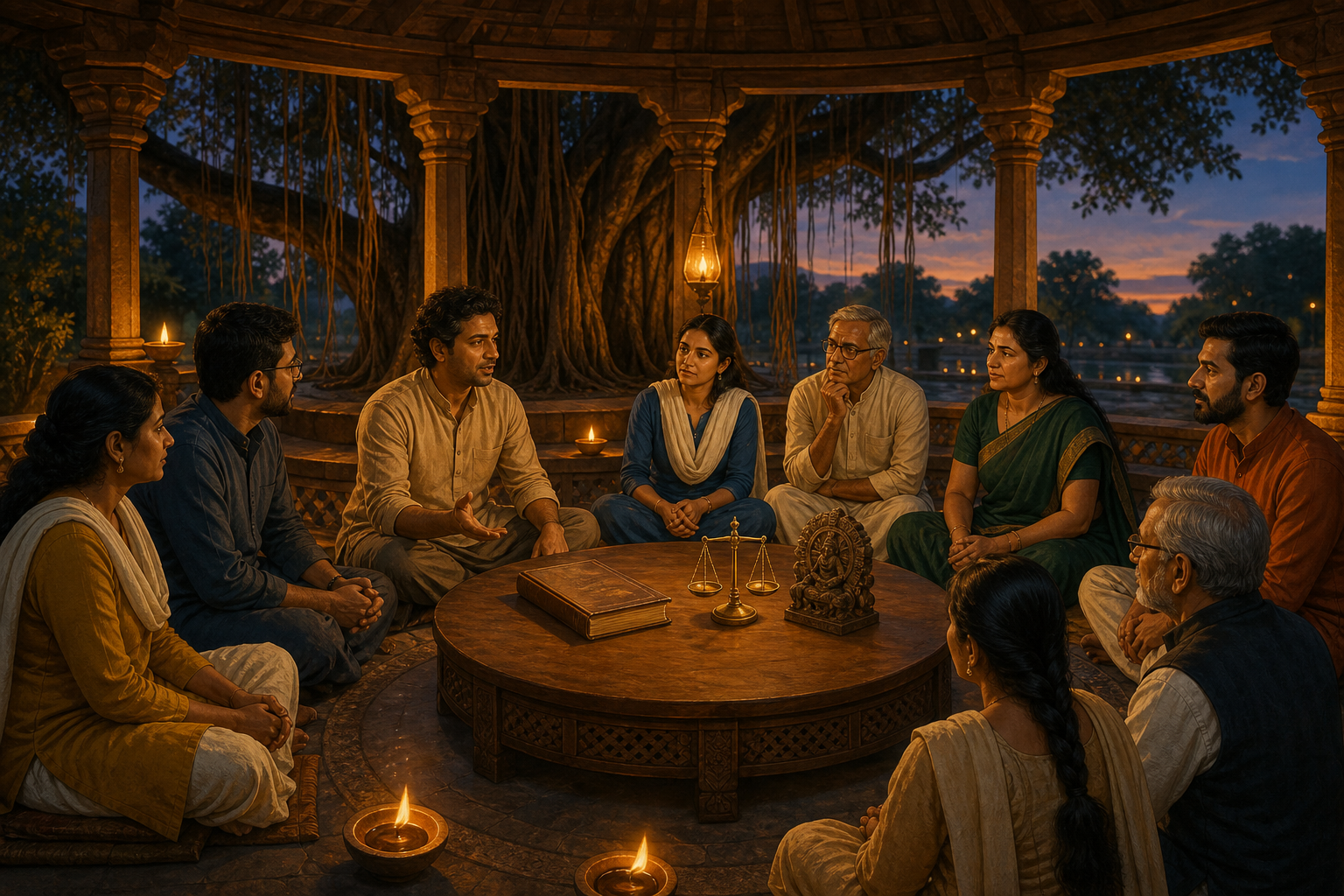
A confident defence of Dharma does not require reflexive defence of every inherited prescription. Nor does intellectual honesty require accepting the claim that one text, one verse or one historical dispute exhausts Hindu civilisation. The practical discipline is viveka: distinguish before judging.
- Defend Hindu dignity precisely. Oppose collective contempt, dehumanisation and the use of selective history to portray living Hindus as morally suspect by birth.
- Leave room for internal examination. A difficult passage can be questioned without surrendering the Vedas, Upanishads, bhakti traditions, philosophical schools, temple cultures and lived forms of Dharma to an opponent’s framing.
- Demand accuracy from allies as well as opponents. A politician does not become a reliable interpreter merely because the politician appears to defend Hindus.
- Refuse inherited guilt. Present-day Hindus are moral agents, not stand-ins onto whom every contested feature of a long and diverse history can be transferred.
- Return the debate to conduct. Ask what each participant is advocating, what evidence supports it and whether the same rule would be applied to another community or text.
This position is not a compromise between two party lines. It is a higher evidentiary standard. It protects Hindu society from caricature while preserving the Dharmic capacity for commentary, disagreement and moral reasoning.
Key takeaways
- The confirmed political exchange establishes Sarma’s accusation against Rahul Gandhi; the accusation alone does not establish Rahul Gandhi’s intent.
- Criticism of Manusmriti is not automatically an attack on Hindus, but criticism of a text must not be used as camouflage for contempt toward Hindu people.
- Manusmriti should be neither equated with the whole of Hindu Dharma nor erased from Hindu intellectual and social history.
- A reliable judgement requires the complete statement, a precisely identified target and verifiable details for any cited passage.
- The strongest pro-Dharma response uses the same evidentiary standard for political allies and opponents.
Before forwarding the next clip from this row, write down the exact claim and one piece of evidence that would make you revise your view. Then ask whether you would accept the same proof if the party names were reversed. That small act will do more for Dharmic public reasoning than another round of labels.
References
