
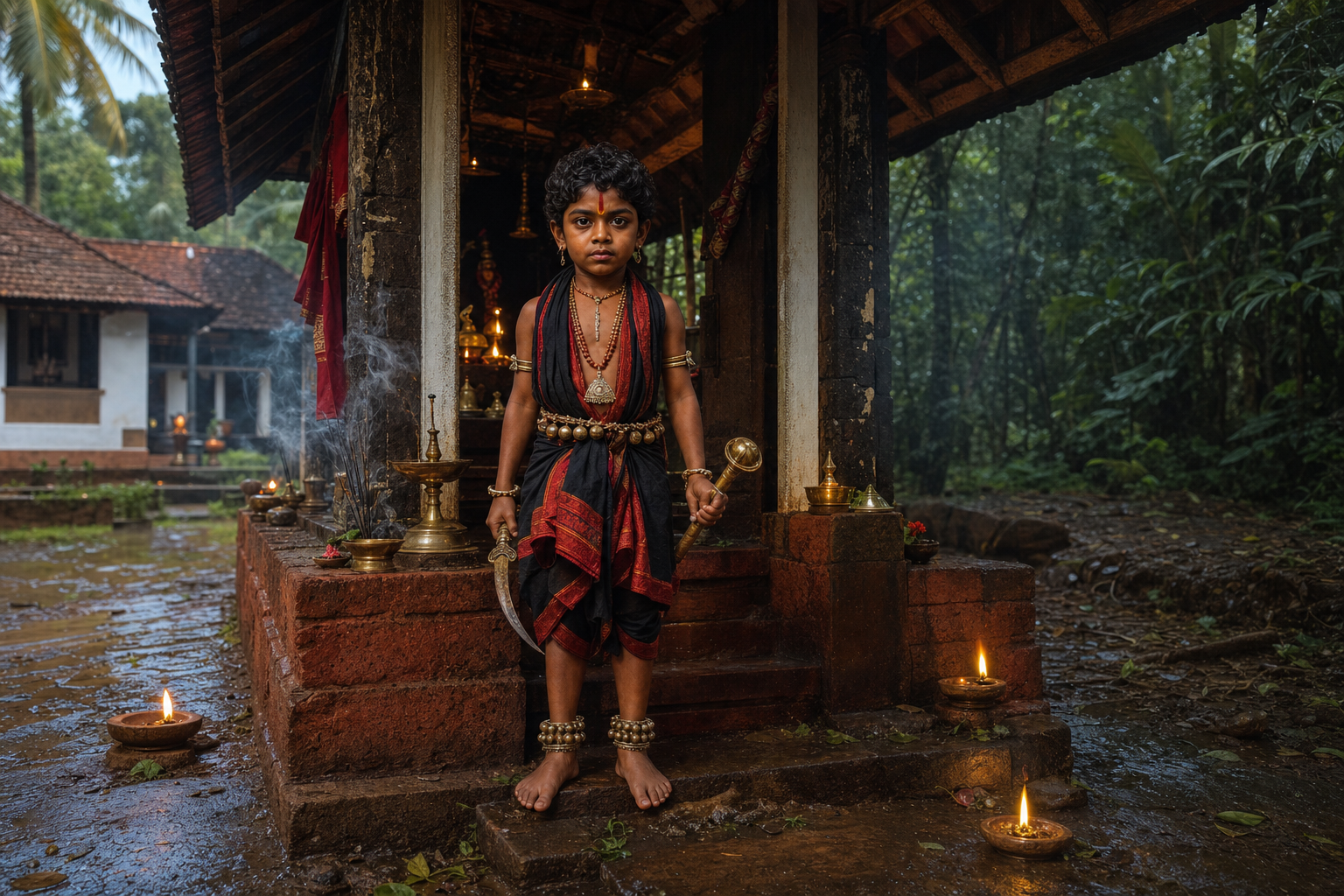
If you have encountered Kuttichathan through a shrine image, a Theyyam photograph, or a frightening story about occult power, you may be wondering what you are actually looking at. Two shortcuts will mislead you: treating Kuttichathan as an ordinary child-form of a major Puranic deity, or reducing him to a dangerous ghost.
The more useful approach is to identify the local tradition first and then read the symbols as a connected language. The compact body, vigilant eyes, weapons, colours, anklets, sacred grove and ritual setting all tell you how this presence is understood: close to the household, quick to act, protective of boundaries and exacting about truth.
Begin with the right category: a local guardian within Dharma
Kuttichathan is best approached as a Kerala spirit-deity, or bhuta/daiva, rather than either a mainstream Puranic deity or a merely hostile ghost. That distinction matters. A local guardian is not outside the Dharmic world, and local does not mean lesser. It means that the deity’s identity is carried through a particular landscape, shrine, ritual lineage, community memory and set of obligations.
The name itself contains the apparent tension. Kutti points toward a small, youthful or childlike form. Chathan belongs to Kerala’s language for potent liminal beings who cannot be sorted neatly into the categories of harmless divinity and absolute evil. Youthfulness explains the speed, play and unpredictability. The guardian role explains the vigilance, severity and concern with boundaries.
This combination is why the trickster dimension should not be mistaken for random mischief. Kuttichathan’s play often carries a moral edge. Narrative cycles present him as exposing arrogance, chastening hypocrisy, intervening for devotees in distress and protecting people who would otherwise be vulnerable. The deeper pattern is not disorder for its own sake. It is the disruption of a false or unjust order so that balance can be restored.
You should also resist the urge to force every account into one biography. Names and mythic lineages vary across Kerala. North Malabar traditions are strongly connected with Theyyam and Kaliyattam. In the Thrissur region, the form may be approached as Vishnumaya Kuttichathan within a Vaishnava-tantric setting. Other accounts emphasize a guardian trained or directed by a tantric adept to protect homes, fields and thresholds.
These are not details to average into a single universal version. When you encounter a shrine or image, ask three questions before deciding what it means: What exact name is used here? Which family, community or shrine lineage preserves the worship? Is the form being encountered in a kavu, a domestic altar, a temple-style sanctuary or a Theyyam performance? Those answers are more reliable than a generic label found online.
Read the image as a complete grammar of protection
Kuttichathan’s iconography works through combinations. A sword does not stand alone, nor does the colour red automatically mean anger. Body, gaze, gesture, ornament, colour and setting qualify one another. Use the following correspondences as a reading aid, not as a checklist for declaring an image authentic.
| What you notice | What it commonly communicates | How to read it carefully |
|---|---|---|
| Compact, youthful body | Immediacy, agility and nearness to domestic life | The small scale does not imply weak power or childish innocence. |
| Bent knees or a forward-moving stance | Readiness to intervene rather than remote sovereignty | Read the pose together with the weapons, gaze and ritual context. |
| Large, intent eyes | Watchfulness over thresholds, promises and conduct | The gaze is protective as well as demanding; it is not simply a sign of rage. |
| Red, black and white | Active protection, boundary-setting absorption, and clarifying benevolence | No colour has one fixed meaning in isolation. Their balance is the point. |
| Short sword and shield | Rapid defence joined to disciplined courage | The shield prevents the sword from becoming an image of aggression alone. |
| Anklets, belt, chain and chest ornaments | Movement, controlled potency and the binding of disruptive forces | The sound of anklets and cymbals can be part of how protected ritual space is announced. |
| Abhaya and varada gestures | Protection and the granting of legitimate blessings | These gestures place fierceness in the service of guardianship. |
| Towering mudi or radiating headgear | Flame-like alertness and an extended field of oversight | This is especially important in performative iconography; sculptural forms may have simpler hair or crowns. |
| Yantric geometry beneath or near the icon | Consecrated enclosure and the focusing of ritual power | A yantra belongs to a lineage and rite. It is not interchangeable decoration or a pattern to copy casually. |
The most revealing feature is the balance among these elements. Red carries active, protective force. Black marks an absorptive and boundary-setting function. White accents introduce clarity and benevolent purpose. Sword and shield likewise belong together: one acts, while the other protects and restrains. Abhaya and varada make the ethical direction even clearer. The power is formidable, but its legitimate purpose is protection and blessing.
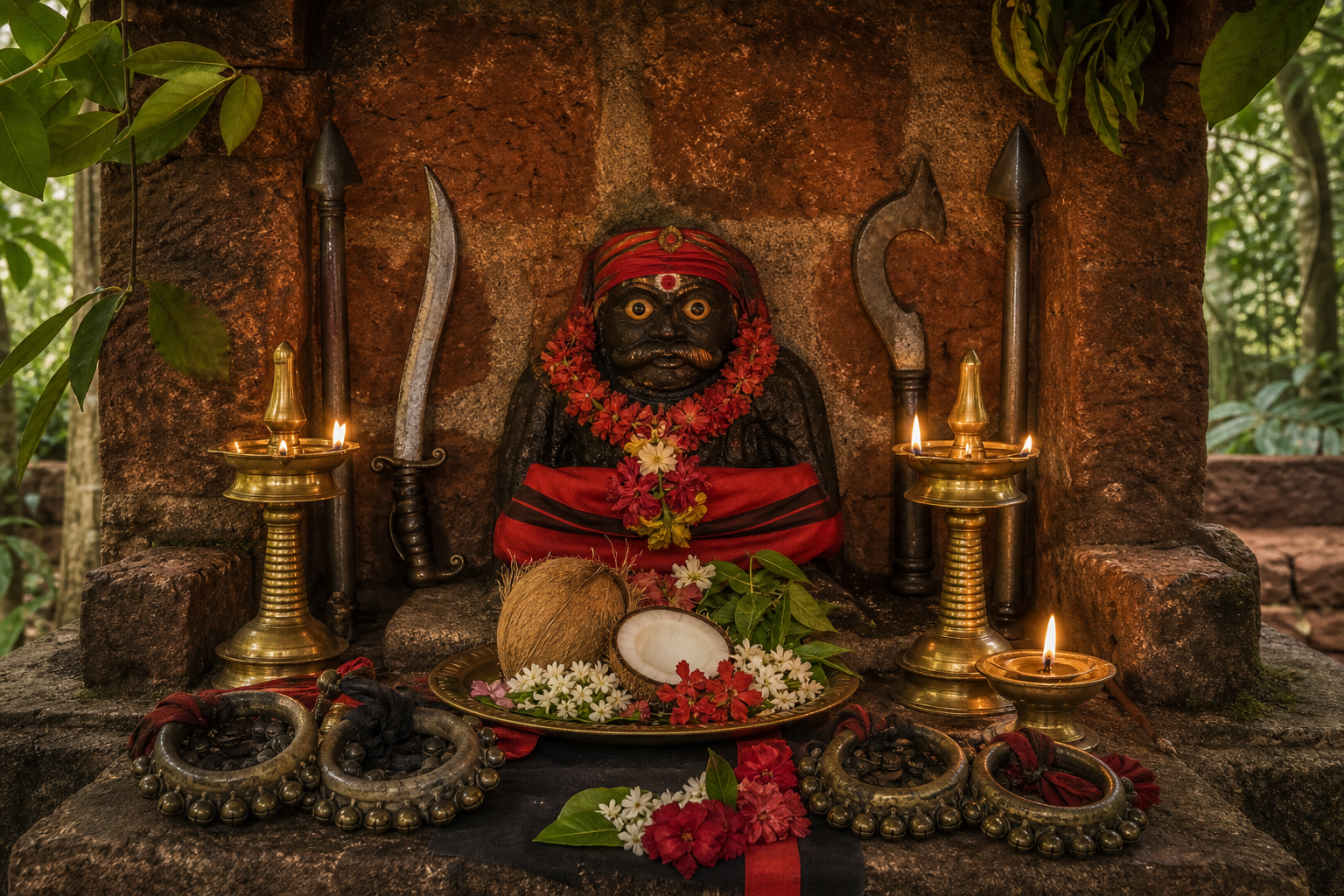
A staff, trident or ritual whisk can appear in particular images. Betel leaves, limes and lamps may form part of the surrounding protective vocabulary. Rooster imagery also occurs in some murals and festival settings, where it can evoke older offering customs and the transition marked by dawn. It should not automatically be declared Kuttichathan’s fixed vahana. If one of these features is absent, that absence does not invalidate the image; local lineages do not all use an identical template.
The shrine environment completes the icon. In a kavu, trees, pathways, lamps, a low sanctum or open peedam and the space used for circumambulation are not a scenic frame around the deity. They are part of the sacred arrangement. Groves shaded by jackfruit, banyan or mango trees express a temple ecology in which divine presence, community memory and living landscape remain connected.
Worship depends on relationship, restraint and truthful intent
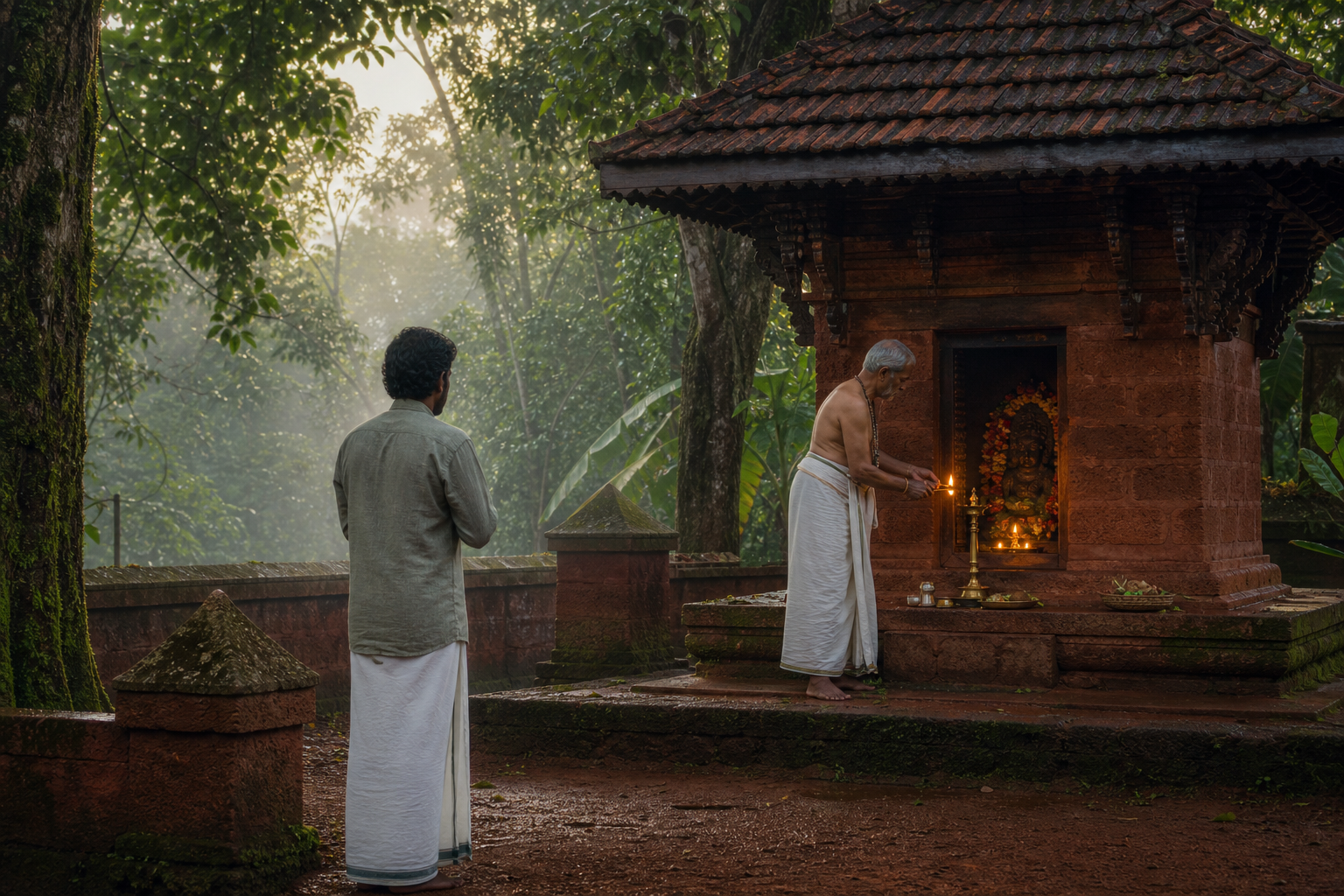
Kuttichathan worship is often sought for protection, safe travel, relief from troubling influences and a truthful resolution to disputes. The recurring concerns are thresholds: the line between safety and danger, promise and betrayal, order and disorder. That is why the worship carries both warmth and seriousness. A guardian who is close enough to help is also close enough to demand consistency.
At many shrines and domestic altars, ordinary observance can include a lamp, incense, water and simple offerings such as jaggery, bananas, puffed rice or coconut. These modest substances fit the deity’s domestic proximity. They also correct a common misunderstanding: devotion to Kuttichathan is not defined only by dramatic tantric rites.
Specialized practice is different. Kuttichathan traditions may intersect with Kerala’s temple-centred tantric ritual culture, associated with precise sequences, mantras, consecrated implements and geometries. Protective yantras can employ interlocked triangles, concentric enclosures and lineage-specific bija syllables. Their purpose is to establish and direct a sacred field, not to provide a portable technique detached from its custodians.
If you want to begin worship, do not begin by downloading a mantra or reproducing a yantra whose lineage you cannot identify. Start with the shrine or family tradition you actually intend to approach. Ask which simple offerings are accepted, whether a particular day or sequence is observed, and which actions belong only to the designated ritual custodian. Precision here is not gatekeeping. It prevents you from mixing practices whose words, placements and intentions depend on a specific consecrated setting.
Guruthi requires the same care. It belongs to Kerala’s protective ritual language for addressing fierce, red and absorptive energies so that harm can be neutralized. Contemporary practice can employ plant-based and symbolic substitutes. The Dharmic boundary is important: the aim is restoration of balance, not fascination with injury. Do not assume that a rite seen at one shrine authorizes you to reproduce it elsewhere or privately.
Your petition should match that ethical direction. If the matter is a conflict, ask for truth, protection and a just resolution rather than harm to an opponent. If you make a promise as part of worship, make one you can keep. A tradition associated with guarding oaths and social boundaries should not be approached through exaggerated vows, coercive wishes or attempts to turn devotion into a weapon.
Theyyam makes the symbolism move, sound and speak
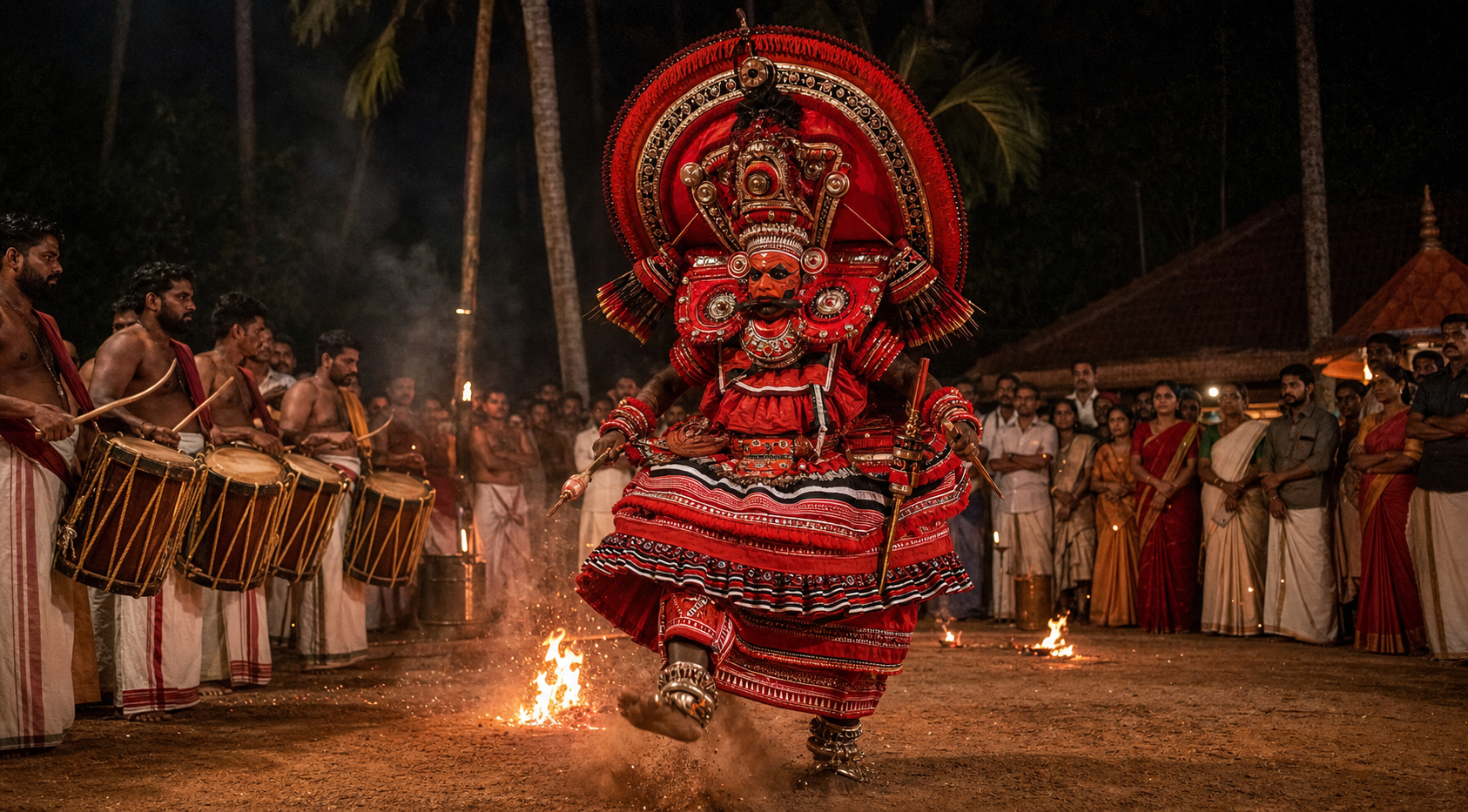
A shrine image concentrates presence into a relatively stable form. Kuttichathan Theyyam makes that same symbolic language mobile. Face-painting, costume, mudi, rhythm, narrative song and choreographed movement turn watchfulness and rapid intervention into something the gathered community can encounter directly.
The eyes are often emphasized with red and black, the brows flare, and the expression can hover between smile and growl. Darting movements communicate speed and unpredictability; sudden stillness becomes vigilance. The anklets sound as the performer moves, while chenda and elathalam establish the ritual pulse. What a small sculptural figure implies through posture, the embodied form demonstrates through time, sound and space.
The narrative songs matter as much as the spectacle. Episodes of protection, justice and transformation give the visual form its moral charge. If you watch only the costume and rapid movement, you will miss why the deity appears before the community. The encounter renews obligations: truth should be kept, arrogance can be corrected, and the vulnerable should not be abandoned.
If you attend, first learn the name of the kavu and the form being performed. Follow the local community’s rules about proximity, offerings and photography. Watch how devotees respond before treating the event as an open stage. Listen for the story carried by the song, even if you later need help understanding its local language and references. Calling Theyyam merely theatre misses its ritual claim; calling it merely an illustration misses the embodied encounter at its centre.
How to approach Kuttichathan without flattening the tradition
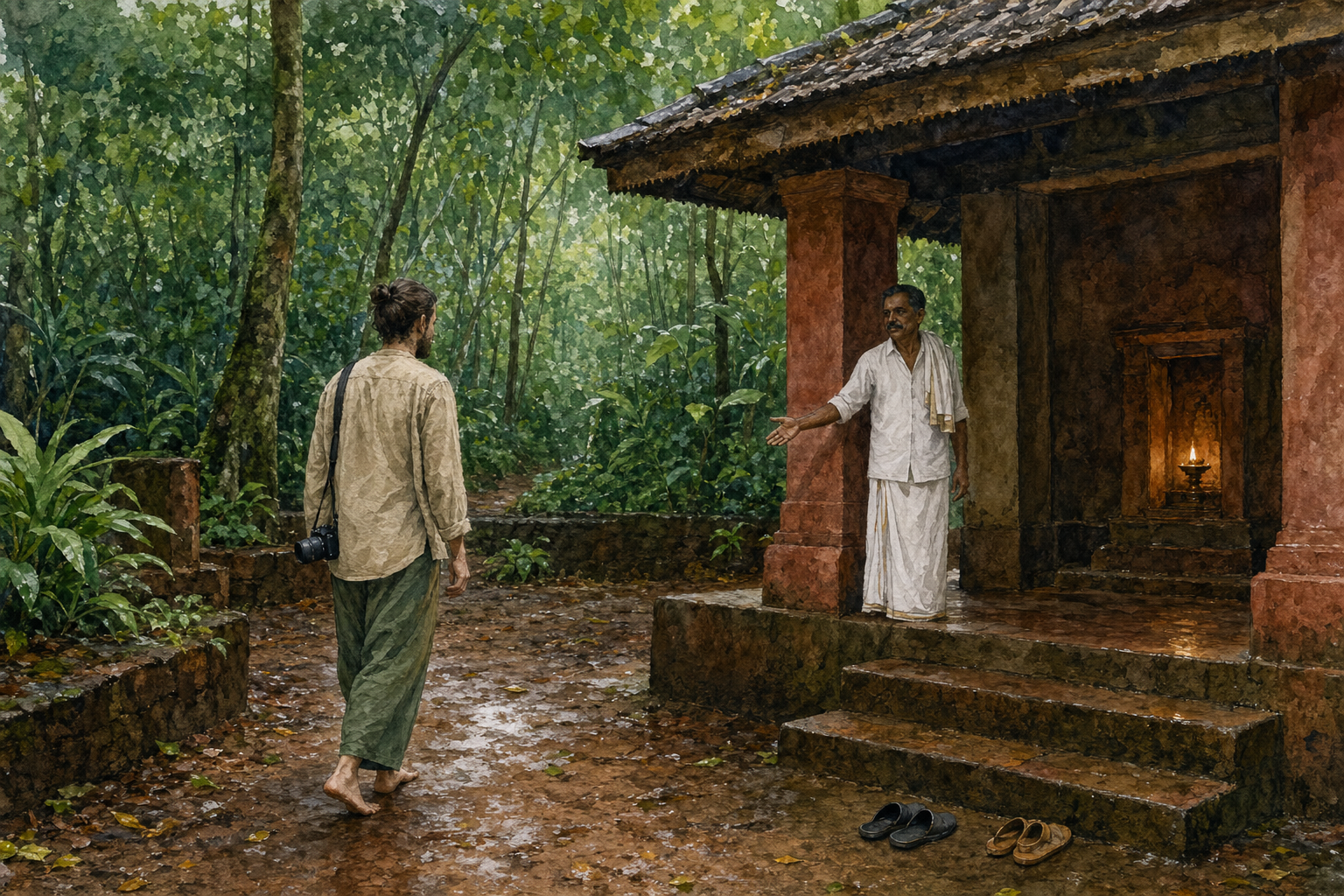
The greatest interpretive error is to remove Kuttichathan from locality. Once that happens, a guardian rooted in shrine, grove, household and performance becomes either a generic miracle-worker or a generic figure of fear. You can avoid that mistake with a short sequence of checks.
- Identify the setting. Determine whether you are dealing with a kavu, household altar, temple-style shrine, Vishnumaya tradition or Theyyam lineage.
- Use the local name. Ask how the deity is addressed there instead of assuming that Kuttichathan, Chathan and Vishnumaya are universally interchangeable.
- Separate common imagery from fixed rules. A youthful form, alert gaze, protective colours and weapons recur, but their exact arrangement varies.
- Ask before adopting a practice. Lamps and permitted food offerings may be simple; mantras, yantras and specialized rites can be lineage-bound.
- Judge a claim by its moral frame. An explanation centred only on fear, revenge or occult control has omitted the traditions of guardianship, oath-keeping and restoration of balance.
- Keep the landscape in view. In a sacred grove, the trees, platform, paths and ritual boundary help explain the deity just as much as the metal, stone or wooden icon.
Key takeaways
- Kuttichathan is a potent local spirit-deity within Kerala’s Dharmic landscape, not adequately described as either a standard Puranic god or an evil ghost.
- The childlike form signifies agility and nearness, while the eyes, stance, weapons and ornaments express vigilant, disciplined protection.
- Red, black and white should be read together as activity, boundary-setting absorption and clarifying benevolence.
- Vishnumaya, kavu worship and Kuttichathan Theyyam overlap in some places, but no single account should erase regional and lineage differences.
- Simple devotion and specialized tantric practice are not the same. Ask the relevant shrine before using a mantra, yantra or protective rite.
- The ethical centre is protection, truth and restored balance. Sensational portrayals focused only on malice or occult control are incomplete.
Your next step can be modest: identify the exact shrine or Theyyam lineage behind the form you encountered, learn the name used there, and ask what observance is appropriate in that setting. That one act of specificity turns curiosity into respectful participation.