
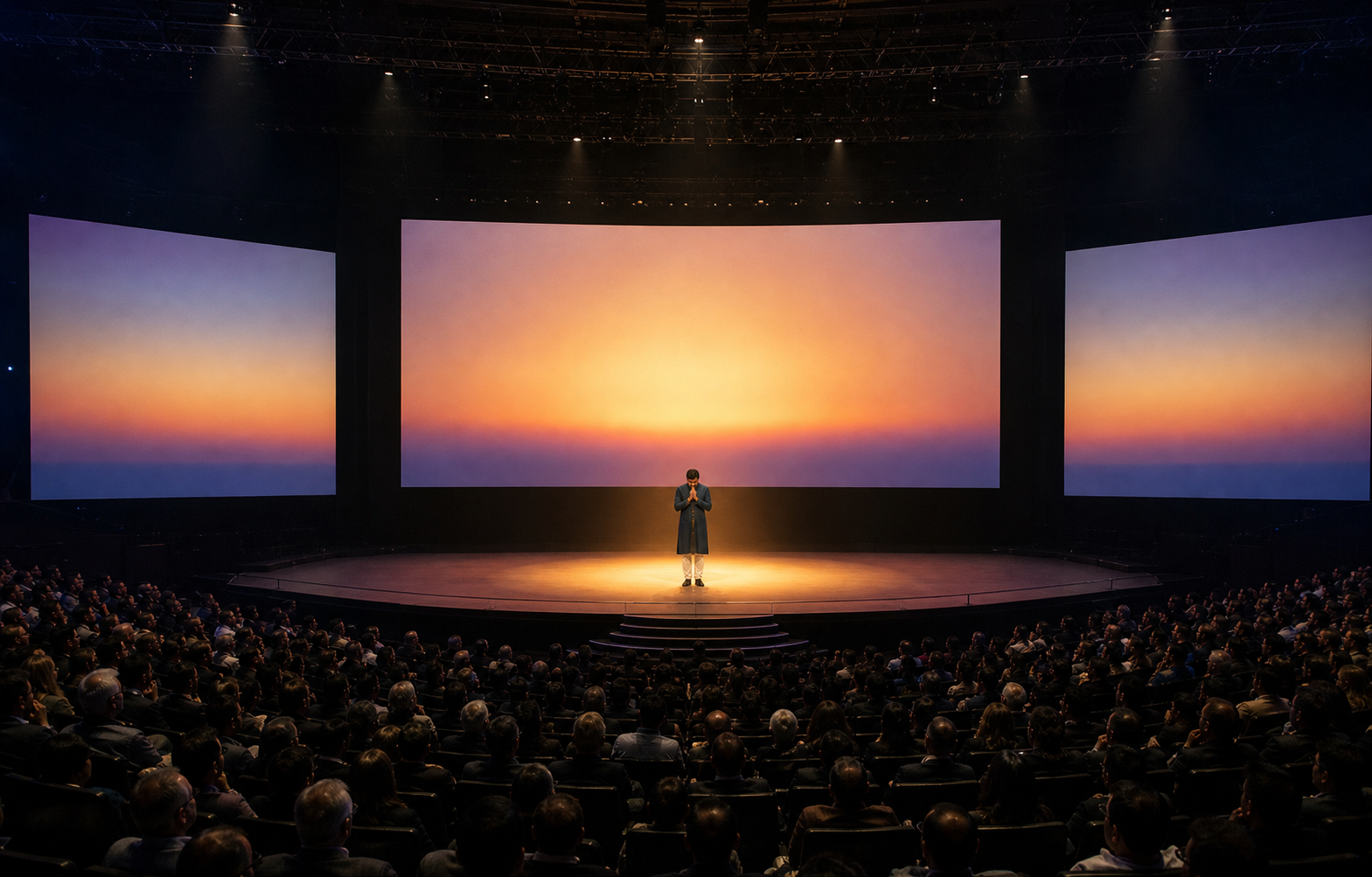
If you watched Vidyut Jammwal bring the Gayatri Mantra into a Street Fighter presentation and wondered whether it was meaningful Hindu representation or merely a promotional gesture, look at what the room actually did: it stopped, listened, and became still.
That response gives you a better way to judge such moments than applause, celebrity, or online reach. A sacred tradition is represented well when its identity, purpose, and manner survive the move into a commercial venue. At CinemaCon, restraint did most of the work.
The silence was the central act
At CinemaCon in Las Vegas, Jammwal began with brief invocations to the sun and then the moon before reciting the Gayatri Mantra. There was no elaborate spiritual set piece. Focused breathing, careful enunciation, and a measured cadence carried the moment.
The contrast mattered. A room that had been buzzing during a high-energy entertainment event became quiet, and many listeners closed their eyes. In an industry presentation, silence can look like empty time that needs to be filled. Here, it became a form of participation. The audience was not required to repeat unfamiliar words or pretend to understand their theology. Attentive listening was enough.
That does not prove that everyone in the auditorium understood the mantra. It shows something more modest and useful: people can recognize disciplined sacred conduct before they possess detailed cultural knowledge. Tone, posture, breath, and the absence of theatrical exaggeration tell an audience how a practice should be received.
It would be a mistake to conclude that a Vedic mantra gained dignity because a global entertainment audience validated it. The dignity was already present. What CinemaCon supplied was visibility. Jammwal did not need to dilute the practice to make the room receptive, and that is precisely why the moment matters for Hindu cultural representation.
His martial-arts background also gave the gesture coherence. Martial disciplines cultivate attention to breathing, balance, timing, and inner steadiness. Those qualities are compatible with the controlled vocalization of mantra. The invocation therefore appeared connected to the person offering it, rather than borrowed as an ornamental fragment of Indian culture.
When you assess a similar appearance in film, advertising, sport, or public ceremony, do not begin with the number of views it received. Notice what the presentation asks the audience to do. Does it protect a few uninterrupted moments for listening? Does the camera permit stillness, or does it smother the practice with reaction shots, branding, music, and applause cues? The treatment of silence often tells you more than the promotional caption.
Read the Gayatri Mantra by its purpose, not only its atmosphere

The Gayatri Mantra comes from Rig Veda 3.62.10 and is also known as the Savitri mantra. Its traditional orientation is the illumination of the intellect. It is a prayer that our understanding may be guided toward clarity, discernment, responsibility, and compassionate conduct.
This matters because the calm produced by a recitation is not the whole meaning of the recitation. If we describe the Gayatri merely as an ancient relaxation technique, we make it easier to market but harder to understand. A settled mind is valuable because it can perceive and choose more clearly. Stillness is a condition for discernment, not the final object of the prayer.
The brief salutations to the sun and moon at CinemaCon preceded the Gayatri Mantra. They were elements of Jammwal’s sequence, not a complete definition of the mantra itself. Keeping that distinction clear prevents a specific Vedic invocation from being reduced to a vague form of nature worship.
The form of the mantra also helps explain the audible and physical effect of its recitation. Gayatri chandas uses three balanced metrical lines, supporting rhythmic breathing and steady vocalization. When breath, sound, and attention move together, mental agitation can diminish and sustained attention can become easier.
Contemporary investigations of resonant, breath-synchronized chanting have associated such practices with calmer stress responses, closer coordination between breathing and heart rhythm, and greater attentional stability. Methods and findings vary, so these associations should not be converted into guaranteed medical claims. The defensible point is narrower: patterned recitation can help create conditions of calm focus, which accords with the role of breath and sound in longstanding mantra traditions.
If someone encountering the practice for the first time asks what they heard, one sentence is enough: The Gayatri Mantra is a Vedic prayer from Rig Veda 3.62.10 for the illumination of the intellect. That explanation is brief, accurate, and more respectful than calling it a generic Indian chant.
Key takeaways: a five-part test for respectful representation
- Name it precisely. Identify the Gayatri Mantra as a Vedic and Hindu invocation. Do not conceal its identity beneath labels such as spiritual sound, Eastern wisdom, or mindfulness music.
- Preserve its purpose. Explain that it seeks illumination of the intellect. Do not present it as a spell for victory, a celebrity flourish, or a device for creating an exotic mood.
- Respect the method. Pronunciation, breath, tempo, and attention are part of the presentation. A rushed or carelessly altered recitation cannot be rescued by impressive staging.
- Protect the listening space. An audience should be free to listen quietly without being pressured to imitate a sacred act it does not yet understand. Silence is a valid and inclusive response.
- Keep commerce outside the sacred act. A mantra can appear within a commercial event without becoming an advertising jingle. The surrounding program may promote a film, but the recitation itself should not be made into a gimmick or sales claim.
The CinemaCon appearance met these standards in a notably simple way. The chant was identifiable, the delivery was deliberate, and the room was allowed to receive it without caricature. Its presence within a Street Fighter launch did not require the mantra itself to behave like another part of the marketing package.
Visibility by itself is not a cultural achievement. A misnamed, trivialized, or decontextualized mantra can spread ignorance to a larger audience. The useful sequence is respect first, context second, and reach third. Reversing that order produces exposure without understanding.
Dharmic solidarity is strongest when the Vedic origin stays visible
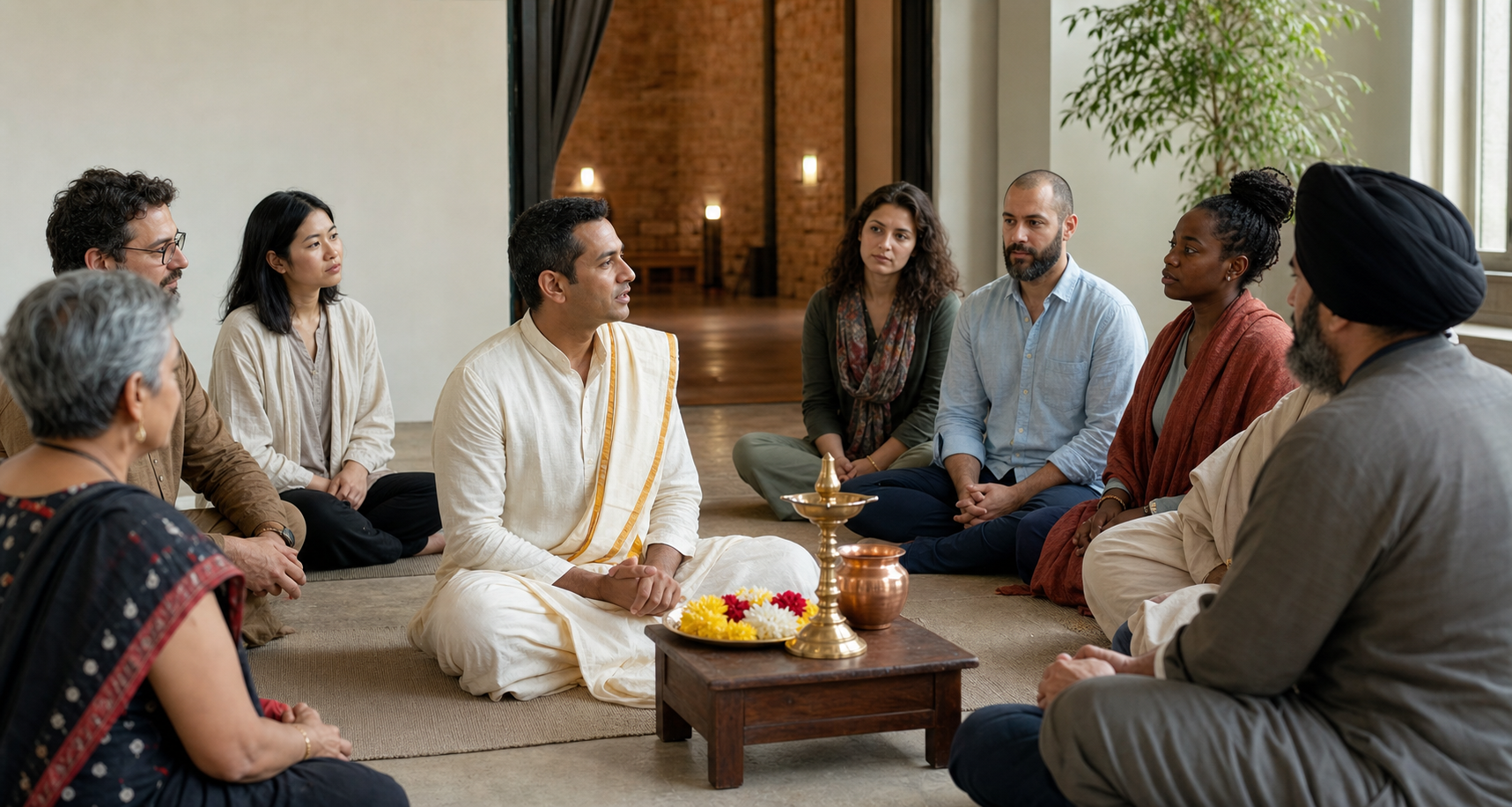
The Gayatri Mantra is specifically Vedic. Its ability to resonate with Buddhists, Jains, Sikhs, or people outside the Dharmic traditions does not make its origin interchangeable. Inclusivity should widen the circle of attentive listeners, not blur the identity of the practice being heard.
There are genuine contemplative convergences across the Dharmic family. Buddhist chanting and metta meditation cultivate attention and goodwill. The Jain Namokar Mantra offers reverence to exalted virtues rather than asking for a personal material reward. Sikh Naam Simran and kirtan center remembrance of the Divine. Each tradition has its own vocabulary, discipline, and theological setting, yet all demonstrate that sound and focused remembrance can reshape intention and conduct.
These are family resemblances, not claims of sameness. Calling the Gayatri a universal or pan-Dharmic mantra would erase the very Vedic specificity that made the CinemaCon moment an instance of Hindu representation. The clearer approach is to name the origin first and discuss the wider contemplative kinship afterward.
If someone asks whether the Gayatri is simply another kind of meditation, you can answer directly: it can be meditative in its disciplined use of breath, sound, and attention, but it remains a specific Vedic mantra with its own sacred identity and purpose. That distinction allows a newcomer to find a point of connection without being given a false equivalence.
This is an important lesson for Dharmic solidarity. Mutual respect does not require Hindus to detach a Hindu practice from its roots. Nor does fidelity to those roots require us to deny meaningful parallels with Buddhist, Jain, or Sikh practice. Pluralism becomes more credible when difference does not have to disappear.
How to carry a sacred practice into a public venue

If you are a performer, producer, teacher, community organizer, or presenter considering a mantra for a public event, the work begins before anyone reaches the microphone. Use this sequence.
- Establish relevance. Know why the invocation belongs at this event and why this person should offer it. A living connection between the speaker, the practice, and the occasion is stronger than decorative cultural placement.
- Write a one-sentence description. Include the exact name, Vedic origin, and purpose. If the description cannot do that clearly, the organizers are not yet ready to present the practice.
- Rehearse the sacred element, not just the stage cues. Enunciation, breathing, and cadence deserve the same preparation as lighting and sound. Work with a knowledgeable practitioner when the person reciting is not already trained.
- Remove competing stimuli. Do not place commentary, sponsor messages, dramatic music, or rapid visual edits over the recitation. Give the mantra an audible beginning, uninterrupted space, and a clear end.
- Let participation remain voluntary. Invite attentive listening without demanding repetition, closed eyes, or a particular posture. Explain the meaning plainly, then allow the audience to respond at its own level of understanding.
If you are sharing the CinemaCon clip rather than staging an event, add context instead of a triumphalist slogan. A useful caption would be: At CinemaCon in Las Vegas, Vidyut Jammwal recited the Gayatri Mantra, a Vedic prayer from Rig Veda 3.62.10 for the illumination of the intellect. The room responded with attentive silence.
Avoid framing the moment as proof that Hindu tradition has finally become worthy because a Western audience listened. That gives an entertainment venue authority it does not possess. Lead with what the mantra is and why its delivery was faithful. The audience’s respectful response is meaningful, but it is the consequence of the representation, not the source of the tradition’s value.
For many diaspora Hindus, hearing the Gayatri Mantra in a Las Vegas auditorium can recall dawn or dusk recitation, temple bells, and family practice. That emotional recognition deserves space, but the most durable result will be cultural literacy rather than a brief wave of online pride. Use the moment to teach the name, textual location, purpose, and discipline of the mantra.
The next time a Dharmic practice appears on a global stage, ask three questions before you celebrate or condemn it: Was it named truthfully? Was it offered competently? Was the audience allowed to receive it without coercion or distraction? When the answer is yes, share it with one clear sentence of context. That is how a short public invocation can become a lasting act of cultural understanding.