
You may have encountered the name Karali beside Chithirai and wondered whether it denotes Kali, a local Amman, or a goddess connected to a particular festival. The safest answer is also the most precise: in a Tamil Shaiva sacred-calendar tradition, Karali is the divine feminine presence associated with the month of Chithirai.
That distinction lets you approach Karali with reverence without inventing an image, mantra, or ritual. You can understand what the monthly association means, work with its symbolism, and know where inherited tradition must take precedence over assumption.
Place Karali within the twelve-month sacred calendar
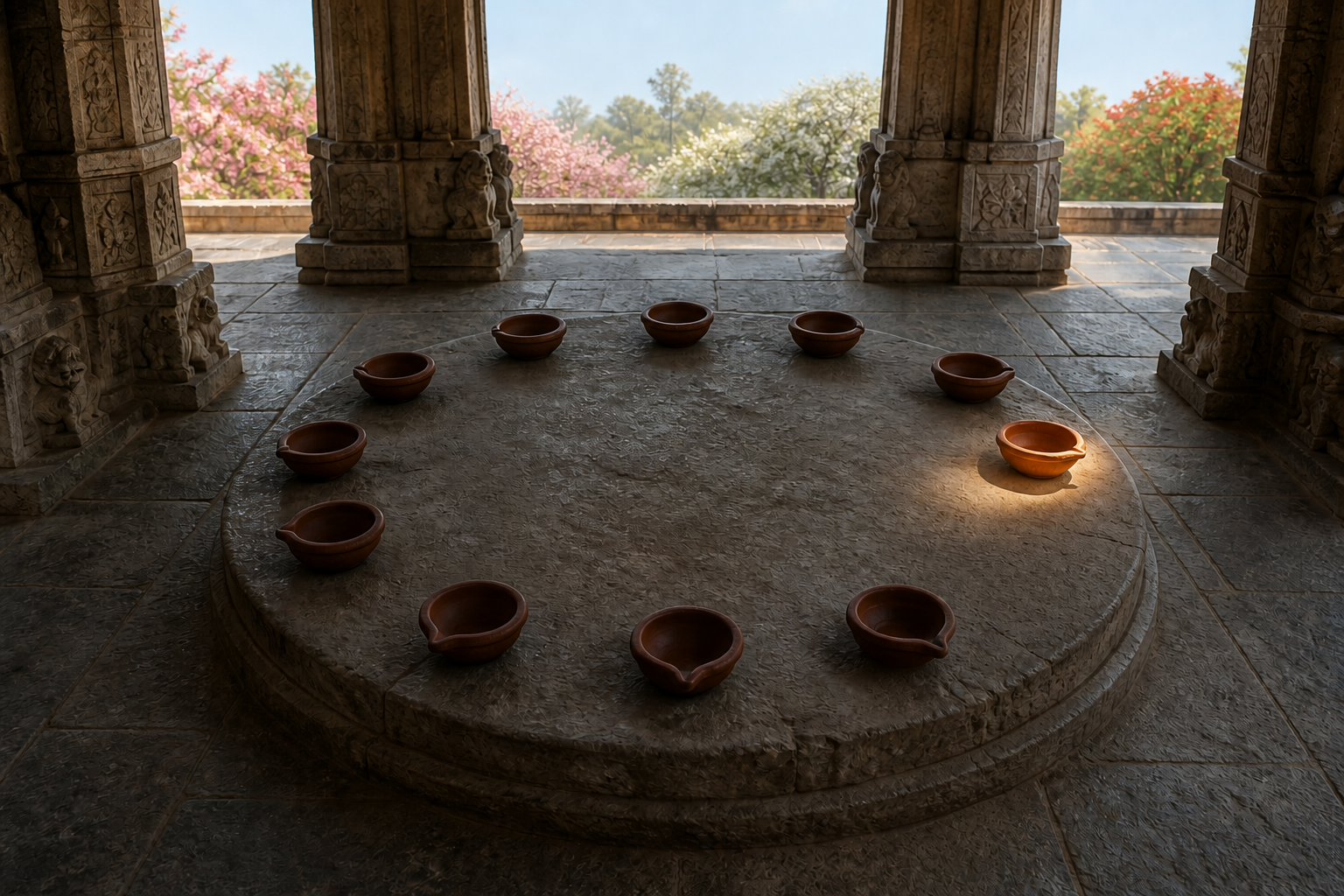
Within this Tamil Shaiva arrangement, Karali presides over Chithirai as one of the Dvadasa Masa Devis. The name Dvadasa Masa Devis means the twelve month-goddesses: twelve forms of divine feminine presence corresponding to the twelve Tamil months.
This framework asks you to see time as more than an empty container for religious events. The month itself becomes sacred. Its arrival is a threshold at which a particular form of Shakti can be remembered, contemplated, and honoured. Moving through the year can therefore become a devotional discipline rather than merely a sequence of dates.
The essential distinction is that Karali’s role here is calendrical. The association identifies the goddess presiding over Chithirai within this particular cycle. It does not, by itself, establish a universal icon, an authorised mantra, a compulsory offering, or an identical temple festival everywhere. Each of those details requires its own grounding in a temple tradition, Agamic practice, family custom, or teaching lineage.
Read Karali’s fierceness without turning it into fear

The name Karali carries a fierce or formidable register. In Dharmic religious language, fierceness should not automatically be translated as evil, cruelty, or ordinary human anger. A fierce Devi can express divine power that refuses compromise with disorder, falsehood, attachment, or spiritual inertia.
Yet a name is not a complete iconographic description. You cannot reliably infer Karali’s posture, weapons, vehicle, colours, hand gestures, or offerings merely from the fact that her name sounds fierce. Nor should she be casually equated with another fierce goddess because two names or moods appear similar. Resemblance can help contemplation, but it is not proof of ritual or theological identity.
You can work with the fierce symbolism without making unsupported claims. At the beginning of Chithirai, ask where firmness is required in your own conduct. Choose one concrete correction: finish a neglected duty, end a dishonest convenience, restrain harmful speech, or restore a discipline you have allowed to weaken. The point is not to claim that Karali guarantees a particular result. It is to let remembrance of formidable Shakti change how you meet the month.
Observe Chithirai without fabricating a ritual
If your family, guru, or temple already maintains a Chithirai observance, begin there. A received practice carries context that an isolated name on a calendar cannot supply. If you have no such instruction, keep the observance modest and be candid that it is personal devotion rather than a prescribed temple rite.
- State the association accurately. Remember Karali as the presiding Devi of Chithirai within the Dvadasa Masa Devi framework. Do not enlarge that statement into claims you cannot verify.
- Keep your established Shaiva practice at the centre. Continue the Shiva worship, nama japa, prayer, or household puja already received through your family or lineage. The monthly remembrance can accompany that practice without displacing it.
- Mark the month’s arrival simply. A respectful pranama, a flower, water, or a period of silent contemplation can serve as a personal marker when these are consistent with your household practice. Do not present your chosen act as a universal Karali ritual.
- Undertake one disciplined correction. Select an action that requires courage and firmness, make it measurable, and sustain it through Chithirai. A precise vow is more useful than vague admiration of divine power.
- Review rather than perform. At the month’s end, ask whether your speech, duty, restraint, or devotional consistency actually changed. Carry forward what became stable and release whatever was merely ceremonial enthusiasm.
Specialised mantras deserve particular care. Similar-sounding deity names do not make a mantra transferable, and a web page cannot confer initiation. If a mantra or rite is described as lineage-bound, secret, or initiatory, seek instruction from a qualified teacher within that tradition. Until then, your established Shaiva practice is a sounder foundation than an impressive formula with uncertain provenance.
Verify images and ritual claims before sharing them
Online devotional material often moves faster than its context. An image can be relabelled, a mantra can be detached from its lineage, and a regional observance can be presented as universal. Before teaching or reposting anything about Karali, test the claim rather than relying on visual resemblance or repetition.
- Check the scope. Is the claim specifically about Karali in the twelve-month Tamil Shaiva cycle, or about a separate deity or local temple tradition?
- Check the provenance. Does the image or ritual come from an identifiable temple, Agamic context, family tradition, or qualified teacher?
- Separate association from description. Knowing that Karali presides over Chithirai does not automatically tell you what her canonical form looks like.
- Separate public devotion from initiation. A simple act of reverence and a specialised mantra practice are not interchangeable.
- Label interpretation honestly. If you are offering a personal symbolic reading, call it that. Do not present inference as inherited doctrine.
A useful rule is to stop where your evidence stops. When all you can establish is the name Karali, the month Chithirai, and the Dvadasa Masa Devi setting, preserve those facts carefully. Leaving an iconographic detail unclaimed is more respectful than filling the gap with another Devi’s attributes.
Key takeaways
- Karali is the goddess associated with Chithirai in a Tamil Shaiva cycle of twelve month-goddesses called the Dvadasa Masa Devis.
- The tradition sacralises time itself: each month can be approached as a distinct period of divine feminine presence.
- Karali’s fierce name supports contemplation of firmness and transformative power, but it does not supply a complete iconography.
- An inherited family, temple, or lineage practice should take priority over rituals reconstructed from isolated online claims.
- If no specific rite has been received, combine simple reverence with one concrete discipline and describe the observance honestly as personal.
- Verify the provenance of images, mantras, offerings, and theological identifications before sharing them as tradition.
When Chithirai arrives, begin with what is securely known: remember Karali, honour the sacred character of time, and choose one form of disciplined action worthy of a formidable Devi. If a living tradition later gives you a more specific practice, receive it in its proper context rather than trying to anticipate it.
References
