
14 June 2026, a Sunday, is Sarva Amavasya across India. In the lunisolar reckoning it is Adhika Jyeshta Amavasya; in Tamil Panchangam it is Vaigasi Masa Amavasai; in Malayalam Panchangam it is Edava Maasa Karthu Vavu; and in the Bengali calendar it is Jyeshto Mash Amabashya. Regions following Amavasyant Panchangam observe this Amavasya as the month-ending tithi. The day is traditionally chosen for Pitru Tharpana, a grateful remembrance of forebears that nourishes continuity, duty, and compassion.
Sarva Amavasya indicates that the Amavasya tithi prevails at local sunrise across the subcontinent, allowing a unified observance irrespective of regional almanac variations. This shared window strengthens the ideal of unity in diversity cherished across dharmic traditions and facilitates a consistent family and community rhythm for ancestor remembrance.
The qualifier Adhika Jyeshta reflects a calendrical intercalation. In the Hindu lunisolar system, an Adhika Maas is inserted when a lunar month elapses without a solar saṅkranti. In 2026, this leads to an Adhika Jyeṣṭha lunar month. The resulting Adhika Jyeshta Amavasya aligns ritual focus on Amavasya-based observances without disturbing the solar-seasonal cadence, preserving both astronomical fidelity and ritual continuity.
Ancestor reverence, as expressed through Pitru Tharpana, resonates across the dharmic family. Hindu households traditionally offer tilodaka to the pitrs, while closely related values of filial gratitude and remembrance appear in Jain, Buddhist, and Sikh milieus through service, meditation, and collective prayer. Observing Amavasya with sincerity and non-harm fosters inner quietude and social harmony, advancing the blog’s commitment to unity among Hinduism, Buddhism, Jainism, and Sikhism.
Recommended muhurta guidance for Pitru Tharpana on Sarva Amavasya prioritizes a clean and calm morning period after snana and up to midday, or as per family and regional practice that may favor the aparahna stride for pitri-karmas. Practitioners typically face south during tarpanam, seat themselves on darbha or a clean mat, and maintain mindful silence. Local Panchang details should be consulted to avoid inauspicious intervals such as Rahu Kaal in that locality.
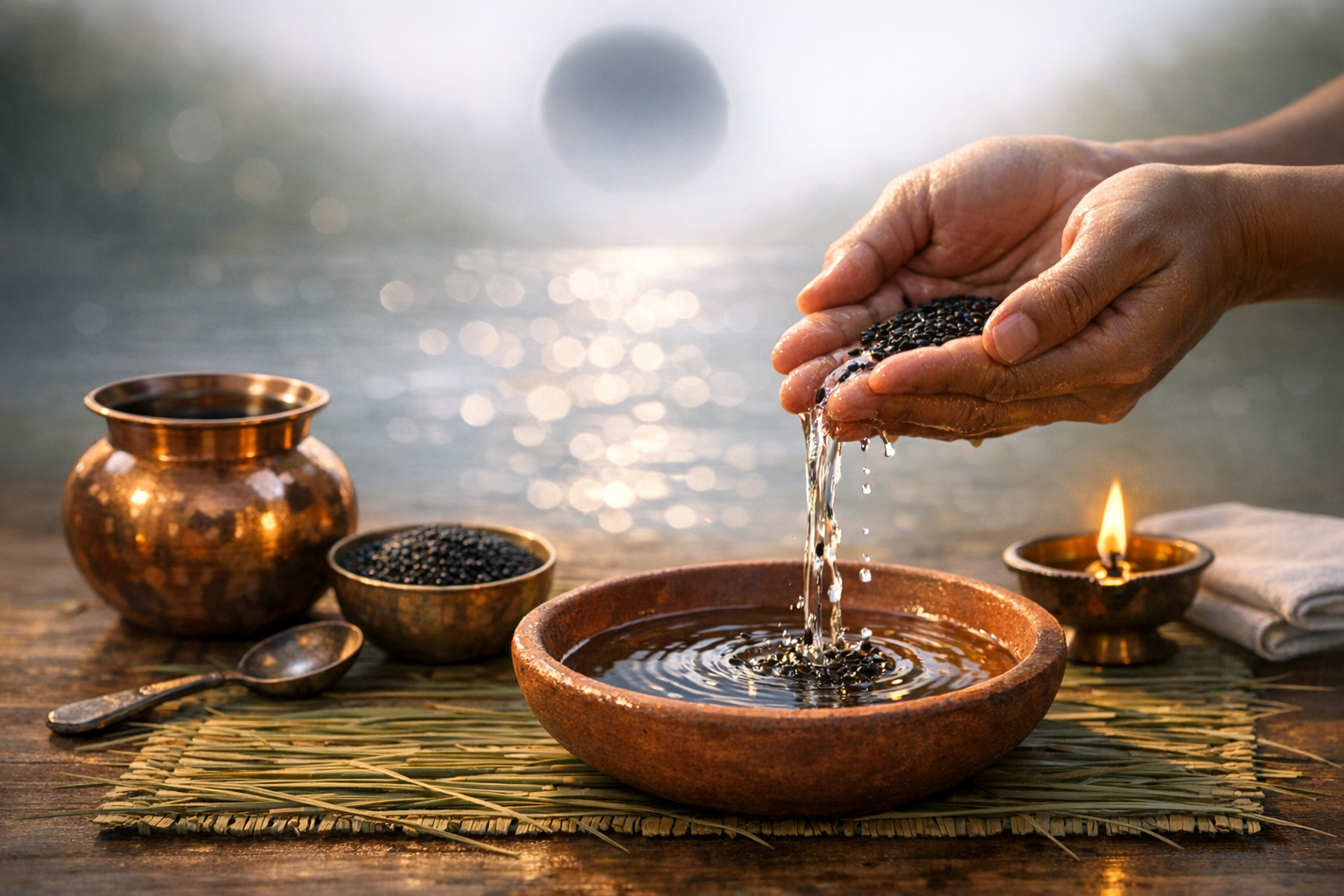
Commonly used materials include water in a copper or clean vessel, black sesame seeds, darbha grass for pavitra and asana, a small spoon, a plate or bowl for tilodaka overflow, and a simple lamp. Those who customarily use a janeu or pavitra should be guided by their sampradaya. Vegan or eco-friendly alternatives to any consumables are readily compatible with the spirit of the rite.
Preparation typically proceeds through snana, clean clothing, simple achamana, and a quiet settling of the breath. A short period of mauna stabilizes attention and opens the heart to gratitude. The sankalpa then articulates time, place, intention, and the specific rite to be undertaken, aligning personal effort with a dharmic and cosmic frame.
Opening invocations recited with composure are customary. For example: śrī-gaṇeśāya namaḥ, śrī-gurubhyo namaḥ, śrī-govinda govinda govinda. Such invocations calm the mind and orient the act toward humility and service.
Core short sankalpa for Amavasya Pitru Tharpana is concise and widely accepted: mama upāta-samasta-durita-kṣaya-dvāra śrī-parameśvara-prītyarthaṃ amāvāsyāyāṃ pitṛ-tarpaṇaṃ kariṣye. This captures purpose, day, and action with clarity for those who prefer a brief formulation.
An extended Vaidika-style sankalpa, adaptable to place and personal details, may be recited as follows: asya śrī-brahmaṇo dvitīya-parārdhe śvetavarāha-kalpe vaivasvata-manvantare kali-yuge prathama-pāde jambudvīpe bhāratavarṣe bhārata-khaṇḍe [country, state, city] [nadī-tīre] uttarāyaṇe grīṣma-ṛtau adhika-jyeṣṭha-māse kṛṣṇa-pakṣe amāvāsyāyāṃ bhānuvāsare śubhe śobhana-muhūrte mama upāta-samasta-durita-kṣaya-dvāra śrī-parameśvara-prītyarthaṃ amāvāsyā-pitṛ-tarpaṇaṃ kariṣye. Practitioners may optionally include gotra and personal name in the appropriate place per family tradition.
For Tamil Panchangam users, the time component can be localized within the same Sanskrit frame, referencing the month as Vaigasi Masa Amavasai to preserve regional convention while retaining the Vaidika structure and intent of the sankalpa.
For the Bengali calendar, one may likewise reference Jyeshto Mash Amabashya within the sankalpa phrase while keeping the rest of the formulation unchanged, thereby honoring local calendrical nomenclature.
For the Malayalam calendar, the same method applies, noting Edava Maasa Karthu Vavu in the relevant place of the sankalpa while preserving the Sanskrit core that defines the rite’s purpose and alignment.
A faithful plain-language intention can also be expressed for those not reciting Sanskrit, for example as a quiet inner vow after the formal sankalpa: With gratitude and humility, on this Sarva Amavasya I offer water and sesame as Pitru Tharpana for the peace, contentment, and upliftment of my ancestors and for the cultivation of virtue, compassion, and clarity in this lineage and all beings.
After the sankalpa, the tarpanam sequence typically proceeds as devatā tarpaṇa, ṛṣi tarpaṇa, and pitṛ tarpaṇa. A simple and widely used pattern is as follows, each line repeated three times with water and sesame offered from the right hand through the fingertips while facing south: om devatābhyo namaḥ tarpayāmi; om ṛṣibhyo namaḥ tarpayāmi; om pitṛbhyo svadhā namaḥ tarpayāmi. The offering should be mindful and unhurried, with each pour accompanied by a gentle remembrance.
When offering to one’s lineage, many traditions recall paternal and maternal lines separately. Those who know the names and gotras of father, grandfather, and great-grandfather, and similarly for the maternal side, may add nāmagotrānusandhāna during pitṛ tarpaṇa. Those who do not know specifics may simply offer to all ancestors known and unknown with the intention of completeness and respect.
Concluding the rite often includes a brief silent prayer for universal well-being, a respectful namaskāra, and, where customary, a small offering in nature such as watering a plant or feeding birds. Acts of compassion, such as annadāna or supporting those in need, extend the merit of the rite beyond the self and reinforce social solidarity.
Practical guidance helps avoid common errors. Clean water and black sesame seeds are recommended for tilodaka. The offering should be directed to a clean, absorbent surface or a dedicated bowl that is later returned to earth or a garden; pouring into a drain is discouraged. If performing near a natural water body, ensure environmental care and minimal disturbance.
Inclusivity is integral to contemporary practice. In many regions, women and men alike observe Amavasya remembrance; where household or regional customs differ, mutual respect and gentle consultation within the family preserve harmony. Those rooted in Buddhist, Jain, or Sikh practices may complement or substitute the Vedic mantras with meditation, ardas, sutra recitation, or dana, staying aligned with the shared dharmic ethic of gratitude and non-harm.
The choice between a short or extended sankalpa depends on familiarity and comfort. The short form preserves accuracy with minimalism, while the extended Vaidika frame situates the act in a cosmological timeline that many find spiritually anchoring. Both approaches are correct when performed with devotion, clarity of intent, and adherence to family or guru guidance.
While regional almanacs may present local nuances, Sarva Amavasya on 14 June 2026 offers a single, widely auspicious window for Pitru Tharpana. Aligning with Vaigasi Masa Amavasai, Edava Maasa Karthu Vavu, and Jyeshto Mash Amabashya acknowledges linguistic and calendrical richness while upholding unity at the level of tithi and purpose.
Symbolically, each libation affirms that present life is interwoven with the gifts and struggles of prior generations. Many practitioners experience a gentle softening of the heart and a clearer sense of ethical duty as the water and sesame descend. This emotional resonance is not incidental; it is the inner fruit of a rite meant to dignify memory, heal subtle bonds, and renew commitment to truth and kindness.
In summary, Amavasya Pitru Tharpana on 14 June 2026 is best approached with simplicity, accuracy, and compassion. The mantras provided, along with the localized calendar references and practical instructions, enable a careful and confident observance. Perennial dharmic values are thereby translated into lived action that honors ancestors, strengthens families, and contributes to social harmony.
Inspired by this post on Hindu Pad.
