
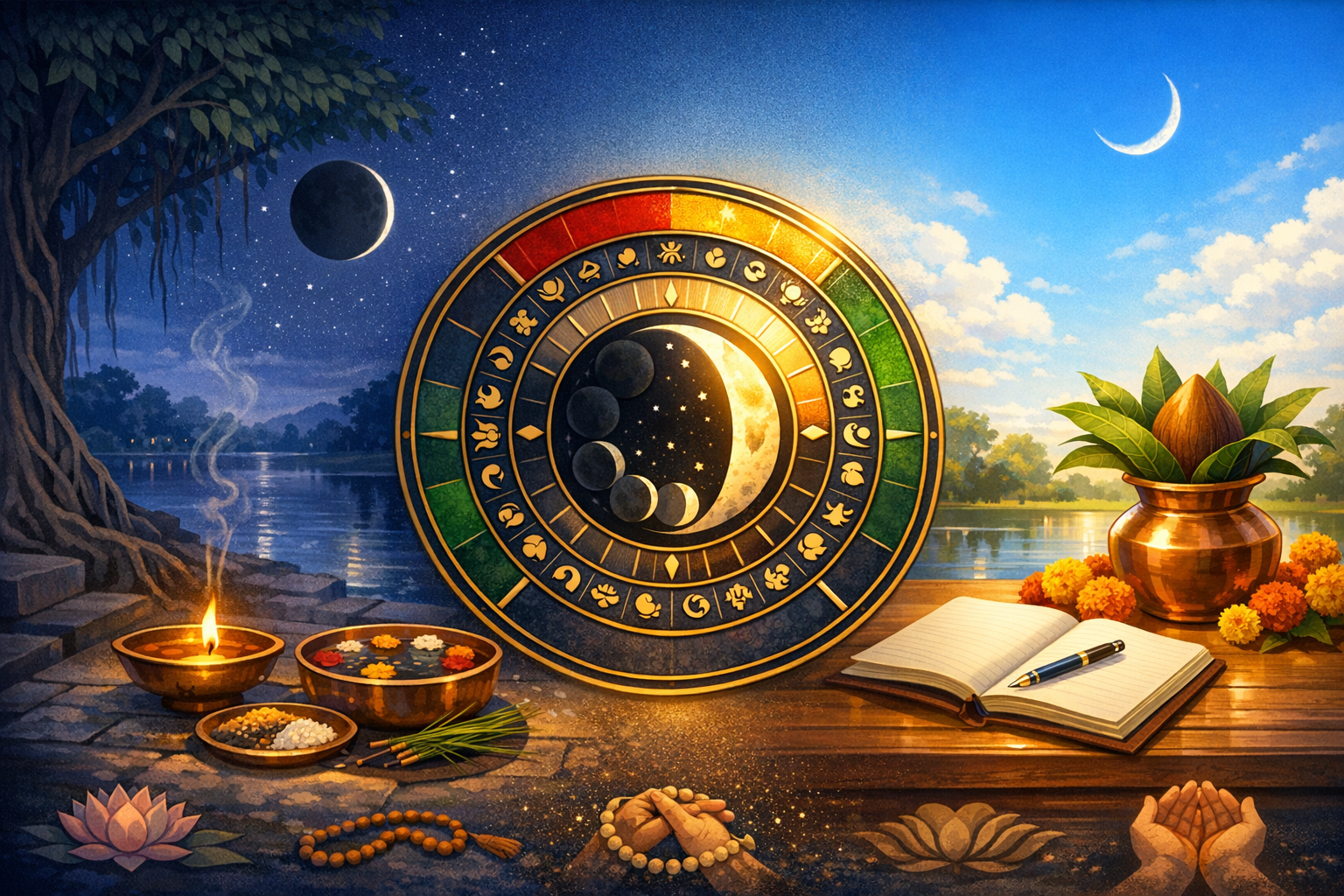
June 15, 2026 (Monday) marks a pivotal calendrical transition in the Hindu calendar (Panchang). Amavasya tithithe no-moon dayprevails until 8:45 AM on June 15, after which Shukla Paksha Pratipada (the first lunar day of the waxing fortnight) continues until 6:17 AM on June 16. Time is applicable in all north, south and eastern parts of India and generally read in Indian Standard Time (IST). These precise tithi boundaries structure the day into two distinct spiritual moods: the inward-facing solemnity of Amavasya in the morning and the outward-facing renewal of Pratipada thereafter.
Because Amavasya coincides with a Monday (Somvar), the morning period is Somvati Amavasya, traditionally regarded as especially potent for pitṛ-kārya (ancestral offerings), introspection, vrata (fasting, where observed), and charity. Many households experience this phase as quietly contemplativean opportunity to settle unfinished inner dialogues, offer Tarpana, and align with the cyclical rhythm of repose before new beginnings. The mood often shifts perceptibly once Amavasya ends at 8:45 AM, when Shukla Paksha Pratipada begins and the day’s energy turns toward initiative, clarity, and renewal.
Across the Dharmic spectrum, these lunar junctures resonate in complementary ways that underscore unity in diversity. In Hindu practice, Amavasya emphasizes inward discipline and remembrance of forebears; Shukla Paksha Pratipada encourages sankalpa (intent-setting) for the fortnight ahead. In Buddhism, the new and full moons frame Uposatha observances of ethical reflection; in Jainism, new-moon and fortnightly days support pratikraman and vrata for purification; and while the modern Sikh Nanakshahi calendar is solar-fixed, many Punjabi households continue to notice key lunar markers such as Pooranmashi and Amavasya in their wider cultural milieu for katha, seva, and shared community practice. This shared attentiveness to lunar rhythm nurtures a lived sense of kinship among Hindu, Buddhist, Jain, and Sikh communities.
Technical note on tithi calculation clarifies why the day divides as it does. A tithi is defined by the elongation between the Moon and the Sun, changing every 12 degrees of geocentric angular separation. Amavasya concludes the moment the Moon–Sun elongation resets after conjunction, and Shukla Paksha Pratipada begins immediately thereafter. The times 8:45 AM (June 15) and 6:17 AM (June 16) capture the exact instants of these transitions for India and ensure that ritual timing, sankalpa statements, and muhurtas can be aligned with astronomical reality.
Good Time (Shubh Muhurat) guidance on this day naturally follows the tithi sequence. The Amavasya morning invites pitṛ-kārya, vrata, japa, and dāna. New initiativessuch as starting studies, planning journeys, setting intentions for projects, or consecrating toolsare best aligned after 8:45 AM, when Shukla Paksha Pratipada begins. This accords with a long-standing Panchang logic: internal quietude and completion during the waning phase yield to outward cultivation and growth once the waxing fortnight opens.
Rahu Kaal should be avoided for fresh undertakings. On Mondays, Rahu Kaal typically falls in the early morning block after sunrise (commonly approximated around 07:30–09:00 when sunrise is near 06:00), though exact bounds depend on local sunrise. Because Amavasya itself lasts into the morning, many will naturally emphasize ancestral observances first and plan auspicious starts later in the day, beyond the morning Rahu Kaal. Yamaganda and Gulika Kaal, while secondary to Rahu Kaal in many regional practices, are also generally avoided for important beginnings, and practitioners are advised to consult a city-specific Panchang for precise windows.
Abhijit Muhurta provides a practical safety valve for time-sensitive tasks. Defined as the central eighth part of the daytime, it straddles local solar noon (approximately 24 minutes before and after the midday point, computed as the exact halfway mark between local sunrise and sunset). Abhijit Muhurta is traditionally considered broadly auspicious for urgent initiations when other windows are constrained, though adherence varies by lineage and regional custom.
Choghadiya can further refine decision-making for those using Gujarati, Rajasthani, and Western Indian conventions. Daytime Choghadiya rotates through Amrit, Shubh, Labh (favorable), Char, Kaal, Udveg, and Rog (unfavorable) in a cyclical sequence of roughly 96-minute blocks. As sunrise shifts by latitude and season, the sequence anchors to the local day; thus, practitioners should identify their location-specific chart for June 15 to select Shubh, Labh, or Amrit periods, particularly after 8:45 AM when Shukla Paksha Pratipada is in effect.
Nakshatra and Rashi readings contextualize daily energies in Vedic astrology. Nakshatra (lunar mansion) qualifies the Moon’s qualitative field for the day, while the Moon’s Rashi (sign) reveals the emotional and environmental tone. On Amavasya, the Moon is conjunct the Sun, so Moon-sign judgments are more tightly coupled to the Sun’s sidereal position than on other tithis. Without location-specific ephemerides for the hour, a responsible approach is to reference a reliable regional Panchang or astronomical almanac for the exact Nakshatra and Rashi at the intended moment of action. The interpretive principle is consistent: select auspicious tasks in accord with favorable Nakshatra attributes and avoid those contraindicated by the day’s stellar and sign-based indications.
Month transitions around mid-June 2026 may intersect with Adhik Jyeshta Maas 2026 in some almanacs, which explains why regional calendars can frame this Amavasya differently (Amānta versus Pūrnimānta reckoning). The functional takeaway is straightforward: the morning remains Amavasya for ancestral observances, and the shift to Shukla Paksha Pratipada after 8:45 AM supports fresh undertakingsregardless of whether the regional tradition names the lunar month by Amānta or Pūrnimānta convention.
Somvati Amavasya observances often include Tarpana where practiced, quiet recitation (japa), and dāna such as food or essential items. Some communities revere the Peepal tree with pradakshina and dipa (lamp) lighting, while others emphasize a bath at a nearby water body. These practices are expressions of gratitude and continuity rather than rigid requirements; their common thread is remembrance, humility, and servicevalues cherished across Hindu, Buddhist, Jain, and Sikh traditions as forms of ethical alignment and community harmony.
After 8:45 AM, Shukla Paksha Pratipada is well suited to gentle commencements: beginning a course of study, drafting a project outline, initiating collaborative work, consecrating a workplace artifact, or setting a home routine for the fortnight. In households, the tonal change from the contemplative Amavasya morning to the fresh Pratipada afternoon is often palpablequietly uplifting and focused, yet still grounded in the dignity and restraint cultivated earlier in the day.
Those coordinating temple visits or community events may use a simple protocol: schedule remembrance and pitṛ-kārya in the morning Amavasya window; avoid the Monday Rahu Kaal block for new undertakings; leverage Abhijit Muhurta for time-critical needs; and plan principal initiations in the post–8:45 AM Pratipada phase, selecting favorable Choghadiya where regionally customary. This approach honors both the astronomical rigor of the Panchang and the pastoral cadence of household and community life.
Finally, this Panchang reading models unity across Dharmic paths by recognizing that shared attention to lunar rhythm fosters empathy, continuity, and common purpose. Whether expressed through Hindu pitṛ-kārya, Buddhist ethical recollection, Jain vrata and pratikraman, or Sikh seva situated within a culturally shared lunar awareness, the core aspiration remains the same: to cultivate inner clarity and outer compassion. June 15, 2026, thus unfolds as a day to complete what must be completed, to begin what seeks to be begun, and to carry both gestures in a spirit of Dharmic solidarity.
Inspired by this post on Hindu Blog.
