
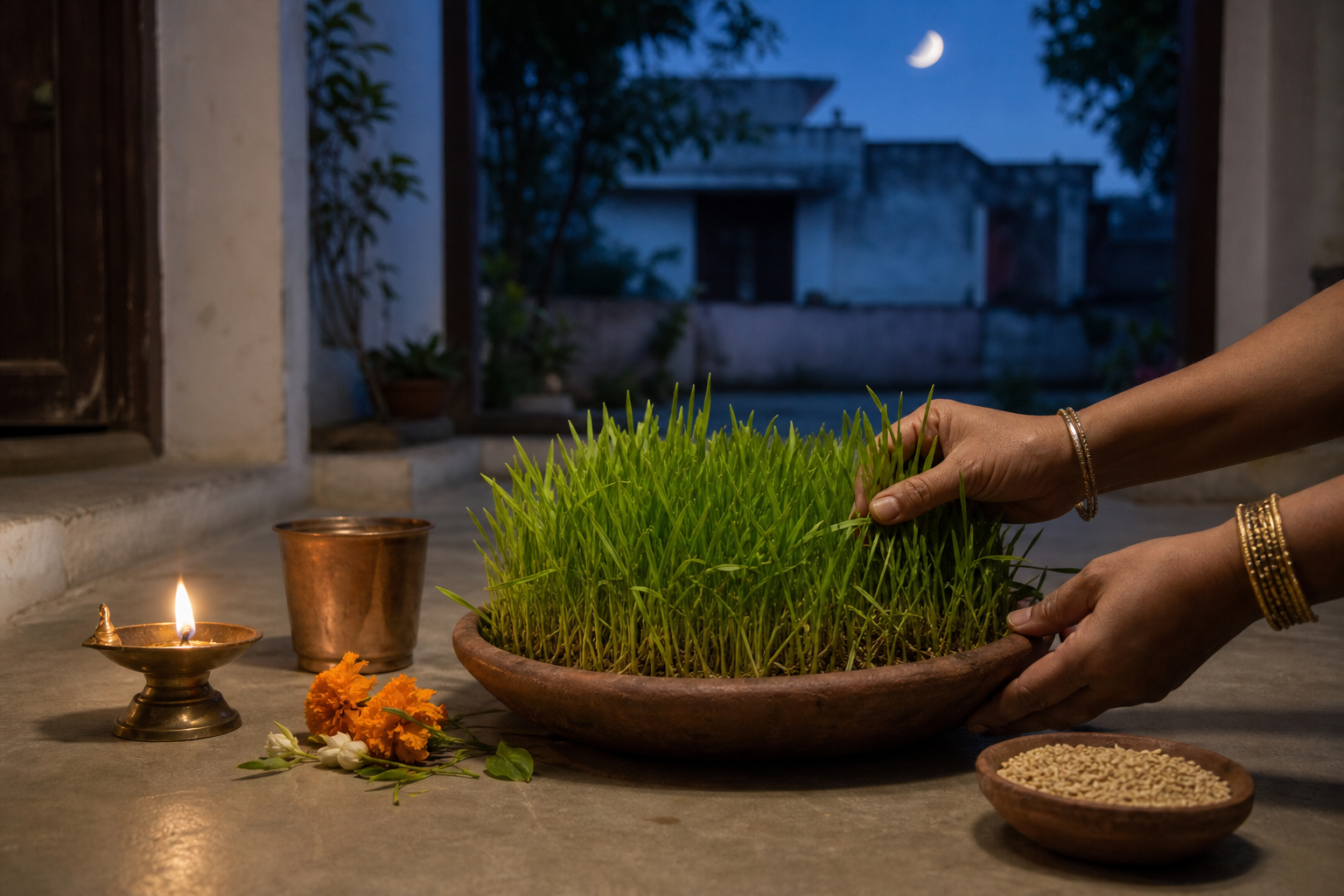
If your family remembers sowing jau for Kajari but no one is quite sure what happens between Navami and Purnima, begin with one correction: this is a festival cycle, not a pair of unrelated dates. You sow and make a sankalpa on Navami, tend the emerging shoots through the intervening days, and complete the observance on Purnima.
For 2026, reserve 22 August for Kajari Navami and 28 August for Kajari Purnima. The plan below will help you prepare the vessel, maintain the daily observance, complete it without polluting a water source, and keep regional family custom where it rightly belongs.
Start with the calendar, but let local custom settle the timing
Kajari Navami falls on 22 August 2026, on Shravan Shukla Navami in the Hindi Vikram Samvat calendars followed in much of the festival’s core region. Kajari Purnima falls on Friday, 28 August 2026, coinciding with Shravan Purnima and Raksha Bandhan.
Those civil dates are enough for advance planning, but they do not create one universal clock time. A lunar tithi can begin on one civil date and end on another. For Navami, households commonly follow the date on which the tithi prevails at local sunrise or during the main daylight period. Purnima observances may likewise have a locally defined window. Check the panchang used by your family, a nearby temple notice, or an elder from the community whose practice you intend to follow.
| Stage | 2026 planning date | Essential action |
|---|---|---|
| Kajari Navami | 22 August | Clean the shrine, make the sankalpa, and sow barley or wheat in clean soil. |
| Intervening days | After Navami through Purnima | Keep the vessel shaded and clean, moisten it lightly when needed, and offer a short daily prayer or aarti. |
| Kajari Purnima | 28 August | Perform the concluding worship and return the sprouts respectfully to water, a field edge, or the roots of a sacred tree according to local custom. |
This sequence matters. If you remember only the Purnima immersion, you miss the discipline at the centre of the vrata: a living thing is placed in your care, attended to each day, and then returned. The continuity between those acts is the observance.
Prepare a small, complete kit before Navami
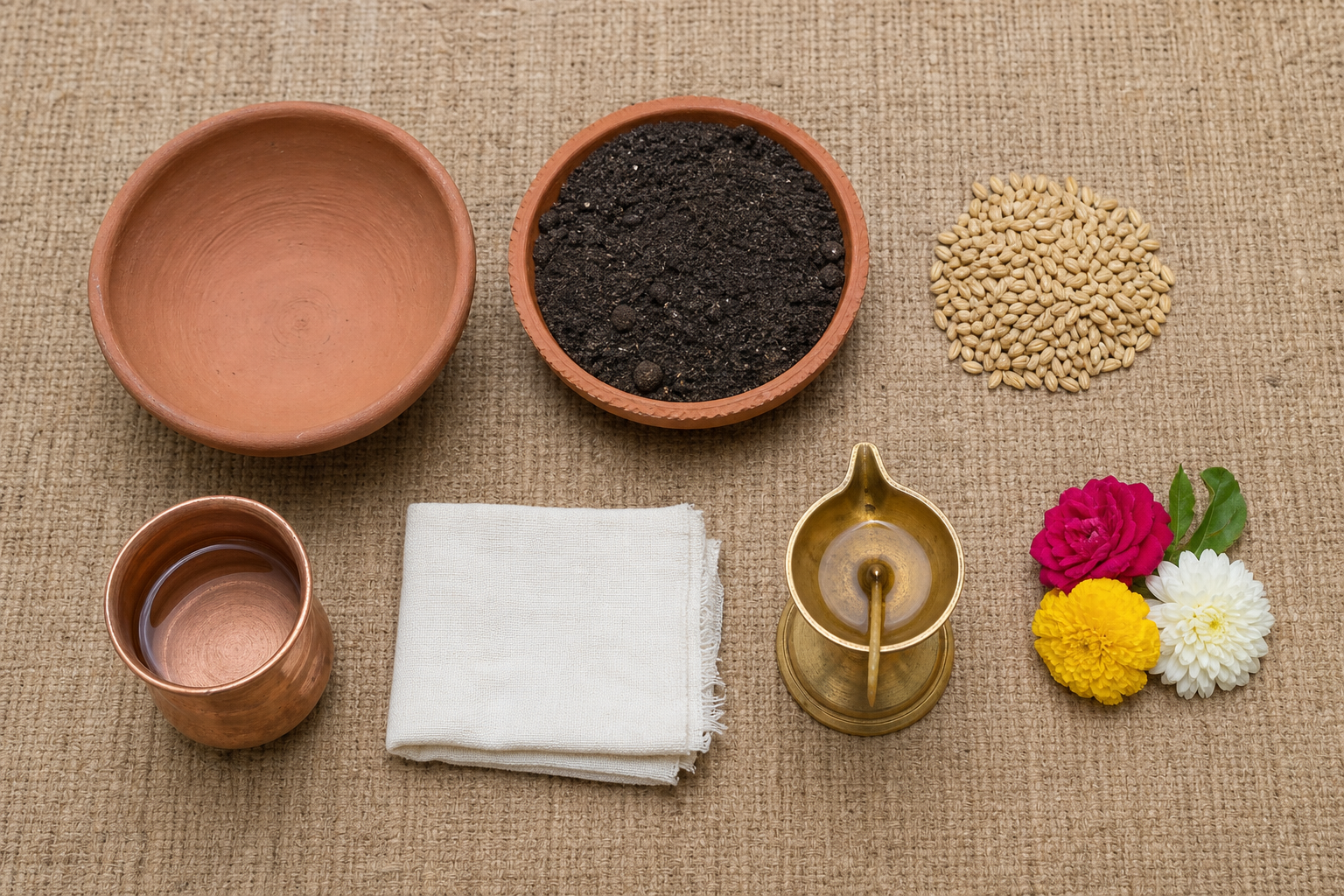
You do not need elaborate decorations. The ritual focus is the seed, soil, water, and steady care. Gather the materials before Navami so that the first morning is not spent searching for a vessel or deciding where the sprouts will eventually go.
- Seeds: Barley, or jau, is especially customary. Wheat is also used in some households. Follow an inherited family practice when you have one rather than replacing it for novelty.
- Soil and vessel: Use clean soil in a small earthen pot, shallow tray, basket, or biodegradable leaf dona or pattal. If the vessel can leak, place it on a reusable plate so that the shrine remains clean.
- Puja materials: Keep water, a lamp, cotton wicks, incense if your household uses it, flowers, seasonal fruit, and a modest sweet offering ready. A clean cloth or chowk can define the worship area.
- A suitable place: Choose a shaded, hygienic corner near the household shrine. The shoots need regular attention, but the vessel should not obstruct daily household activity.
- A completion plan: Decide in advance whether your family returns the sprouts to a clean river, pond, or well, places them at a field edge, or offers them at the roots of a Peepal, Neem, or another locally revered tree.
- A daily routine: Choose a short time when someone can check the soil and perform the household’s brief prayer or aarti. Consistency is more appropriate here than a long ceremony that cannot be maintained.
Rinse the grain and let it dry before sowing if that is your household method. Moisten the soil rather than soaking it. The aim is to nurture shoots, not to leave seed sitting in stagnant water. Locally sourced grain and biodegradable ritual materials keep the preparation aligned with the agrarian and ecological meaning of the festival.
Your sankalpa can name the purposes carried by the tradition: gratitude for rain, protection of crops, health and longevity of children, harmony in the household, and the wellbeing of farmers and the wider community. Use your family’s established wording when it is known. If it is not, state the intention plainly in a language you understand; there is no need to pretend that an improvised formula is an inherited mantra.
Many women, particularly married women in the regions where Kajari is established, undertake a vrata during this cycle. Practice varies from a partial fast to sattvic meals while ordinary responsibilities continue. Do not impose a severe food restriction merely because another household follows one. If fasting is unsafe for you, participate through the sowing, daily worship, charity, and concluding offering rather than treating hunger as the measure of devotion.
Carry the observance from sowing to respectful return
On Kajari Navami: establish order and sow the grain
- Clean the household shrine and the immediate floor area. Sprinkle sanctified water and prepare a simple auspicious floor design if that belongs to your practice.
- Fill the chosen vessel with clean, lightly moistened soil. Sow the barley or wheat without crowding the surface into a thick, airless layer.
- Place the vessel on the prepared altar. Some households also install a kalash; others treat the seed vessel itself as the central focus.
- Make the sankalpa for household wellbeing, children’s health, crop security, timely rain, healthy soil, and protection from seasonal harm.
- Invoke Devi in the form familiar to your family, such as Gauri, Bhagavati, Kajari or Kajli Mata, or the sustaining Mother Earth principle. Offer the lamp, water, flowers, fruit, incense, and aarti.
The deities and ritual vocabulary vary across communities. That is not a defect to be corrected by making every home use the same name. The stable core is the reverent sowing of grain, the intention of protection and prosperity, and the continuing care that leads to Purnima.
Between Navami and Purnima: make care the daily practice
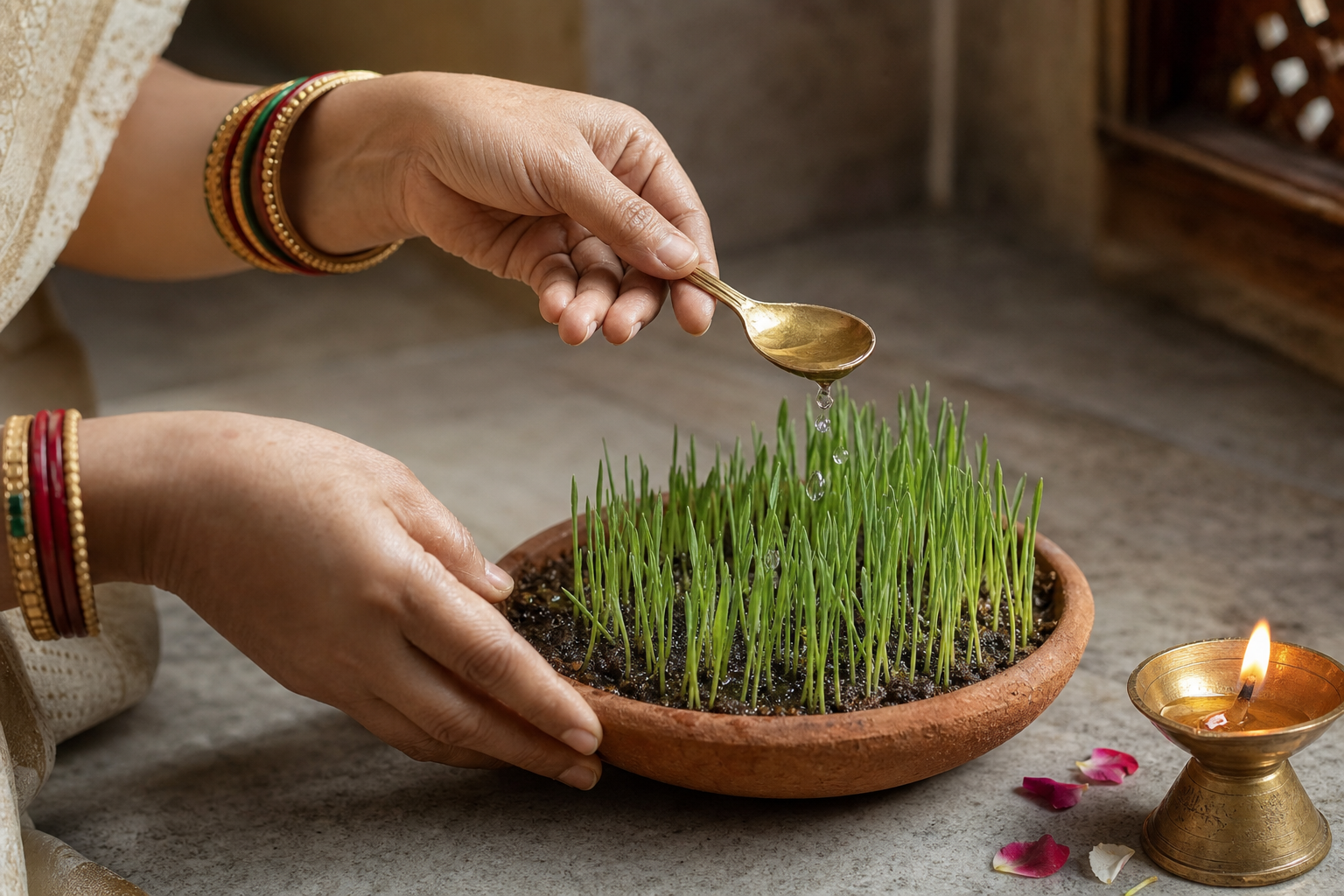
Check the soil each day and add only the water it needs. Keep the vessel shaded and the surrounding area clean. Perform a brief aarti or prayer and, where customary, make a small offering. The shoots’ emergence gives the cycle its visible rhythm: what was entrusted to soil on Navami becomes green before the concluding worship.
Do not turn the tray into a private system of crop prediction or a judgment on the family’s worth. Barley and wheat function as symbolic stand-ins for the wider fertility and resilience of fields that may actually contain paddy, maize, or millets. The practical lesson is attentive stewardship: seed, soil, water, and family life all suffer when care becomes occasional.
A modest act of charity can extend the vow beyond the shrine. Families may distribute grain, water, or a simple meal. Watering plants or feeding birds can also express the observance’s ethic of seasonal care. Choose an act you can perform quietly and responsibly rather than using charity as decoration for the puja.
On Kajari Purnima: worship, return, and honour protective bonds
- Begin with the concluding home worship. Offer water, flowers, a lamp, seasonal fruit, and the prayers or stotras used in your family.
- Carry the sprouted vessel carefully to the place chosen for completion. A simple family procession is enough; the ritual does not depend on spectacle.
- At a clean waterbody, offer gratitude for rain, fields, farmers, and the sustaining power of Bhagavati before returning the sprouts according to local practice.
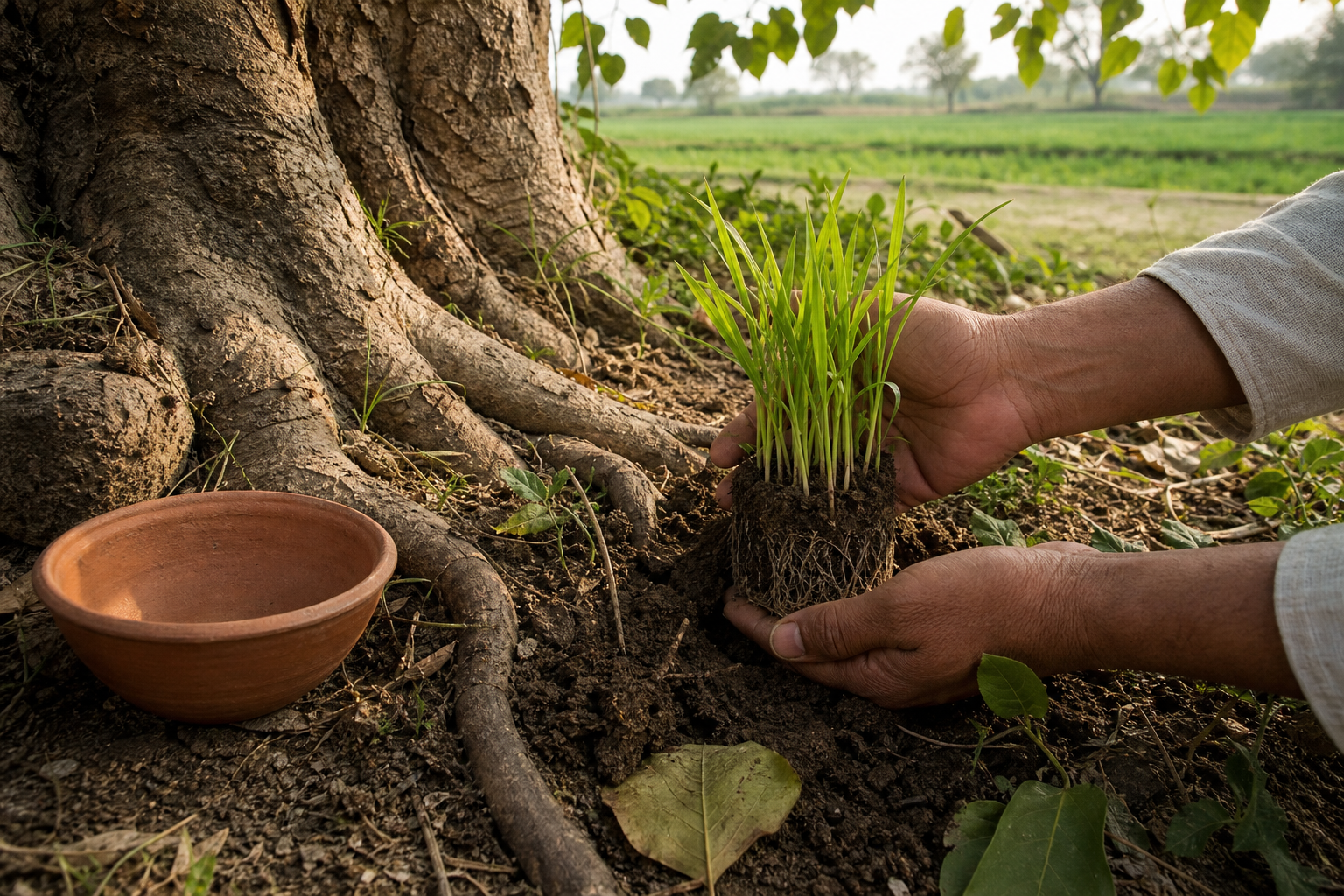
- If water immersion is impractical, environmentally inappropriate, or locally prohibited, place the sprouts at a field edge or at the roots of a sacred tree. A portion may be retained at the household shrine where that is customary.
- Keep plastic bags, synthetic cloth, foil, and non-biodegradable decorations away from water and soil. Carry puja materials in a leaf container, earthen vessel, or reusable basket, and bring all non-organic items home.
A storm drain, roadside ditch, or visibly polluted pond is not a respectful substitute for a clean waterbody. If you cannot complete the return safely on Purnima, keep the sprouts respectfully at the shrine while you consult your temple or community about an accepted local alternative.
Kajari Purnima shares Shravan Purnima with Raksha Bandhan. Some communities complete the seed offering in the morning and tie rakhi later; your household may use another order. Keep both observances intact rather than compressing one into a decorative part of the other. The common thread is protection: siblings affirm mutual obligation, while the Kajari rite recognizes the bonds linking household, rain, seed, field, and community.
If kajri geet belongs to your local or family tradition, the evening is a natural time to sing or listen. These monsoon songs are especially associated with the Mirzapur-Varanasi cultural belt and neighbouring Awadhi and Bhojpuri-speaking areas. Their themes of dark rain clouds, longing, reunion, and relief preserve the emotional memory of the sowing season. Ask an elder which version belongs to your locality; a familiar regional melody carries more cultural truth than a generic song chosen only because its title contains the word kajri.
Keep the symbol agricultural and the tradition regional
Kajari observance is most strongly associated with Madhya Pradesh, Chhattisgarh, and Uttar Pradesh, including Bundelkhand, Baghelkhand, Awadh, and adjoining cultural zones. One locality may emphasize domestic worship, another a women’s vrata, another community singing, and another the agricultural offering. You can preserve the tradition without pretending that every regional form is identical.
The small vessel brings the monsoon field into the home. It asks the household to notice what agrarian life makes impossible to ignore: rain must arrive in season, soil must remain healthy, seed requires protection, and a crop is never secured by a single day’s attention. That is why an ordinary tray of shoots can carry prayers for both family continuity and harvest resilience.
Do not confuse Kajari Navami with Kajari Teej
The similar names cause a practical calendar mistake. Kajari Navami is Shravan Shukla Navami and inaugurates the seed-tending sequence that culminates on Shravan Purnima. Kajari or Kajli Teej is a separate observance, generally placed earlier according to its own regional reckoning in the Krishna Paksha of Shravan or Bhadrapada, with distinct marital and devotional emphases. A calendar entry for Teej therefore cannot be used to date the Navami-Purnima cycle.
Let neighbouring Purnima observances remain distinct
Shravan Purnima also carries Vedic Upakarma in some communities and Narali Purnima in coastal regions. Their coexistence shows how one lunar day can hold several seasonal duties: renewal of study, kinship protection, gratitude to waters, and care for seed and harvest. It does not make the rites interchangeable. If your family observes more than one, give each its own sankalpa, materials, and customary sequence.
Readers from Buddhist, Jain, and Sikh traditions may recognize the wider dharmic values of restraint, compassion, service, ecological respect, and interdependence. That shared ethical ground should not be used to relabel Kajari as a universal liturgy. Respect is clearer when we acknowledge both kinship among dharmic values and the particular Hindu households and agrarian communities that maintain this festival cycle.
Key takeaways
- Plan Kajari Navami for 22 August and Kajari Purnima for 28 August in 2026, then confirm local tithi timing through your family’s panchang, temple, or community elder.
- Sow barley on Navami, or wheat where that is the inherited custom, in clean soil placed in an earthen, shallow, or biodegradable vessel.
- Keep the shoots shaded, lightly moistened, and clean; sustain the sankalpa with a short daily prayer or aarti until Purnima.
- Complete the cycle with worship and a respectful return to a clean waterbody, field edge, or sacred tree. Never leave plastic or synthetic decorations behind.
- Observe Raksha Bandhan and other Shravan Purnima duties in their own proper form, even when they share the same day.
- Do not use a Kajari Teej date for Kajari Navami. They are separate observances with different calendar positions and ritual emphases.
Your best next step is to put both dates in the family calendar and contact the elder or temple whose regional method you will follow. Once timing and the completion place are settled, the rest is deliberately simple: prepare clean soil, tend the seed faithfully, and return it without leaving waste behind.
References
- DharmaRenaissance Blog – Kajari Purnima 2026: Comprehensive Guide to Date, Sacred Rituals, and Agrarian Blessings
- DharmaRenaissance Blog – Kajari Navami 2026: Sacred Prelude to Kajari Purnima – Date, Rituals, Meaning, and Regional Heritage
