
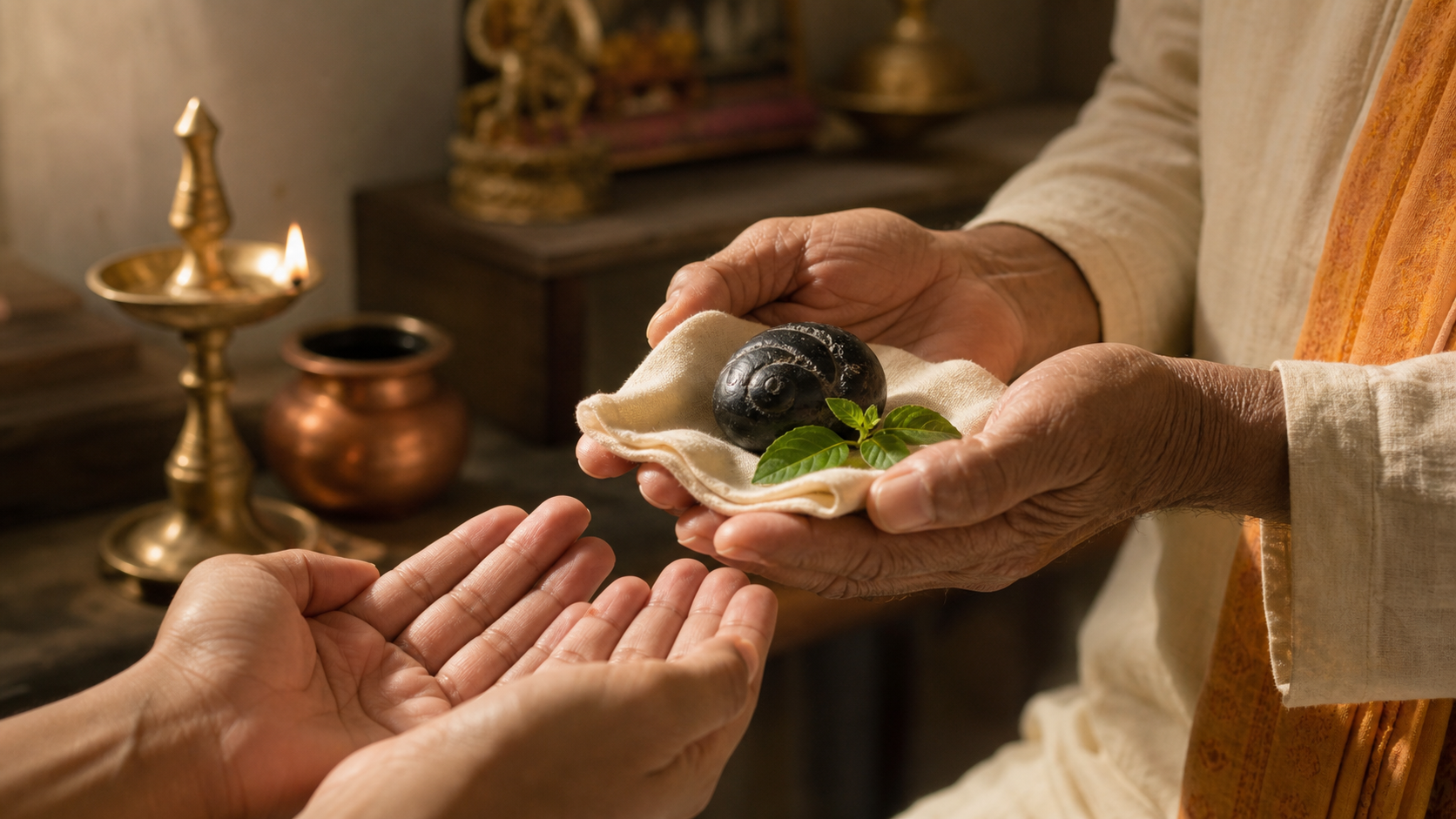
If you are thinking of buying a Shaligram online for a wedding, housewarming, or family altar, the practical answer is simple: do not buy it. Within Vaishnava dharma, a Shaligram is received as dana or prasada, not acquired as merchandise.
The right question is not which stone is rarest or most valuable. It is whether the Shaligram can pass, without a price, to someone who understands that receiving it begins a responsibility of seva. Here is how to make that decision, conduct the gift respectfully, and handle difficult situations without extending the commercial chain.
Why putting a price on a Shaligram changes the relationship
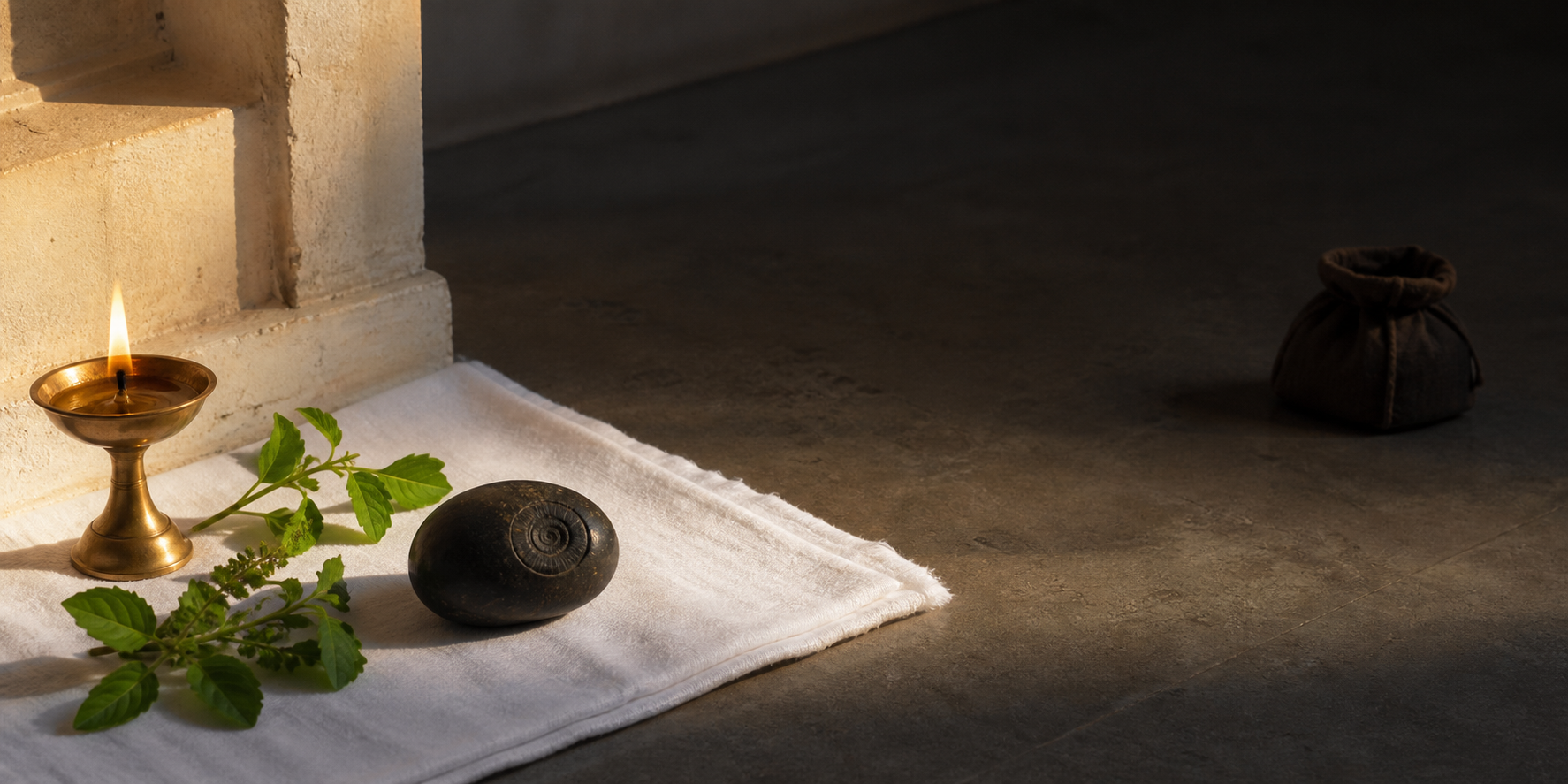
A Shaligram is a naturally formed sacred stone found in the bed and banks of the Kali Gandaki River region associated with Muktinath in present-day Nepal. It is commonly an ammonite fossil, and its spiral or chakra-like markings arise through natural processes rather than human carving. Within Vaishnava traditions, however, it is not treated merely as an interesting fossil. It is revered as a svayambhu manifestation of Vishnu: a divine presence that does not depend on human manufacture or ritual animation.
That theological status explains the prohibition on sale. Dharma traditions distinguish between property that can be owned and exchanged and a divine presence placed in human care. The norm against devata-vikraya censures the sale of a deity, sacred icon, sacred stone, or object reserved for divine worship. In this understanding, the custodian does not own Vishnu and therefore cannot put a price on Vishnu.
Custodianship is closer to trusteeship than possession. You receive the Shaligram so that you may serve, protect, and worship it. When you later pass it to a suitable person, you transfer that responsibility. A sales contract reverses the relationship: the buyer becomes the apparent owner, the stone becomes inventory, and rarity becomes a reason to demand a higher price.
Puranic traditions associated with the Skanda Purana, Padma Purana, and other texts praise the gifting of a Shaligram as an act of extraordinary punya. That merit should not be misunderstood as a reward obtained by handing a sacred burden to anyone available. The gift is meritorious because it expresses relinquishment, preserves worship, and helps establish a living relationship with Vishnu in another household. An unwanted surprise gift may satisfy the outward act of transfer while defeating its purpose.
The principle also has recognizable parallels across the dharmic family. Buddhist dana-paramita disciplines generosity, Jain aparigraha loosens possessiveness, and Sikh seva and dasvandh place giving within service rather than personal gain. These are distinct traditions, not interchangeable doctrines, but they share a warning that is useful here: sacred giving deteriorates when it becomes a strategy for profit or acquisition.
How to tell a genuine gift from a disguised sale
Commercial language can make the boundary look more complicated than it is. A seller may call the payment a donation, facilitation fee, energy exchange, or contribution. The label does not settle the matter. Ask what the payment is actually purchasing.
Treat the arrangement as a sale, or at least stop and seek guidance, when any of these conditions appears:
- You must pay a stated amount to receive the Shaligram itself.
- The amount rises according to the number of chakras, claimed type, auspicious quality, size, or supposed rarity.
- A compulsory donation is required as the condition for handing over the stone.
- The arrangement permits trade-ins, resale, bidding, or exchange for another Shaligram.
- The stone is promoted as a collectible, investment, status symbol, or source of guaranteed worldly results.
- The person transferring it speaks chiefly about market value while saying little about provenance, worship, and the recipient’s readiness.
A practical test is to ask two questions. Would the Shaligram still be given if the recipient made no optional donation? Does the demanded amount increase because one formation is advertised as rarer than another? If the answer is no to the first question or yes to the second, money is functioning as the price of the sacred stone, whatever terminology appears on the receipt.
Transport, travel, or ordinary ritual accessories can involve real-world expenses, but that observation must not become a loophole for pricing the Shaligram. If a compulsory charge is ambiguous, do not pay first and rationalize it later. Ask a trusted Vaishnava acharya or established temple authority whether the particular arrangement conforms to your sampradaya and local norms.
The clearer paths are relational rather than commercial: receive a Shaligram freely from a family elder or preceptor, accept it as prasada through a recognized tirtha setting in accordance with temple practice and local regulations, or accept custodianship from a household that can no longer sustain its seva. These routes keep the transfer within a chain of responsibility rather than a chain of resale.
Avoiding the market also has practical value. Commercial demand can encourage artificial carving, chemical treatment, and irresponsible extraction from sensitive riverine settings. Photographs and elaborate product descriptions cannot reliably turn an unknown marketplace listing into sacred provenance. When the origin is unclear and the seller is assigning premiums to markings, declining the purchase protects both dharma and discernment.
Prepare the recipient before you prepare the ceremony
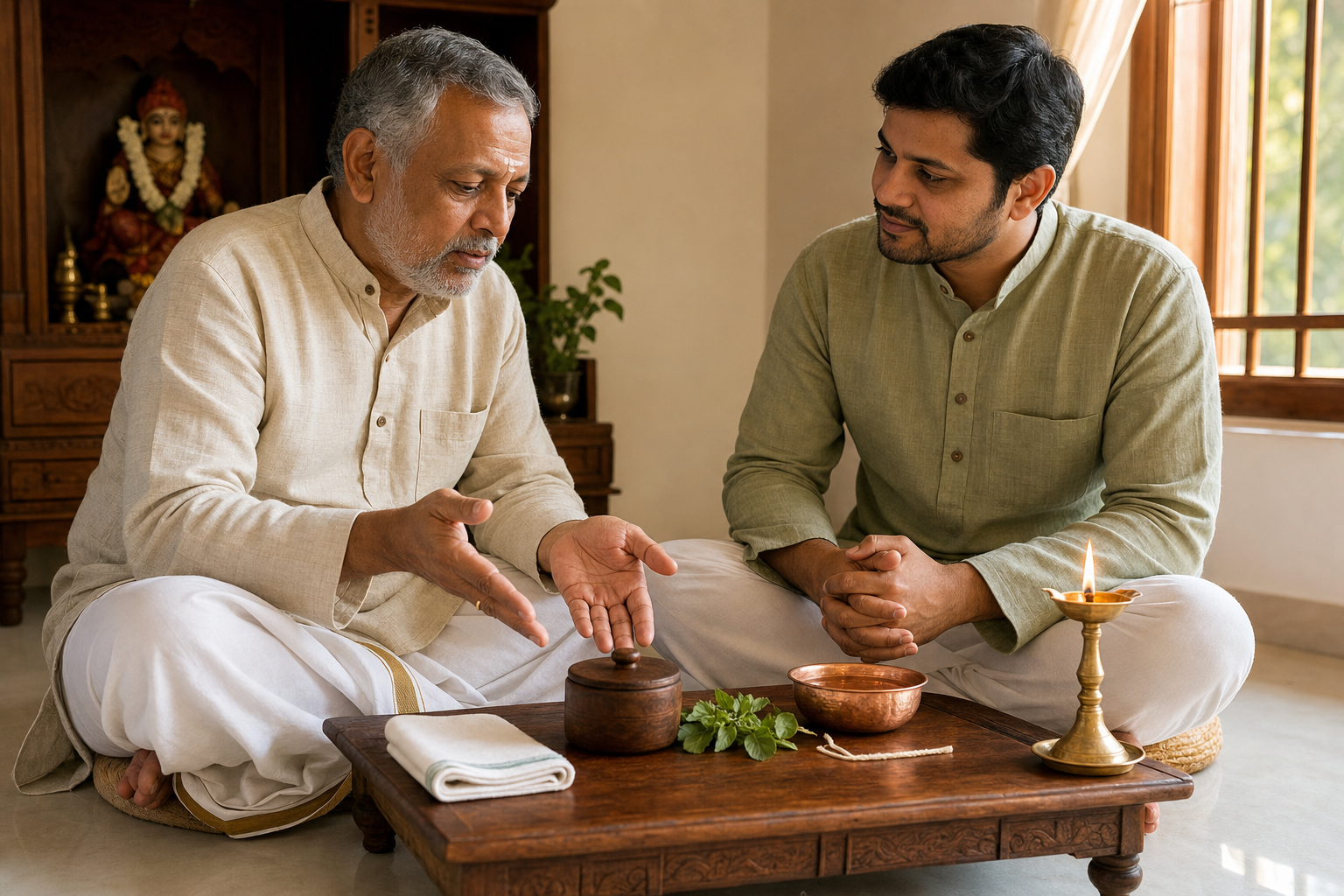
Choose someone who has freely accepted the responsibility
A Shaligram should not be used as a conventional religious present. Before arranging the transfer, speak plainly with the intended recipient. Explain that this is not an ornament to place in a cabinet and not a token that can later be sold. Ask whether the person sincerely wants to become its custodian.
A suitable recipient should be able to answer these questions:
- Where will the Shaligram be kept and worshipped?
- What household or sampradaya practice will guide the seva?
- What regular rhythm of worship can be maintained honestly?
- Who can provide guidance if a ritual question arises?
- Who will care for the Shaligram during illness, travel, or another prolonged interruption?
- Which relative or temple could accept custodianship if the household eventually becomes unable to continue?
Readiness is not measured by wealth, display, or the ability to perform an elaborate daily ritual. It is measured by shraddha, consistency, cleanliness, and willingness to seek guidance. Household Shaligram worship is not exclusively male in living practice; women and men both participate in domestic worship across India and Nepal. Details of achara differ, so a family should follow its legitimate lineage without turning one regional custom into a universal rule.
Ekadashi, Akshaya Tritiya, Kartika Purnima, and Guru Purnima are traditionally regarded as suitable occasions. Marriage, housewarming, and the establishment of a family altar may also provide meaningful settings. But an auspicious date cannot repair an unsuitable transfer. Secure the recipient’s consent and worship plan first; choose the date second.
Use a simple rite that makes the responsibility explicit
The ceremony need not become a display. Its function is to mark a free transfer of sacred trust and to begin the recipient’s seva with clarity.
- Confirm the origin and terms. Make certain that the Shaligram is already in legitimate custody, that it is being given freely, and that no price or valuation is attached to the transfer.
- Agree on the recipient’s practice. Identify the family or sampradaya achara that will govern worship. Resolve major questions before the handover, not after the recipient feels overwhelmed.
- Prepare a clean setting. Use a clean altar area and a clean yellow or white cloth. A Tulasi plant or leaves, a small lamp, and a copy of the Vishnu Sahasranama or Bhagavad Gita are appropriate accompaniments.
- Light the lamp. The giver and recipient should approach in a state of cleanliness appropriate to their tradition and sit together before the altar.
- Make a shared sankalpa. No invented display of Sanskrit is necessary. In clear language, the giver can state that the Shaligram is entrusted freely for Vishnu-seva, and the recipient can state that the responsibility is accepted with reverence.
- Hand over the wrapped Shaligram without payment. Do not mention a market value, rarity estimate, or future resale value. Such language undermines the meaning the rite is establishing.
- Provide a care plan. Give the recipient the relevant family instructions and the name of a knowledgeable elder, preceptor, or temple to contact. A sacred transfer should not leave a new custodian alone with avoidable uncertainty.
The cloth, lamp, Tulasi, and sacred text support the rite; they do not transform a purchase into dana. If the Shaligram was first obtained through a commercial transaction, wrapping it as a gift does not erase the earlier sale.
Receiving the Shaligram begins seva, not ownership

Establish a sustainable household rhythm
Within Vaishnava practice, a Shaligram is generally understood not to require prana-pratishtha because its divine presence is inherent rather than ritually installed. That does not mean care is optional. It means you do not have to treat it as an inert object awaiting human activation. Ask your preceptor how worship should begin in your lineage, then establish the practice promptly.
A concise household puja may include the following:
- Clean yourself and the worship space according to your household achara.
- Light a dipa and make a brief sankalpa.
- Bathe the Shaligram with clean water. Where customary, Panchamrita may also be used.
- Dry it gently with a dedicated clean cloth.
- Offer Tulasi leaves with devotion.
- Recite Om Namo Narayanaya, the Vishnu Sahasranama, or suitable passages from the Bhagavad Gita or Bhagavata Purana.
- Offer sattvic naivedya and conclude with arati according to your custom.
Daily worship is the traditional ideal. Where a household genuinely cannot sustain that schedule, a consistent weekly rhythm performed with attention is preferable to bursts of elaborate worship followed by neglect. This is practical guidance, not permission to disregard a stricter lineage rule. If your family’s achara requires daily seva, arrange the necessary support before accepting the Shaligram.
If worship becomes impossible
Do not wait until the Shaligram has been forgotten in storage. When age, illness, relocation, or another lasting circumstance makes worship impossible, arrange an orderly transfer to a willing relative or a local temple that has agreed to maintain the seva. Confirm acceptance first. Leaving a sacred responsibility at a temple without permission merely transfers your practical problem to someone who did not consent to it.
Do not sell the Shaligram, list it online, discard it, or use its claimed rarity to negotiate an exchange. The same principle that governed your receipt governs your relinquishment: pass the seva through relationship and consent, without putting a price on the divine presence.
If you already bought one
Do not compound the original transaction by reselling the Shaligram or trading it for a supposedly better type. Begin treating it with reverence, establish appropriate care, and take the specific facts to a qualified acharya in your tradition. If prayashchitta or a formal transfer is considered appropriate, that guidance should come from someone competent to apply your sampradaya’s practice, not from a merchant trying to sell another stone.
If you cannot undertake the seva, ask a suitable relative or recognized temple whether it can freely accept custodianship. Avoid a panicked or disrespectful disposal. The useful next step is to end commercial circulation and restore a relationship of care.
Do not let classifications recreate the marketplace
Traditional descriptions do associate particular names with chakra patterns and other natural formations. Those classifications are not a license to create luxury tiers. Steady devotion matters more than typological rarity, and pursuing a rare specimen through trade contradicts the non-commercial discipline surrounding Shaligram worship.
If you catch yourself comparing listings, prices, sizes, or promises of exceptional benefits, step back. The decisive question is not whether you have found the most prestigious Shaligram. It is whether a genuine, non-commercial path of transmission exists and whether you are ready for the seva that follows.
Key takeaways for a dharmic transfer
- A Shaligram is received as a sacred trust, not purchased as personal property.
- A mandatory payment tied to the stone, its markings, or its claimed rarity is a sale in substance even when given a devotional label.
- The intended recipient should consent before the ceremony and have a realistic plan for regular worship.
- Family elders, preceptors, and recognized tirtha settings provide appropriate relational paths for dana or prasada when their rules and local regulations are respected.
- A simple gift rite should identify the free transfer, the recipient’s responsibility, and the achara that will guide seva.
- If the custodian can no longer continue, the Shaligram should be entrusted freely to a willing relative or temple rather than sold.
Before you give or accept a Shaligram, have one explicit conversation: who will perform the worship, according to which tradition, and what will happen if that person can no longer continue. If those answers are not clear, pause the transfer. Protecting the Shaligram from both neglect and commerce is itself part of the seva.