
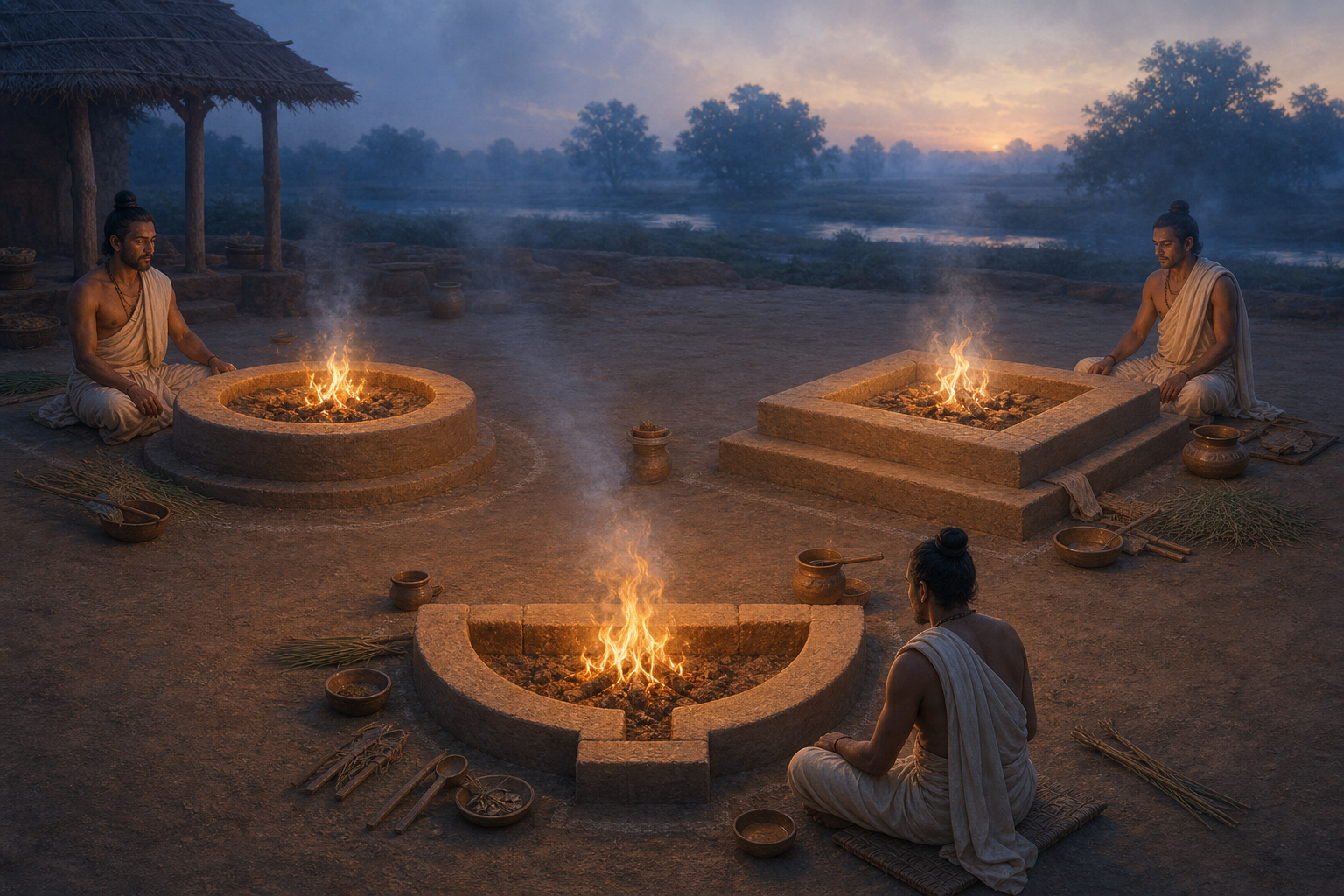
If you encountered Dakshinagni while learning about Vedic fire worship, you may be wondering whether it is simply an ancestral fire placed in the south, or whether it is something you can add to an ordinary household havan. Neither description is sufficient. Dakshinagni belongs to the disciplined three-fire system maintained by an āhitāgni, and its identity comes from its place, its work, and its relationship with the other two fires.
That distinction matters. It keeps you from reducing a carefully ordered Vedic institution to a symbol, and it prevents a modern adaptation from being mistaken for a lineage-specific rite. Once you understand the three fires as a working system, the southern fire becomes much easier to interpret.
The shortest accurate answer: place, task, and relationship
Dakshinagni combines dakṣiṇa, meaning south, with agni, meaning fire. It is therefore the southern fire of the Vedic sacrificial enclosure. Direction identifies it, but direction alone does not define it. A flame does not become Dakshinagni merely because someone lights it south of another hearth.
In many śrauta traditions, Dakshinagni is identified with the anvāhāryapacana fire. This name points to one of its principal operations: preparing prescribed ritual food associated with the after-offering portion and the ritual community, including officiating priests and householders. It also supports ancillary operations that must remain distinct from the offering made on the āhavanīya.
This gives you a reliable first definition: Dakshinagni is the southern, commonly anvāhāryapacana, fire within the established Vedic triad. It is not an independent altar, a generic kitchen flame, or another name for every fire connected with ancestors.
The distinction between identity and symbolism is essential. The south carries ancestral meaning, but the fire’s ritual identity is also operational. If an explanation discusses the pitṛs yet says nothing about cooking, separation of functions, or the other two hearths, it has described only part of Dakshinagni.
Read the three fires as one ritual system
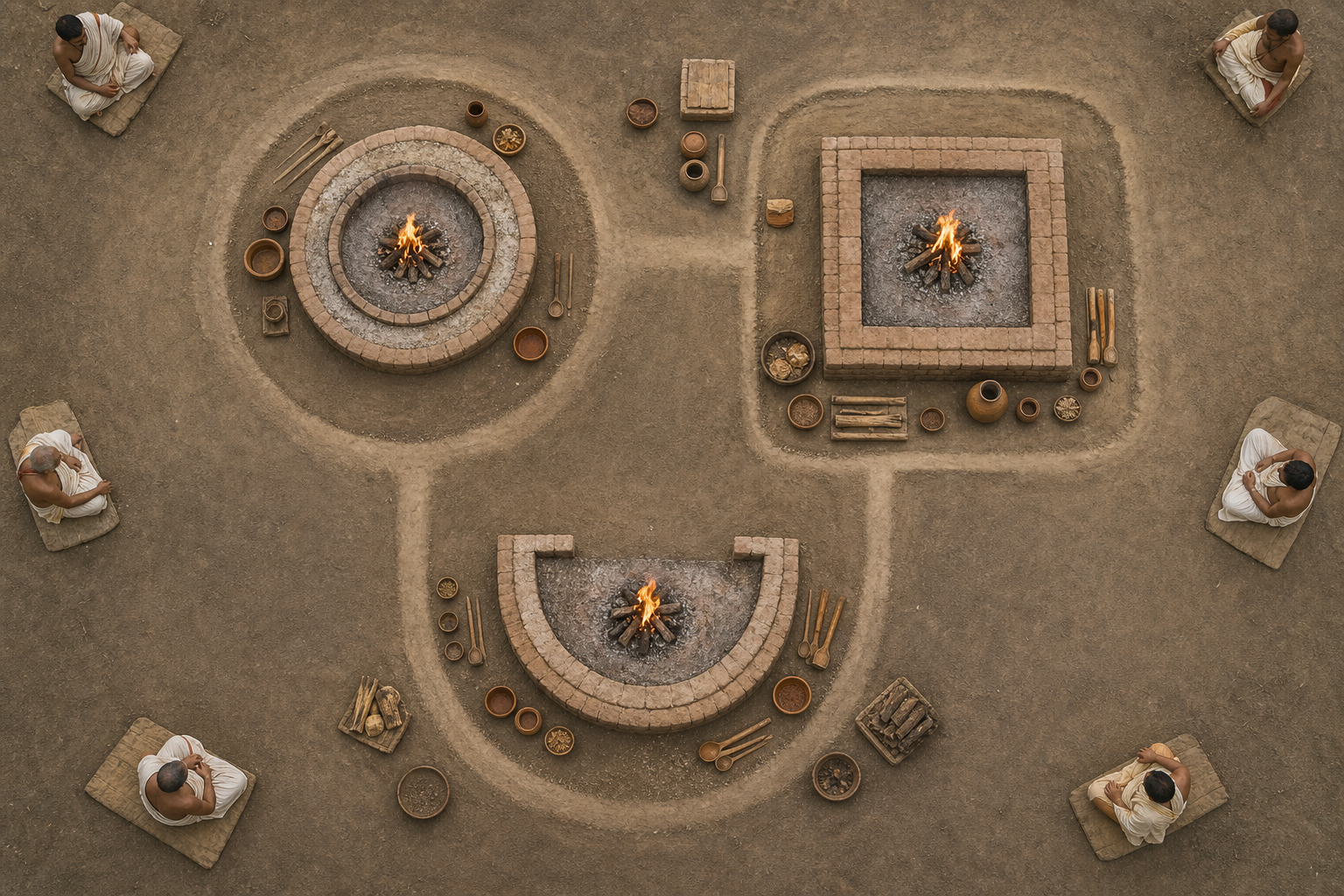
The clearest way to understand Dakshinagni is to stop looking at it in isolation. The three-fire ritual field coordinates household continuity, offerings to the deities, ritual preparation, and the disciplined handling of materials. Each hearth has its own boundary, but none is fully intelligible without the others.
| Fire | Usual position | Primary working role | Relationship within the triad |
|---|---|---|---|
| Gārhapatya | West | The perennial household fire | Provides the fire from which the other hearths are kindled |
| Āhavanīya | East | Receives the prescribed oblations directed to the deities | Preserves a dedicated offering space distinct from cooking and auxiliary work |
| Dakshinagni or anvāhāryapacana | South | Supports prescribed ritual cooking and associated operations | Completes the field without taking over the āhavanīya’s oblation function |
Gārhapatya supplies continuity. Āhavanīya provides the designated place of divine offering. Dakshinagni makes room for preparation and supporting work without confusing those acts with the oblation itself. This is ritual specialization rather than a ranking of more sacred and less sacred fires.
Think of the arrangement as a grammar. Position tells you where an act belongs; transfer tells you how one act remains connected to the household fire; and separation prevents different ritual purposes from collapsing into one another. The sacred order lies partly in doing the right thing and partly in doing it at the right hearth.
This is why an ordinary single-fire homa should not automatically be described with the vocabulary of the full triad. A contemporary havan can be meaningful on its own terms, but it does not become traiṣṭhāgni practice simply by receiving three symbolic names. If your family or temple uses one fire, describe that practice as it is unless a competent lineage authority identifies a more specific ritual framework.
The same caution applies to diagrams. A picture showing three flames may help you remember east, west, and south, but it cannot by itself show the transfer of fire, the sequence of acts, the assignment of vessels, or the rules for handling residues. In Vedic ritual, the map is only the beginning of the procedure.
Why the south evokes ancestors without defining the whole fire
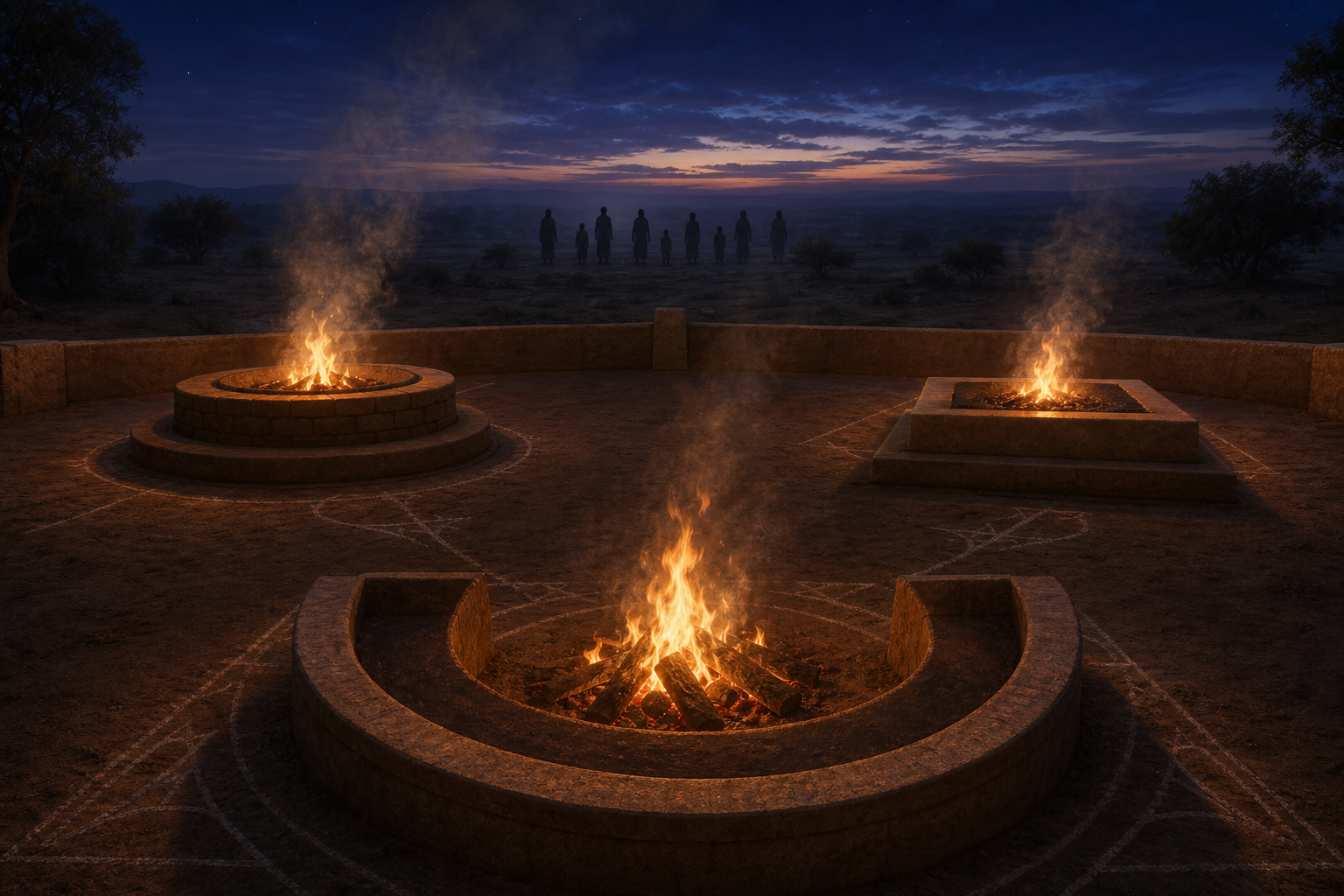
The south has an ancestral valence across much Vedic and post-Vedic thought. It is associated with the pitṛs, the forebears to whom the living remain indebted, and later interpretive layers also connect the direction with Yama. Dakshinagni therefore stands within a field of remembrance, inheritance, and obligation across generations.
You should still resist the easy equation Dakshinagni equals ancestor fire. Directional symbolism does not erase liturgical function. The southern hearth prepares prescribed food and supports carefully separated operations within yajña. Its ancestral resonance deepens that role; it does not replace it.
Cosmological mappings make the point more vivid. Interpretations often relate gārhapatya to earth, āhavanīya to the luminous realm, and Dakshinagni to an intermediary or ancestral domain. Such mappings explain how a household enclosure can mirror a larger moral and cosmic order. They should be read as interpretive structures, however, not as a universal substitute for procedural instruction.
Three questions will help you judge claims about the southern fire:
- What action is being described? Ask whether the passage concerns ritual cooking, an auxiliary operation, remembrance of ancestors, or a broader cosmological interpretation.
- Which ritual context is in view? Śrauta, gṛhya, and modern homa settings should not be treated as interchangeable merely because all employ fire.
- Which school supplies the procedure? Āpastamba, Baudhāyana, Kātyāyana, and other lineages can differ in placement details, geometry, and sequence even when they share the basic three-fire logic.
If an explanation cannot answer those questions, treat it as a general introduction rather than a ritual manual. This is especially important when a symbolic interpretation is presented with an exact altar drawing. Precision in appearance does not guarantee fidelity to a particular śākhā or sūtra tradition.
The ancestral dimension is best understood as an ethic of continuity. The householder receives life, learning, and ritual inheritance from earlier generations, then carries them forward through disciplined action. Dakshinagni gives this continuity a place in the sacrificial field while also serving the living ritual community through the preparation of food.
What changes when curiosity becomes actual practice
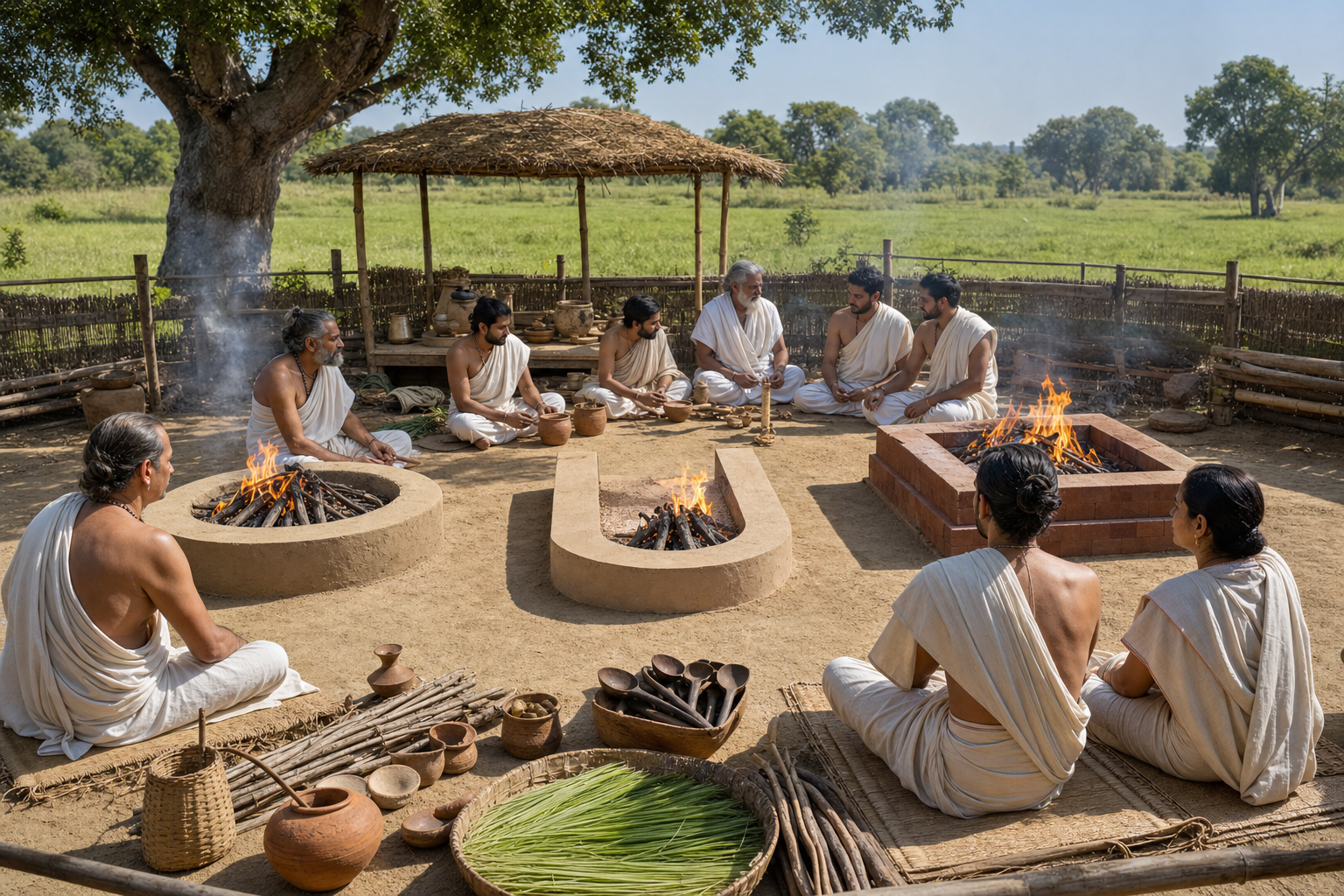
Learning the meaning of Dakshinagni is open to any serious student. Establishing and tending it is a different undertaking. The three fires are instituted through agnyādheya, the formal establishment of the fires, and the householder who assumes their maintenance becomes an āhitāgni. This is described as a lifelong discipline, not an occasional decorative addition to a festival homa.
The daily rhythm includes agnihotra, the morning and evening offering, while seasonal rites and larger sacrifices extend the same ordered system. Fire is carried from gārhapatya to the other hearths according to prescribed procedures. Ritual food, oblations, implements, residues, embers, and ash are handled through rules that preserve both purity and separation of purpose.
Continuity also matters when a household relocates. Procedures for transporting embers and re-establishing the triad preserve the relationship with the already established household fire rather than treating the new setting as the beginning of an unrelated flame. In larger soma rites, the southern hearth’s culinary and supporting responsibilities expand with the needs of the assembled ritual community, while the distinction from the āhavanīya remains intact.
Do not build from a generic altar diagram
Dakshinagni is often described as semicircular or D-shaped, but its geometry is not identical across schools. Even a broadly correct shape can become misleading when detached from the lineage that specifies its dimensions, orientation, construction, and sequence of use.
The wider ritual field may involve approved fuel woods, samidh, paridhi logs, darbha or kuśa grass, offering implements such as juhū, sruva, and sruk, designated water, and carefully governed management of embers and ash. A list of materials still does not constitute authorization or instruction. Their use depends on sequence, mantra, ritual role, and school-specific procedure.
If you intend to move beyond study, work with a qualified teacher or officiant grounded in the relevant lineage. Do not maintain an open sacred fire from a web description alone. Besides compromising the rite, improvised construction, fuel handling, or ember transfer can create an ordinary fire hazard. For personal worship without that training, use the form of homa already authorized in your family or sampradāya rather than naming an improvised southern flame Dakshinagni.
Use this checklist when evaluating an explanation
- Does it show Dakshinagni in relation to gārhapatya and āhavanīya, rather than as a solitary fire?
- Does it identify gārhapatya as the continuing household fire from which the others are kindled?
- Does it distinguish divine oblation on the āhavanīya from cooking and auxiliary work on the southern hearth?
- Does it say which textual or lineage tradition governs any exact shape, placement, or sequence?
- Does it distinguish historical śrauta discipline from a modern symbolic adaptation?
- Does it avoid claiming that southern placement alone turns an ordinary flame into Dakshinagni?
An explanation that passes these checks can help you study the system. One that fails several of them may still contain a meaningful reflection on fire or ancestors, but it should not guide practice.
What to observe at a living rite
If you have permission to witness a rite in which the three fires are maintained, watch relationships rather than waiting only for a dramatic offering. Notice where each hearth stands, from which fire another is kindled, where food is prepared, and which materials never cross into the āhavanīya’s dedicated function.
Ask the officiant which school governs the procedure and whether Dakshinagni and anvāhāryapacana are being used as equivalent names in that setting. Those two questions will teach you more than guessing the meaning of every movement from direction alone. Follow the boundaries set by the officiants; adding fuel, crossing the enclosure, or placing anything near a hearth is participation, not passive observation.
What the southern fire teaches beyond the enclosure
Dakshinagni shows that sacred life is not made only of the moment of offering. Preparation, cooking, care for participants, management of remains, and preservation of continuity also belong to dharma. The southern hearth gives these supporting acts a defined place instead of treating them as incidental work outside the sacred event.
This is a particularly useful correction for modern readers. We often notice the visible oblation and overlook the discipline that makes it possible. The Vedic triad refuses that split. Offering, household continuity, food preparation, priestly service, and remembrance of forebears operate within one ordered field, yet their boundaries remain clear.
The lesson also clarifies how to speak across Dharmic traditions. Buddhism, Jainism, and Sikhism all preserve luminous imagery associated with knowledge, discipline, awakening, or the wisdom of the Guru. Those resonances can support respectful conversation, but they do not make Dakshinagni a shared ritual institution. It remains specific to the Vedic sacrificial framework. Shared meanings should help us understand one another without erasing real differences in practice.
Key takeaways
- Dakshinagni is the southern fire within the Vedic three-fire system, not any fire casually placed in the south.
- It is widely identified with anvāhāryapacana, the hearth associated with prescribed ritual cooking and supporting operations.
- Gārhapatya, āhavanīya, and Dakshinagni form an interdependent field with distinct functions and boundaries.
- The south carries ancestral associations, but Dakshinagni should not be reduced to a generic pitṛ fire.
- Exact geometry and sequencing vary by school, so a universal online diagram cannot serve as a complete ritual manual.
- Establishing the fires through agnyādheya is a serious, continuing discipline requiring lineage-specific guidance.
The next time you encounter Dakshinagni, draw the three directions before interpreting the symbol: west for gārhapatya, east for āhavanīya, and south for the anvāhāryapacana fire. Then ask what is transferred, what is offered, and what is prepared. That small discipline will keep your study anchored in the living architecture of yajña.