
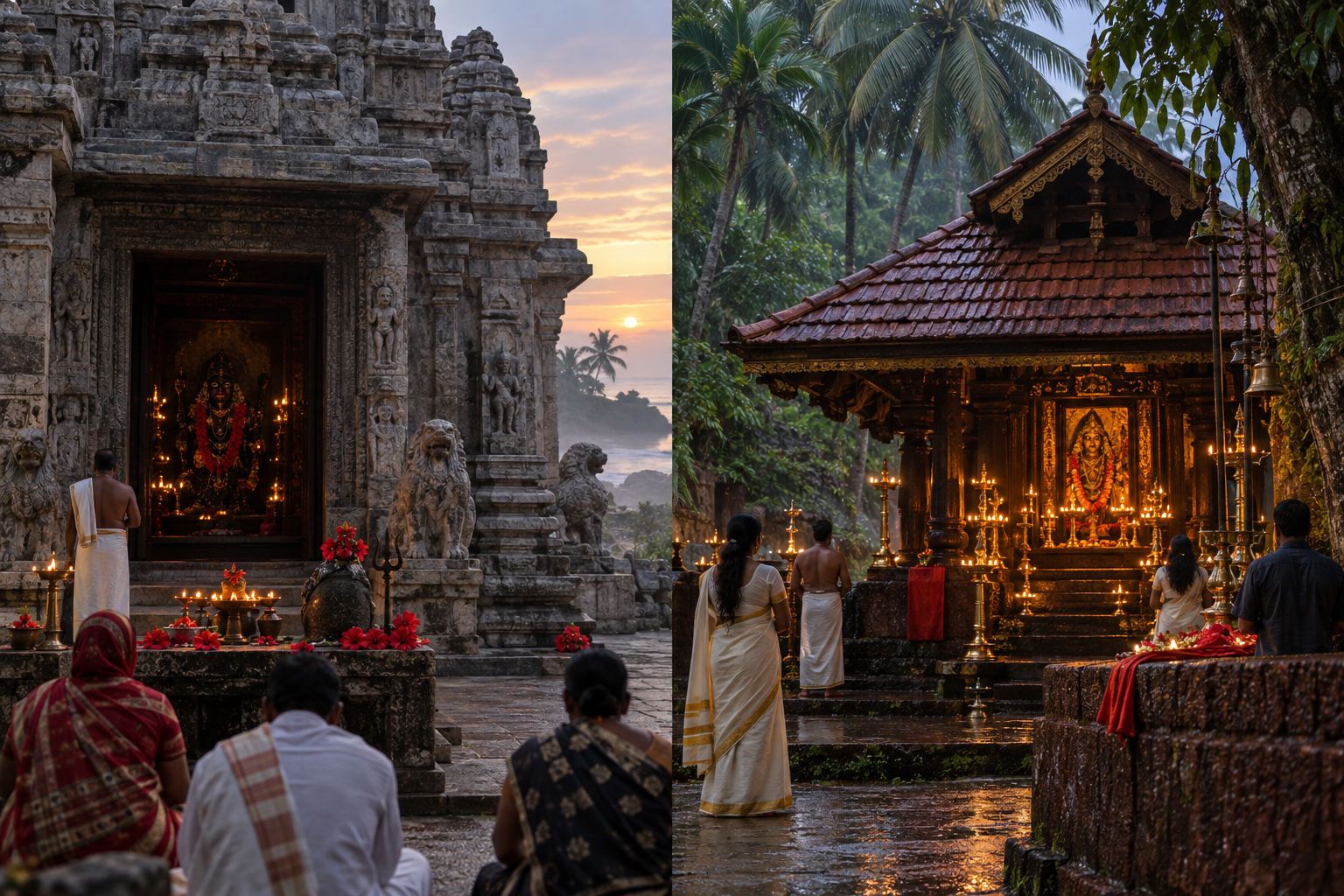
You may have arrived with a deceptively simple question: are Chamunda and Bhadrakali two names for the same Goddess? A flat yes erases living regional traditions. A flat no misses the profound kinship between these fierce forms of the Divine Mother.
The useful answer lies between those extremes. You can recognize a shared sacred vision while allowing Odisha’s Chamunda tradition and Kerala’s Bhadrakali tradition to speak in their own names, places and ritual languages.
Begin with shared ground, then keep the names intact
Across India’s eastern and southwestern coasts, Chamunda in Odisha and Bhadrakali in Kerala have long been worshipped as fierce forms of the Divine Mother. That common frame establishes a genuine relationship. It does not establish that every story, image, observance, offering or temple convention is interchangeable.
This distinction matters because a divine name is more than a label attached to a generic figure. It carries the memory and devotional vocabulary of a community. Replacing every regional name with a single broad category may look like an affirmation of unity, but it can make the actual tradition harder to see.
At the same time, regional distinctiveness should not be mistaken for theological isolation. Chamunda and Bhadrakali can be approached as members of a wider sacred family without being reduced to duplicates. Kinship does not require uniformity.
The word “fierce” also needs care. Within a Hindu sacred setting, a fearsome appearance does not by itself mark a deity as evil. Divine severity can be contemplated as a form of power rather than as the opposite of holiness. If you begin with the assumption that serene forms are sacred while terrifying forms are demonic, you will misread the religious language before local devotees have had a chance to explain it.
Use three levels to avoid false equivalence
A reliable comparison keeps three levels separate. Most confusion begins when a claim that is sound at one level is stretched across all three.
- The shared theological level: Chamunda and Bhadrakali can both be understood within fierce worship of the Divine Mother. This is the level at which their resemblance becomes meaningful.
- The regional level: Chamunda is being encountered through Odisha, while Bhadrakali is being encountered through Kerala. Geography is not incidental here. It identifies the cultural setting in which a form is remembered and worshipped.
- The local level: A particular temple, household or devotional community may preserve its own explanations and conventions. The exact practice must therefore be learned where it is actually performed.
Now apply the framework carefully. Saying that both are fierce Mother forms does not prove that their rituals are identical. Noticing that their local customs are distinct does not make them unrelated. And affirming a spiritual unity does not give an outsider permission to overwrite either community’s vocabulary.
This is also a useful test for claims you encounter elsewhere. When someone announces that the two are “exactly the same” or “completely different,” ask which level is under discussion. The claim may express a devotional conviction, a regional identity or a rule followed at one shrine. Those are not automatically competing answers; they may be answers to different questions.
Approach a shrine without importing another shrine’s rules
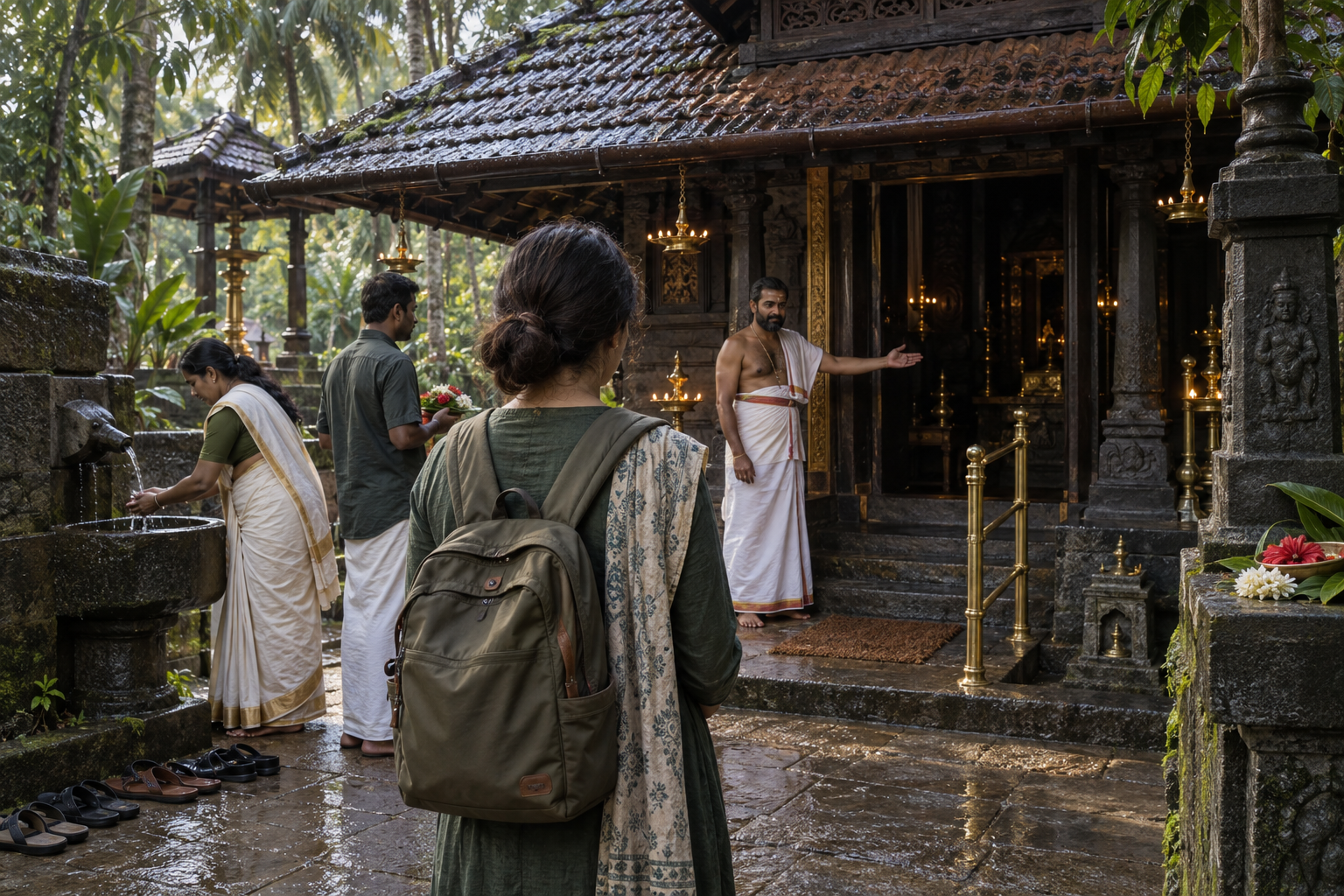
If your interest is practical rather than merely comparative, begin with the local form in front of you. A respectful visit does not require you to settle every theological question beforehand. It requires you to notice where you are and to avoid treating general knowledge as local authorization.
- Use the name used by the community. At a Chamunda shrine, begin with Chamunda. In a Bhadrakali setting, begin with Bhadrakali. You can explore broader relationships after honoring the immediate identity.
- Observe before classifying. Read the shrine’s notices, watch how regular devotees conduct themselves and notice which spaces or actions have restrictions. Do not assume that a custom seen in another region transfers automatically.
- Ask narrow questions. “How is the Devi addressed here?” and “What may a first-time visitor do?” will produce more useful answers than “Is she really the same as another goddess?”
- Separate viewing from participation. Recognizing a symbol or admiring an image does not teach you a ritual procedure. If you wish to participate, follow the guidance given by the temple or the tradition responsible for that worship.
- Do not invent a home practice from visual fragments. If a mantra, offering or observance interests you, first ask whether it is part of ordinary public devotion or requires instruction. When you do not know, a simple respectful prayer is more appropriate than assembling an improvised rite from unrelated material.
This method is not excessive caution. It is how you preserve both dimensions of the encounter: the wider recognition of Devi and the authority of the particular tradition through which you meet her.
Read fierceness as sacred language, not spectacle
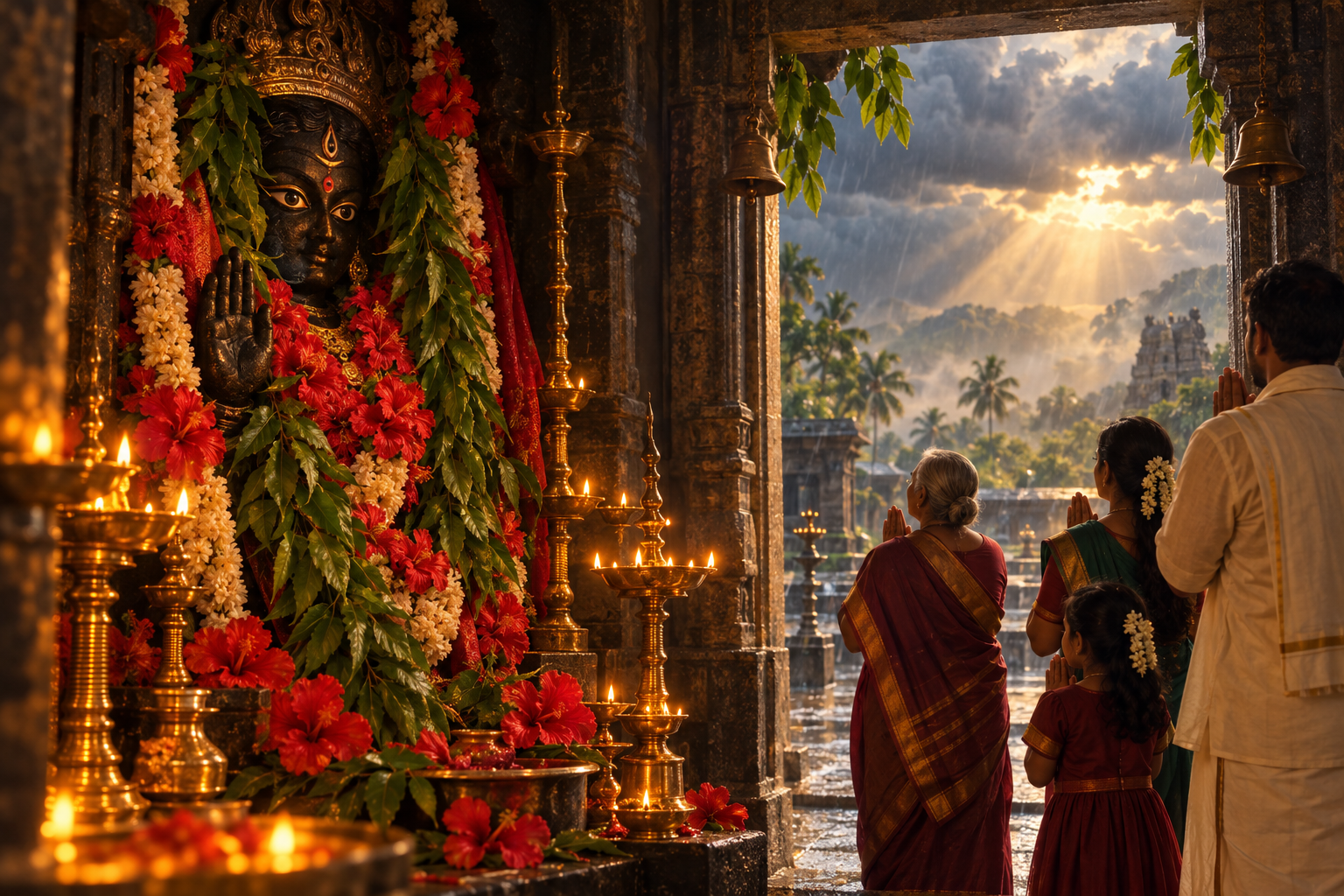
Fierce divine imagery is easily reduced to spectacle. A viewer notices what is visually unsettling, labels it “dark” or “violent,” and stops there. That reaction reveals the viewer’s categories more readily than it reveals the deity.
A better reading begins with questions. What does the worshipping community understand this power to mean? How does it distinguish fear of the image from reverence for the Goddess? Which parts of the form are explained locally, and which interpretations have merely been carried in from elsewhere? These questions do not predetermine the answer. They make room for the tradition’s answer.
You should also keep devotional meaning distinct from cultural analysis. The first asks how a worshipper relates to the Mother. The second asks how a community preserves a form across place and time. Both are legitimate, but neither should silently replace the other. A catalogue of regional differences cannot exhaust devotion, while a broad declaration of spiritual oneness cannot substitute for learning local history and practice.
For a Dharmic reader, the essential discipline is to resist a borrowed binary in which beauty means goodness and terror means evil. Hindu traditions can place the sacred in forms that unsettle as well as forms that console. You do not have to soften the fierce Mother into a harmless metaphor to recognize her divinity.
Key takeaways
- Chamunda in Odisha and Bhadrakali in Kerala share the broad religious frame of the fierce Divine Mother.
- Shared sacred meaning does not make their names, local identities or practices interchangeable.
- Compare them at three distinct levels: theological kinship, regional expression and local observance.
- At a shrine, follow the name and conventions of the community responsible for that form.
- Do not infer a ritual from an image or transfer a practice from one regional setting to another without guidance.
- A fearsome appearance should not be treated as evidence that a Hindu divine form is malevolent.
The next time you encounter either tradition, write down two things separately: what belongs to the wider vision of the Divine Mother, and what belongs to this particular place. That small habit will help you see unity without manufacturing uniformity.
References

Leave a Reply
You must be logged in to post a comment.