
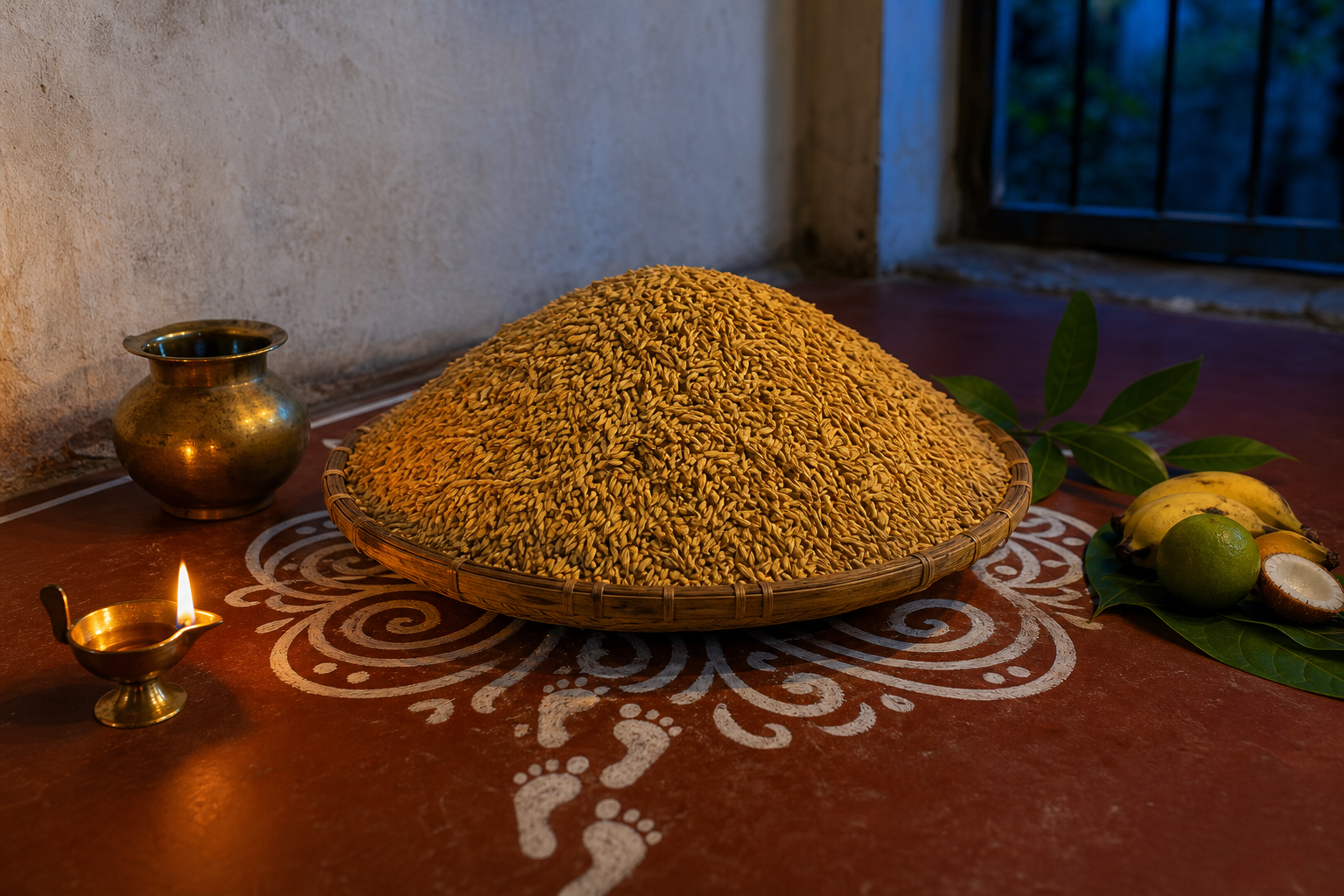
Perhaps you remember a bamboo kulo filled with paddy, white alpana under a lamp, and tiny footprints entering the house, but no one ever explained why the grain mattered. Or perhaps you now live far from Bengal and want to preserve the worship without turning it into a decorative imitation.
Begin with the part that cannot be replaced: in Bedi or Beri Lakshmi worship, grain is not scenery placed beside the deity. It is the living center in which Lakshmi is invited and honored. Once you understand that, you can adapt the size of the altar while preserving its Dharmic logic of nourishment, discipline, gratitude, and responsible abundance.
The grain is the sacred form, not an accessory
If you treat the paddy as an offering waiting beside the “real” representation of Lakshmi, you miss the defining feature of this Bengali practice. The grain-filled altar is an aniconic form: divine presence is invoked through consecrated substances rather than confined to a sculpted murti. Aniconic does not mean merely metaphorical. The altar is prepared, bounded, invoked, offered light and food, and approached as Lakshmi’s seat.
The two names illuminate what the household is doing. Bedi directs attention toward the sanctified altar or plinth associated with vedi. Beri evokes a protective enclosure. One emphasizes the place where sacred presence is established; the other emphasizes abundance gathered within a boundary. If your family says one name rather than the other, there is no need to correct its inherited vocabulary. Ask what the elders call the form and retain that name.
Unhusked paddy, or dhān, is especially meaningful because it still carries both seed potential and protective covering. Polished rice is food ready for immediate use; paddy also points toward the next season. It can become nourishment, seed stock, livelihood, or continuity. Lakshmi is therefore approached not simply as cash or acquisition, but as śrī: auspicious well-being capable of sustaining life beyond the present moment.
The calendar strengthens that meaning. Kojagari Purnima comes under the clear autumn full moon, after the rains and around the period when paddy is ripening. Thursday observances in late autumn and practices connected with nabanna, the new rice, may extend the season in particular households. The timing places worship between labor and its hoped-for fruit. When you prepare the altar, notice that you are not performing a generic wealth rite. You are giving thanks for the conditions that allow work to become food security.
How to read the altar’s materials
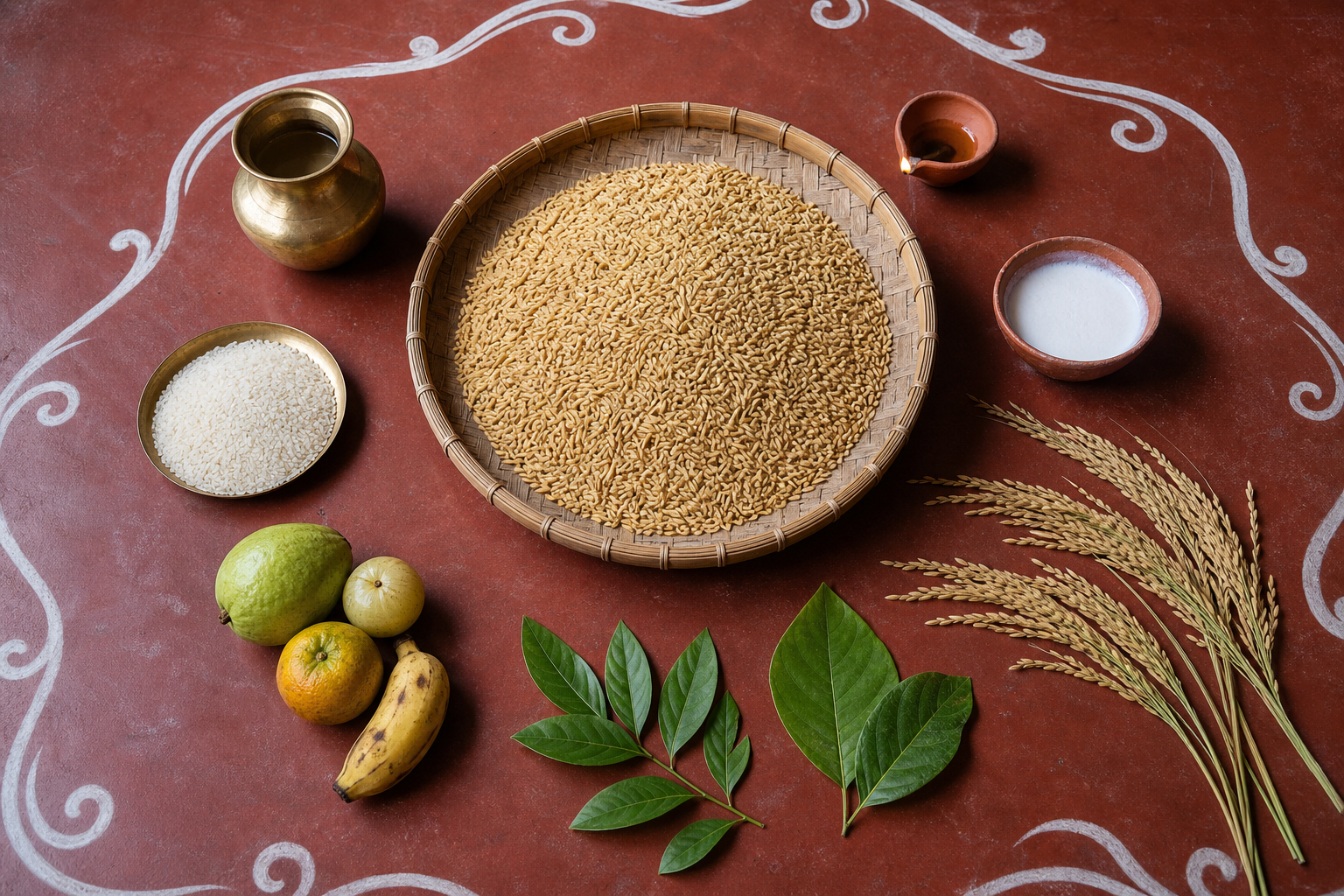
A Bedi or Beri altar is best read as a set of relationships rather than a collection of isolated symbols. Grain needs a field; abundance needs a boundary; light needs vigilant attention; food depends on labor. The meanings below are practical readings, not a rigid codebook. Your household’s inherited explanations should take priority where they differ.
| Material or motif | What it expresses | What you should notice or do |
|---|---|---|
| Dhān, or unhusked paddy | Potential, protection, nourishment, and continuity | Use clean grain and decide before worship how it will be respectfully retained, planted, or returned to household use. |
| Bamboo kulo, earthen tray, or low wooden platform | The meeting of sacred abundance with ordinary household and agricultural labor | Do not hide the familiar implement under excessive decoration. Its connection to work is part of the theology. |
| Turmeric and vermilion | Sanctity, health, and auspicious marking | Apply them deliberately to the grain or altar rather than using them merely to add color. |
| Rice-paste boundary, flowers, or enclosing leaves | Abundance protected by discipline and right limits | Make the boundary visible and keep the sacred center orderly instead of crowding it with unrelated ornaments. |
| Lotus, paddy, conch, and footprint alpana | Lakshmi’s seat, auspicious presence, cultivation, and entry into the home | Choose a few clear motifs you understand. A simple hand-drawn form carries more meaning than an elaborate pattern copied without attention. |
| Lamp and owl | Radiant energy joined to wakefulness, humility, and oversight | Keep the lamp stable and attended. Let the owl remind you that wealth requires vigilance rather than fascination with excess. |
| Water, incense, flowers, and food | Hospitality offered to sacred presence | Use household-appropriate offerings. Rice, puffed rice, rice-flour preparations, coconut, banana, and seasonal sweets all keep the offering close to the altar’s agrarian language. |
The boundary deserves particular attention. It does not teach that prosperity should be locked away from others. It teaches that resources need form and direction. Food stored carelessly spoils; money without restraint disappears or harms; harvest without sharing becomes hoarding. The enclosure turns a material fact into a moral instruction: abundance becomes śrī when it is protected from waste and directed by dharma.
The owl makes the same lesson visible from another angle. Bengali Lakshmi imagery does not require you to read the ulūkā as a frightening omen. Beside grain and lamp, it can be understood as watchfulness over stores and humility in the presence of wealth. Grain is the resource, flame is active energy, and the owl is oversight. Remove oversight, and even a full granary can be squandered.
How to prepare a simple grain-centered observance
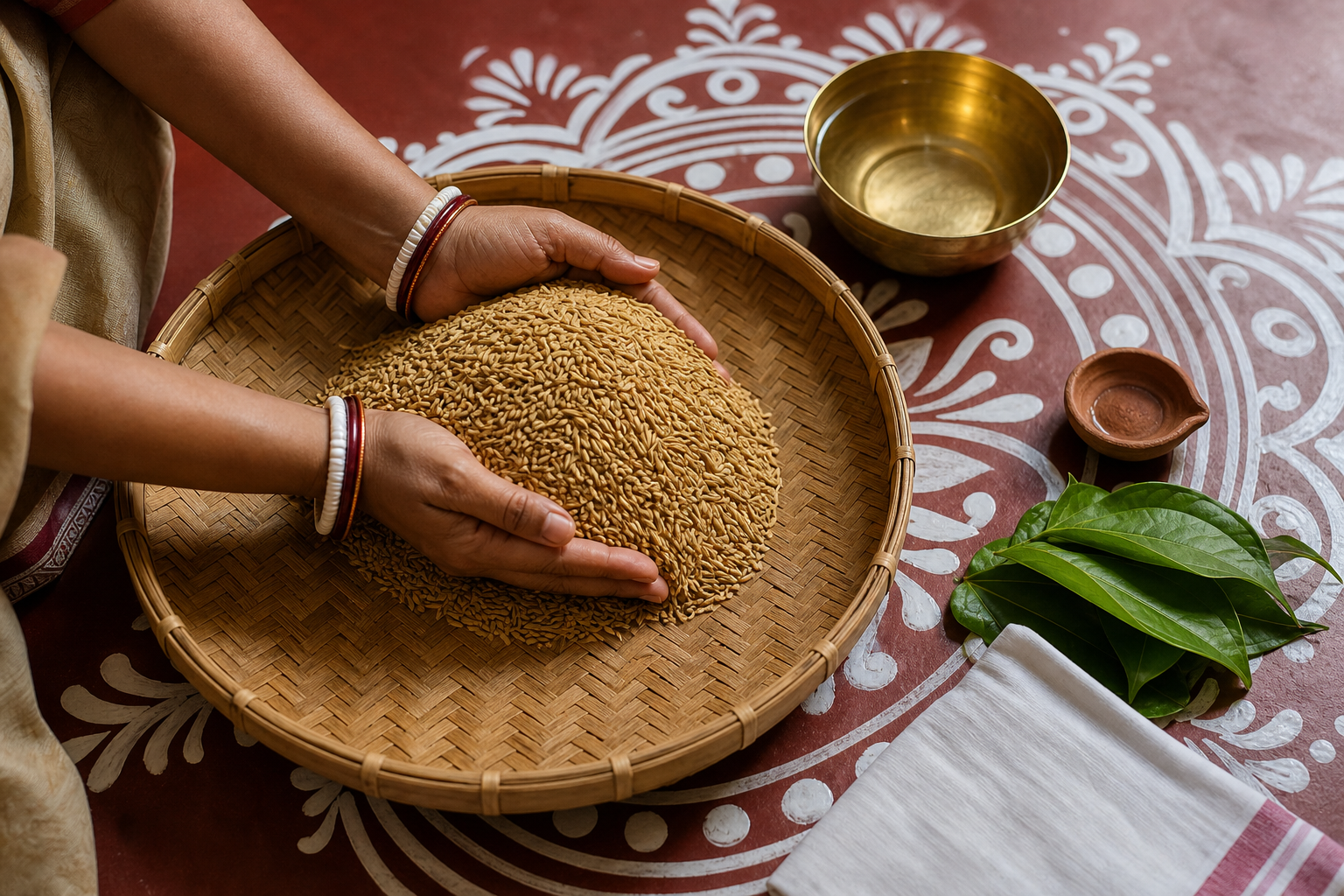
No single checklist should erase family or district custom. Households in Birbhum, Bankura, Nadia, the 24 Parganas, and elsewhere may preserve different names, foods, songs, mantras, and ways of arranging the altar. If you have access to an elder or a priest familiar with your family observance, retain that lineage’s mantra, sequence, and rules. Use the following as a practical framework when the physical setting must change, not as a declaration that every Bengali household worships identically.
- Identify your household occasion. Kojagari Purnima is a principal time for Bengali Lakshmi worship, but some families also keep late-autumn Thursdays or a post-harvest observance associated with new rice. Follow the date and form your household recognizes.
- Clean and settle the worship area. Choose a quiet floor, shelf, or low table where the altar will not be disturbed. Cleaning is not cosmetic preparation; it marks the movement from casual use to deliberate care.
- Mark the sacred field. Draw an alpana with rice paste if the surface allows it. A lotus, paddy sheaf, conch-like curve, circle, or small footprints is sufficient. On a rented or delicate floor, use a removable mat or an appropriate eco-safe chalk.
- Establish the grain center. Place clean dhān in a shallow earthen tray, bamboo kulo, or low wooden platform. A pinch of turmeric and an auspicious vermilion mark may be added according to custom.
- Make the enclosure visible. Use a rice-paste line, a ring of flowers, or leaves to articulate the beri. The point is not decorative density. The eye should be able to recognize a gathered center and the boundary that protects it.
- Arrange the offerings. Place water, flowers, incense, and a securely positioned lamp nearby. Add the rice preparations, coconut, banana, seasonal sweets, or other foods accepted by your household tradition. Do not create an unnecessary shopping burden in the name of Lakshmi; the materials already teach sufficiency and care.
- Invoke and offer in the inherited sequence. Household worship may use the fivefold pañcopacāra or the fuller sixteenfold ṣoḍaśopacāra pattern. Use the mantra and order you have received. If you have not received one, seek guidance locally rather than inventing Sanskrit formulas whose meaning and ritual place you do not know.
- Complete the worship with ārati and responsible aftercare. Move the lamp before the altar as your custom directs, distribute the offered food as prasāda, and handle the altar grain according to the family’s established practice. Do not let consecrated grain become disposable decor once the gathering ends.
A small apartment does not require a miniature imitation of a village courtyard. A symbolic handful of paddy, potted rice grass, a compact tray, and a removable alpana surface can preserve the grain-centered structure in an urban or diaspora home. Reduce scale before you reduce meaning. The recognizable essentials are a clean place, living grain, a deliberate boundary, suitable offerings, invoked presence, and reverent aftercare.
Biodegradable materials already belong naturally to this form of worship. Paddy, leaves, flowers, rice paste, bamboo, clay, cotton wicks, and food do not need to be displaced by plastic decorations. If an adaptation produces a large bag of ritual waste while leaving the sacred grain forgotten, the adaptation has reversed the altar’s own teaching.
The worship continues after the lamp is lowered
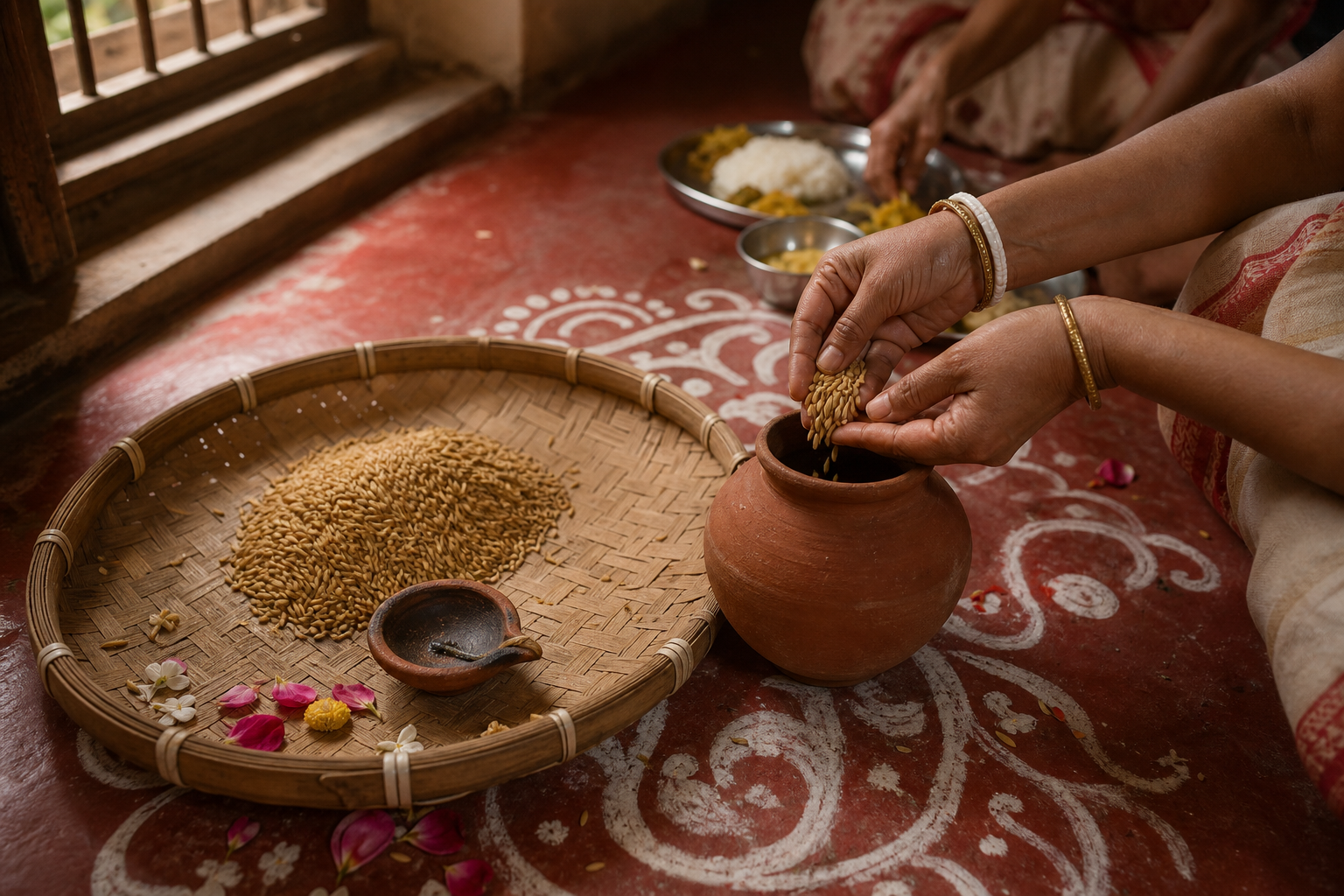
The strongest test of the observance comes after ārati. A beautiful altar can still leave the household unchanged. Sacred-grain symbolism becomes useful when it alters how you store food, teach children, recognize labor, share what you have, and dispose of nothing thoughtlessly.
First, give the altar grain a next life. In some homes, it is sown in a courtyard corner or mixed into seed stock. In others, it is retained with the household’s pantry grain as a sign of continuity. These are not interchangeable instructions, so ask what your family does. Their shared principle is circularity: grain honored as sacred should return to cultivation, safekeeping, or purposeful household use rather than being thrown away.
Second, let the altar expose neglect. When you clean the worship area, look at the pantry as well. Bring older grain forward for timely use, secure stores from moisture and pests, and notice food bought without a plan. This is not a substitute ritual invented for modern life. It is a direct application of the beri: resources remain auspicious when attention protects them from waste.
Third, preserve skill as well as symbolism. Women have often carried the household expertise of preparing the space, drawing alpana, arranging offerings, and remembering the sequence. Honor that knowledge without making its preservation one person’s burden. Ask an elder to demonstrate one motif and name it. Let younger family members sort flowers, prepare wicks, arrange fruit, or trace the footprints. A child who handles the materials with guidance learns more than one who is shown only the finished altar.
Fourth, allow prosperity to move outward. Share prasāda, acknowledge the hands that produced and prepared the rice, and resist displaying abundance merely to rank one household against another. Lakshmi’s association with food security and order makes generosity an expression of prosperity, not a reduction of it.
This ethic also creates a meaningful conversation across Dharmic traditions without pretending their theologies are identical. Hindu worship of Lakshmi joins abundance to śrī and dharma. Buddhist attention to interdependence and mindful consumption, Jain restraint and ahimsa, and the Sikh disciplines of honest work, seva, and sharing the fruits of labor each reject careless or self-enclosed plenty. Sacred grain gives you a tangible way to see that shared civilizational intuition: nourishment is healthiest when received gratefully, used conscientiously, and shared.
Key takeaways
- In Bedi or Beri Lakshmi worship, the grain-filled altar is a sacred form in which Lakshmi is invoked, not background decoration for another image.
- Dhān carries a double meaning: it is present nourishment and protected potential for a future harvest.
- The visible enclosure teaches that abundance needs discipline, safekeeping, and a just purpose if it is to become śrī.
- You can reduce the altar’s physical size for an apartment or diaspora home while retaining its grain center, boundary, offerings, invocation, and aftercare.
- The treatment of the grain after worship matters. Follow family custom so it returns respectfully to cultivation, seed stock, or household safekeeping.
- The most durable transmission happens through participation: let younger relatives draw, sort, arrange, listen, and learn the household names for what they are doing.
Before your next Kojagari Puja or family Thursday observance, ask an elder two concrete questions: what form of grain does our household establish, and what do we do with it afterward? Build the altar around those answers. Bengali Lakshmi worship remains living when sacred material, inherited memory, and household responsibility travel together.
References
