

If you are trying to awaken a neighbourhood around Hindu culture, protect a community institution, help families navigate public systems or increase civic participation, the difficult part is not filling a meeting hall once. It is building a network that remains useful, truthful and trustworthy after the first burst of enthusiasm fades.
You need more than slogans and forwarded messages. You need a visible purpose, repeatable local work, disciplined communication and safeguards against coercion. This playbook shows you how to organise ideological mobilisation without allowing service to become bait, identity to become hostility or trusted institutions to become channels for manipulation.
Key takeaways
- Name the kind of work you are doing: cultural education, seva, civic participation and electoral campaigning require different boundaries.
- Build credibility through recurring, useful local action. Attendance at a large event is not the same as an organised community.
- Give volunteers defined responsibilities, maintain an issue register and report back on unfinished commitments.
- Treat WhatsApp and similar groups as governed community infrastructure, not informal pipelines for unchecked claims.
- Protect young people by monitoring behaviour and institutional practices, never by profiling a religion, caste or neighbourhood.
- Let satya, ahimsa, seva, self-discipline and accountability govern the method as well as the message.
Begin with a public covenant, not an ambiguous slogan
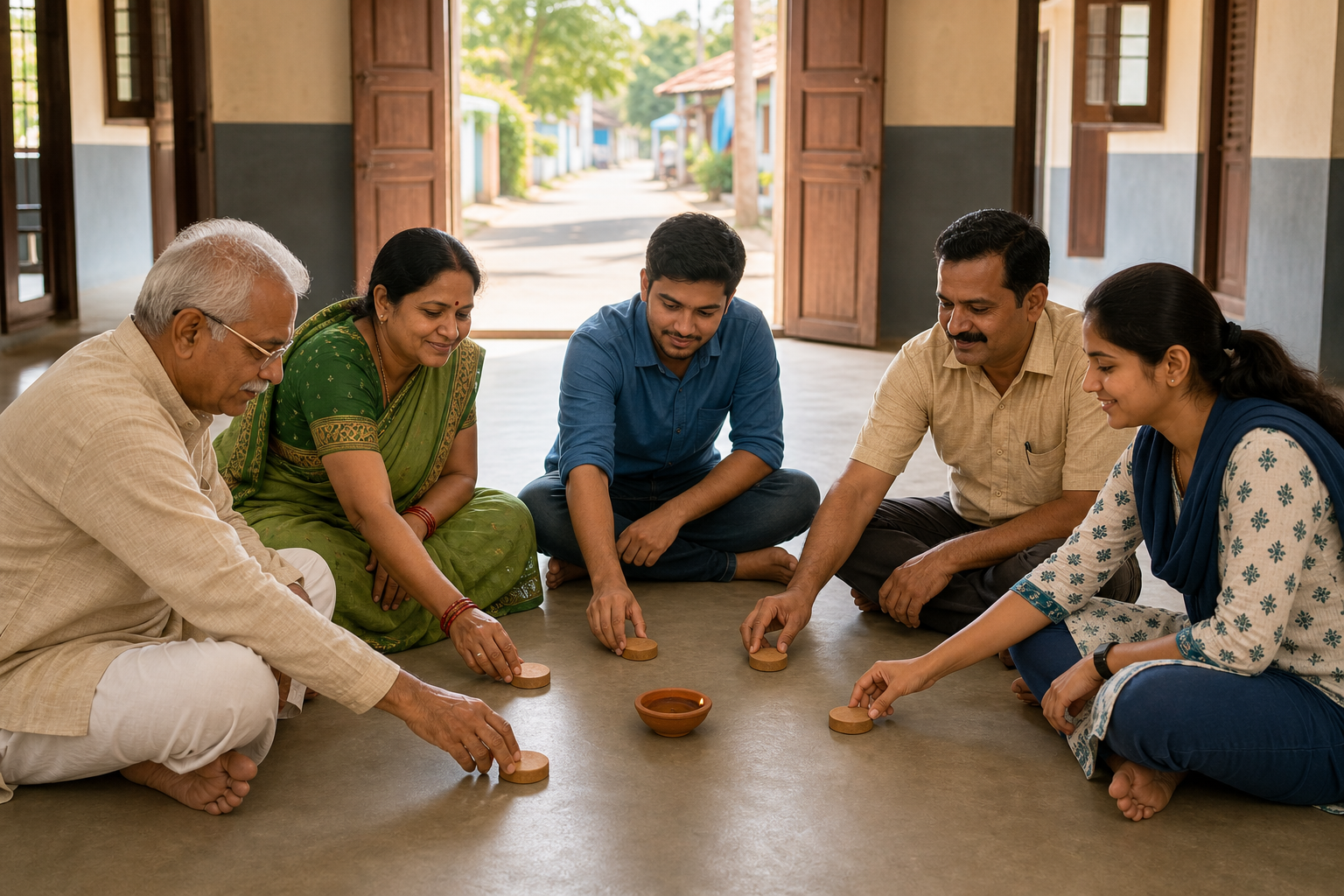
Grassroots ideological mobilisation turns shared beliefs into sustained collective action through local relationships. There is nothing inherently improper about that. Every durable civic tradition teaches, persuades, recruits volunteers and develops leaders. The danger begins when the declared purpose and the actual activity separate: a sports programme becomes an ideological screening ground, relief becomes conditional on loyalty, or a cultural gathering quietly turns into campaign canvassing.
Write a short public covenant before recruiting widely. A resident should be able to read it and understand what your group exists to do, what it will never do and how its leaders can be challenged. Include:
- Purpose: name the local problem and the civilizational value that guides the response.
- Scope: identify the ward, village, temple catchment, student community or professional network you actually serve.
- Methods: list the activities you will use, such as cultural education, documentation help, heritage work, mentoring, relief preparation or voter information.
- Non-negotiable boundaries: prohibit threats, humiliation, forced conformity, hidden inducements and dehumanising descriptions of any community.
- Use of assistance: base eligibility on need and the declared mission, never on political obedience, attendance at ideological sessions or a promise to vote a certain way.
- Transparency: identify responsible office-bearers, communication channels, funding or material support, and the process for approving public claims.
- Accountability: provide a complaint route that does not require someone to confront the person they are reporting.
- Safety: name the person responsible for youth safeguarding and the route for escalating a credible risk of harm.
The covenant should also separate four kinds of activity that are too often blended. A group may undertake more than one, but participants deserve to know when the lane changes.
| Lane | Legitimate purpose | Boundary to publish |
|---|---|---|
| Cultural education | Teach history, texts, traditions, languages and local heritage | Do not disguise candidate advocacy as neutral cultural instruction |
| Seva | Relief, mentoring, documentation help, neighbourhood care and practical assistance | Do not make assistance conditional on ideological or electoral loyalty |
| Civic participation | Explain public services, documentation, voter registration, lawful representation and local issues | Use verified information, obtain consent for messages and distinguish civic facts from political opinion |
| Electoral activity | Advocate for a party, candidate or programme within the law | Disclose the partisan purpose and do not solicit votes through prohibited appeals to religion, caste, community or language |
This separation matters especially in a Dharmic movement. Dharma and Hindutva should not be treated as interchangeable labels. Dharma supplies ethical restraints and duties; Hindutva is a modern political ideology operating in the public sphere. A volunteer may support both, but the organisation should say plainly when it moves from civilizational education to candidate or party advocacy. That transition changes the legal context, the consent expected from participants and the range of people who can reasonably take part.
A practical Dharmic test can be applied to every proposed action. Satya asks whether the claim has been verified. Ahimsa asks whether the language needlessly turns a neighbour into an enemy. Seva asks whether the activity produces a real public benefit. Self-discipline asks whether leaders obey the same rules as volunteers. Equal regard asks whether differences among Hindu sampradayas, Buddhists, Jains, Sikhs and people outside the Dharmic family can be handled without coercion or contempt.
If an activity fails these tests, a sacred vocabulary does not rescue it. If it passes them, ideological clarity becomes a source of reliability rather than a licence for aggression.
Build an operating rhythm that converts trust into service

In West Bengal, grassroots mobilisation has often taken a low-decibel form built around neighbourhood meetings, devotional gatherings, service initiatives, doorstep contact and digital reminders. Its organisational lesson travels beyond Bengal: repeated useful presence usually matters more than the spectacle of a single event.
Begin with an asset-and-issue map, not a demographic suspicion map. Record the institutions people already trust, the skills residents can offer, the needs that recur and the communication permissions people have actually given. Useful fields include:
- the locality or institution concerned;
- the issue residents have raised in their own words;
- the evidence or document needed to verify it;
- the trusted contact who can help without controlling access;
- available skills, space, transport or material support;
- the volunteer who owns the next action;
- the current status and last update;
- any privacy, youth-safety or conflict-of-interest concern.
The needs will differ by place. A border district may repeatedly encounter documentation and security anxieties. A refugee-descended community may need patient help with identity records and entitlements. A peri-urban youth network may care more about skills, apprenticeships and employment. Do not import a national slogan and assume it explains the local problem. Listen first, record what you heard, verify it and then choose the work.
Give every recurring responsibility an owner
A network becomes dependable when responsibility is distributed but visible. Depending on the activity, assign a convener, seva coordinator, cultural-learning lead, fact verifier, records custodian, youth safeguarding lead and civic liaison. Each role needs a backup and a clear route for handing over unfinished work. Otherwise the group is merely a crowd orbiting one overworked personality.
Use an issue register at each recurring meeting. Review unresolved needs before introducing new campaigns. Record who owns the next action, what evidence is still missing and when residents will receive an update. A disciplined meeting can move through the following sequence:
- Hear new concerns without promising an answer on the spot.
- Separate verifiable facts from interpretations, rumours and political opinions.
- Review open service commitments and identify anything that is stalled.
- Assign an owner for each accepted action and record the next visible step.
- Check whether youth safety, privacy or legal boundaries are implicated.
- Close by stating what will be communicated publicly and who will communicate it.
Service should never function as a concealed recruitment fee. Help with a document, relief need or public scheme because it fits your mission, not because the beneficiary attended a lecture, repeated a slogan or disclosed a vote. People may grow interested in your worldview after seeing principled work, but that interest must remain freely chosen.
Measure the network by reliability rather than applause. Track whether cases are closed, volunteers return, new people learn to lead, corrections are issued, complaints are resolved and youth activities remain visible to parents. Also watch for dependency: if every decision, password and contact list rests with one person, apparent unity is hiding institutional fragility.
Give WhatsApp a constitution
Digital channels can carry devotional material, historical explanations, meeting reminders and civic instructions across a locality. They can also move an emotionally charged falsehood faster than a responsible volunteer can correct it. Hyperlocal messaging and language-specific online outreach therefore need information integrity as well as reach.
Publish rules for official groups. Keep administrative access with more than one accountable adult. Do not use disappearing messages for schedules, permissions or institutional instructions. Archive logistics in a reviewable channel. Separate service updates from campaign messages, and do not assume that permission to join a relief or temple group is permission to receive partisan outreach.
Before forwarding a factual claim, require the volunteer to answer:
- Where did the claim originate?
- Does the linked material actually support the wording being circulated?
- Are the date, location and people correctly identified?
- Has an old image, clipped video or unrelated event been given a new caption?
- Is the message a fact, an inference, an opinion or a request for verification?
- What harm would follow if the claim were wrong?
- Who is responsible for publishing a correction in the same channel?
Label uncertain material as uncertain instead of adding a dramatic caption. If a false claim has already been circulated, delete-and-silence is inadequate. Post the correction where the original appeared, state what was wrong and update any volunteer talking points derived from it. Satya is not merely the absence of deliberate lying; it requires repairing an error after discovering it.
Make civic participation granular without making it coercive
Large appeals often fail because nobody owns the final practical step. Booth-level methods such as the panna pramukh model assign a volunteer to a small cluster of voters for roll checks, issue feedback and turnout reminders. The useful principle is granularity: a named person closes a defined gap. It is not permission to treat personal data, family relationships or religious identity as organisational property.
For non-partisan civic work, volunteers can direct residents to official voter information, explain documentation steps, note access problems and share polling logistics that have been verified. For partisan work, identify the sender and purpose, respect a refusal, keep service assistance separate and never imply that temple access, community standing or material help depends on a vote.
The Election Commission of India’s Model Code of Conduct and the Supreme Court’s decision in Abhiram Singh v. C.D. Commachen in 2017 mark serious legal boundaries around soliciting votes in the name of religion, caste, community or language. A cultural label does not immunise campaign conduct. When a community organisation formally enters electoral advocacy, it should obtain current election-law guidance and train volunteers on the language they may and may not use.
Protect trusted institutions and young people from capture

The same trust that makes grassroots work effective can make it vulnerable. Temples, sports clubs, coaching circles, study groups, seva projects and messaging communities bring people together around mentorship, aspiration and belonging. A bad-faith organiser can try to redirect that social capital toward isolation, obedience or violence.
The Maharashtra ATS case involving the alleged use of local football clubs as access points for radicalisation remains publicly under-detailed. It should be treated as a safeguarding warning, not as permission to declare a faith, sport or neighbourhood guilty. The proper question is whether an adult is exploiting institutional authority and trusted relationships to advance harmful conduct.
Manipulation rarely begins with an explicit invitation to violence. It may begin with performance advice, injury help, academic support, a recommendation to join a private group or an offer of special access. The conversation can then move toward grievance, exclusive identity, loyalty tests and separation from outside relationships. By the time overtly harmful demands appear, the young person may fear losing status, friends or a valued mentor.
Look for clusters of conduct, not identity markers
No single change proves radicalisation. Adolescent privacy, political curiosity, religious seriousness and disagreement with parents are not themselves evidence of extremism. Concern rises when several observable behaviours appear together, especially when an adult or closed group is directing them:
- selection, playing time, access or advancement is rewarded for ideological compliance;
- ordinary training or study is moved into unexplained private sessions;
- a participant is pressured to cut off friends, family members or prior mentors;
- alternative viewpoints are treated as betrayal rather than disagreement;
- teammates or neighbours are described as impure, disloyal or less worthy of protection;
- official communication moves into disappearing-message channels or private accounts;
- travel, training or service activity is concealed or explained inconsistently;
- questions about organisers, funding, curriculum or destination provoke threats or punishment.
Document the behaviour in neutral language. Record what happened, who was present, what was communicated and what immediate risk exists. Do not write that someone looked suspicious because of clothing, prayer, surname, caste or locality. Behaviour-based notes help a safeguarding lead make a proportionate decision; identity-based accusations damage innocent people and contaminate any serious inquiry.
Put safeguards into ordinary operations
A safeguarding system should be visible before a crisis. Sports and other non-religious youth programmes should prohibit staff from using training authority for political or religious indoctrination. A group explicitly created for Dharmic education should publish its curriculum, teachers and parental expectations instead of pretending that no worldview is being taught.
Community institutions can make the following controls routine:
- vet adults placed in positions of authority and repeat verification periodically;
- publish a code of conduct covering private meetings, transport, gifts, digital contact and ideological pressure;
- keep parents informed about schedules, venues, responsible adults and changes of plan;
- ensure that official youth groups have oversight from more than one approved adult;
- provide a confidential complaint route accessible to both young people and parents;
- train coaches, teachers and volunteers with realistic scenarios showing how grooming can progress;
- maintain contemporaneous notes and designate a single institutional contact for safety agencies;
- review allegations fairly, protect confidentiality and avoid public naming before facts are established.
If there is no immediate threat, the safeguarding lead can gather the limited facts needed, involve the parent or guardian where appropriate and arrange a calm conversation that does not begin with an accusation. If information indicates a credible risk of violence or clandestine harmful training or travel, contact local police or the appropriate security agency promptly. Volunteers should not stage their own confrontation or amateur investigation; doing so can increase danger, destroy evidence and expose a young person publicly.
Safety and rehabilitation are not opposing choices. A young person moving toward a harmful network may also need a credible route back into ordinary life: a respected mentor, qualified psychosocial support, educational help, an apprenticeship, a scholarship opportunity or meaningful service. These options do not replace lawful reporting when violence is a credible risk. They prevent the community’s response from reducing a recoverable human being to a permanent label.
Put these items on the next meeting agenda
Bring a draft covenant, a role sheet, an open issue register, a digital verification protocol and a youth-safeguarding route. Choose a local need that fits your actual capacity. Assign named responsibility, publish the next step and invite criticism through a channel people can safely use.
Then return to the community with evidence of what was completed, what failed and what needs more help. That is how awakening becomes more than rhetoric. When people can see service delivered, mistakes corrected, young people protected and leadership shared, Dharmic conviction earns the authority to endure.
References
- Hindu Janajagruti Samiti – Maharashtra ATS Exposes Football-Based Radicalisation: Safeguarding Youth, Sport, and Unity
- Hindu Existence – Inside West Bengal’s Quiet Mobilization: RSS ‘jagaran,’ Identity Politics, and 2026 Stakes
