
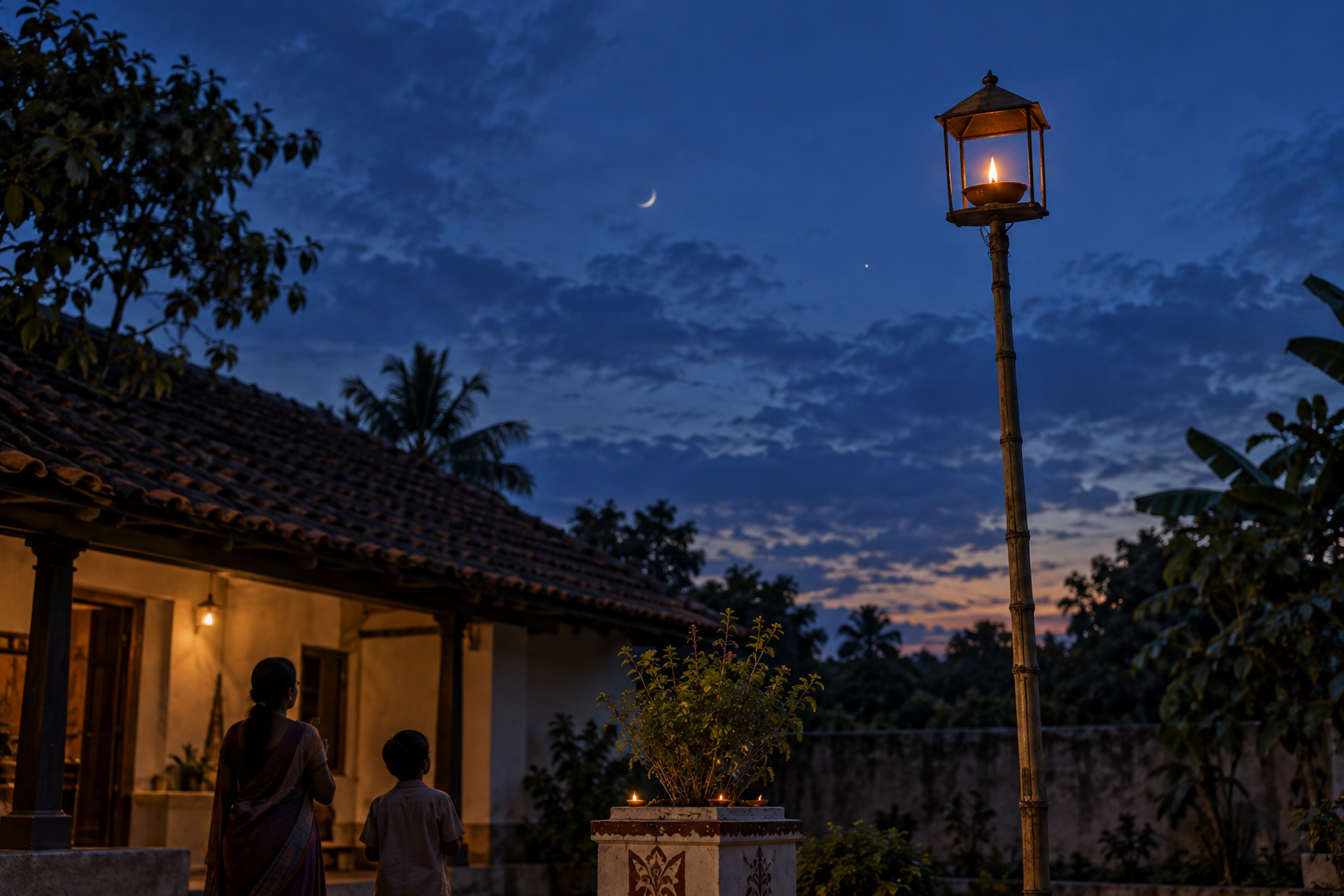
If you have heard that a lamp should be raised during Kartik but no longer have someone at home who can show you how, the difficult part is not lighting the flame. It is knowing how to honour the custom without presenting one family’s method—or a newly improvised method—as a rule for every Hindu.
Akash Pradip gives you a clear centre to work from: a light offered toward the sky, joining devotion to the divine with remembrance of those who came before us. You can observe it meaningfully even when inherited details are incomplete, provided you distinguish what your family received, what a trusted teacher advises, and what you have adapted for your present circumstances.
What the sky lamp is meant to hold
The Akash Pradip, also known as Akashdeep, is lit during the sacred month of Kartik and carries the symbolism of guiding ancestral souls home. Its meaning therefore rests on two connected movements: reverence rises toward the divine, while memory reaches back through the generations.
This is devotional symbolism, not a mechanical formula. The flame makes an inward disposition visible. You remember that your life did not begin with you, that the departed are not erased from family memory, and that a household can direct even a small daily act toward something higher than itself.
The skyward orientation matters because it moves the lamp beyond ordinary illumination. It is not lit because a room is dark. It is lit as an offering and a sign of direction. But that does not turn height, expense, or spectacle into measures of devotion. A precariously suspended lamp is not more sacred because it is harder to manage.
It is equally important not to turn the custom into a source of fear. If you do not know every inherited rule, acknowledge the gap instead of inventing consequences for getting something wrong. Begin with remembrance, reverence, and sincerity; then seek the local or family-specific details from people who actually know them.
Recover your family’s practice before assembling a new one
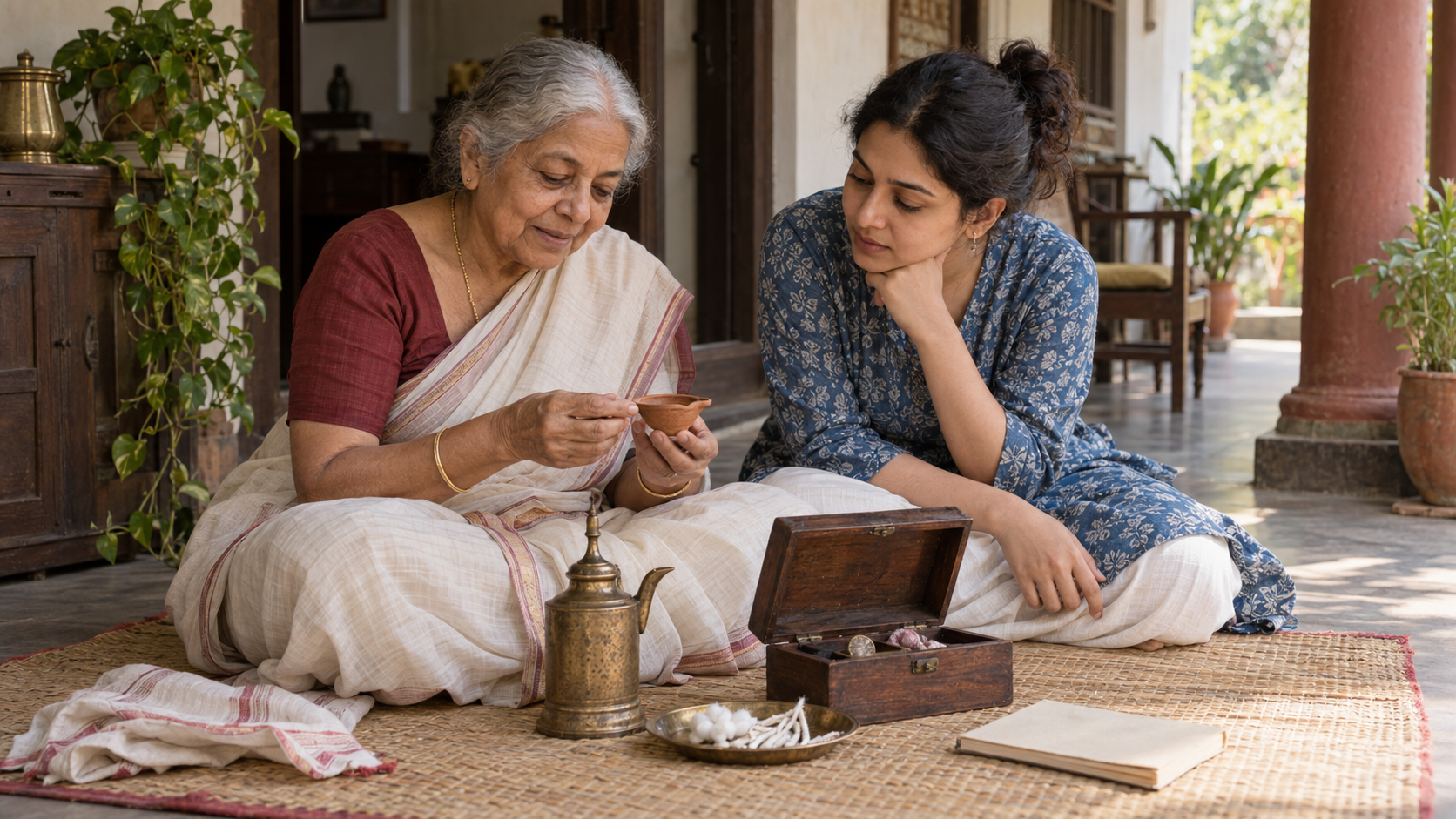
Akash Pradip may be simple in principle while varying in household form. If your parents or grandparents observed it, your first task is recovery rather than redesign. A short, focused conversation with an elder is more useful than collecting many disconnected instructions online.
Ask concrete questions. General prompts such as “What did we do in Kartik?” often produce general answers. These questions are more likely to recover a usable practice:
- What did our family call the observance: Akash Pradip, Akashdeep, or a regional name?
- Was the lamp lit throughout Kartik or only on particular evenings?
- Where was it placed, and how was the holder secured?
- What kind of lamp and fuel did the household use?
- Was a mantra, family prayer, name, or remembrance spoken?
- Who prepared the lamp, who lit it, and who remained responsible for the flame?
- Which details are clearly remembered, and which are uncertain?
That final question prevents guesswork from hardening into inherited history. Record firm memories separately from possibilities. A relative saying, “I think it was done this way,” has still given you something valuable, but it should not be labelled as certainty.
If family memory has broken, consult a temple priest, acharya, or knowledgeable practitioner familiar with your family’s region and sampradaya. Tell them plainly what you know and what you do not. Ask for a modest observance suited to your circumstances rather than requesting the most elaborate version available.
Do not combine every variation you encounter. A collection of unrelated regional details can look impressive while belonging to no living tradition. Choose one coherent line of guidance, note where it comes from, and follow it consistently enough to understand what you are doing.
A modest observance when inherited instructions are missing
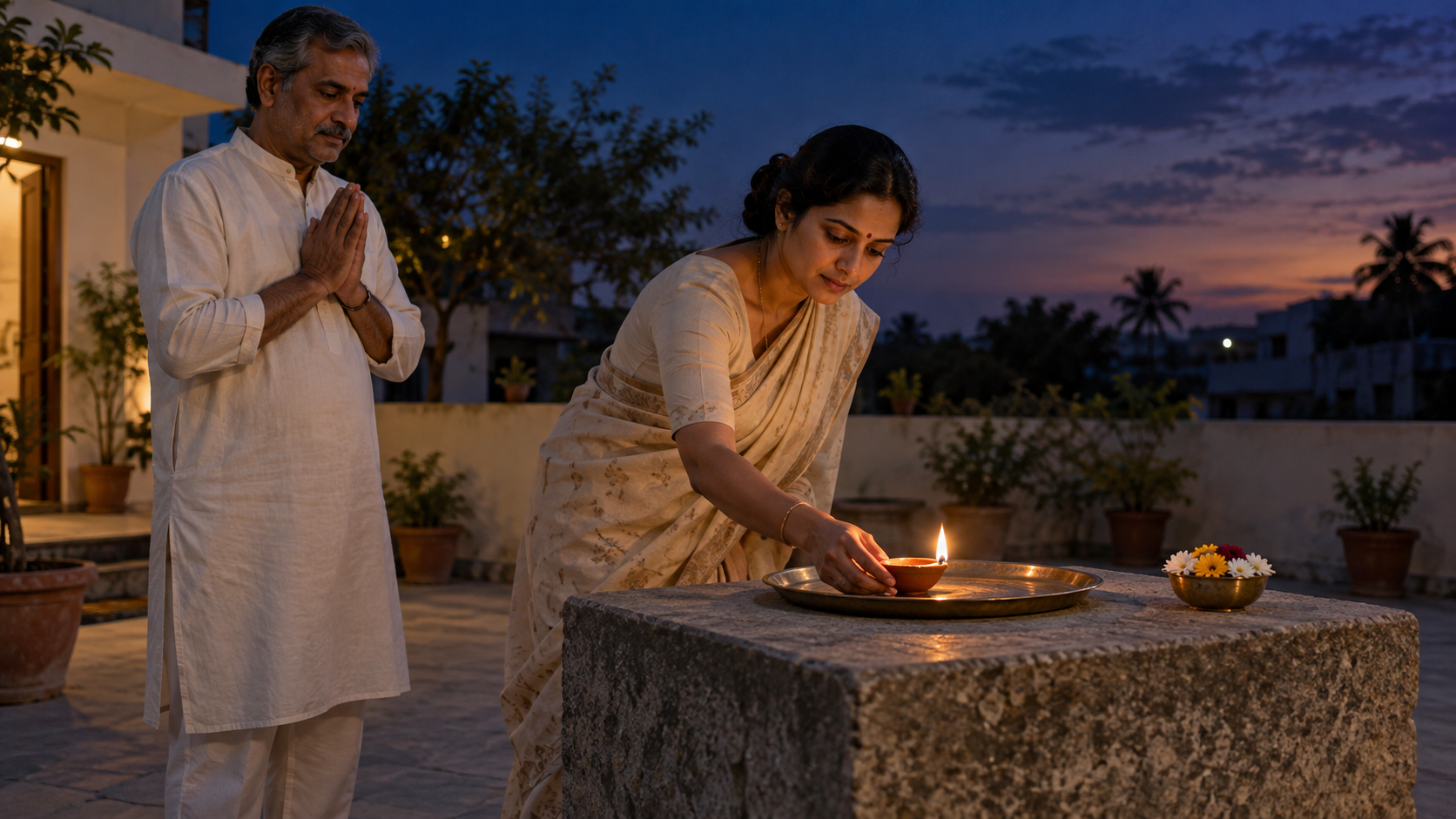
You may wish to begin this Kartik even though no complete family procedure survives. In that case, use a deliberately minimal form. The steps below are not presented as a universal vidhi. They are a transparent personal adaptation built around the known heart of Akash Pradip.
- Identify Kartik using the calendar your community follows. Use the panchanga or observance calendar followed by your family or temple. If you are unsure which calendar applies, ask before fixing dates.
- State your intention simply. You might offer the light in reverence to the divine and in grateful remembrance of your ancestors. This wording is an intention, not a claim that you have recovered a lost family mantra.
- Select a stable lamp and non-combustible holder. If you do not know whether your household traditionally used a particular material or fuel, do not invent a rule. Use what your trusted local guidance recommends and what you can handle safely.
- Choose a safe skyward location. An outdoor area, courtyard, terrace, or balcony may be unsuitable if the flame could tip, meet dry material, or be carried by wind. Never balance a lamp on a railing or improvised ledge merely to gain height.
- Light the lamp with full attention. Offer a prayer you genuinely know, or remain silent for a few moments. You can remember deceased family members without pretending to possess a formal invocation that was never taught to you.
- Remain responsible until the flame is out. Do not leave an open flame unattended. Keep it away from children, animals, curtains, plants, paper decorations, and walkways. Extinguish it safely if weather or circumstances change.
This modest form preserves the distinction between tradition and adaptation. You are not claiming that every Hindu must perform these exact steps. You are keeping the core intention alive while leaving room to learn a fuller inherited or locally grounded procedure later.
Let safety and honesty set the limits
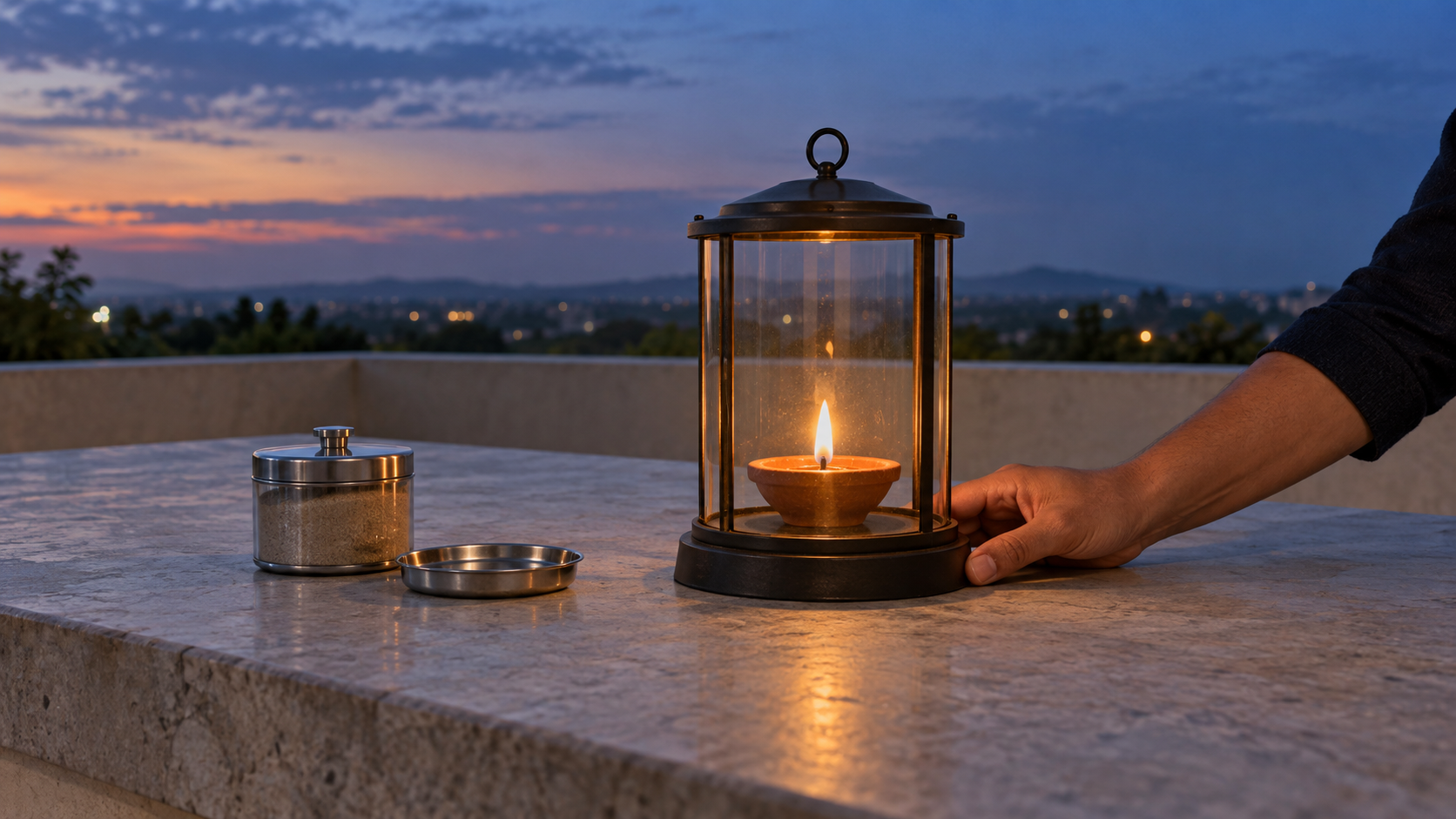
A living tradition has to pass through real homes. Your home may now be an apartment with smoke alarms, balcony restrictions, strong winds, or no protected outdoor space. Those conditions are not spiritual failures. They are practical facts that must shape how you handle fire.
Check the rules of your building and the conditions around the intended location before lighting anything. If an open flame cannot be used safely or lawfully, do not improvise a hanging arrangement. Ask a knowledgeable teacher whether an indoor observance or another symbolic adaptation is appropriate. If you use an electric light for personal remembrance, describe it honestly as an adaptation rather than declaring it identical to a traditional flame.
Weather deserves the same respect. Wind can overturn a lamp or carry flame into nearby material; rain can make elevated surfaces slippery; a dark terrace can conceal trip hazards. Decide where the responsible person will stand, how the lamp will be reached, and how it will be extinguished before it is lit.
Honesty also applies to presentation. A photograph may preserve family memory, but the observance does not need to become a display. If arranging the image begins to matter more than attending to the flame, ancestors, and divine presence, the priorities have reversed. Prepare the space first, put the phone aside during the offering, and allow the act to remain quiet.
Teach children through responsibility rather than spectacle. Explain why the lamp is being offered, name the family members being remembered when appropriate, and give children a safe task away from the flame. The lesson is not merely that a lamp appears in Kartik. It is that remembrance requires attention, gratitude, and care.
Key takeaways
- Akash Pradip is a Kartik sky-lamp observance joining divine reverence with remembrance of ancestral souls.
- Recover your household version by asking elders precise questions about timing, placement, materials, prayer, and responsibility.
- Keep remembered facts separate from uncertain recollections so that guesses do not become family doctrine.
- If no complete procedure survives, make any minimal observance explicitly as an adaptation, not a universal ritual rule.
- Do not treat height, decoration, expense, or online visibility as measures of devotion.
- Never leave the flame unattended or place it where wind, combustible material, children, animals, or an unstable support create danger.
Before Kartik begins, make one call to the oldest relative who may remember the custom and write down the answers. Then identify the safe place, the responsible person, and the prayer or silence you will offer. A carefully recovered small practice can carry more truth than an elaborate ritual assembled from guesses.
References

Leave a Reply
You must be logged in to post a comment.