
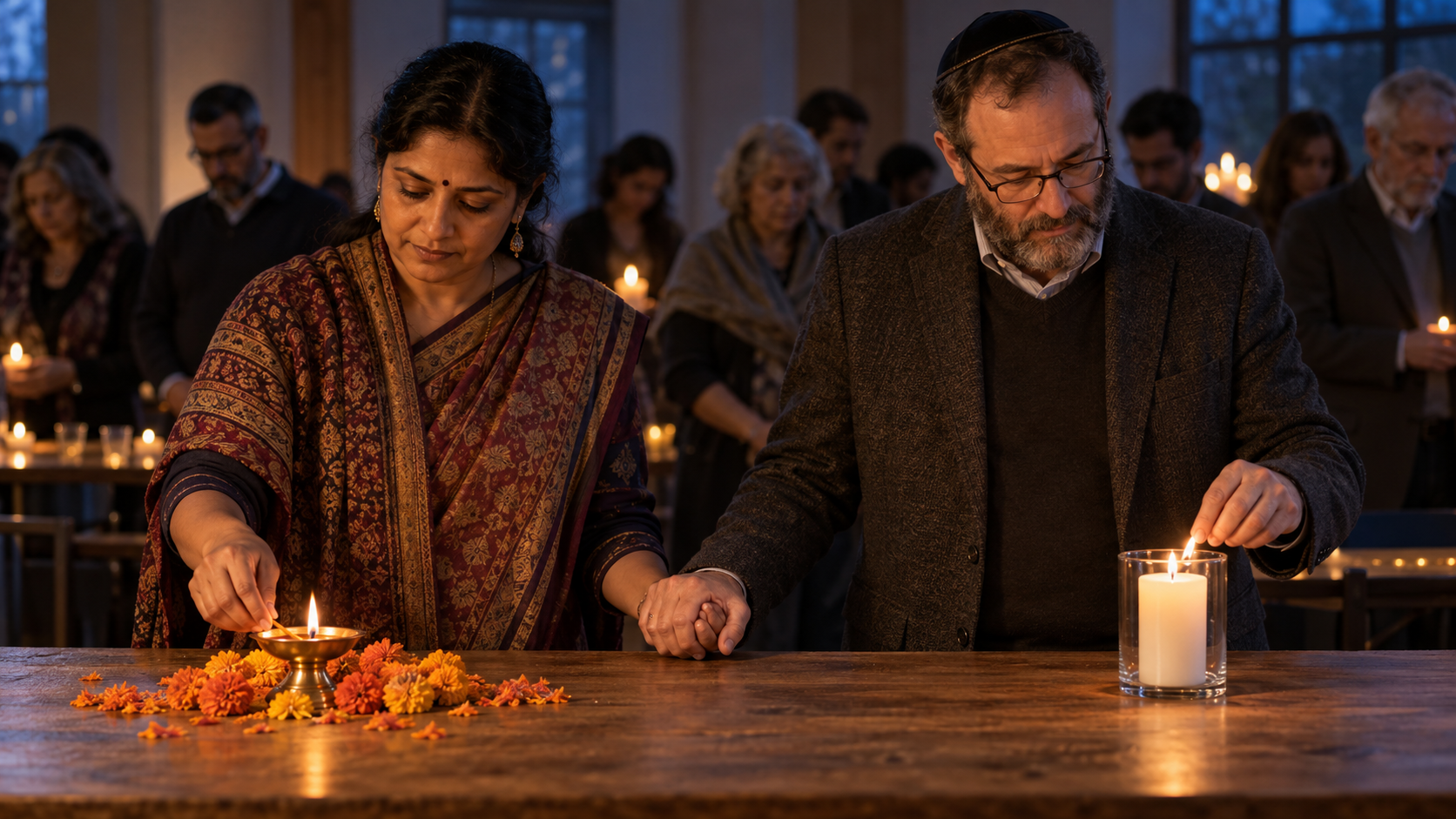
If you are Hindu and wondering what solidarity with Jewish neighbours should require after October 7, begin by refusing a false choice. You can name the murder of civilians without euphemism, oppose antisemitism without endorsing every decision of a government, and bring a distinctly Dharmic ethic to the work without dissolving either tradition into generic spirituality.
The public statement is the easy part. The real test comes when Jewish grief is rationalised, a sacred identity is mocked, or someone needs practical help. Hindu-Jewish solidarity becomes credible when moral clarity passes into disciplined service.
Moral clarity does not require political uniformity
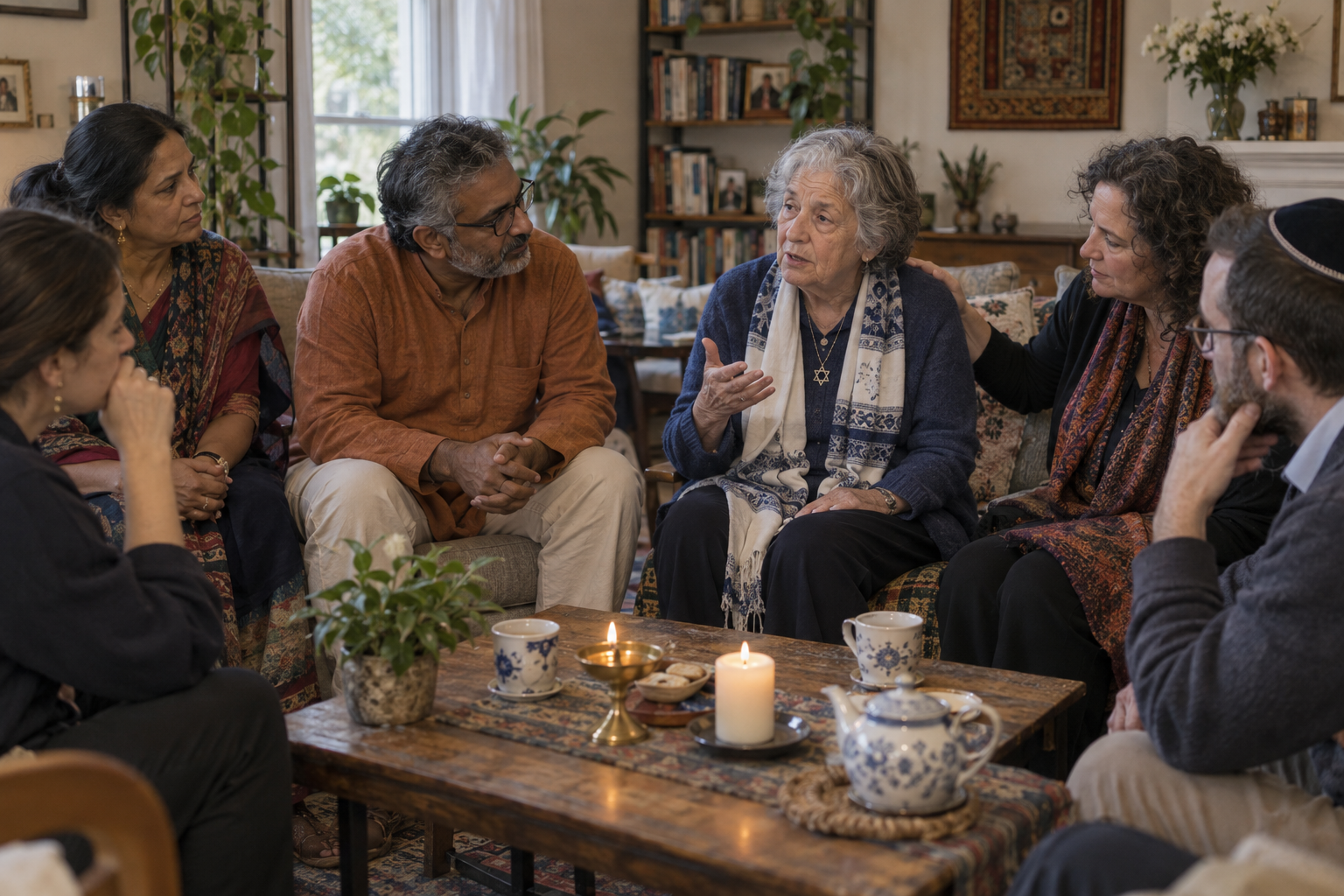
On October 7, 2023, Hamas terrorists attacked southern Israel in what became the deadliest attack on Jews since the Holocaust. The first obligation of solidarity is to say plainly what happened. Civilians were massacred. Their deaths do not become defensible when the murderer supplies a political slogan.
A condolence should not force a grieving Jew to pass a geopolitical examination before receiving your sympathy. Do not append a political “but” to the recognition of murdered civilians. There are proper settings for examining military conduct, borders, diplomacy and the decisions of elected leaders. Mourning is not one of them.
This distinction also prevents solidarity from becoming ideological obedience. Criticising a particular Israeli policy is not automatically antisemitic. Holding Jews everywhere collectively responsible for Israel, celebrating Jewish deaths, intimidating Jewish institutions, or treating antisemitism as an acceptable instrument of another cause crosses a different moral line.
When a conversation becomes confused, separate three questions:
- What happened to the victims, and can we name the wrong without qualification?
- Who is at risk now, and what would make that person or community safer?
- Which policy questions remain open to legitimate argument?
At a memorial, answer the first question. During a threat, act on the second. At a political forum, debate the third. Mixing all three into every encounter is how sympathy becomes a bargaining tactic rather than a moral response.
The cockpit rescue shows how dharma moves from prayer to action

A remarkable episode aboard flydubai flight FZ1073 gives this solidarity a concrete human shape. On September 30, 2026, the Dubai-to-Tel Aviv flight was carrying more than 170 people, including mostly Israeli citizens, four United States citizens and 27 children. UAE and Israeli authorities said co-pilot Hamam al-Hammami attacked Captain Smit Machchhar with an emergency crash axe and intended to crash the aircraft into Ben Gurion Airport.
Machchhar, a Hindu pilot from India, continued resisting despite grave wounds and managed to open the cockpit door. Passengers Yaniv Hanoun, Shota Musaeve and others entered, overpowered the attacker and helped arrest the aircraft’s dive. Reserve flydubai pilots travelling aboard the flight then assumed control and landed it safely in Tabuk, Saudi Arabia.
The rescue did not depend on one cinematic hero acting alone. A wounded captain created an opening. Passengers accepted the danger of entering the cockpit. Trained pilots then performed the specialised work needed to land the aircraft. Each person did the duty available to him at the moment it became necessary.
That sequence matters for anyone who speaks of dharma. Courage is not a mood. It is the decision to protect life, followed by cooperation and competent action. Devotion can steady that decision, but it does not replace it.
As he lay wounded, Machchhar recited the Hanuman Chalisa and later credited his faith in Shri Hanuman with giving him strength to continue fighting. His family described a living household practice: listening to the Chalisa at night and teaching his child to recite it in the morning. The prayer was not an emergency prop borrowed for one frightening hour. It belonged to a discipline formed before the crisis arrived.
Hindus should resist translating this into vague language about “inner strength.” Machchhar named Shri Hanuman and the Hanuman Chalisa. Shri Hanuman embodies strength governed by devotion, courage without vanity, steadfastness and service beyond the self. Those qualities are intelligible to people of any faith, but their Hindu source need not be hidden to make them intelligible.
The episode offers a usable four-part model for Dharmic public action:
- Form the practice before the emergency. A prayer, discipline or ethical commitment becomes dependable through repetition.
- Let devotion strengthen duty. Prayer should make you more willing to protect life, not less willing to act.
- Accept shared agency. You may begin the rescue without being able to complete it alone.
- Make room for competence. Once immediate danger is contained, the person with the relevant skill should lead.
India already carries another example of such duty in Neerja Bhanot. During the September 5, 1986 hijacking of Pan Am Flight 73 in Karachi, the 22-year-old senior purser warned the cockpit crew, concealed the passports of American passengers being hunted by the gunmen, opened an emergency exit and was killed while shielding children. Her dharma was not restricted to people of her own religion or nationality. Neither was Machchhar’s.
Do not turn either person into a mascot. Honour their conduct by forming the same habits at an ordinary scale: notice who is endangered, understand your role, act without waiting for applause, and cooperate with anyone trying to preserve life.
Real solidarity preserves each community’s religious voice
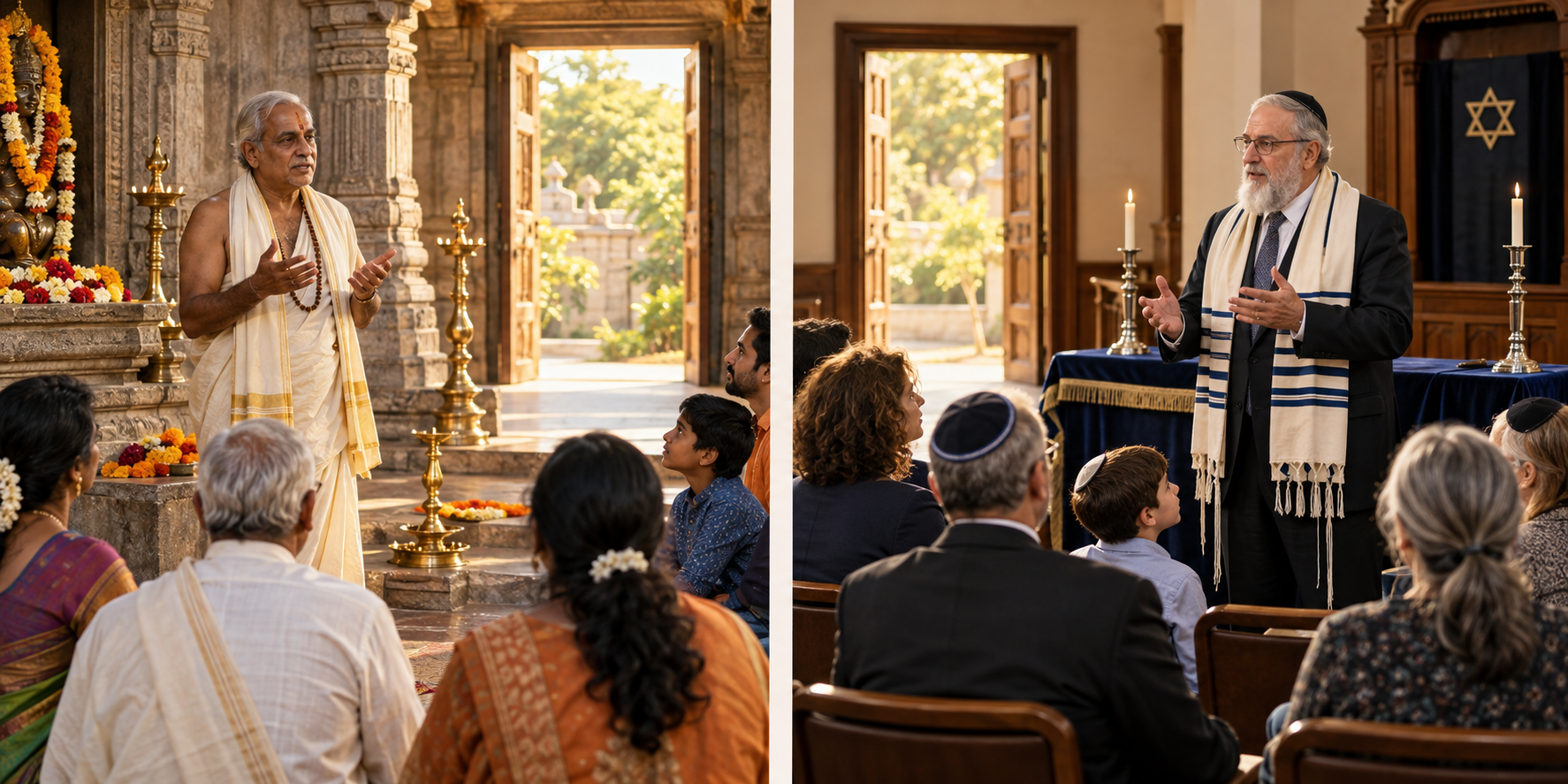
The Jewish response to Machchhar’s courage did not require suppressing his Hindu identity. A billboard at Israel’s Ad Halom Junction placed his photograph beside the words “Thank you, hero”. Israeli vocalist Ben Raivitz, who is trained in Hindustani classical music, performed the Hanuman Chalisa and offered prayers for Machchhar’s recovery.
Notice the form of that gratitude. A Jewish society thanked a Hindu rescuer while allowing his prayer, his deity and his religious vocabulary to remain visible. That is a stronger model than declaring that all religions are basically the same. Respect does not need sameness.
Use the same principle when organising a Hindu-Jewish gathering:
- State the purpose on the invitation. Mourning, learning, community safety and shared service are different events and require different expectations.
- Let Jewish participants choose the language, names and prayers through which they describe Jewish grief. Do not rewrite their experience into terms more comfortable for outsiders.
- Speak from Hindu tradition without embarrassment. Explain Shri Hanuman through devotion, disciplined strength, courage and service rather than reducing him to a caricature.
- Do not combine prayers or rituals without the consent of the people responsible for them. Sharing sacred space is not permission to improvise with another community’s practice.
- Allow disagreement where it genuinely exists. Solidarity against the murder of civilians and hatred of Jews does not require a manufactured interfaith consensus on every political or theological question.
A coalition based only on a common enemy will eventually become another source of suspicion. Condemning Hamas terrorism cannot become permission to blame Muslims collectively, just as opposing an Israeli policy cannot become permission to target Jews collectively. The stable basis for Hindu-Jewish friendship is reciprocal protection of life, memory, worship and religious particularity.
The working rule is simple: be universal about human dignity and precise about history, identity and belief.
Turn sympathy into a dependable local practice

If you belong to a mandir, cultural association, student group or professional network, solidarity should be visible in the way your institution behaves. Use this sequence when a Jewish community faces an attack, threat or attempt to disrupt its mourning.
- Verify before amplifying. Check the exact date, names, location and public statement from the responsible institution or authority. Separate an observed action from an allegation about motive. In the FZ1073 case, for example, the alleged plan should remain attributed to UAE and Israeli authorities even while the passengers’ rescue actions can be described directly.
- Contact the affected community privately. Ask one practical question: “Would a public statement, attendance, volunteers, a meeting space or quiet support be most useful?” Do not make the recipient manage your emotions or educate you before you help.
- Publish language that can survive scrutiny. A Hindu organisation could say: “On October 7, we remember the civilians murdered in Hamas’s attack and stand with our Jewish neighbours against antisemitism. Violence against civilians is adharma. We will defend every community’s right to mourn, worship and live without intimidation.” Adapt it to confirmed facts; do not add claims merely because they are circulating online.
- Show up under the host’s conditions. At a vigil or synagogue event, follow security instructions, observe the requested dress and conduct, and do not arrive with banners, flags or slogans that organisers have not approved. Presence should lower the burden on the host, not create another one.
- Challenge hatred in the spaces you actually influence. Correct the antisemitic message in the family chat, temple group, classroom or workplace where it appears. Preserve evidence before reporting abuse, and avoid forwarding hateful material more widely under the pretext of condemning it. If there is an immediate physical threat, alert organisers or emergency services instead of attempting a lone confrontation.
- Build continuity after attention moves elsewhere. Keep a named contact in each community. Arrange an exchange in which each tradition explains one practice in its own language, or choose a service project together. A relationship becomes resilient through repeated, low-drama cooperation.
There are also bargains you should refuse to make. Do not say, “We supported you, so you owe us support on every Hindu issue.” Do not use Jewish trauma as a prop for an unrelated argument. Do not ask Jewish neighbours to certify every analogy involving Hindu suffering. And do not treat opposition to anti-Hindu hatred and opposition to antisemitism as competing causes. A principle offered only in exchange for repayment is not a principle.
Key questions before you act
Does Hindu-Jewish solidarity mean supporting every Israeli government policy?
No. It means recognising Jewish humanity, naming antisemitism, refusing to rationalise the murder of civilians, and helping Jewish neighbours live and worship safely. Government policy remains open to evidence-based criticism. Collective blame does not.
What if Hindu and Jewish participants disagree about the war?
Define the meeting’s scope before it begins. A memorial should not be converted into an ambush debate. A dialogue intended to address political disagreement needs a moderator, agreed terms and enough time for genuine answers. In either setting, establish non-negotiable boundaries against celebration of civilian deaths, religious slurs and collective guilt.
What is the smallest meaningful first step?
Find the appropriate Jewish organisation in your area, send a short note that names the occasion or concern, ask what would be useful, and complete the help you offer. Reliability matters more than the size of the gesture. A private act that reduces someone’s burden is worth more than a public message designed mainly to display the sender.
Before you leave this question at the level of sentiment, choose one action: send the note, correct the falsehood, attend the invited gathering, or put a continuing Hindu-Jewish exchange on your community calendar. The lesson of the Hanuman Chalisa in that wounded cockpit is exacting: devotion proves itself when strength becomes service and service protects life.
References

Leave a Reply
You must be logged in to post a comment.