
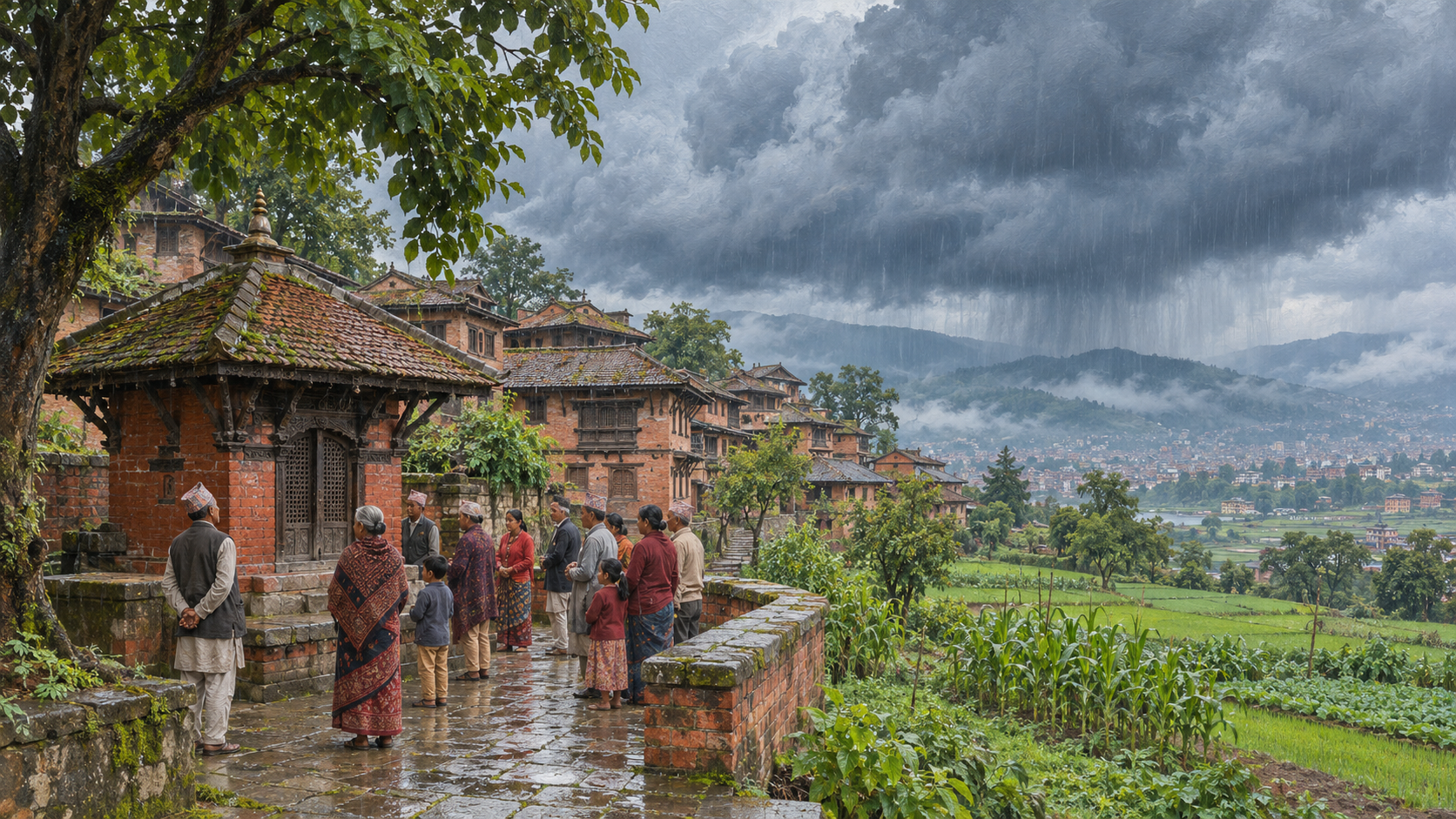
If you came here looking for a universal Aakash Devi mantra, fasting rule, or festival date, pause before borrowing one from elsewhere. The worship in question belongs to a specific Newar Hindu setting at Halchowk, on the outskirts of Kathmandu, and its local identity is the first fact to keep intact.
Once you begin with place and community, the tradition becomes much clearer. Aakash Devi is connected with Aakash Bhairav, the sky, rain, agriculture, and protection. Those elements belong together; they are not a loose catalogue of divine attributes.
Begin with Halchowk, not a generic sky-goddess label
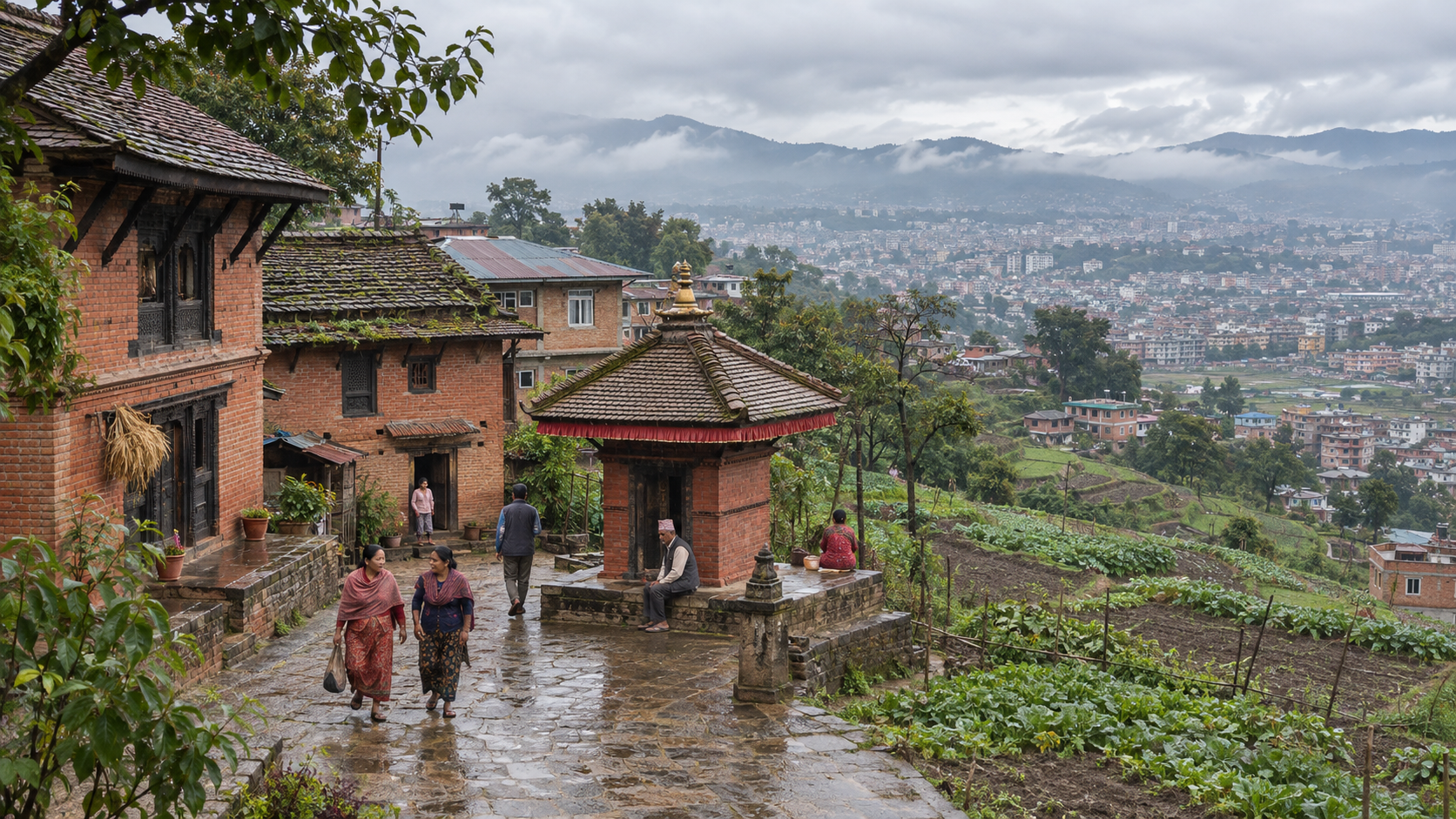
Aakash Devi is revered by Kathmandu’s Newar Hindu community and worshipped through the Halchowk Aakash Bhairav Jatra in Nagarjun Municipality, on the city’s outskirts. Halchowk is therefore not incidental background. It identifies the community and sacred setting in which her worship has meaning.
This distinction protects you from an easy mistake: presenting a local tradition as though it were practised uniformly throughout Nepal. Aakash Devi may properly be called a goddess worshipped in Nepal, but that does not establish a single nationwide ritual, calendar, or theology. The accurate description is narrower and more useful: she is a revered goddess of the Newar Hindu tradition associated with Halchowk.
If you are writing, teaching, or introducing someone to this worship, retain all three anchors: Halchowk, the Newar Hindu community, and the Halchowk Aakash Bhairav Jatra. Removing them turns a living tradition into a vague label.
Aakash Devi is understood in relation to Aakash Bhairav
Local tradition describes Aakash Devi as the feminine counterpart of Aakash Bhairav, a fierce form of Bhairava associated with the sky. That relationship is essential to understanding why a jatra bearing Aakash Bhairav’s name can also be central to the worship of Aakash Devi.
The word “counterpart” should be handled carefully. It establishes a paired sacred relationship, but it does not by itself prove that the two names are interchangeable, that one is merely a lesser version of the other, or that rites addressed to one may automatically be transferred to the other. It also does not justify identifying Aakash Devi with a better-known goddess simply because both are feminine divine forms.
The most defensible formulation is also the clearest: Aakash Devi is locally understood as the feminine counterpart of the sky-associated Aakash Bhairav. If a local custodian gives a fuller theological explanation, let that explanation lead. Until then, do not fill the gap with an imported genealogy or a guessed equivalence.
Rain, agriculture, and protection form one sacred chain
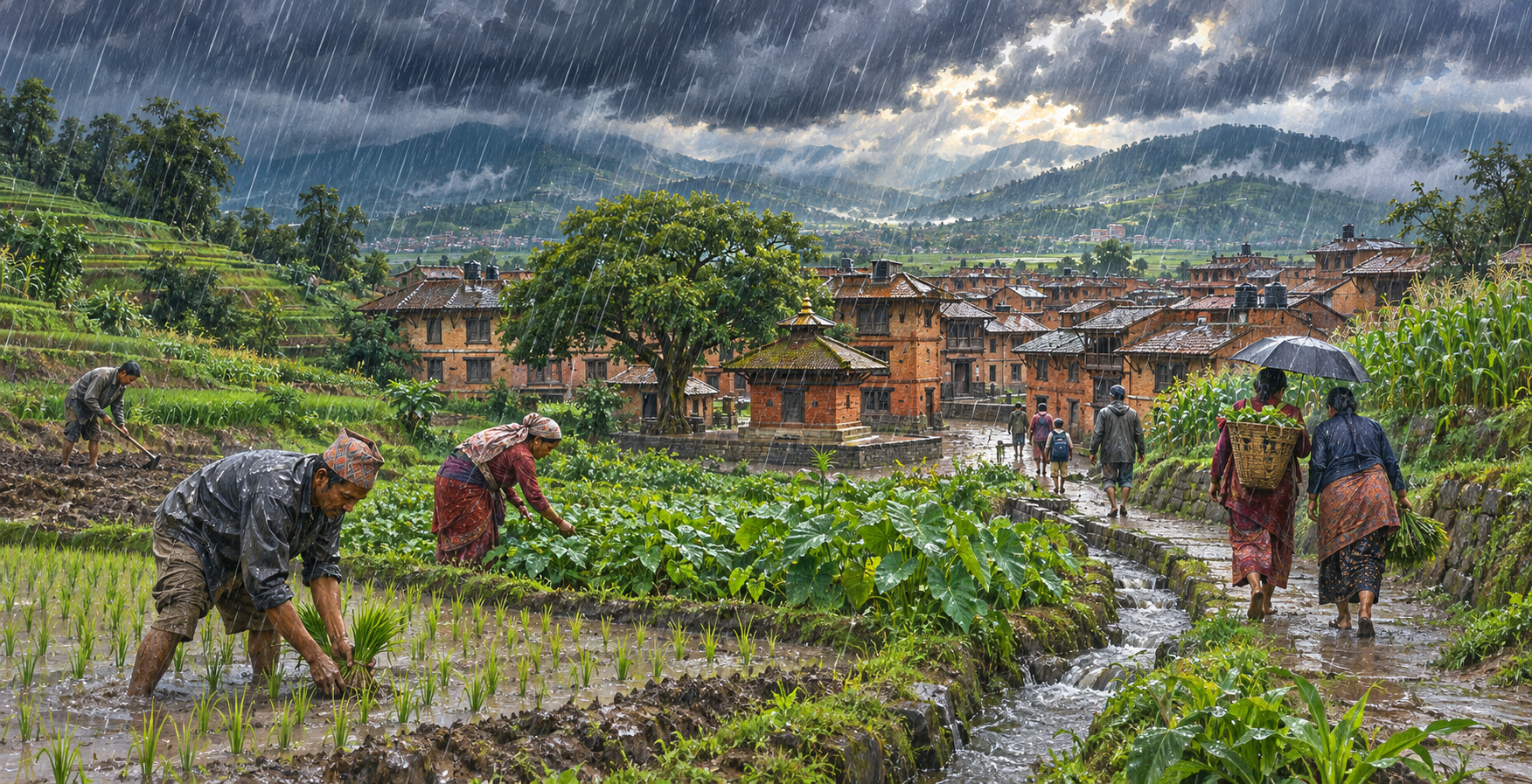
Aakash Devi’s connection with rain, agriculture, and protection becomes intelligible when you read those functions as a sequence. The sky bears rain. Rain sustains cultivation. Cultivation supports households and the wider community. Protection, in this setting, concerns the conditions on which life and livelihood depend.
This is more illuminating than calling her only a “weather goddess.” That shorthand makes the tradition sound mechanical, as though worship were merely an attempt to control rainfall. Rain-bearing grace has a larger devotional horizon: fertility, food, continuity, collective well-being, and safety from the insecurity that follows when the natural order does not sustain cultivation.
At the same time, do not reduce the goddess to an ecological metaphor. For devotees, Aakash Devi is an object of worship, not just a poetic name for the water cycle. The responsible middle path is to explain the real dependence linking sky, rain, crops, and community while preserving the sacred character of that relationship.
How to approach the worship without inventing details
Information about a local jatra is often repeated after being detached from the people who maintain it. If you plan to visit, write about, or participate in the Halchowk observance, use the following checks.
- Name the tradition precisely. Say “Aakash Devi of the Halchowk Newar Hindu tradition” when the context requires clarity. Do not silently turn a local observance into a universal Nepalese practice.
- Keep unverified ritual details out. A date, mantra, fast, offering, procession route, or household-puja sequence should not be supplied by analogy with another goddess. Similarity of divine function is not evidence of identical ritual.
- Confirm current arrangements locally. Before travelling, ask people connected with Halchowk about the jatra’s present timing, route, access, and expectations. Festival logistics can change even when the sacred tradition remains continuous.
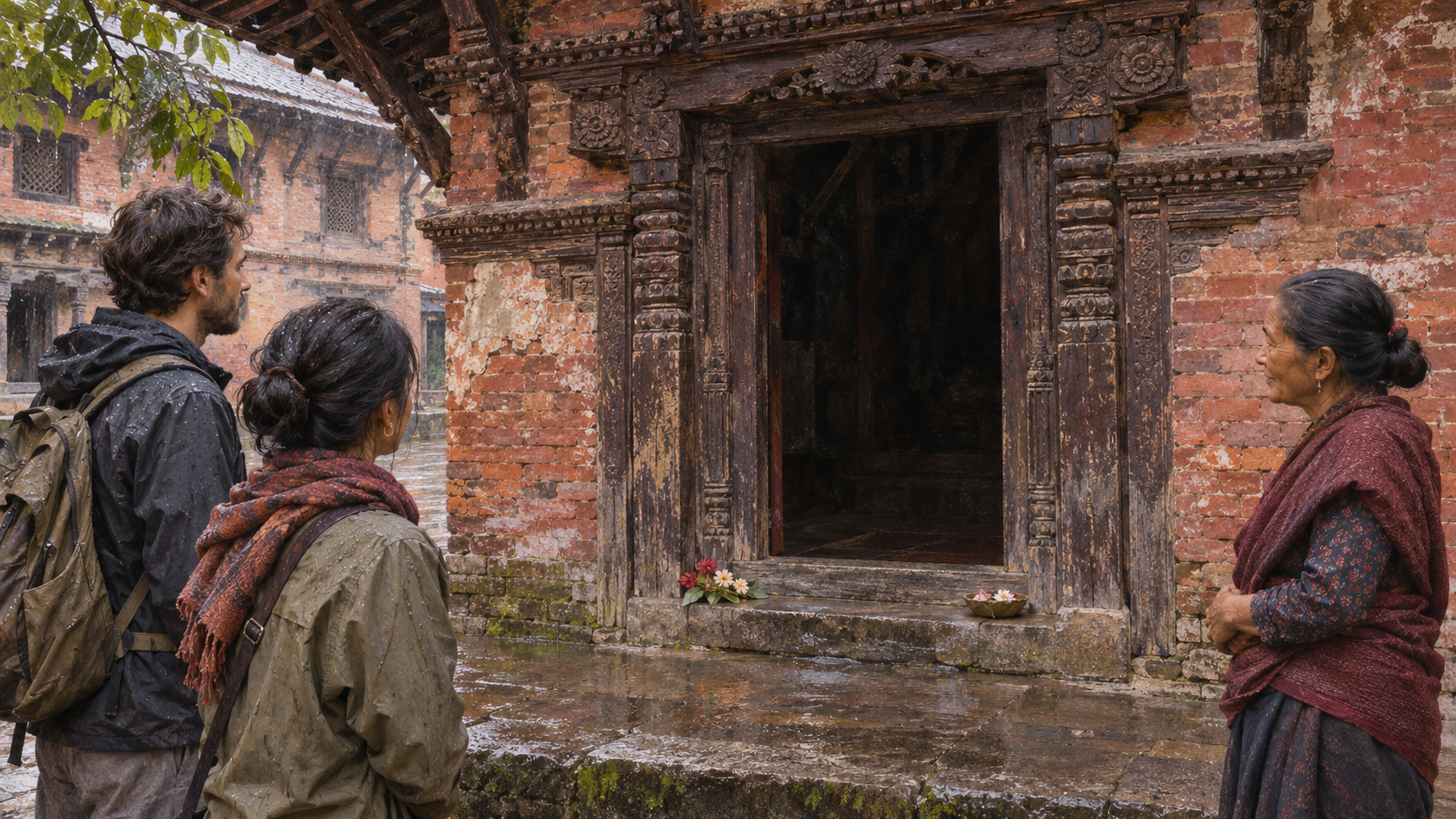
- Follow community boundaries. Ask before photographing worshippers, sacred objects, or restricted moments. Follow instructions given by participants and organisers rather than treating the jatra as a public performance staged for visitors.
- Preserve the relationship with Aakash Bhairav. Do not describe Aakash Devi in isolation when that omission would erase the paired form through which local tradition understands her.
These checks are especially important online. A confident ritual instruction can travel much farther than its correction. When a detail is unknown, saying less is more faithful than supplying a polished guess.
Key takeaways
- Aakash Devi is rooted in the Newar Hindu community of Halchowk, in Nagarjun Municipality on the outskirts of Kathmandu.
- Her worship is expressed through the Halchowk Aakash Bhairav Jatra.
- Local tradition understands her as the feminine counterpart of Aakash Bhairav, a fierce, sky-associated form of Bhairava.
- Rain, agriculture, and protection are connected aspects of her sacred role, not unrelated attributes.
- No mantra, date, offering, fast, or home-puja method should be presented as established without confirmation from the local tradition.
The sky may be universal, but this worship has an address. If you intend to visit, teach, or publish, your next step should be local verification in Halchowk. Keep the place, community, and relationship with Aakash Bhairav visible, and leave unsupported ritual details unstated. That discipline gives a living Dharmic tradition room to speak in its own voice.
References

Leave a Reply
You must be logged in to post a comment.