
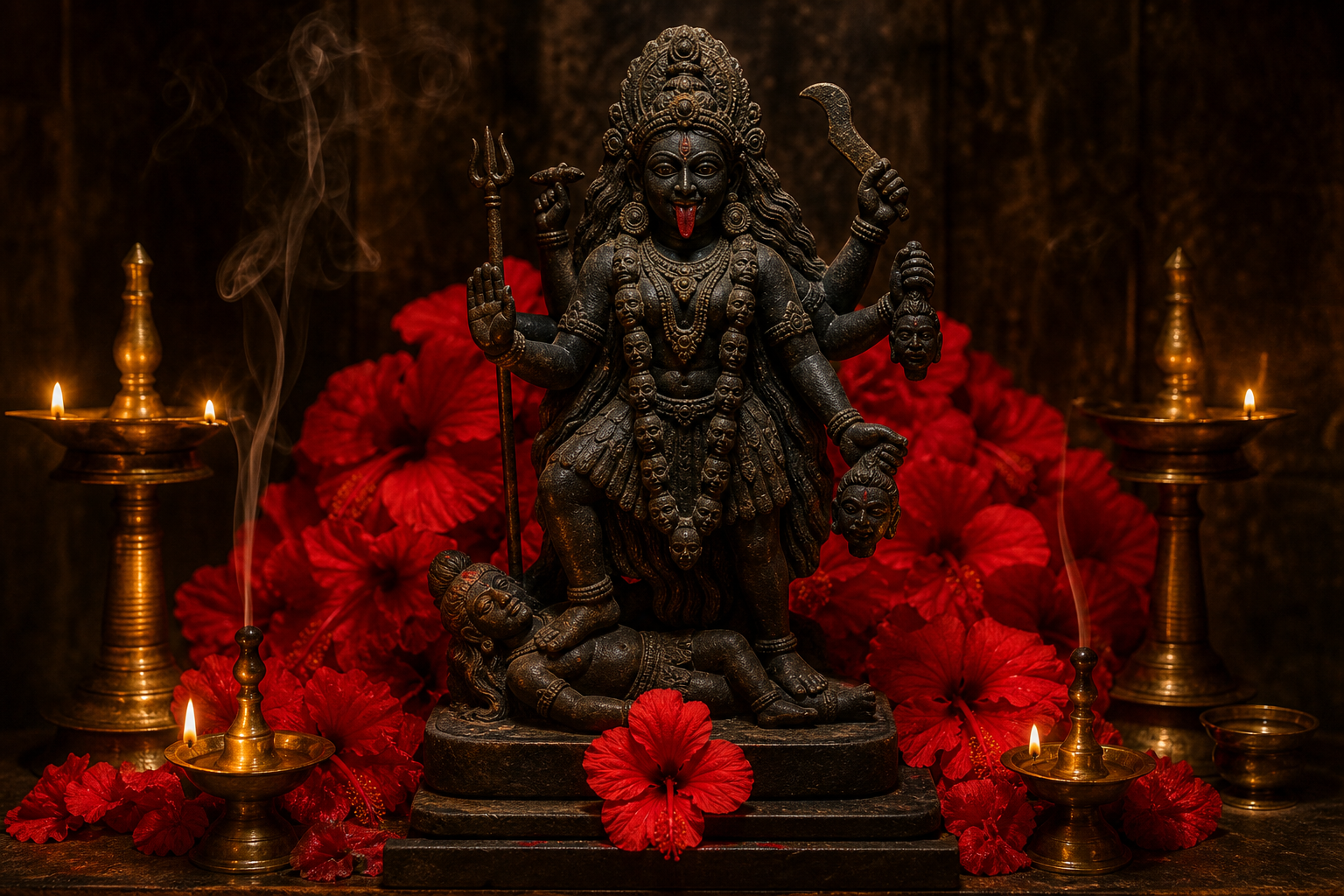
If you have seen an altar to Goddess Kali covered in crimson hibiscus, the useful question is not simply which flower she prefers. You may be wondering why this particular bloom belongs so closely to her worship, whether its red color represents blood, and what you should hold in mind when you offer it.
The hibiscus is powerful because it gathers several layers of Kali worship into one gesture. Its color recalls the Raktabija battle, its softness turns a fierce image toward non-violent devotion, and its form can help steady the mind on Shakti, the elements, and the purpose of puja.
The red flower makes Kali’s protective fierceness visible
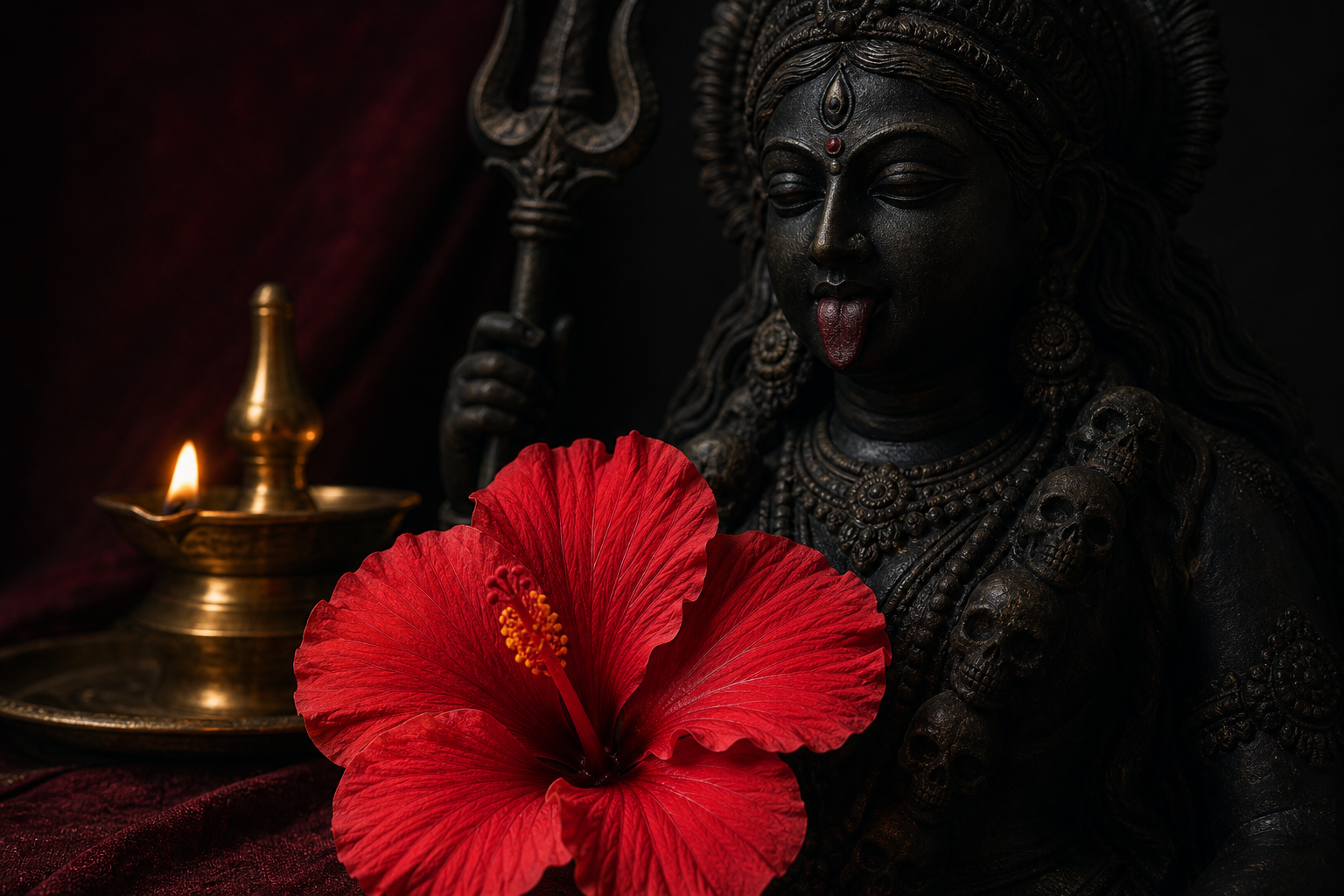
Color functions as a language in Shakta worship. The intense red of the japa pushpa, or hibiscus, corresponds to the blood imagery surrounding Kali and to her extended red tongue. It therefore does more than decorate the murti. It places a recognizable sign of her dynamic power before the worshipper.
That power should not be confused with cruelty. Kali’s fierceness is directed against a force that ordinary methods cannot contain. She enters the Raktabija battle to stop disorder from multiplying, and the flower helps the devotee remember that protective purpose.
The texture of the offering matters as much as its color. A soft flower evokes blood without reproducing violence. In this devotional reading, the hibiscus transforms an image of conflict into an act of reverence. Fierceness is not erased; it is offered back to the Divine through beauty, restraint, and attention.
This gives you a practical way to understand the offering. Red signifies intense Shakti, but the flower shows how that intensity should be handled. Strength need not become aggression. A forceful response can remain disciplined, protective, and governed by dharma.
Raktabija explains why the symbolism is about containment
The Devi Saptashati, also known as the Devi Mahatmya within the Markandeya Purana, recounts the battle against Raktabija. Every drop of the asura’s blood that reaches the ground produces another form of him. Striking him in the usual way therefore makes the crisis worse: each wound creates more enemies.
Kali answers the problem at its point of multiplication. She consumes the blood before it can touch the earth, preventing new forms from arising. Her action is fierce because the danger is self-replicating. The episode is not merely a display of destructive power; it is an image of decisive intervention when disorder feeds upon every attempted response.
The hibiscus recalls that central image through color. Yet an important distinction keeps the symbolism honest: the Devi Saptashati supplies the Raktabija narrative, while lived Shakta tradition makes the red flower a ritual embodiment of that memory. You do not need to claim that every interpretation of the hibiscus appears as a verbatim command in the scripture. A meaningful tradition can grow around a sacred narrative without collapsing the narrative and the later ritual custom into the same thing.
For contemplation, notice the unusual structure of Raktabija’s power. The problem does not merely persist; it multiplies whenever it is met without understanding. Before offering the flower, ask which challenge in your own conduct behaves that way. It might be anger intensified by each reply, fear strengthened by repeated avoidance, or distraction fed by every new impulse. This is a contemplative application of the episode, not a claim that the story is only psychological.
Then make the offering with one clear intention: do not feed the pattern you want Kali’s courage to help you interrupt. That turns a myth remembered at the altar into a discipline carried beyond it.
Five petals can guide reflection without becoming a rigid rule
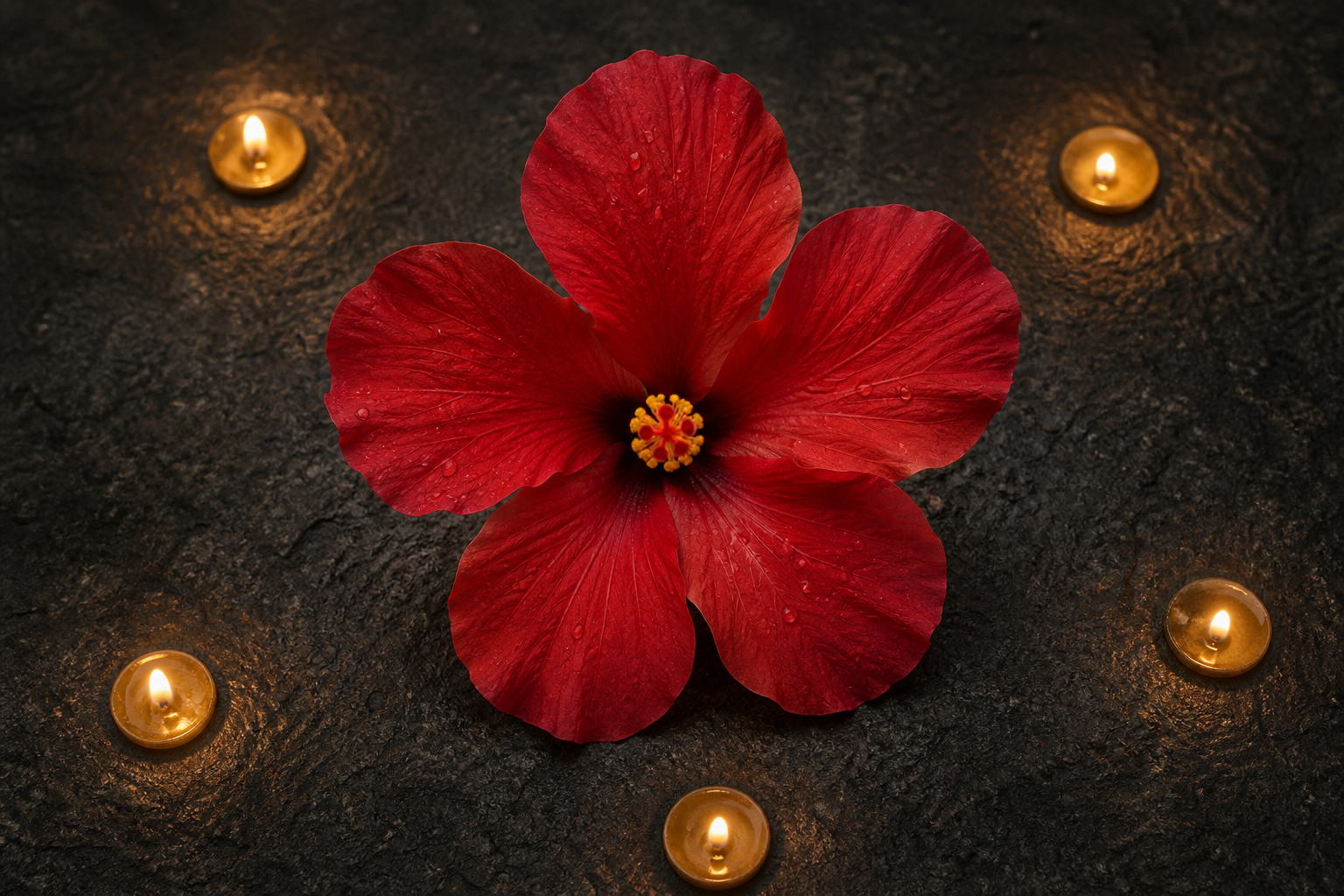
The basic hibiscus form is often seen as five-petaled. Some practitioners understand those petals through the panchabhuta, the five great elements: earth, water, fire, air, and space. Others connect them with panchopachara, the fivefold sequence of offerings used in a concise form of puja.
These readings are best used as contemplative aids. The petals can remind you that worship involves the whole embodied world rather than an idea isolated from it. Material flower, visible color, ritual movement, sound, fragrance, and attention all participate in the act of offering.
Do not turn the number into a pass-or-fail test. Hibiscus varieties differ, and a flower’s appearance does not establish one compulsory theological correspondence. If your lineage teaches a particular fivefold meaning, follow it. If it does not, you can simply let the form recall the elements or the ordered movement from external offering toward inner concentration.
This distinction protects the practice from two opposite mistakes. Treating the petals as meaningless decoration loses a useful layer of contemplation. Treating one symbolic reading as the only possible rule mistakes a teaching device for universal doctrine.
How to make the offering a focused act of worship
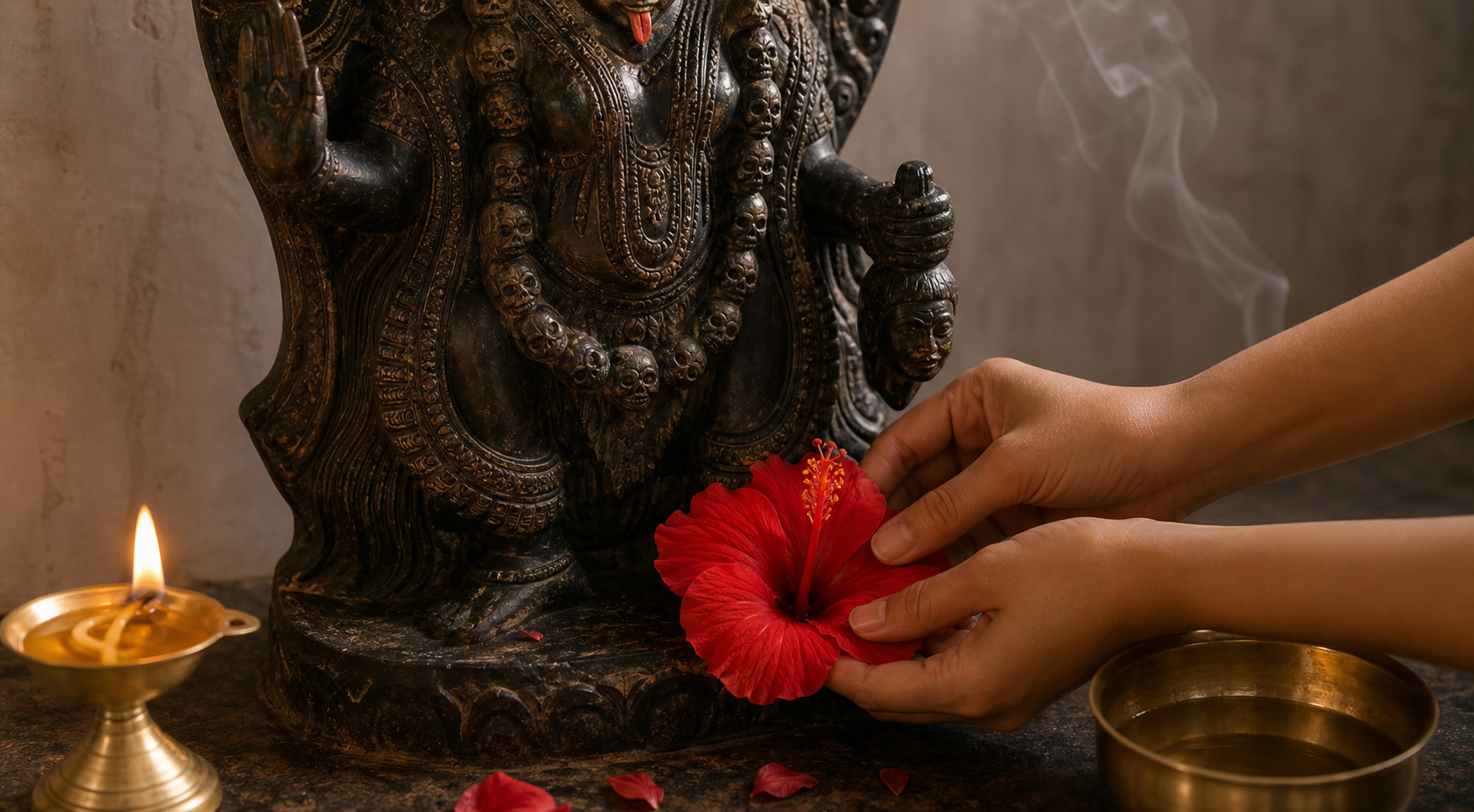
You do not need to force every interpretation into a single moment. A simpler offering is usually more attentive. When red hibiscus belongs to the puja you are performing, use this sequence to keep the symbol connected to conduct:
- Set apart the flower. A single crimson bloom can carry the symbolism; a garland expresses the same devotion collectively and repeatedly.
- Name one multiplying pattern. Bring one internal or external challenge to mind rather than loading the offering with every concern you have.
- Recall Kali’s intervention. Remember that she stops Raktabija’s blood before it reaches the ground. Focus on the containment of disorder, not violence for its own sake.
- Offer with the practice taught in your tradition. If your puja includes a Shakta mantra, recite it as received. The symbolism does not require inventing a supposedly universal formula.
- Gather the senses. Let the red flower, incense, conch, or bell serve one-pointed attention when those elements are present. They should direct the mind toward the Goddess rather than become ritual background noise.
- Carry one decision away from the altar. Choose a specific act of courage or restraint that prevents the challenge you named from spreading further.
The hibiscus is especially prominent during Kali Puja on the new moon night of Kartik, which coincides with Diwali in many regions. In Bengal, single blossoms and garlands form part of a vivid sensory field of mantra, incense, conch, and bell. The aim is not sensory excess. Each element gathers scattered attention around the presence of the Goddess.
In a temple or lineage-based observance, follow the procedure of that tradition. The reflections above can deepen an established puja, but they are not a reason to replace its sequence with a self-designed ritual. Symbolism serves worship when it clarifies the offering rather than making the worshipper preoccupied with private interpretation.
Questions devotees commonly ask about the hibiscus
Must the hibiscus be red?
The symbolism discussed here depends strongly on crimson or scarlet. Red creates the visual connection with the Raktabija episode, Kali’s tongue, and the intensity of Shakti. Other flowers or colors may have a place in particular local or lineage practices, but they do not automatically carry this same set of meanings. Follow the custom of the puja you are actually performing.
Does the flower stand for literal blood sacrifice?
Not in the non-violent devotional interpretation at the heart of this offering. The flower evokes the blood imagery of Raktabija while transforming it into beauty and reverence. It allows the worshipper to remember Kali’s uncompromising protection through an act consistent with ahimsa, compassion, and restraint. That explanation should not be inflated into a claim about every historical Kali tradition; it describes what the symbolic flower itself enables the devotee to do.
Do the five petals have one authoritative meaning?
No single five-petal interpretation needs to be imposed on every worshipper. Panchabhuta and panchopachara are meaningful ways to contemplate the form, but they function as ritual and teaching frameworks. Flower varieties differ, and lineage instruction should take priority over a generalized symbolic chart.
What should you remember at the moment of offering?
Remember the movement from multiplication to containment. Kali confronts a danger that grows through every spilled drop; you offer a delicate red flower and ask that fierce clarity be governed by dharma. The offering becomes complete in practice when you refuse to feed one harmful pattern after you leave the altar.
The next time you hold a hibiscus before Kali, choose one thing that must stop multiplying. Place the flower with attention, then make your next response part of the offering. That is how the crimson bloom moves from sacred symbol to living devotion.
References
