
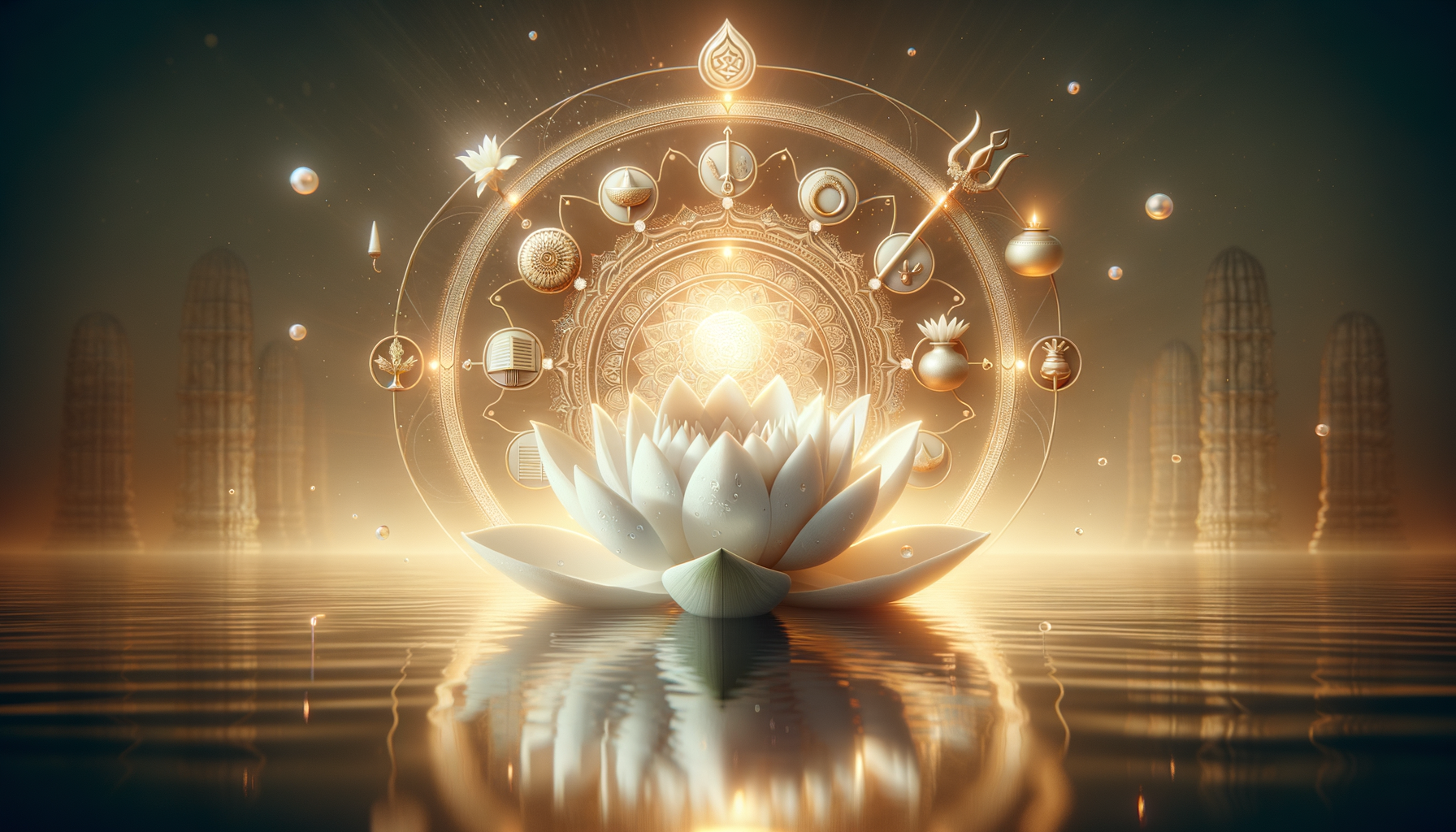
The white lotus stands in Hindu iconography as a powerful symbol of purity, transcendence, and spiritual awakening. Rising unsullied from muddy waters, it communicates how spiritual life can flourish amidst worldly complexitiesa central insight in Hinduism and other dharmic traditions. While the pink lotus frequently appears as the sacred seat of deities, the white lotus often signals the highest refinement of sattvaclarity, peace, and ethical luminositypointing toward moksha.
Across the dharmic familyHinduism, Buddhism, Jainism, and Sikhismthe lotus signifies inner purity and spiritual resilience. This shared symbolism fosters unity in diversity: each tradition articulates the metaphor in its own vocabulary, yet all affirm the same idealliving in the world without being of it. In this way, the white lotus becomes a common bridge across spiritual lineages.
In Hindu art and temple sculpture, a deity seated or standing upon a white lotus conveys consummate purity and unwavering wisdom. The lotus-pedestal, or padma, forms a visual grammar of divine presence: it is not merely a throne but a statement about consciousness that remains unstainedjust as a lotus leaf repels water.
Saraswati is often depicted on a white lotus, a choice that underscores her essence as vidyāpure knowledge, refined speech, and contemplative clarity. The whiteness intensifies her association with lucidity and truth, guiding seekers toward jñāna that is both illuminating and compassionate. In lived practice, many devotees describe a sense of effortless focus when contemplating Saraswati on a white lotus, as if the image itself invites interior stillness.
While Lakshmi is commonly shown with a pink lotus, several traditions portray her with a white lotus to emphasize ethical wealthprosperity aligned with dharma, generosity, and inner abundance. In such imagery, the white lotus reframes prosperity as a means for service, stewardship, and balance rather than mere accumulation.
Vishnu’s epithet Padmanabha evokes the cosmic lotus from which Brahma emerges, a motif that occasionally appears as white in regional and period-specific iconography to accent universal purity. Although Brahma’s lotus is frequently rendered pink, white variants highlight creation arising from untainted, equilibrated consciousness. This nuance illustrates how Hindu iconography accommodates multiple schools, regions, and philosophical emphases without contradiction.
Shiva and Śakti imagery also engages the lotus grammar. In forms associated with serene puritysuch as Mahāgaurīthe white lotus accentuates purification and auspicious renewal. These choices vary by text, lineage, and local tradition, yet converge on the same principle: whiteness signifies the refined sattva that undergirds spiritual clarity.
The white lotus is equally at home in yogic psychology. The sahasraraoften envisioned as a thousand-petaled white lotusrepresents the crown of consciousness, where awareness opens to a sense of vastness beyond ego. Meditative visualization on a white lotus is widely reported by practitioners to cultivate calm, steadiness, and gentle upliftqualities aligned with spiritual awakening.
Scriptural and poetic traditions reinforce this symbol. The Bhagavad Gita likens the liberated person to a lotus leaf untouched by water“padma-patram ivāmbhasā”a vivid image of inner freedom lived amidst action. Sikh Gurbani invokes the lotus to teach graceful detachment in the world. In Buddhism, the white lotus signifies pristine wisdom; in Jain art and literature, lotus emblems evoke purity of conduct and contemplation. Such convergences reveal a shared civilizational ethos that honors inner discipline, compassion, and clarity.
Ritually, offering a white lotus in puja expresses a devotee’s aspiration to approach the divine with a pure heart. Temple artists and iconographers often choose the white lotus to gently guide onlookers toward introspection. Many visitors describe feeling soothed and centered before such images, as if the visual language itself were a quiet instruction in dharma and mindfulness.
When Hindu gods and goddesses are shown atop a white lotus, the visual teaching is clear: cultivate purity without withdrawal, wisdom without pride, and compassion without fatigue. This teaching resonates across dharmic traditions, strengthening a spirit of interfaith harmony rooted in shared values rather than uniformity of forms.
For contemporary seekers, engaging with this symbolism can be practical and immediate. When viewing temple art or studying Hindu iconography, notice the color of the lotus and its contextwhite often signals a call to ethical clarity, serene discernment, and inner stillness. A brief period of quiet breathing while contemplating the lotus can transform observation into contemplation, turning art into a doorway for personal insight.
Ultimately, the white lotus’s enduring appeal lies in its profound simplicity. It speaks to a universal aspiration across Hinduism, Buddhism, Jainism, and Sikhism: to remain inwardly clear and outwardly compassionate. In that clarity, the lotus becomes not just an image beneath a deity, but a mirror of the awakened heart.
Inspired by this post on Hindu Blog.
