
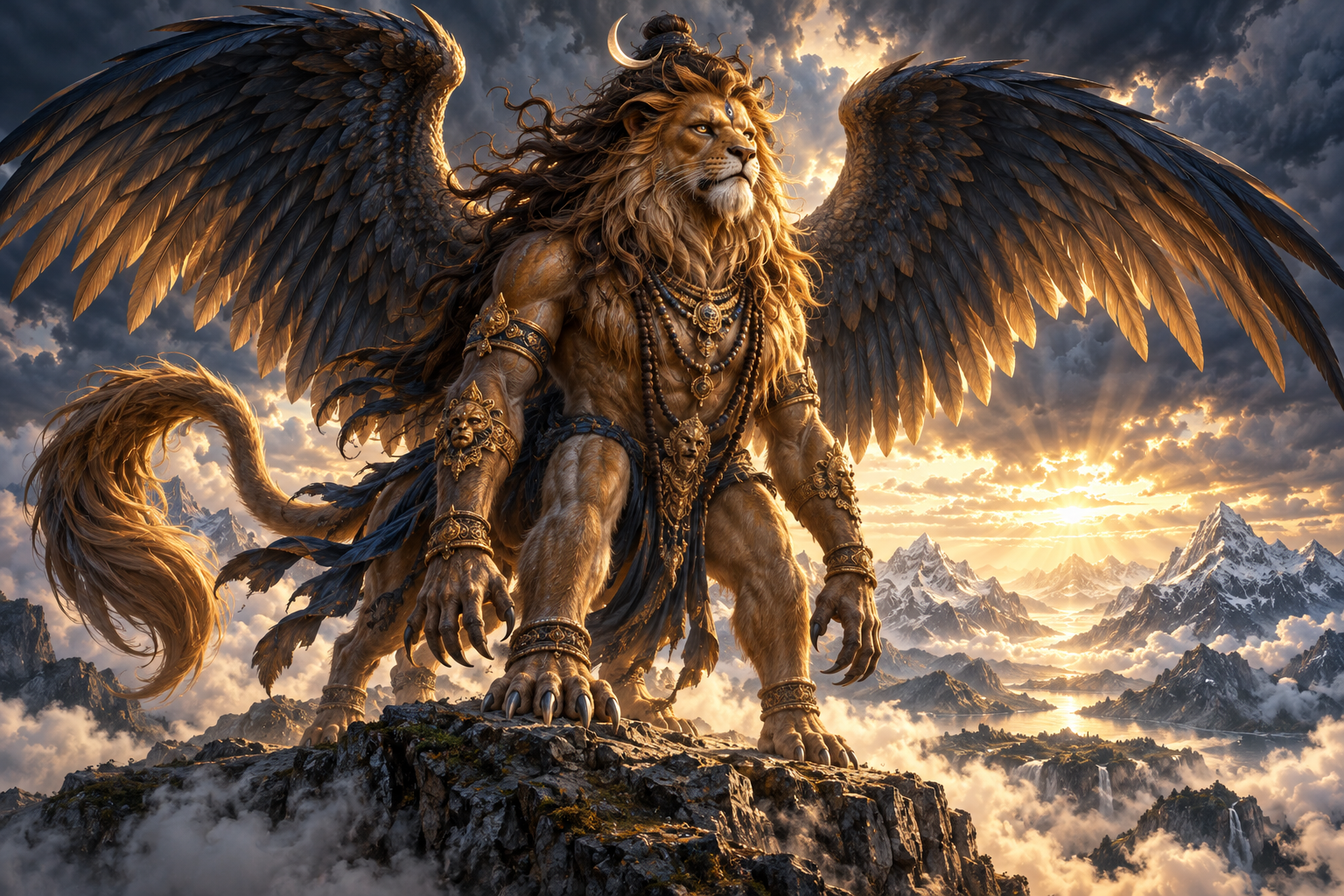
You may have encountered Sharabha in a temple name, sacred image, or festival notice and wondered whether he is Shiva, a fantastic creature, or a claim about one deity defeating another. The clearest answer begins with his purpose: Sharabha is a formidable manifestation of Shiva who appears to pacify Narasimha.
Keep that purpose in view and the unusual lion-bird form becomes easier to understand. Its overwhelming strength serves restoration, not conquest. That distinction will help you recognize Sharabha, explain the legend carefully, and approach his Jayanti without turning a sacred narrative into sectarian rivalry.
Begin with Sharabha’s purpose, not only his appearance
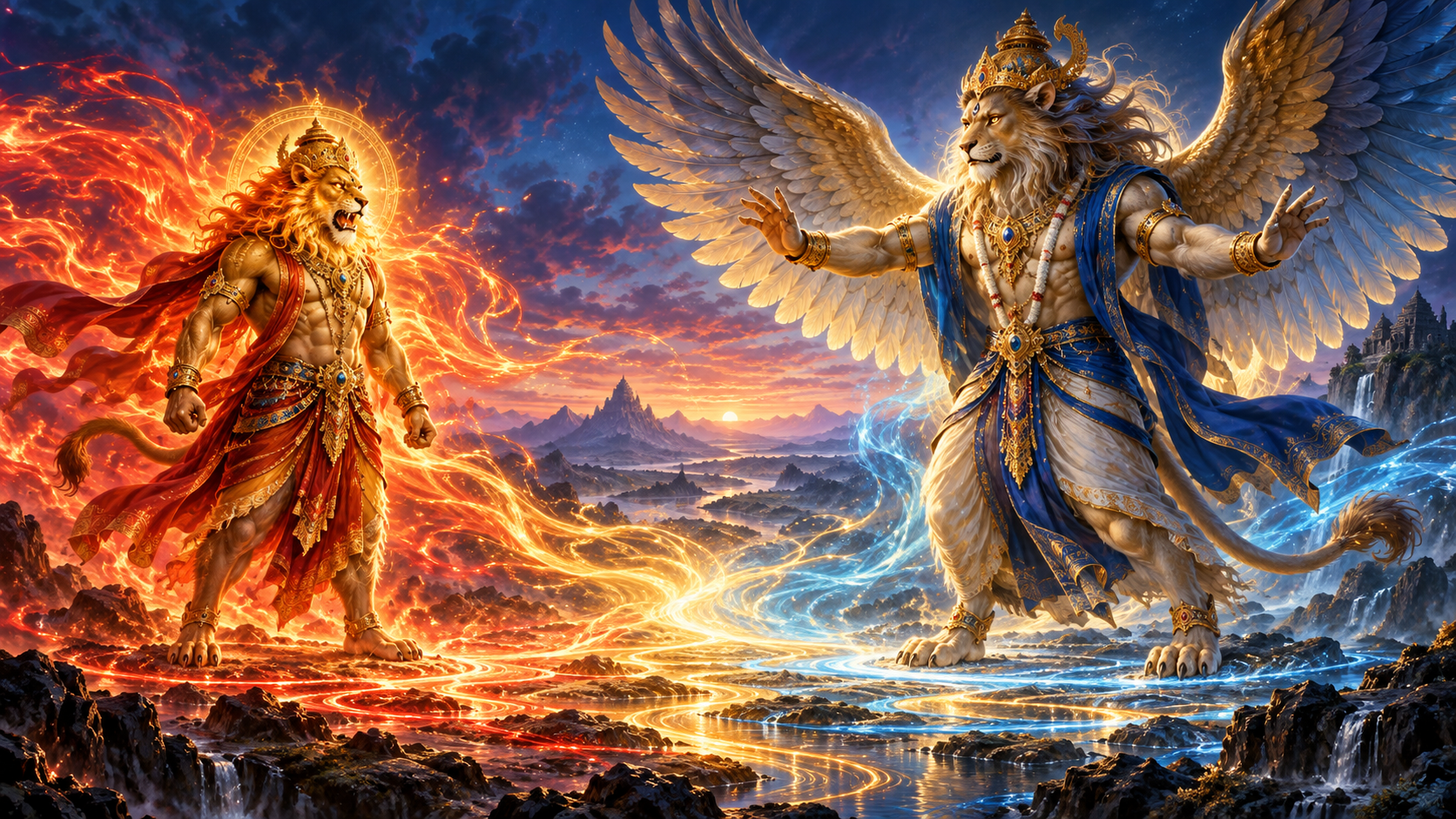
Lord Sharabha, also revered as Sharabheshwara Swamy, is an avatar of Lord Shiva who assumes a form mightier than a lion. His defining task is to pacify Lord Narasimha Swamy. The story therefore gives you three firm anchors: Sharabha’s identity is Shiva, his power exceeds that of a lion, and his intervention aims at pacification.
Sharabha is described as an immense bird-like being with wings and a strong beak. Calling him Shiva’s lion-bird avatar is a useful shorthand because it joins two aspects of the description: lion-surpassing power and a gigantic avian form. It should not become a demand that every sacred image resemble the same zoological hybrid in precisely the same way.
If someone asks you who Sharabha is, you do not need a long catalogue of limbs, weapons, or speculative symbolism. A careful answer is enough: Sharabha is Shiva manifesting as a vast, powerful winged being to bring Narasimha to calm. That sentence preserves the identity, form, and purpose without adding details the basic account does not establish.
Why the word “pacify” changes the entire reading
The most common misreading begins when “more powerful than a lion” is remembered but “to pacify” is forgotten. Power then becomes a scoreboard: Which deity is stronger? Which sect wins? That framing shrinks a theological image into a contest its central action does not require.
Pacification is different from annihilation. Sharabha’s terrifying capacity has a regulating purpose. The form is powerful enough to meet an overwhelming condition, yet its work reaches completion in calm. A fierce appearance and a restorative mission are not opposites here; the first serves the second.
This also tells you how to discuss the legend respectfully. Do not retell it simply as Shiva attacking Narasimha or as evidence that devotion to one invalidates devotion to the other. Say what the narrative actually emphasizes: Shiva assumes an extraordinary form because Narasimha must be pacified. Relative power belongs to that task; it need not be inflated into a permanent ranking of the divine.
You can also use the image as an inward discipline without pretending that your reflection is the only canonical interpretation. When anger, fear, pride, or urgency becomes difficult to govern, the question is not merely whether you can summon greater force. Ask whether the force you summon actually returns the situation to steadiness. Sharabha’s mission gives power a test: does it restore order, or does it merely continue escalation?
Recognize the form without inventing an iconographic rulebook
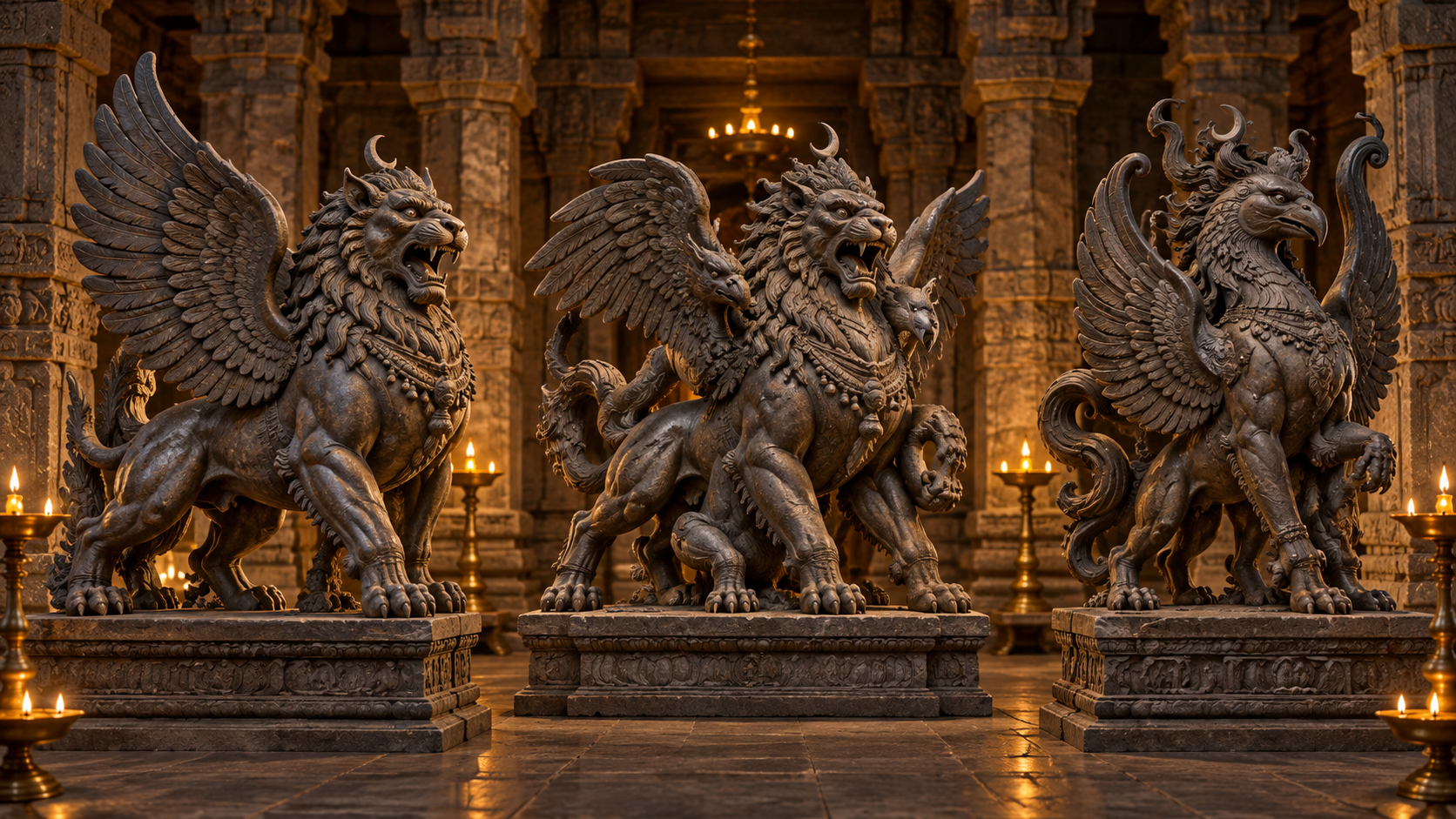
When identifying Sharabha, begin with the features that are securely attached to him: the names Sharabha and Sharabheshwara Swamy, his identity as a manifestation of Shiva, immense bird-like presence, wings, strong beak, lion-surpassing power, and the mission of pacifying Narasimha. These features provide a reliable starting point.
They do not provide a complete manual for judging every murti or regional representation. If an image contains additional heads, limbs, weapons, attendants, or animal features, do not immediately universalize them as mandatory. Check the temple’s own name for the murti, its sthala tradition, and the explanation given by the community responsible for its worship. Local detail should be identified as local detail unless you have a firm basis for saying otherwise.
The same discipline applies online. A dramatic image may be labelled Sharabha merely because it is winged and fierce. Before repeating the label, look for at least two anchors: an explicit identification with Shiva and a connection to the pacification of Narasimha. Visual resemblance alone is weaker evidence than a named devotional context.
If you are deciding whether Sharabha is “a bird” or “a lion-bird,” you need not force an either-or answer. The description foregrounds a huge bird with wings and a powerful beak while also presenting a form stronger than a lion. “Lion-bird” communicates the composite force of the image; the avian features explain what you should actually look for.
Approach Sharabha Jayanti with precision and restraint

Sharabha Jayanti falls in the Vaisakha month and is especially auspicious for Shaivites. Vaisakha identifies the sacred month, but that fact alone does not supply a civil-calendar date for every year or community. Confirm the observance through the panchanga followed by your temple, family, or sampradaya rather than copying an undated festival graphic.
Three checks will keep your observance grounded. First, verify the date locally. Second, ask whether a nearby Shiva temple explicitly observes Sharabha Jayanti or worships Sharabheshwara Swamy. Third, follow the prayers and procedures actually transmitted in that setting. A fierce sacred form is not a reason to improvise mantras, ritual claims, or promises of supernatural results.
If no local public observance is available, you can still mark the occasion through careful learning and contemplation. Read the basic account slowly, keep Shiva’s pacifying purpose at the centre, and examine where strength in your own conduct needs to become disciplined rather than merely intensified. This is a modest approach, but it is more faithful than manufacturing an elaborate ritual from fragments found online.
The practical theme is clear: power is not complete merely because it can overpower. It becomes dharmic when it is directed toward restoring balance. Let that theme govern how you speak about Sharabha as well as how you observe his Jayanti.
Key takeaways
- Sharabha, or Sharabheshwara Swamy, is an avatar of Lord Shiva.
- He appears in a form mightier than a lion to pacify Lord Narasimha Swamy.
- His defining physical description is an immense bird-like being with wings and a strong beak.
- The legend is best read through its stated purpose of pacification, not as a sectarian contest between Shiva and Narasimha.
- Sharabha Jayanti occurs in Vaisakha and is especially auspicious for Shaivites; verify the exact observance through your local calendar and tradition.
- When identifying an image or ritual claim, separate the firmly established features from additions belonging to a particular temple or community.
The next time you meet Sharabha in an image, festival notice, or conversation, begin with one question: what is this immense power meant to accomplish? The answer—pacification—will keep your understanding devotional, precise, and free from an unnecessary contest between traditions.
References

Leave a Reply
You must be logged in to post a comment.