
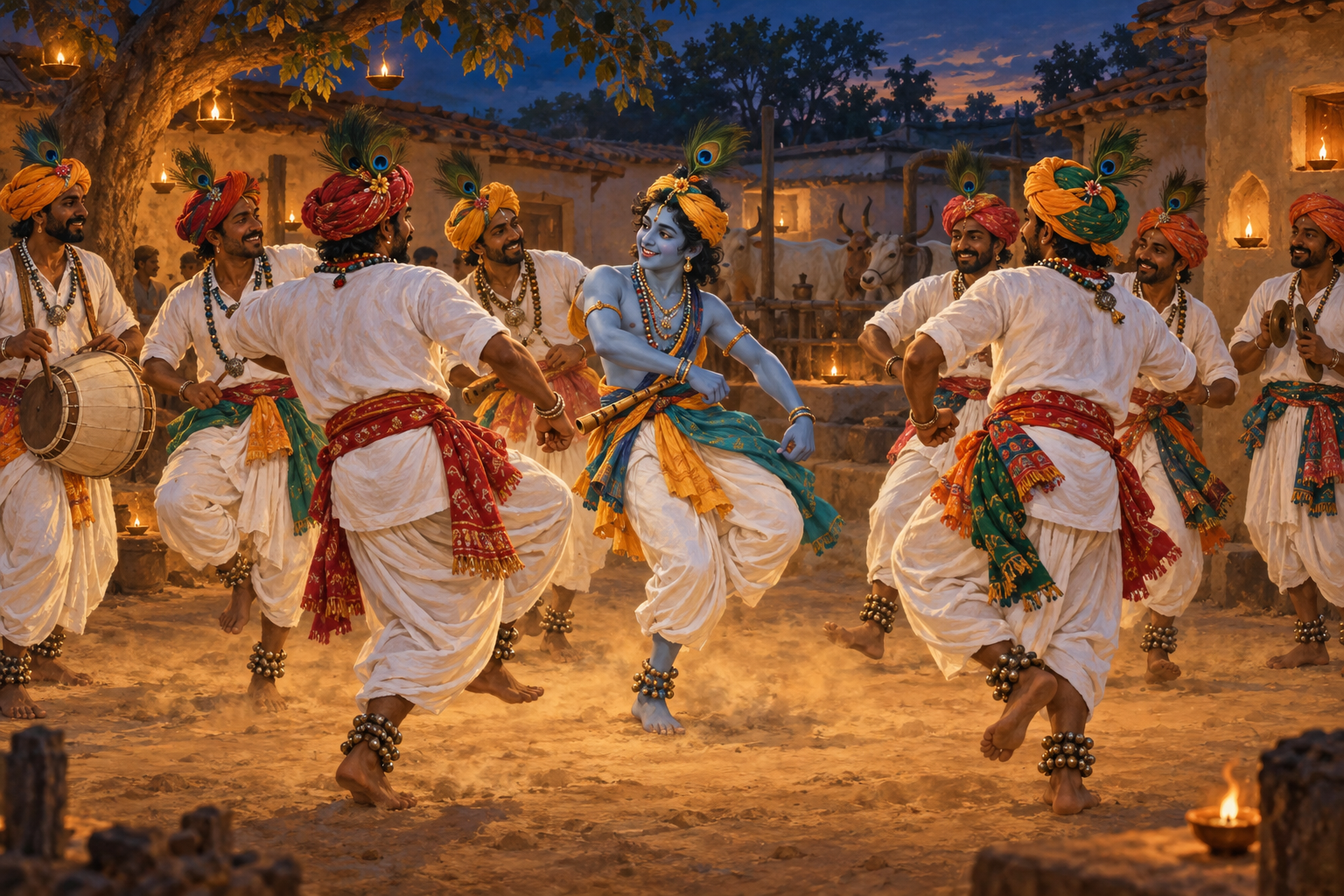
You may know Krishna as the teacher of the Bhagavad Gita, the child of Yashoda, or the beloved of the gopis. Baredi dance asks you to meet him in another way: as the friend who walks, plays, works, and celebrates among companions.
That change of relationship is the key to understanding the dance. If you look only for costume, rhythm, or spectacle, you will miss its devotional center. If you begin with sakha-bhava, however, Baredi becomes an embodied answer to a practical question: what does it mean to live as though Krishna is not merely above you, but also beside you?
Friendship with Krishna is a precise devotional stance
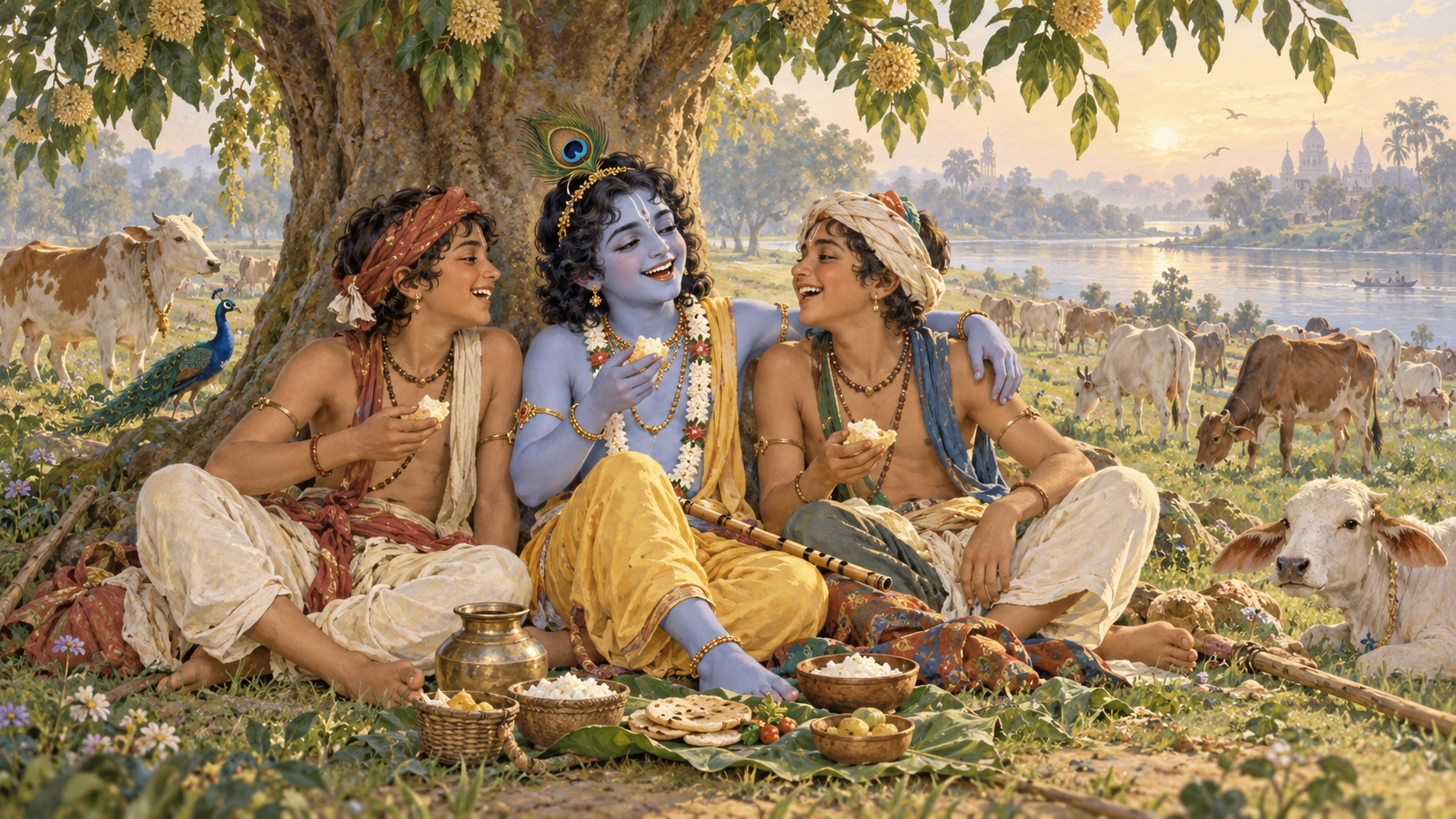
Bhava means more than a passing emotion. In devotional life, it is the settled relationship through which you approach the divine. The Bhagavata Purana presents several principal modes of relationship: shanta, peaceful reverence; dasya, service; sakhya or sakha-bhava, friendship; vatsalya, parental affection; and madhurya, the intimacy of beloved and lover.
These modes are not personality labels to collect. Each asks something different of the devotee. Dasya emphasizes obedience and service. Vatsalya allows the devotee to care for Krishna as a parent cares for a child. Sakha-bhava cultivates trust, loyalty, candor, shared activity, and the ease of companionship.
Friendship does not make Krishna less divine. It changes the devotee’s distance from him. Awe remains possible, but fear no longer controls the relationship. The friend can speak honestly, share ordinary life, and take joy in Krishna’s presence without requiring every encounter to feel solemn.
Krishna’s cowherd companions provide the clearest devotional image. They do not stand permanently at the edge of the scene waiting for a formal audience. They roam with him, eat with him, play with him, depend on him, and allow him to depend on their companionship. Their devotion is expressed through participation.
This is why sakha-bhava is central to understanding Baredi dance. The important word is not merely dance. It is with: moving with Krishna, celebrating with companions, and remembering the divine through a shared act rather than a private idea.
Baredi makes the theology visible
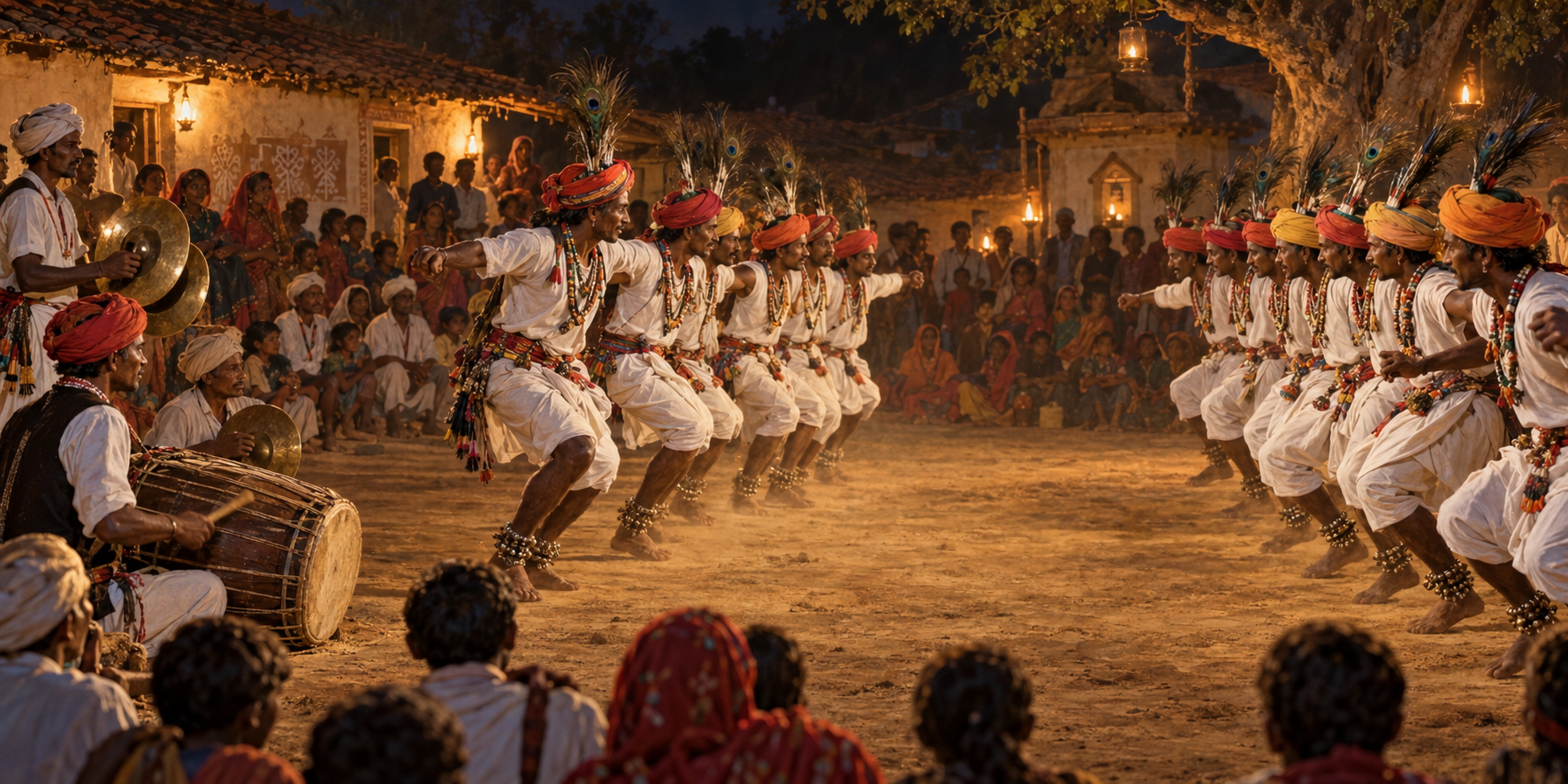
Baredi belongs to the cultural world of Bundelkhand, Madhya Pradesh, and Chhattisgarh. Its regional identity matters. The dance should not be detached from the people, places, and inherited devotional memory that give it meaning.
A philosophical explanation can tell you that companionship is a form of bhakti. A communal dance can let you notice what companionship requires. You have to remain aware of other people. You must respond rather than act in isolation. Your movement occupies shared space, and what you do affects the whole. Friendship becomes visible as coordination, attention, restraint, energy, and mutual presence.
This does not mean that every step has a secret theological translation. Treating each gesture as a code can create meanings that practitioners themselves never claimed. The sounder reading begins with the dance’s overall relationship to Krishna: divine friendship is enacted communally, through bodies moving in relation to one another.
Three features of that reading are especially useful:
- Presence matters more than distance. Sakha-bhava places the devotee within Krishna’s company rather than permanently outside it.
- Participation matters more than observation. Friendship is sustained by shared action, not admiration alone.
- Community protects the bhava from becoming fantasy. A group practice requires you to attend to actual companions, not only to a private image of spiritual intimacy.
This is Baredi’s deeper value for someone who may never perform it. It shows that theology need not remain in commentary or private meditation. A community can remember a relationship with Krishna through rhythm, movement, repetition, and the discipline of being together.
How to watch or host Baredi without flattening it
If you encounter Baredi at a festival, cultural program, temple event, or online, you face a choice. You can consume it as an attractive folk performance, or you can approach it as a living regional expression of Krishna devotion. The second approach requires only a little more attention, but it changes what you see.
- Locate the performance before interpreting it. Find out where the performers come from, how they name the tradition, and whether the presentation belongs to a devotional, festive, or staged setting. Do not assume that every performance has exactly the same context.
- Ask what participants say about Krishna. Their explanation should come before an outsider’s symbolic theory. If they describe companionship, community memory, worship, celebration, or regional identity, preserve those words in any caption or introduction.
- Watch relationships, not only technique. Notice how performers maintain awareness of one another, how the group creates a shared field of movement, and how collective rhythm changes the role of the individual. These observations bring you closer to sakha-bhava than a list of visual details does.
- Do not use folk as a synonym for anonymous. Name Baredi, Bundelkhand, and the performers’ own community or place when that information is available. A generic label such as Indian traditional dance erases the very inheritance you intend to celebrate.
- Ask before recording sacred or communal moments. Public visibility does not automatically make every person, ritual, or performance free material for your channel. When recording is welcomed, keep the name and context attached to the clip.
If you are organizing a program, give the introduction enough time to explain sakha-bhava. A useful introduction should answer three questions: What is the tradition called? Where does it belong? What relationship with Krishna does it express? That is more valuable than a long sequence of exotic descriptions.
Avoid the opposite mistake as well. Baredi should not be reduced to an abstract theological illustration. It is a cultural tradition carried by real communities. Theology helps you understand the dance, but it does not replace the people who preserve and perform it.
A daily practice of friendship devotion
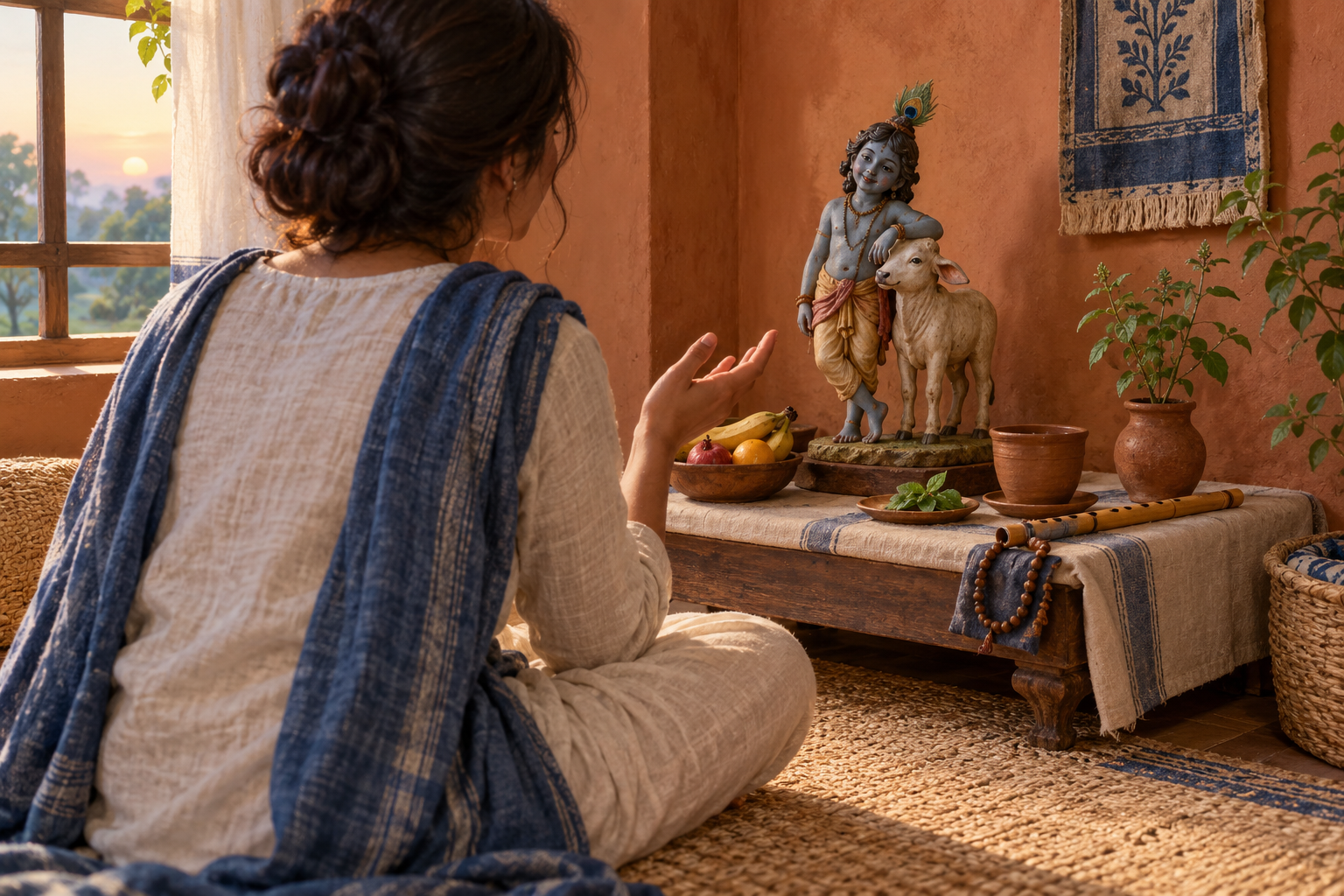
You do not need to imitate a regional dance outside its setting to learn from it. What you can carry into daily practice is its relational principle: include Krishna in the ordinary movement of life.
Begin with four concrete habits:
- Speak plainly. Once a day, address Krishna without ceremonial language. State one gratitude, one difficulty, or one failure honestly. Friendship devotion cannot grow if prayer is used only to present a polished version of yourself.
- Attach remembrance to an ordinary action. Choose a recurring activity such as walking, preparing food, beginning work, or returning home. Remember Krishna’s name at that moment. The aim is not to manufacture a dramatic emotion; it is to stop dividing life into sacred and irrelevant hours.
- Practice the loyalty you invoke. Before asking what Krishna as friend can give you, ask whether you are becoming a trustworthy friend to others. Keep one neglected promise, make room for someone who is routinely overlooked, or offer help without turning it into a performance of virtue.
- Make devotion shareable. Join a bhajan, study circle, seva activity, or simple household observance when you can. Sakha-bhava is personal, but it need not be solitary. Shared practice tests whether spiritual warmth is producing patience and fellowship.
There is an important boundary here. Friendship with Krishna is not permission to make Krishna endorse every preference you already have. A true friend does not merely flatter. Sakha-bhava should make you more truthful, dependable, and receptive to correction. If it produces only familiarity without responsibility, the language of friendship has become sentimentality.
You can test the practice at the end of the day with three questions: Where did I remember Krishna as present? Where did I behave like an unreliable friend? What one act tomorrow would make companionship visible? These questions turn bhava from an admired concept into a discipline.
Key takeaways
- Sakha-bhava is devotion through friendship: trust, candor, loyalty, shared action, and closeness to Krishna.
- Baredi is best understood as a regional, communal expression of that relationship, not merely as visual entertainment.
- Do not assign a theological meaning to every movement unless practitioners themselves identify it.
- When presenting or recording Baredi, retain its name, place, community context, and connection with Krishna.
- To practice friendship devotion, include Krishna in ordinary routines and become more trustworthy toward the people around you.
The next time you encounter Baredi, begin with one question: what kind of relationship is this dance teaching you to notice? Then take one small part of its answer into your own day. Remember Krishna during an ordinary task, keep faith with a friend, and let companionship become an action rather than a devotional slogan.
References
- Hindu Blog – Roaming with Krishna: The Baredi Dance Of Bundelkhand and the Sacred Bond of Friendship

Leave a Reply
You must be logged in to post a comment.