
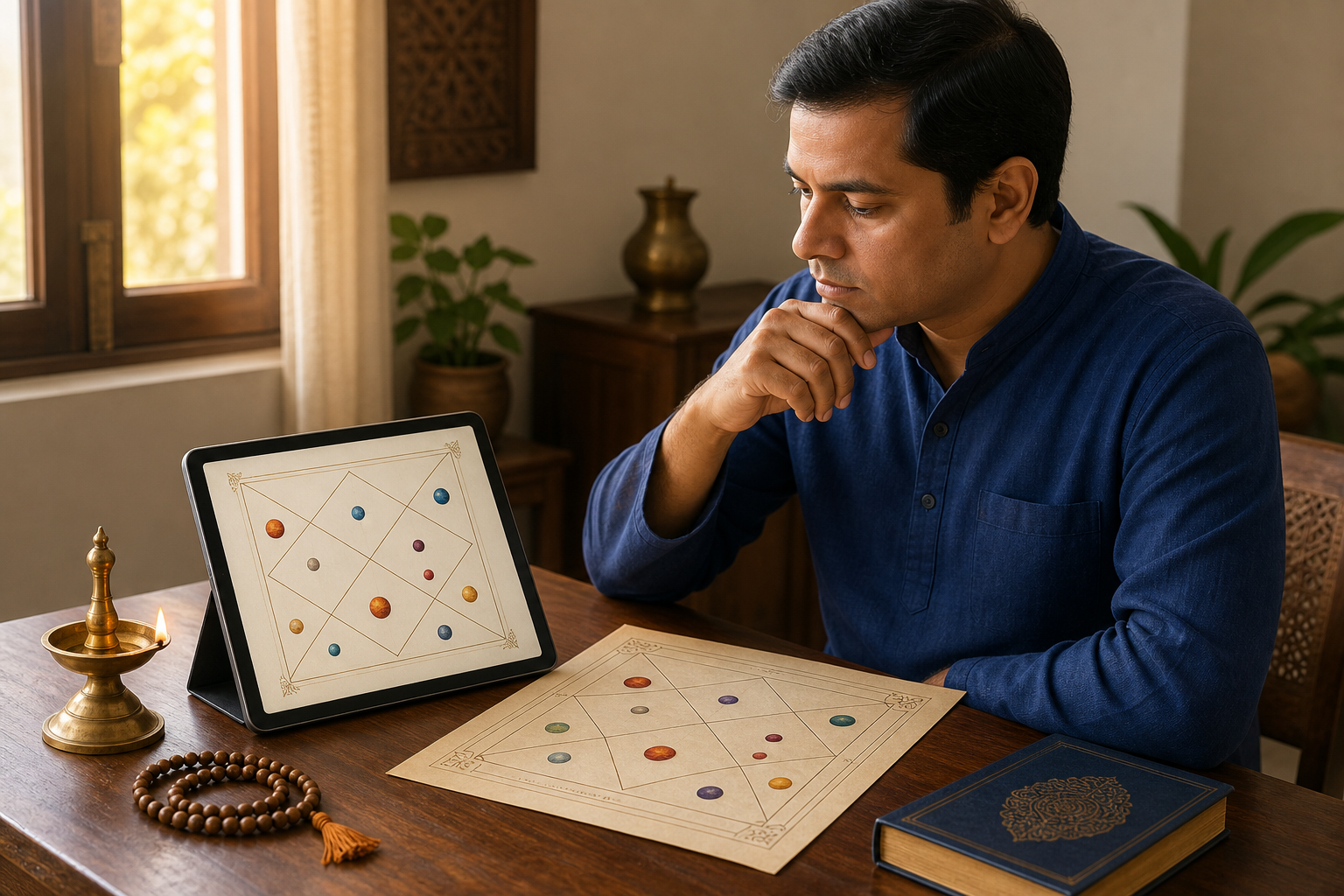
You generated an online Janm Kundli because you wanted clarity about a real concern – perhaps career, marriage, education, finances, health, or spiritual direction. Instead, you received a dense chart filled with unfamiliar abbreviations, planetary tables, yogas, Dashas, and predictions that may not even agree with one another.
The way through that confusion is to separate three tasks: verifying the calculation, reading the chart in a stable order, and deciding what deserves action. A polished prediction cannot repair incorrect birth data, and a correct chart still cannot make your decisions for you.
Before interpreting the chart, verify that it is yours

A Janm Kundli maps planetary positions for a particular time and place of birth within Vedic astrology. Its calculation therefore depends on your date of birth, exact birth time, and birthplace. If one of those inputs is unreliable, some of the most confident-looking parts of the interpretation may also be unreliable.
Check the input screen before reading a single prediction:
- Confirm that the date was entered in the format the website expects. A day-month-year field can easily be mistaken for month-day-year.
- Check the birth time and its AM or PM designation. Do not replace an unknown time with a convenient guess and then forget that you guessed.
- Verify the birthplace shown by the tool rather than assuming that the first similarly named location is correct.
- Record where the birth time came from, such as a hospital record, family document, or family recollection. Those sources do not carry the same degree of certainty.
- Save one master copy of the birth details you used. Otherwise, small changes made during repeated searches can produce several charts that appear to contradict one another.
Next, inspect the calculation and display options. A useful platform should make its choices visible. Look for Lahiri or Chitra Paksha Ayanamsa, North Indian and South Indian chart layouts, Hindi output in Devanagari, divisional charts such as Navamsa or D9, and transparent Panchang calculations. North Indian and South Indian layouts organize the same underlying information differently; changing the visual style should not silently change the planetary placements.
Language is also more than a cosmetic preference. If you learned Jyotisha terminology in Hindi, reading Lagna, Rashi, Nakshatra, Dasha, Bhava, and Panchang in Devanagari can prevent a loose English paraphrase from becoming an unintended interpretation. Keep the original terms beside any translation so that you can return to the chart rather than depending entirely on generated prose.
If the birth time is uncertain, mark the chart as provisional. Lagna, Bhavas, and other time-sensitive conclusions should not be treated as settled facts. A competent, tradition-grounded astrologer may later use birth-time rectification, supported by a record of significant life events, to refine the Lagna and house cusps. Until then, uncertainty is part of the reading; it is not an inconvenience to hide.
Birth information is personal data. Before entering it into an online service, read the privacy policy and check whether the service explains how the information is stored or used. Accuracy and privacy belong in the same first step.
Read the Kundli in a fixed order

A common source of confusion is starting with the most dramatic yoga or prediction on the page. That reverses the proper task. First establish the chart’s structure, then examine timing, and only then consider interpretation.
- Begin with Lagna and the twelve Bhavas. This gives you the basic orientation of the chart and identifies the life areas being discussed. If the birth time is doubtful, keep that warning beside every house-based conclusion.
- Record the Rashi and Nakshatra placements exactly as displayed. At this stage, you are making an inventory, not declaring that one placement defines your personality or destiny.
- Review planetary strengths and listed yogas in the context of the full chart. A yoga shown by software is a relationship within the chart, not a complete verdict about an entire life.
- Locate the Vimshottari Dasha timeline. Note the period shown as current and the next transition listed by the tool. Dasha adds a timing framework; it should not be confused with the natal chart itself.
- Separate Gochara, or current transit indications, from natal placements. A transit is a changing layer. Label it accordingly so that a temporary indication does not become a permanent identity.
- Open the Navamsa or D9 as a supporting chart for relationship and dharmic-alignment questions. Do not let one attractive or worrying D9 statement erase the context supplied by the principal chart.
- Use the Panchang for its appropriate purpose, including lunar observances and auspicious Muhurta choices. Choosing a time for an event is a different question from making a lifelong prediction about the person holding the event.
The distinction between natal structure, Dasha timing, current Gochara, divisional-chart context, and Panchang timing is essential. Mixing them together produces statements that sound precise but cannot be checked. Keeping them separate lets you ask where each conclusion came from.
| Chart output | Question to ask | How to treat it |
|---|---|---|
| Lagna and twelve Bhavas | Which life area is being interpreted? | Provisional when birth time is uncertain |
| Rashi and Nakshatra placements | What does the chart actually list? | Record before interpreting |
| Planetary strengths and yogas | What other chart factors provide context? | Never use one item as the whole verdict |
| Vimshottari Dasha | Which period is active, and when does the listed transition occur? | Use as a timing layer |
| Gochara | What belongs to the current period rather than the natal chart? | Revisit as transits change |
| Navamsa or D9 | Does it add context to relationship or dharmic themes? | Use as a supporting lens |
| Panchang | Is the question about Muhurta or observance? | Use for timing choices |
This method also gives you a practical test for online interpretations. If a paragraph cannot be connected to a visible chart factor or timing layer, treat it as a prompt for inquiry rather than a conclusion.
Turn predictions into questions you can act on

An online Kundli may discuss education, career, relationships, health, finances, and spiritual practice. Those categories are broad enough to sound personally significant even when an interpretation gives you little usable information. Make each prediction pass four tests before giving it weight:
- Basis: Which Lagna, Bhava, placement, strength, yoga, Dasha, divisional chart, or transit is being used?
- Scope: Is the statement about a tendency, a particular life area, a present period, or an allegedly fixed outcome?
- Timing: Does it arise from the natal chart, the Dasha sequence, a current Gochara, or a Muhurta calculation?
- Action: What proportionate and reversible step would still make sense if the interpretation later proved incomplete?
That last test protects your agency. A useful interpretation should lead to observation, preparation, disciplined effort, or a better question. It should not demand an impulsive decision merely because the language sounds certain.
If a career reading points to difficulty or transition, do not resign solely because the software used an ominous phrase. Examine your actual work conditions, strengthen the skills you may need, and gather evidence before changing direction. The chart can tell you where to pay attention; it cannot supply missing facts about your employer, obligations, or opportunities.
If a relationship interpretation raises concern, translate it into a conversation about expectations, communication, duties, or boundaries. Do not use a placement or yoga as a label that denies another person the chance to speak and act. Compatibility language is especially harmful when it becomes a substitute for character, consent, and direct knowledge of the person.
Health and financial predictions require firmer boundaries. A Kundli must not diagnose illness, replace appropriate medical care, determine medication use, or justify delaying an evaluation. In the same way, it must not replace financial evidence or qualified advice when debt, savings, investment, insurance, or livelihood is at stake. Use a reading to notice a concern and become more attentive, not to make a high-consequence choice without the relevant professional knowledge.
Education and spiritual-practice themes are often more suitable for small experiments. You might revise a study routine, become more consistent in Abhyasa, make room for Seva, or observe how a recurring tendency affects your conduct. These actions can be reviewed by their actual effects. They preserve the difference between guidance and surrendering judgement.
Resolve uncertainty before accepting remedies or major advice

If two online Kundlis disagree, do not average their predictions or choose the version you prefer. Compare their inputs and settings first. Confirm the same date, time, birthplace, and Ayanamsa. Check whether the apparent difference is only the North Indian or South Indian layout. Then compare the actual planetary placements, Dasha timeline, divisional charts, and Panchang information.
A disagreement caused by uncertain birth time requires a different response from a disagreement caused by display style. In the first case, keep time-dependent claims provisional and consider rectification with a competent astrologer and a record of key life events. In the second case, learn how the two visual conventions place houses and signs before assuming that the charts conflict.
Automated interpretations should also disclose their limits through their wording. Be cautious when a reading gives an absolute guarantee, attaches a frightening outcome to an unverified birth time, or urges an irreversible decision without showing how the conclusion was reached. Confidence is not evidence of calculation quality.
Remedies deserve the same scrutiny. The most constructive responses are practices that strengthen conduct: mindful discipline, Seva, Ahimsa, and gratitude. They can become part of personal growth and community well-being without turning fear into a transaction. A remedy should not promise that ethical effort can be replaced by a purchase, nor should it pressure you to spend money to escape a predicted disaster.
Ask four questions before adopting any remedy:
- Does it respect Ahimsa and avoid harm to you, another person, an animal, or the wider community?
- Does it encourage disciplined conduct rather than fear, blame, or dependency?
- Can it coexist with your real duties and with medical, financial, or other professional care where those are needed?
- Is anyone guaranteeing a result or using urgency to prevent you from seeking a second interpretation?
A Janm Kundli belongs specifically to the Vedic astrological framework. Hindu, Buddhist, Jain, and Sikh traditions do not all interpret astrology in one uniform way, even where lunar observances, ethical reflection, or disciplined inquiry may overlap. Respecting Dharma’s diversity means neither forcing one framework upon every path nor abandoning the shared ethical demand for compassion and responsibility.
Karma is not served by fatalism. An interpretation that removes effort, responsibility, and moral choice from the picture has ceased to be useful guidance. Your chart may offer a language for patterns and periods; your response still belongs to you.
Key takeaways for your next online reading
- Verify the birth date, exact time, birthplace, and source of the recorded time before interpreting anything.
- Check the Ayanamsa, chart layout, language, divisional-chart access, Panchang transparency, and privacy policy of the platform.
- Read Lagna and Bhavas first, placements and yogas next, then Dasha, Gochara, Navamsa, and Panchang in their proper roles.
- Require every prediction to identify its chart basis, scope, timing layer, and proportionate action.
- Keep time-sensitive conclusions provisional when the birth time is uncertain; do not conceal uncertainty with confident prose.
- Use spiritual remedies to deepen discipline, Seva, Ahimsa, and gratitude – never as substitutes for evidence, ethical responsibility, or necessary professional care.
On your next reading, choose one concern and trace it from the generated prediction back to the chart and its timing layer. Then take one reversible action that remains wise even if the interpretation changes. That is how an online Janm Kundli becomes a tool for discernment rather than a verdict you are expected to obey.
References
