
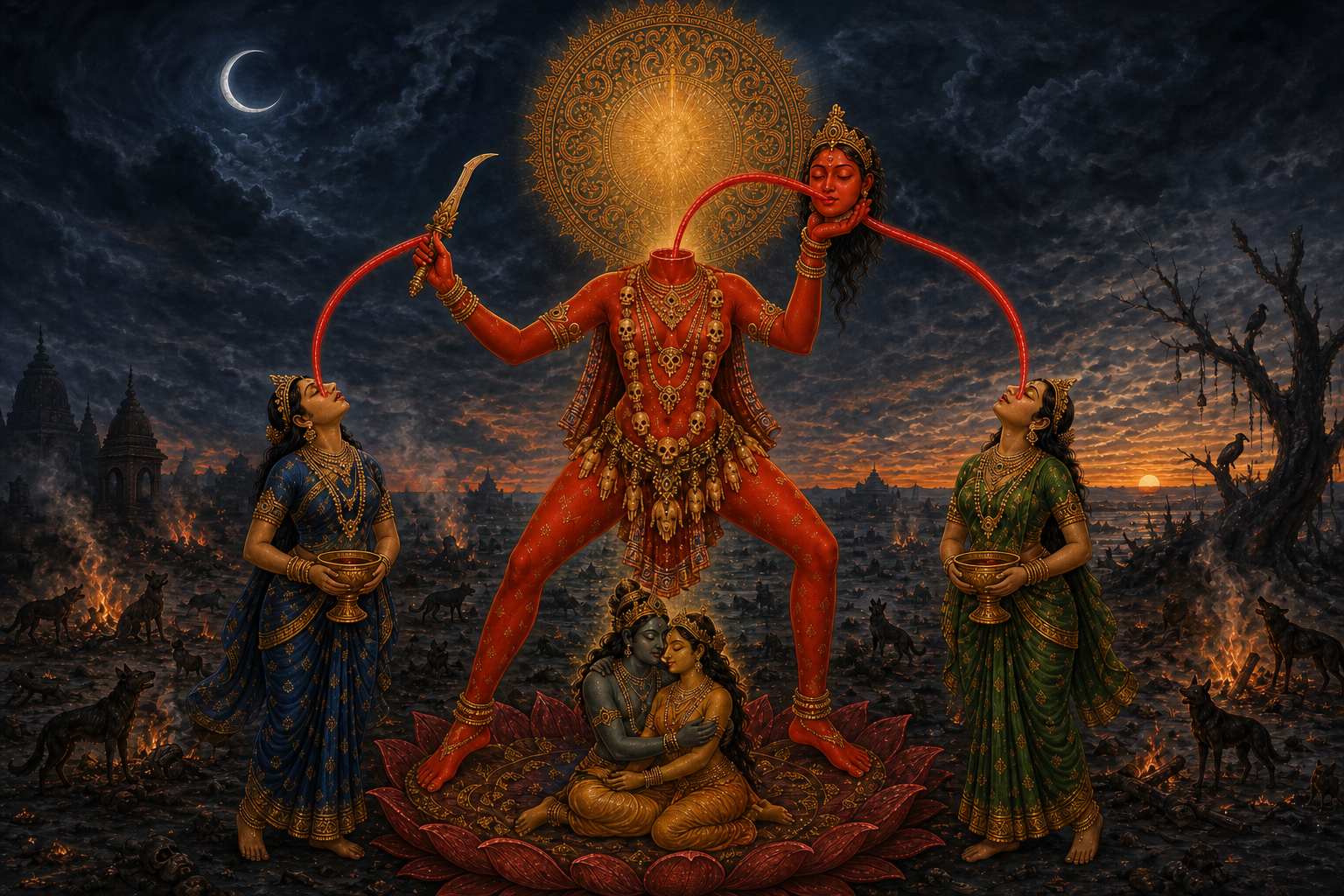
If Chinnamasta’s image has unsettled you, that does not mean you have misunderstood it. A living goddess holds her own severed head while blood flows toward her and two companions. The scene is meant to interrupt an easy, comfortable reading.
You can begin to make sense of it by asking three questions: What has been severed? What remains alive? Who is being nourished? Those questions reveal a disciplined meditation on ego, vital energy, desire, mortality and compassion. They also keep you from treating sacred symbolism as either meaningless horror or a literal instruction.
Read the impossible survival before reading the violence
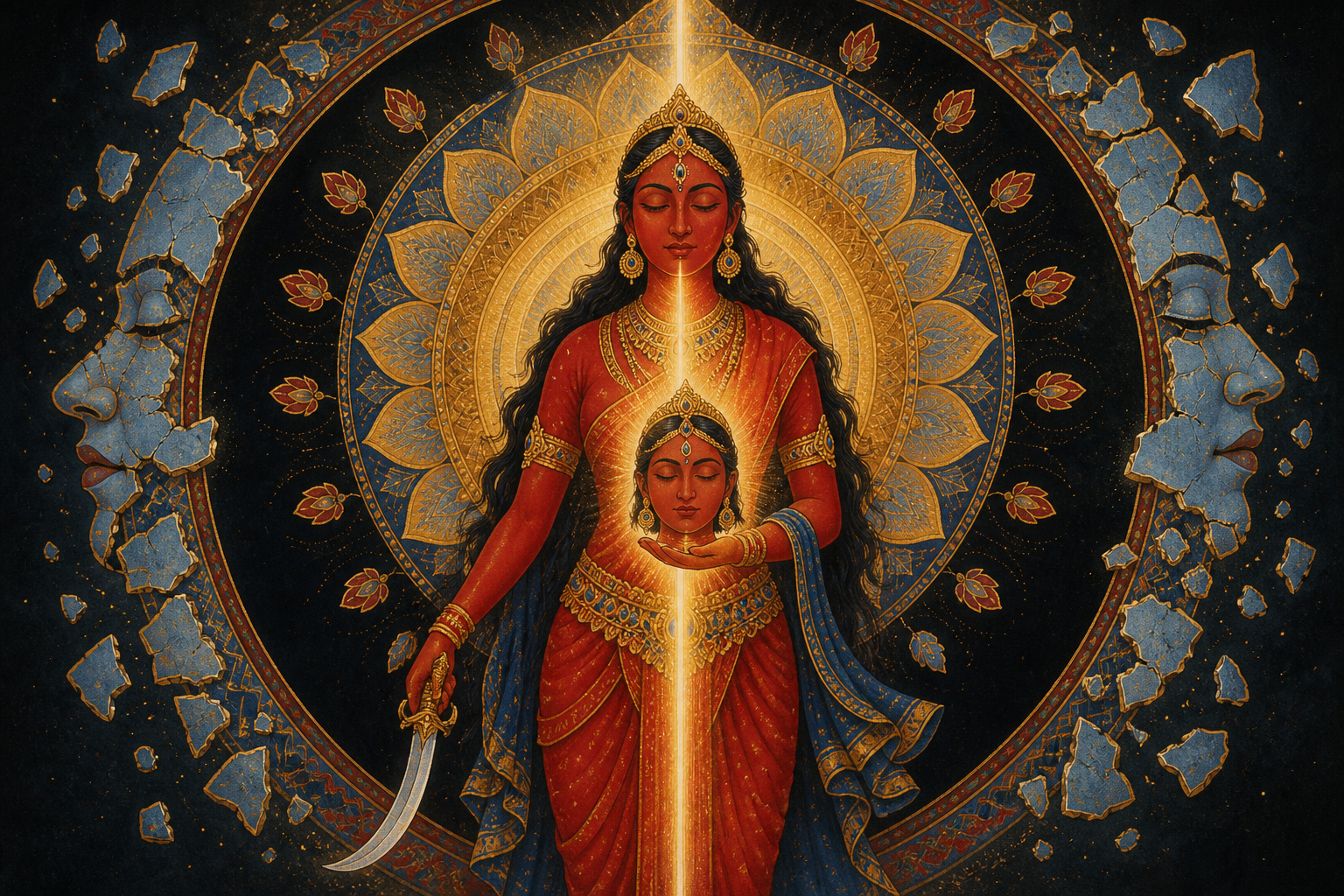
Chinnamasta is self-decapitated yet fully conscious, active and capable of nourishment. She does not lie defeated beneath an attacker. She stands, holds her living head and directs the flow released from her body. The physical impossibility is not an incidental oddity. It is the first key to the image.
A merely literal reading sees injury and expects the destruction of awareness. The icon refuses that outcome. Consciousness remains, agency remains and generosity remains. A central Tantric interpretation therefore understands the severance as ahamkara-bheda: a breaking through the ego’s claim to be the fixed centre and owner of experience.
Here, ego does not simply mean having a personality, making decisions or using the word “I.” It means compulsive identification: “I am only this status,” “I must possess this outcome,” or “Without this desire being satisfied, I am nothing.” Chinnamasta cuts the false finality of such claims. She does not destroy lucid awareness along with them.
This distinction matters whenever people loosely call the image “ego death.” If that phrase makes you imagine helplessness, self-hatred or the erasure of moral responsibility, it misses what the icon actually shows. Chinnamasta remains powerful enough to witness, choose and sustain others. What falls is possessive centrality, not awakened capacity.
When you look at the severed head, notice four things before assigning it a meaning:
- The goddess performs the act rather than appearing as a passive victim.
- The head remains awake rather than becoming an inert object.
- The body continues to stand with force and purpose.
- The released energy becomes nourishment rather than meaningless waste.
That sequence changes the question. Instead of asking only, “Why is this image violent?” ask, “Which false identity has been interrupted, and what deeper power becomes available after that interruption?”
The three streams turn apparent loss into nourishment
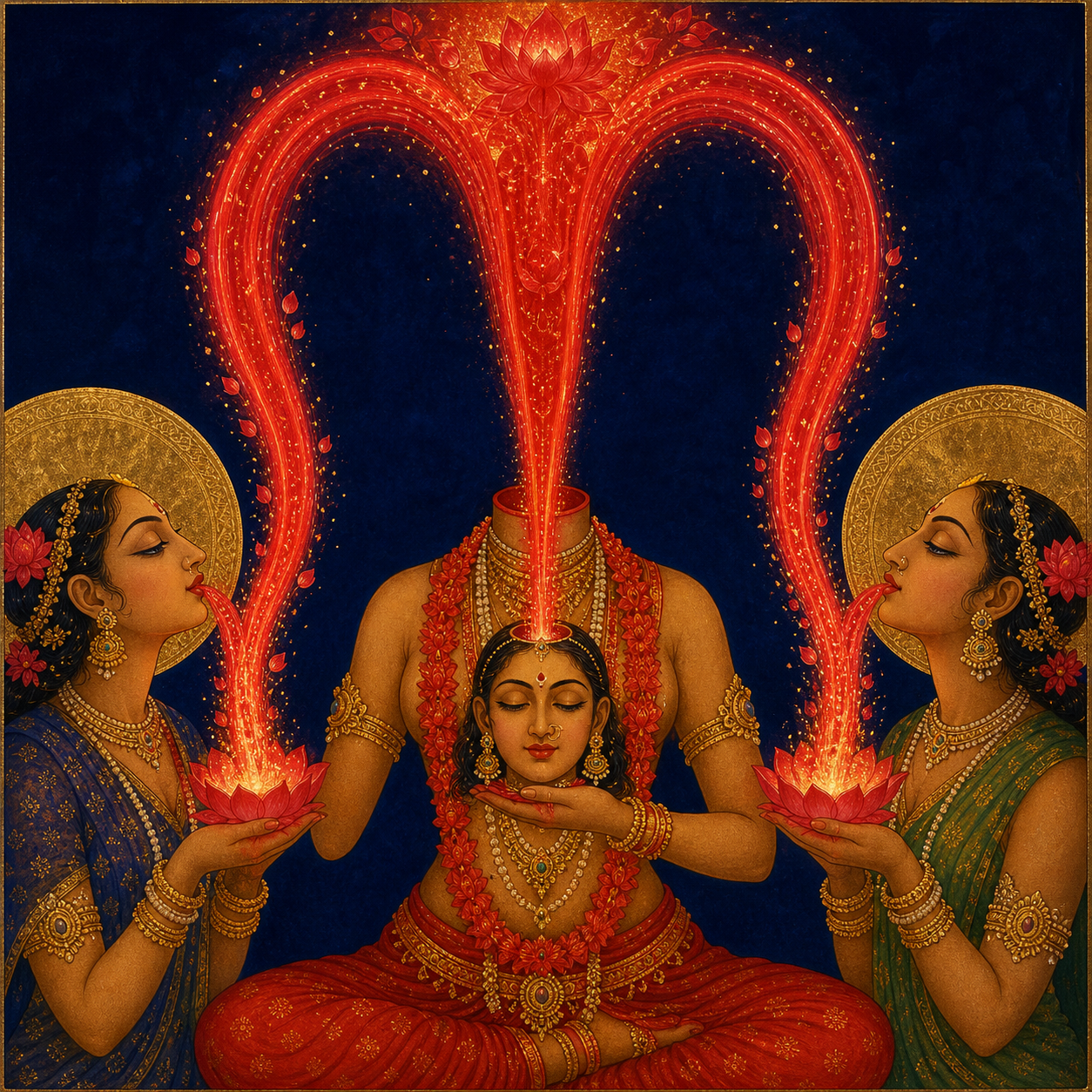
Three streams arc from Chinnamasta’s neck. One reaches the head she holds; the other two feed attendants commonly identified as Dakini and Varuni. The symmetry makes the blood more than a sign of death. It is life-force consciously redistributed.
The stream feeding Chinnamasta’s own head is essential. The goddess does not disappear so that everyone else may live. Awareness remains nourished at the same time as her companions. The image therefore does not endorse limitless self-depletion disguised as spirituality. Its pattern is simultaneous sustenance: consciousness receives, companions receive and energy continues to move.
A subtle-body interpretation associates the three streams with ida, pingala and sushumna, the channels through which prana is understood to move. Within that reading, Chinnamasta also evokes Kundalini rising through the central channel while opposing currents come into balance. This is an illuminating Tantric lens, but it should not be turned into a rigid anatomical diagram. The imagery supports an association among the threefold flow, balanced energy and awakened awareness; it does not by itself establish an uncontested one-to-one label for each visible stream.
You can apply this part of the image during a demanding transition without pretending that the icon offers a mechanical technique. Ask:
- What energy is currently trapped in defending an identity, grievance or desired outcome?
- What part of that energy must remain available for clear seeing?
- What part can become patient work, restraint, service or care for another person?
The point is not to romanticize exhaustion. If your giving eliminates the awareness needed to act wisely, it no longer resembles Chinnamasta’s threefold nourishment. Her head receives life even as life is shared.
Standing over Kama and Rati means mastery, not disgust
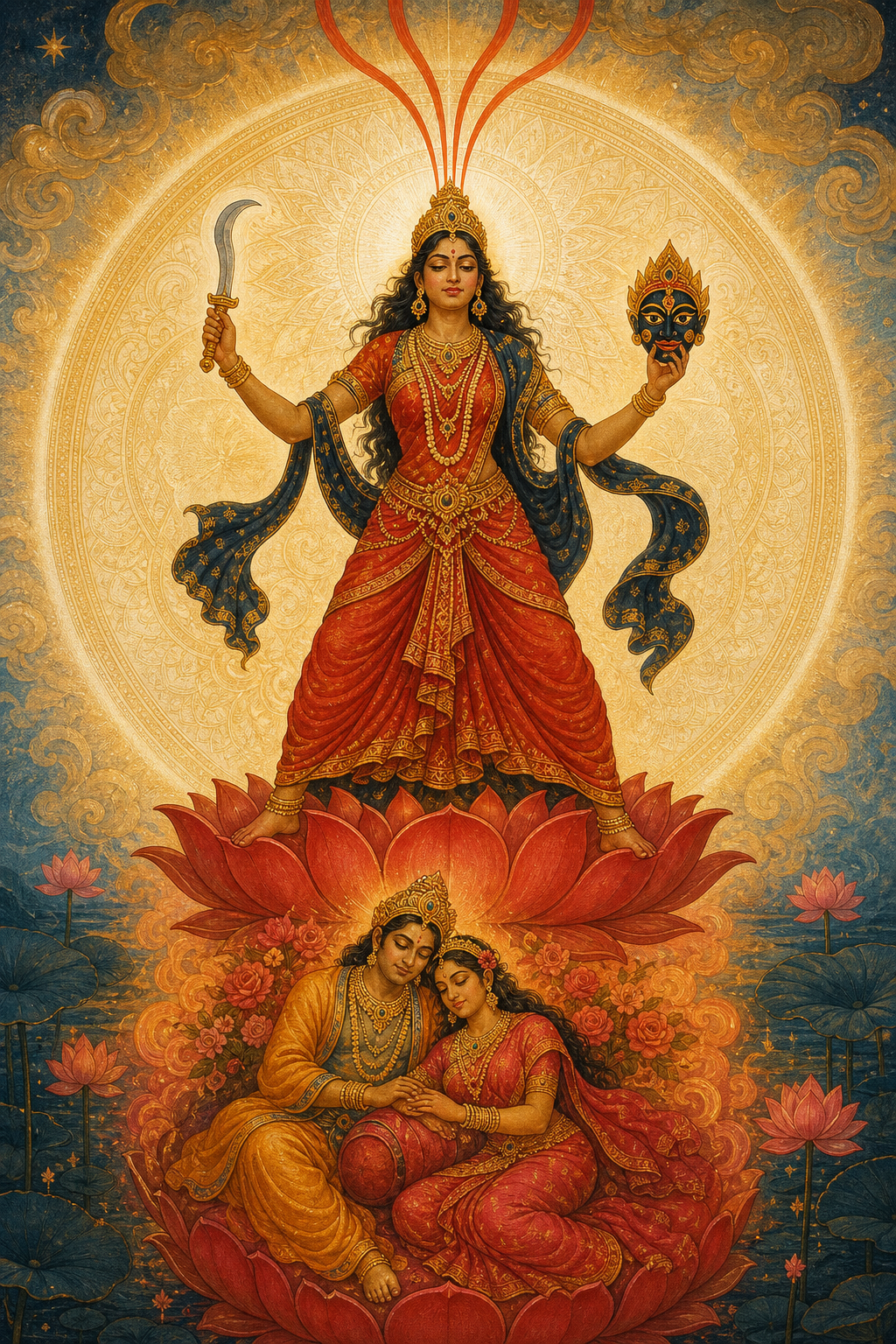
Chinnamasta is commonly shown standing above the embracing forms of Kama and Rati. It is easy to misread this as a declaration that sexuality, pleasure or embodied life is impure. Yet desire has not been removed from the scene. It remains visible, potent and close to the goddess.
Her position establishes a hierarchy of awareness. Desire is present, but it does not command her. She neither flees from it nor surrenders sovereignty to it. Raw impulse becomes material for disciplined consciousness.
This gives you a sharper framework than the usual choice between suppression and indulgence:
- Suppression refuses to acknowledge desire and allows it to operate unseen.
- Captivity treats desire as an order that must be obeyed.
- Integration recognizes the energy of desire while retaining the freedom to direct it.
To use this distinction, name the desire precisely. “I am attached” is too vague. Do you want recognition, intimacy, possession, victory, certainty or relief? Then separate the energy of wanting from the object you currently expect to satisfy it. The energy may be converted into disciplined work, honest conversation, devotion or restraint even when the original object should not be pursued.
Chinnamasta does not ask you to become numb. She asks whether desire occupies its proper place. A desire you can see, question and redirect is beneath awareness. A desire that determines what you are permitted to notice has climbed onto the throne.
The cremation ground and jackals complete the cycle
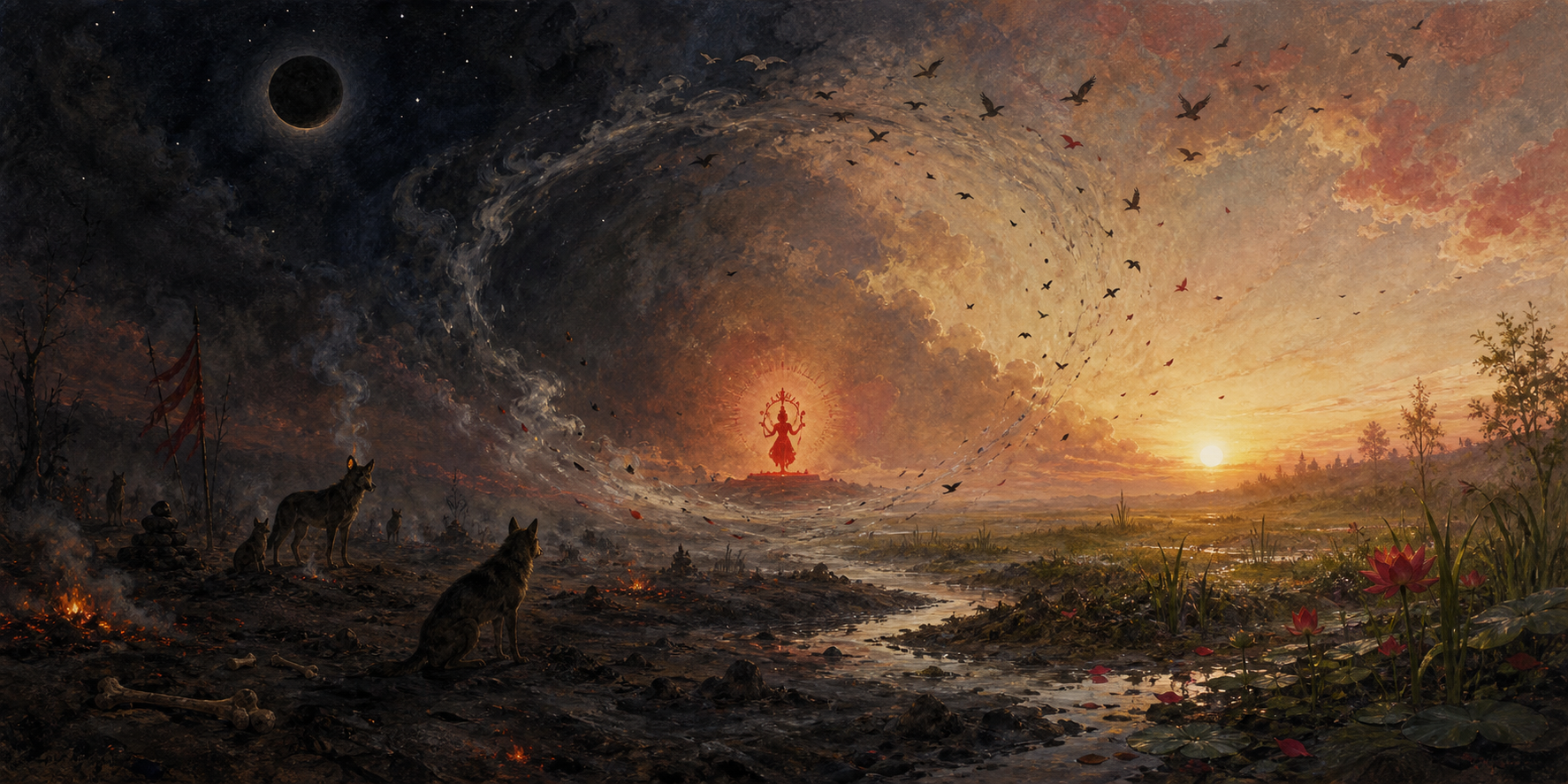
The cremation ground places the entire vision within impermanence. Bodies, identities and possessions that once appeared stable eventually lose their familiar form. This setting is not decorative gloom. It prevents the viewer from quietly rebuilding the very illusion of permanence that the severed head has exposed.
Jackals appear in some Chinnamasta iconographies, often near the edges of the scene. Because they are not present in every representation, you should not treat them as a required identification mark or invent them where an image does not show them. Where they do appear, their cremation-ground role deepens the symbolism.
As nocturnal scavengers, jackals inhabit thresholds and participate in nature’s recycling of form. What human attachment calls unbearable ruin becomes part of a larger process of dissolution and reuse. The jackal’s appetite can therefore symbolize the consumption of fear, clinging and psychic residue that no longer serves awakening.
This does not make instinct evil. The jackal represents instinct brought inside a wider wisdom. Its presence tells you that transformation cannot be completed by displaying only serene, socially acceptable parts of yourself. Fear, appetite and aversion must be recognized, disciplined and reintegrated rather than merely exiled from view.
When a jackal appears in a reproduction, examine its function before deciding that it is simply an omen of terror:
- Notice whether it occupies a boundary rather than the visual centre.
- Relate it to the cremation ground and the breakdown of fixed form.
- Ask what it consumes and what that consumption allows the larger scene to become.
You can turn this symbolism toward an actual ending in your life. Name what has ended without immediately trying to resurrect it. Identify what remains useful, what must be released and which instinctive reaction still needs to be brought under awareness. Chinnamasta’s cremation ground is not a command to despise the world. It is a demand to stop confusing a temporary form with an eternal possession.
A contemplative method that does not literalize the image
Fierce iconography becomes distorted when it is treated either as an instruction to imitate physical violence or as permission to abandon ethical restraint. Chinnamasta’s usefulness lies in sustained symbolic attention. You can approach the image through a simple sequence that keeps observation ahead of speculation.
- Inventory what is actually present. Note the standing body, living head, three streams, two attendants, Kama and Rati, the setting and any jackals. Do not add details from another version of the icon.
- Hold each apparent opposite together. The image joins severance with vitality, mortality with nourishment, desire with discipline, and terror with compassion. Do not solve the tension by deleting one side.
- Name one form of clinging. Choose a present identity, desired result or fear of loss. Specificity matters more than dramatic language.
- Find the energy hidden inside it. Ask how much attention is spent defending, feeding or avoiding that attachment.
- Redirect one part compassionately. Convert some of that energy into clearer awareness, a restrained action, necessary work or concrete care for someone else.
This sequence reflects the icon’s movement: sever fixation, remain awake and redistribute energy. It is more faithful than using Chinnamasta as a decorative emblem of rebellion, because it requires a change in how you relate to identity and desire.
You may also recognize related Dharmic themes without claiming that different traditions teach an identical theology. Vajrayana Chinnamunda uses corresponding imagery to dramatize the cutting of clinging thoughts and the disclosure of shunyata and fearless wisdom. Jain tapas and aparigraha emphasize restraint and non-possessiveness. Sikh teachings confront haumai while cultivating chardi kala. The family resemblance lies in overcoming self-centred grasping and acting with resilient compassion; the distinct vocabularies and paths should still be allowed to remain distinct.
Key takeaways
- Read Chinnamasta’s severed head as the interruption of compulsive identity, not the destruction of awareness.
- Read the three streams as purposeful nourishment and redistribution, not mere loss.
- Read Kama and Rati as desire held under conscious mastery, not as proof that embodied desire is inherently impure.
- Read the cremation ground and jackals as impermanence, instinct and the recycling of what attachment can no longer preserve.
- Never isolate one frightening element from the relationships that give the complete image its meaning.
The next time you encounter Chinnamasta, resist the urge to decide immediately whether the image is beautiful or terrible. Follow one stream, one gaze and one relationship at a time. Then write a single sentence naming what you need to stop defending and where that recovered energy should go. That is where fierce symbolism begins to become disciplined insight.
References
