

If you have wondered why Śrī Krishna is so closely associated with fresh butter, appetite is the least useful answer. The butter līlā joins household labor, a child’s mischief, a mother’s authority, and Bhagavān’s willingness to become vulnerable before love.
The key is to read Navneet Priya and Dāmodara together. One name tells you what Krishna delights in: an essence brought forth through patient churning. The other reveals what can bind Him: not force, status, or elaborate display, but intimate devotion expressed through care.
Navneet Priya names the essence, not merely the food
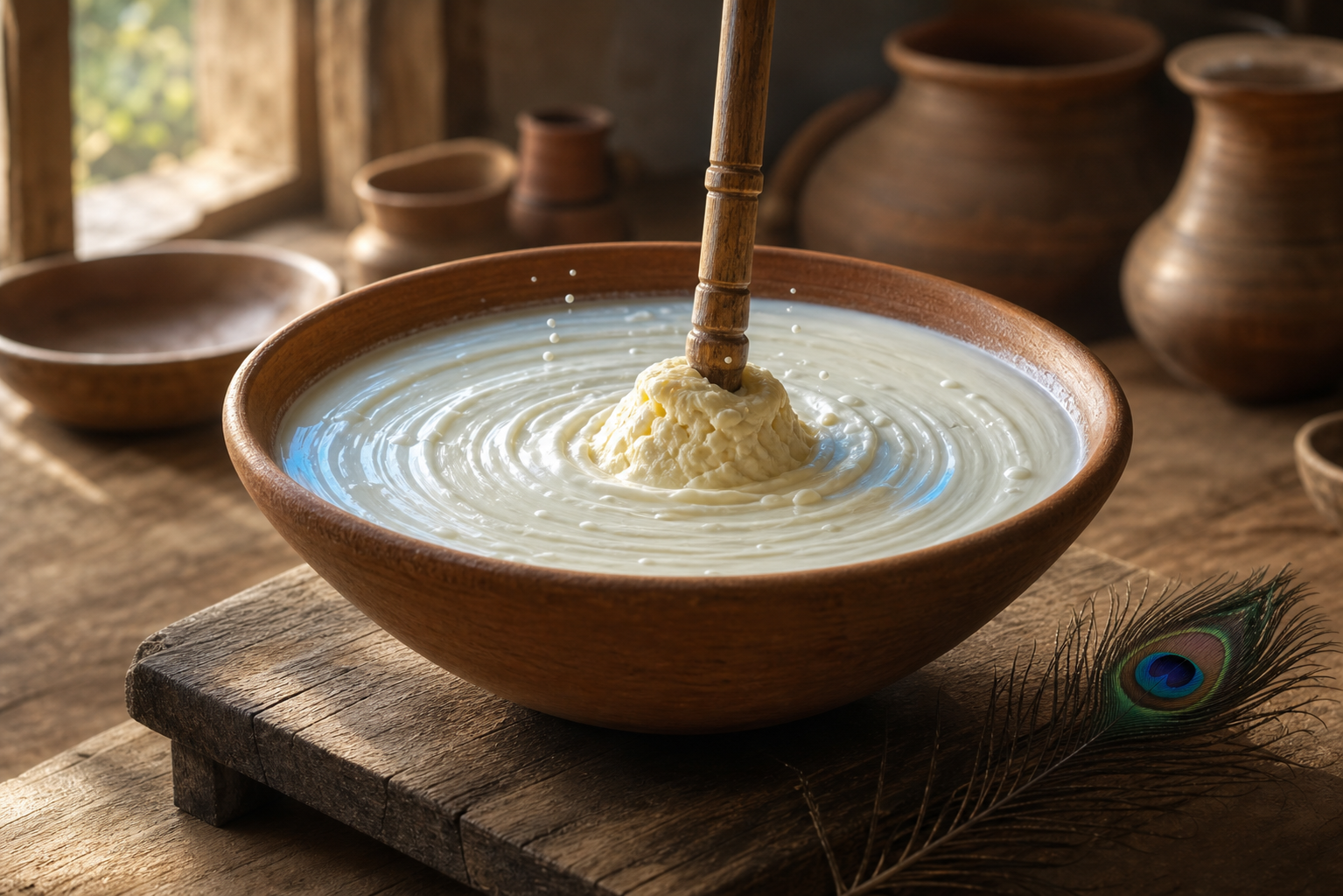
Navneet is the familiar form of the Sanskrit navanīta, fresh butter newly extracted from curds. Nava conveys newness, while nīta carries the sense of something led or brought forth. Priya means beloved or dear. Navneet Priya therefore means the One to whom freshly churned butter is especially dear.
The precision matters. Navanīta is not a general name for every milk preparation, and it is not the same as ghṛta, or ghee. Fresh butter is gathered by churning cultured milk; ghee is produced through a further process and has its own ritual place, including the feeding of sacred lamps. When Krishna reaches into a butter pot, the object is the soft, newly gathered result of domestic work.
That is why butter can carry more meaning than a luxurious food would. Milk must be tended, cultured, and churned before its hidden richness separates and becomes visible. The devotional parallel is direct: a mind exposed to teaching but never disciplined remains like unchurned curd. Japa, kīrtana, meditation, restraint, and sevā keep working upon it until clarity, tenderness, and steady affection begin to emerge.
The butter is thus a fitting image of the heart’s concentrated offering. Krishna is not impressed by bulk for its own sake. Navneet Priya directs your attention toward what has been carefully refined within you. A small act carrying patience and sincere affection can express more bhakti than an impressive act performed for display.
When you next see Bāla Krishna holding a lump of butter, ask three questions: Who churned it? What care did the work require? What does Krishna do with the result? Those questions restore the household, the relationship, and the offering that disappear when the image is reduced to a cute child with a favorite snack.
Read the butter theft and the binding as one līlā
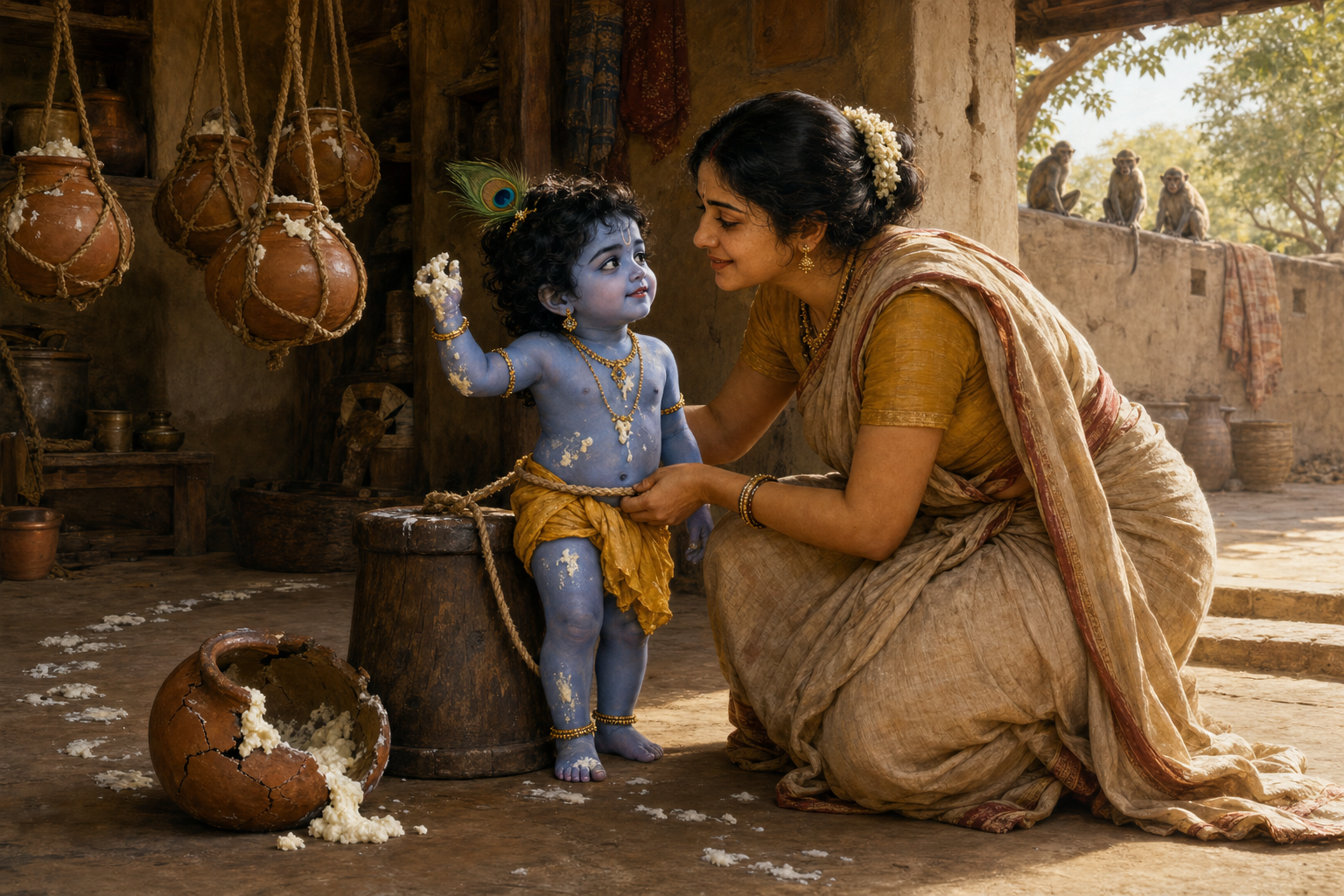
In the childhood narratives of Vraja, Krishna enters the homes of the Gopīs, finds their stored butter, eats it, and shares it with companions and monkeys. The Gopīs complain to Yaśodā, but their complaints belong to a world of close familiarity in which annoyance and delight can coexist. Krishna is not accumulating wealth. He converts a carefully guarded household product into relationship and play.
The fuller interpretive key appears in Śrīmad-Bhāgavatam 10.9, the Dāmodara-līlā. Yaśodā is churning curd. Krishna’s mischief leads to a broken butter pot, and His mother pursues and binds Him with rope. The same Supreme Lord associated with cosmic majesty permits Himself to be fed, chased, corrected, and restrained by His mother.
Do not isolate the theft from the binding. The sequence has a moral and devotional shape:
- Care comes first. The butter exists because someone has tended, cultured, and churned the milk.
- Mischief disrupts possession. Krishna eats and distributes the butter rather than hoarding it.
- The community speaks. The Gopīs do not pretend that nothing happened; they bring their complaints to Yaśodā.
- Maternal authority remains real. Yaśodā does not stop loving Krishna when she corrects Him.
- The unlimited accepts limitation. Krishna allows a household rope and a mother’s determination to hold Him.
This is not a religious exception permitting a human being to steal because Krishna did so in līlā. Human conduct remains subject to dharma, responsibility, and the consequences imposed by ordinary relationships. The episode belongs to Bhagavān’s intimate play in Vraja, where the theological point is His freedom to become accessible to love. Using it to excuse selfish behavior reverses its meaning.
It is equally mistaken to turn Yaśodā into a powerless admirer who finds every action adorable. Her correction is part of her devotion. Vātsalya-rasa, the devotional relationship of parental affection, includes feeding, protecting, cleaning, worrying, pursuing, and setting limits. Love is not shown by abandoning accountability; accountability itself can become loving service.
Vātsalya-rasa also changes the devotee’s position. Bhagavān is approached not only as a sovereign from whom you request protection or favor, but as the Divine Child for whom you accept responsibility. The devotee prepares His food, dresses Him, awakens Him, sings to Him, and puts Him to rest. Theologically, the inversion is astonishing: the One upon whom everything depends chooses to depend upon the devotee’s care.
This does not make Krishna ordinary. The tension between transcendence and intimacy is the point. If He were merely an ordinary child, His submission would carry no theological surprise. If He remained only remote and majestic, Yaśodā’s maternal love could not reach Him. Dāmodara holds both truths together: the infinite Lord is not diminished when love binds Him; His freedom is revealed in His willingness to be bound.
When you contemplate this līlā, notice what actually prevails. Yaśodā does not defeat Krishna through greater physical power. Her persistence arises from maternal care, and Krishna receives that care. The visible rope gives Dāmodara His name, but devotion supplies the deeper bond.
Turn the churning image into a disciplined practice
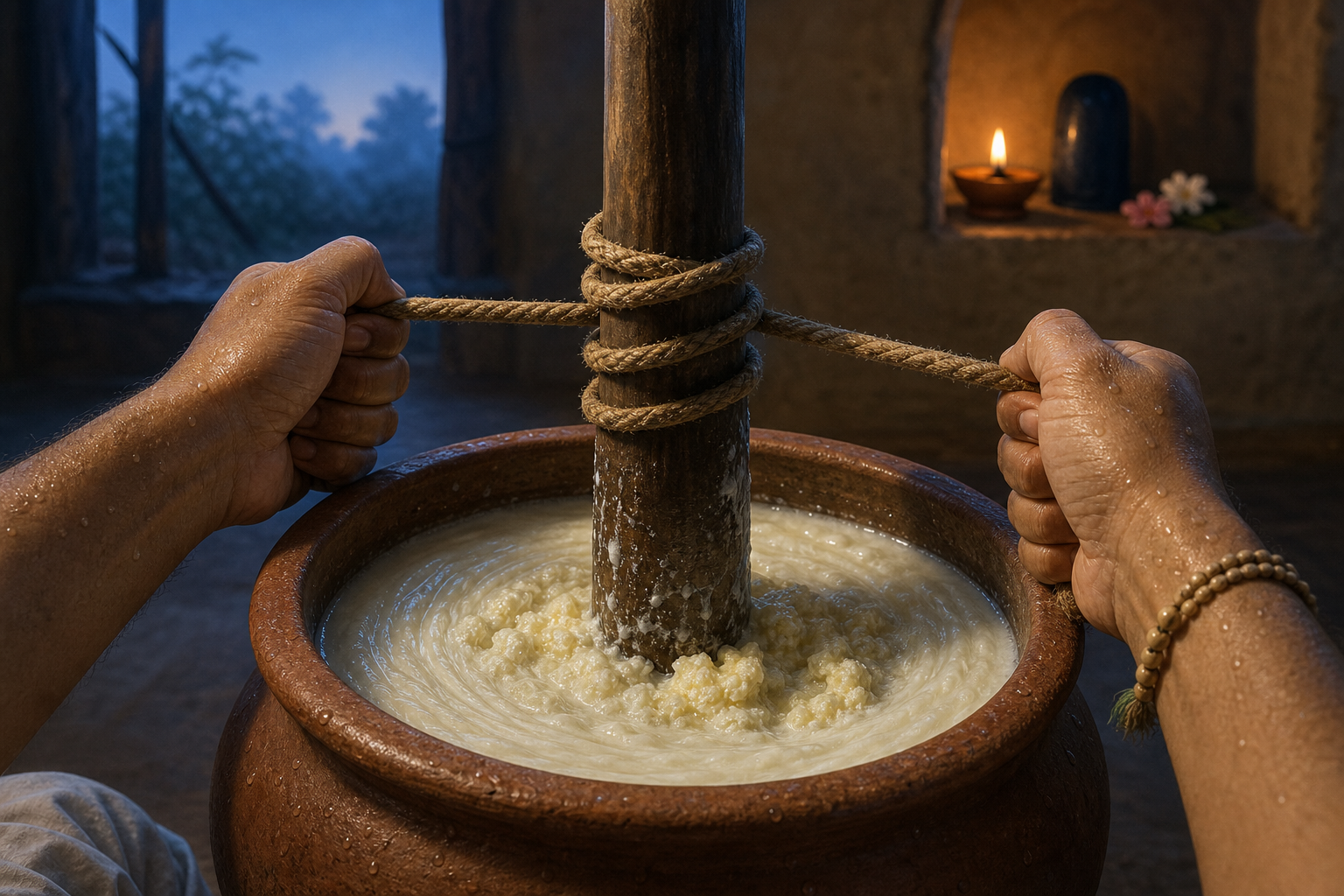
The metaphor becomes useful only when it changes what you do. Admiring butter does not churn curd, and admiring spiritual qualities does not cultivate them. You need a repeatable practice that works on the same mind often enough for its habits to become visible.
Use three movements: culture, churn, and offer
- Culture the mind. Choose a practice already honored in your path, such as japa, kīrtana, meditation, scriptural remembrance, or attentive sevā. Keep returning to it instead of replacing it whenever novelty fades. Culture requires continuity.
- Churn what arises. Repetition exposes impatience, distraction, vanity, resentment, and the wish for recognition. Do not mistake that exposure for failure. It shows you what the practice is working upon. Return to the name, prayer, task, or object of meditation without dramatizing the interruption.
- Offer the extracted quality. At the end, identify what the discipline is making available: perhaps clearer attention, a softer response, greater restraint, or steadier affection. Give that quality practical form through one act of service. Otherwise, spiritual refinement becomes another possession stored for the self.
This sequence prevents a common mistake. People sometimes treat inner peace as the final product of sādhana. The butter līlā points beyond private calm. Krishna’s butter enters relationship: it is offered, taken, shared, contested, and remembered. In the same way, clarity becomes spiritually credible when it helps you speak more truthfully, serve more patiently, or cause less harm.
Keep a home observance simple and rooted
If your family or sampradāya has an established form of Bāla Krishna sevā, follow it. The inherited sequence, mantra, and rules of offering should take priority over a generic reconstruction. If you are making a simple devotional remembrance rather than performing a formal temple rite, the following structure keeps the symbolism clear:
- Prepare a clean place and a modest portion of fresh butter. Makkhan-miśrī, butter with rock sugar, is a familiar offering where the household tradition permits it.
- Address Krishna as Navneet Priya, Bāla Gopāla, or by the name used in your family practice. Let the name direct your mind toward loving care rather than culinary indulgence.
- Offer the food with your customary prayer. If you do not have a prescribed prayer, state a plain devotional intention without presenting it as a traditional mantra: may restlessness be churned into clarity, affection, and service.
- Pause long enough to make the offering attentive. An elaborate arrangement cannot compensate for hurried indifference.
- Receive and share the offering as prasāda according to your practice. Prepare only what will be treated respectfully; waste contradicts the gratitude the ritual is meant to cultivate.
During Kārtika, Gauḍīya Vaiṣṇava communities sing the Dāmodarāṣṭakam before ghee lamps, contemplatively returning to Yaśodā’s binding of Krishna. Pushtimarg sevā, especially the worship of Bāla Krishna associated with Śrīnāthjī at Nathdwara, gives butter offerings a prominent place within a theology of grace and loving nourishment. These traditions illuminate the same līlā through distinct inherited forms; they should not be blended carelessly into one supposedly universal procedure.
Fresh butter and the ghee lamp also play different symbolic roles. Navanīta recalls the churned essence Krishna tastes and shares. Ghṛta sustains the flame placed before Him. Your temple or lineage may join these elements in one observance, but the distinction helps you understand why each is present.
Let the dairy offering pass an ethical test
A tradition that reveres cows cannot treat the conditions behind dairy as irrelevant. The offering should direct you toward gratitude, non-cruelty, moderation, and responsible stewardship. If the ritual encourages waste, competitive display, or indifference to animal suffering, its material form is working against its devotional meaning.
Use a modest quantity, obtain it as responsibly as your circumstances allow, and waste none. If dairy presents an ethical or household conflict, do not invent a substitute and describe it as an inherited requirement. Ask the relevant temple, teacher, or family authority how your tradition handles the situation. The inner symbolism is important, but it does not give you permission to rewrite a formal sevā while claiming continuity.
Carry the līlā into family and community without flattening it
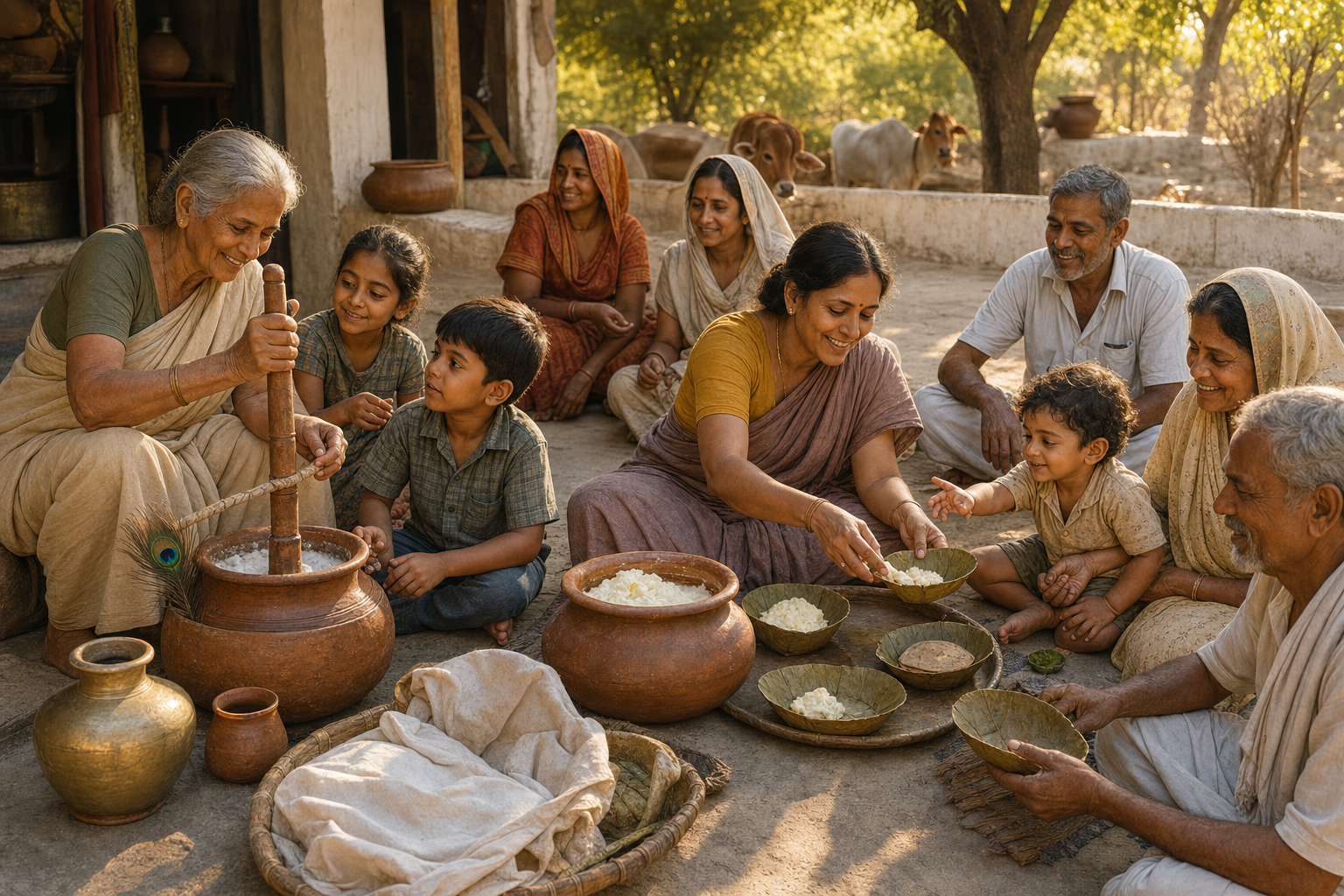
Give children the whole narrative, not a slogan
Makkhan-chor, the butter thief, is an affectionate and memorable name. It is also easy to detach from its setting. If you are telling the līlā to a child, include the work of churning, the Gopīs’ complaints, Yaśodā’s pursuit, and Krishna’s submission to correction. Otherwise the lesson can shrink into the idea that charming people escape consequences.
Three questions help a child notice the devotional structure:
- Who worked to make the butter, and what kind of care did that require?
- What did Krishna do with the butter besides eating it?
- How can Yaśodā correct Krishna without ceasing to love Him?
Those questions make room for delight without discarding dharma. They also show that parental affection is active. Yaśodā’s love is not passive approval; it is care strong enough to pursue the child and assume responsibility for His conduct.
Learn to read the public forms of the līlā
Dahi Handi carries the butter-pot memory into civic space. Especially in Maharashtra and parts of western India, teams called Govindas form human pyramids to reach suspended pots of curd. The visible achievement is reaching the handi, but the structure depends upon coordination, courage, balance, and trust. When spectacle receives all the attention and mutual care receives none, the celebration loses part of what the reenactment can teach.
Temple sculpture and devotional painting offer another way to study the līlā. In Hoysala carvings, Chola bronzes, Tanjore panels, and Pahari-Kangra painting, look for the details that identify Navneet Priya: the infant hand holding butter, the churn or handi, the reaching gesture, and companions such as calves or monkeys. These are not incidental decorations. They locate divine sweetness inside the textures of an ordinary household and its living environment.
Regional languages carry the same memory in different sounds. Hindi songs call Krishna Makkhan-chor; Tamil devotion remembers the Lord who loves vennai; Telugu and Kannada repertoires likewise celebrate His butter-centered childhood play. You do not need to force every name into one linguistic form. The continuity lies in the relationship among the Divine Child, the churned offering, and the devotee’s affection.
The story itself remains specifically Vaiṣṇava. Its broader dharmic resonance should not be used to pretend that Hindu, Buddhist, Jain, and Sikh traditions teach an identical theology of Krishna. A more honest bridge lies in the method and ethical fruit: disciplined refinement that becomes compassion, Jain ahiṃsā and inner purity, Buddhist karuṇā, or Sikh sevā grounded in humility. Use the analogy to recognize civilizational affinities, not to erase the boundaries that give each tradition its integrity.
Key takeaways
- Navneet Priya means the One to whom freshly churned butter is dear; the name emphasizes an essence brought forth through care.
- The butter theft and Dāmodara-līlā belong together. Krishna’s play is answered by complaint, maternal correction, and His willing submission to love.
- Vātsalya-rasa approaches Bhagavān through feeding, protection, discipline, and other forms of parental care, not through sentiment alone.
- The churning metaphor becomes practical when steady sādhana extracts clarity and tenderness that you then convert into sevā.
- A butter offering should remain modest, attentive, rooted in the relevant tradition, and consistent with non-cruelty and respect for food.
- Regional songs, images, and festivals preserve the līlā in different forms without changing its central relationship of essence, affection, and divine accessibility.
The next time you say Navneet Priya, do more than picture butter in Krishna’s hand. Choose one quality your practice is patiently drawing out of you, and place it into service that same day. That is how the name moves from affectionate memory into living bhakti.
References
