

If you searched for this placement because marriage or partnership feels emotionally unpredictable, you probably do not need a longer list of rituals. You need to know which remedies matter first, what they are meant to correct, and how to practise them without turning astrology into blame.
The practical aim is emotional steadiness: calmer speech, clearer agreements, respectful boundaries, and a home in which both people can be heard. No remedy can control your spouse or guarantee a particular relationship outcome. Traditional observances become useful when they train you to nurture, communicate, and repair more skilfully.
Read the placement as a practice, not a verdict
Within Lal Kitab practice, Chandra represents the mind, emotional nourishment, maternal blessings, and inner calm. The 7th house concerns marriage, committed partnerships, agreements, and dealings with other people. Put these meanings together and the remedial question becomes direct: how do you bring a more settled mind into your closest relationships?
Moon in the 7th house is not, by itself, a declaration that marriage will fail or that your partner is the problem. A responsible judgement would require the full horoscope. Even then, astrology should help you notice patterns, not furnish an excuse for suspicion, harshness, dependency, or broken commitments.
Use the remedies in three layers. Begin with conduct: maternal respect, truthfulness, non-harming speech, and reliability. Add a sustainable Monday observance to steady the mind. Treat gemstones and formal graha shanti as optional supports that require competent guidance. Reversing this order often leaves the actual relationship pattern untouched.
Key takeaways
- The primary remedy is not an object you buy. It is the emotional quality you bring to your relationships.
- Honour your mother or maternal caretakers through concrete care, while keeping necessary boundaries intact.
- Keep Monday practice simple enough to repeat: sincere worship, 108 repetitions of the Chandra mantra, charity, and quieter conduct.
- Practise satya and ahimsa together. Honesty without kindness becomes aggression; kindness without honesty leaves resentment unresolved.
- Use a pearl or formal graha shanti only after full-chart guidance, not merely because the Moon occupies the 7th house.
- Measure progress through behaviour: less reactive speech, more reliable agreements, quicker repair, and greater emotional safety.
Begin with maternal respect, but do not confuse it with submission

Lal Kitab gives unusual importance to the connection between Chandra and the mother. For a 7th-house Moon, disrespect toward the mother or maternal figures is traditionally understood to disturb both relational and professional harmony. The remedy is seva expressed in ordinary life, not ceremonial politeness covering unresolved hostility.
If the relationship is safe, choose a recurring act that meets a real need. Listen without immediately correcting her. Help with a task she finds difficult. Keep a promise you have repeatedly postponed. Speak courteously when you disagree. If you have caused hurt, name the behaviour plainly and make a specific amendment instead of offering a vague apology.
If your mother has died, lives far away, or cannot be contacted, the principle can still be practised. Remember her with gratitude, care for a maternal elder or caregiver, or direct seva toward someone who needs nourishment and support. The remedy rests in cultivating reverence and care; it does not depend on staging a perfect family scene.
If the relationship is abusive, coercive, or unsafe, respect does not require renewed exposure to harm. Maintain the boundary that protects you. You can refrain from vindictive speech, work on your own resentment, and express the nurturing side of Chandra through service elsewhere. Fear-driven reconciliation is not a spiritual duty.
Pay attention to emotional spillover. A difficult exchange with a parent can follow you into a conversation with your spouse, client, or business partner. Before answering in that charged state, pause and identify what actually belongs to the present exchange. This small separation prevents an old wound from speaking through a new relationship.
Build a Monday observance you can actually sustain
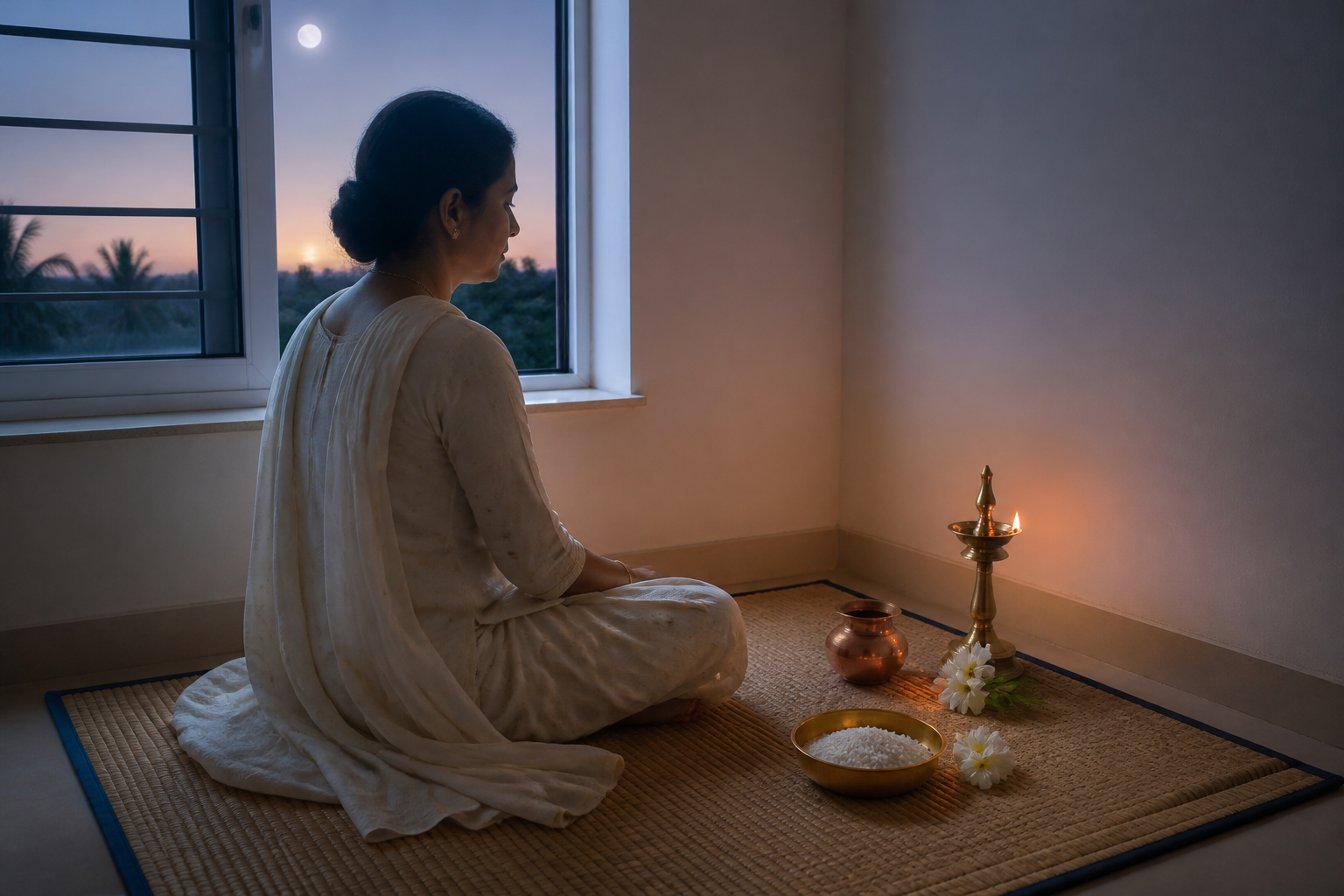
Somvar, Monday, is traditionally associated with Chandra and is the natural day for lunar remedies. Consistency matters more than creating an elaborate performance that exhausts you after its first attempt. A useful observance brings devotion, ethical action, and mental quiet into the same day.
- Begin with a clear sankalpa. You might resolve that your speech, decisions, and relationships will become calmer and more truthful.
- Perform one concrete act of care for your mother, a maternal caretaker, or someone in need. Let the act answer an actual need rather than your desire to feel ceremonially complete.
- Offer a simple prayer to Chandra or to Shiva and Parvati. White flowers, milk, rice, or curd may be included according to your household tradition. Use consumable items respectfully and avoid waste.
- At moonrise, repeat Om Som Somaya Namah 108 times. Keep the pace unhurried. After the japa, sit with quiet breath awareness so the mantra is followed by the steadiness it is meant to cultivate.
- Complete the observance with a relational commitment: make a delayed apology, clarify an agreement, listen to your partner without interruption, or fulfil something you promised.
If Somvar vrat belongs to your family or sampradaya, follow its established form. Do not invent severe food restrictions to prove sincerity. When fasting is medically inappropriate, choose a non-food observance such as japa, puja, seva, restrained speech, or charity. The discipline is meant to refine the mind, not injure the body.
On a clear evening during Shukla Paksha, gentle moon-gazing or offering arghya to the Moon can become a quiet extension of the practice. Use the moment to release the urge to win an argument in your imagination. Return instead to the next truthful and compassionate action available to you.
Lunar balance also depends on what happens after worship. Avoid carrying late-night overstimulation into sleep, keep your sleep pattern reasonably consistent, and soften your speech on Mondays. A sacred day loses its remedial value if the puja is followed by contempt, manipulation, or a preventable quarrel.
Turn the relationship itself into your main sadhana

The 7th house makes partnership conduct central. Satya asks you to tell the truth; ahimsa asks you to tell it without needless injury. Practised separately, either can become distorted. Bluntness can masquerade as honesty, while avoidance can masquerade as peace.
When a difficult matter arises, replace accusation with a sequence that both people can answer:
- Describe the specific event rather than assigning a permanent character flaw.
- Name your own feeling or concern without claiming to know the other person’s hidden motive.
- Ask for a clear change instead of expecting your partner to infer what would help.
- Repeat back the other person’s concern before defending your position.
- End with an agreement that each person can recognise and keep.
- Return to the issue if the agreement fails; do not store it as ammunition for an unrelated conflict.
This is where ritual becomes verifiable. If your Monday japa is sincere, it should gradually appear in the tone you use when disappointed, the fairness of your agreements, and your willingness to repair harm. A spouse does not have to share your astrological belief for you to become a more trustworthy partner.
Joint puja or a short shared meditation can help when both people welcome it. It should never be imposed as a test of love or used to declare one partner spiritually defective. Ask for consent, keep the practice simple, and allow each person to retain their own relationship with dharma.
Dharmic traditions offer different methods for cultivating the same relational virtues. Buddhist metta develops loving-kindness; Jain pratikraman centres reflection, accountability, and repair; Sikh seva and simran join service with remembrance. You do not need to mix traditions indiscriminately. Choose a practice rooted in your own path and let compassion, truthfulness, and responsibility be the common measure.
Ritual is not an adequate response to fear, coercion, threats, or violence. If those conditions are present, put safety first and seek qualified local support. Where the problem is recurring conflict rather than immediate danger, relationship counselling can work alongside spiritual practice. Astrology should never be used to persuade you to tolerate harm or to postpone necessary help.
Use charity, puja, and gemstones with proportion
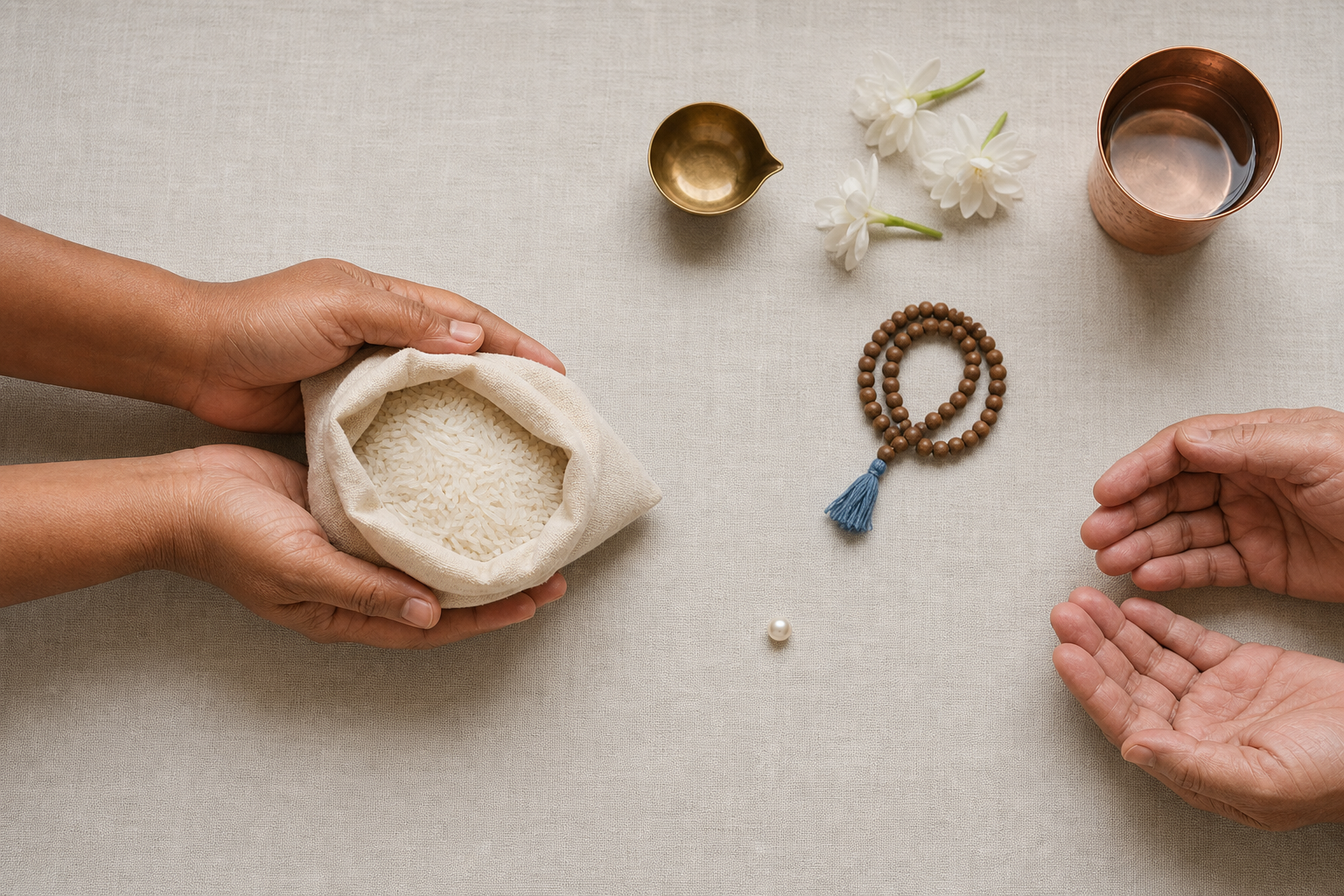
Let lunar charity nourish someone
Traditional Chandra charity uses cooling, nourishing, or white items. Milk, rice, curd, and white garments may be donated to people in need, especially on Mondays. Select what the recipient can actually use, confirm that perishable food can be stored safely, and give without making the person participate in your ritual.
Feeding cows and providing clean water in public places also express Chandra’s nurturing quality. Carry them out responsibly: offer suitable food where feeding is permitted, and maintain any water vessel so it remains clean. Seva ceases to be care when it creates waste, dirt, or inconvenience for others.
Do not treat charity as a transaction in which a donation purchases obedience from a planet. Its remedial force lies in training generosity, tenderness, and responsibility. Those qualities are directly relevant to the emotional atmosphere of partnership.
Reserve formal graha remedies for informed use
Chandra Graha Shanti or Navagraha puja may be performed with a qualified priest when a fuller remedial rite is appropriate. Ask what the sankalpa means, what participation is expected from you, and how the rite should be supported through daily conduct. A costly ceremony does not cancel dishonesty, neglect, or repeated boundary violations.
Pearl, or Moti, is traditionally associated with Chandra. The customary recommendation is a pearl set in silver and worn on a Monday during Shukla Paksha. Do not wear one merely because an app or isolated placement identifies Moon in the 7th house. Gemstone advice should be aligned with the full horoscope and given by someone competent to assess it. Until then, ethical conduct, mantra, prayer, and seva are the safer starting points.
Judge progress by what changes between people
Do not look only for omens after beginning a remedy. Keep brief notes after important interactions: what triggered you, what you said, whether you listened, whether an agreement was kept, and what helped the relationship return to calm. This shows whether the practice is entering your behaviour.
Useful signs are incremental: less harsh speech, fewer impulsive reactions, more dependable follow-through, clearer boundaries, and better cooperation. Your partner’s sense of emotional safety matters more than your private conviction that the ritual worked. If the same harmful pattern continues, revise the conduct, seek counselling where needed, and do not keep adding rituals to avoid the conversation.
Begin on the next Monday with the smallest complete cycle: one act of maternal respect or nurturing seva, sincere worship, 108 repetitions of the Chandra mantra, and one promise to your partner that you can actually keep. Let repetition reveal what needs repair. The deepest 7th-house Moon remedy is a relationship in which care becomes dependable rather than occasional.
References
