

You have a hall full of committed people, a shared Dharmic vocabulary, and a civic problem everyone recognises. What often disappears after the chairs are stacked is not conviction. It is the chain connecting conviction to a named public outcome.
If you want to strengthen Dharmic civic mobilisation in Maharashtra, build that chain before calling the next gathering. A Sabha can educate and unite people; a civic campaign must also identify the problem, document it, assign responsibility, secure a response, and verify that the improvement lasts.
Define a public outcome, not merely a successful gathering
A large attendance, an inspiring address, or a widely shared photograph can show interest. None of them tells you whether the neighbourhood became safer, cleaner, better informed, or more capable of defending its cultural interests.
The missing bridge is a campaign charter. Before mobilising volunteers, write a problem statement that names the place, the observable condition, the people affected, the responsible public office, and the correction you want. Use a sentence such as this:
At [exact location], [observable condition] is affecting [specific users]. We ask [responsible office] to correct it, publish evidence of routine maintenance, and provide an accessible grievance channel.
This formulation prevents a common failure: demanding that authorities generally improve something without defining what improvement would look like. It also makes verification possible. A broken light can be checked. An interrupted water supply can be checked. A missing cleaning record can be checked. A broad claim that the administration does not care cannot be closed in the same way.
In Kolhapur, Hindu Vidhidnya Parishad formally asked the Municipal Commissioner to address unhygienic public toilets. The issue is mundane only if you never have to depend on those facilities. For women, children, elderly people, sanitation workers, commuters, vendors, students, and pilgrims, unreliable toilets affect safety, dignity, mobility, and public health.
That is an instructive model for Dharmic action. Saucha should not remain a word invoked inside a discourse while an avoidable sanitation failure continues outside the venue. Dharma becomes publicly legible when ethical teaching produces disciplined service and accountable civic engagement.
Build an evidence trail that an authority can act on
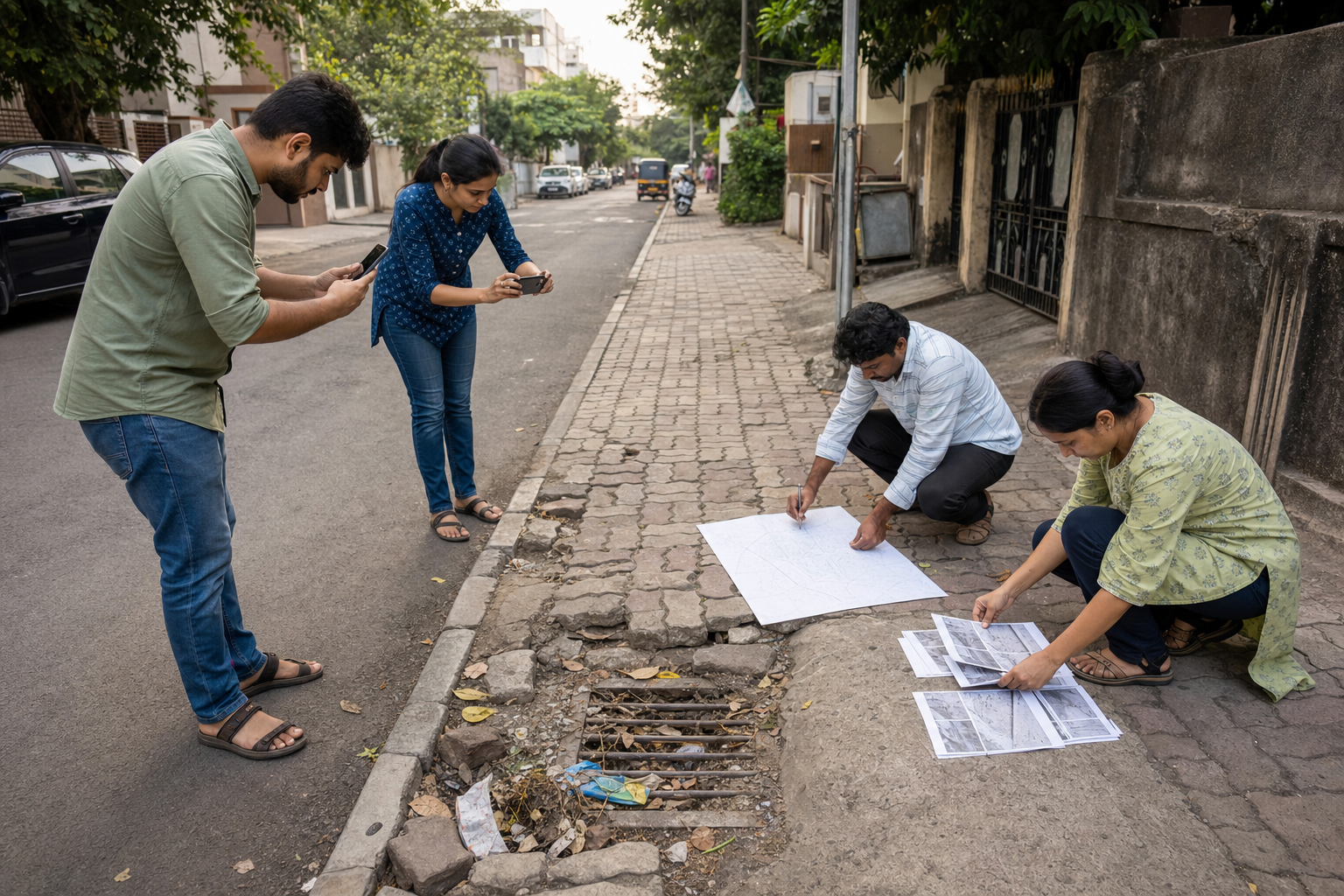
Officials need a resolvable case, not a cloud of anger. Your evidence should be detailed enough to identify the asset and the fault, but simple enough for volunteers to collect consistently.
For a public-toilet campaign, use the same inspection fields at every visit:
- Exact facility name and location, with any asset or ward identifier displayed on site.
- Date and time of the observation.
- Whether water is available and the basic fixtures are functional.
- Whether a cleaning schedule or completed checklist is visible.
- Whether lighting and ventilation are working.
- Whether waste is being removed safely.
- Whether accessibility signage is clear.
- Whether a QR code, helpline, or other grievance channel is displayed and usable.
- Photographs of observable defects taken from appropriate public areas, without including toilet users or invading anyone’s privacy.
- The complaint reference, municipal response, assigned office, and result of the follow-up inspection.
Keep observations separate from conclusions. Write that there was no water at the tap when inspected, not that the municipality never supplies water. Record that no cleaning entry was visible, not that nobody ever cleans the facility. Precise language makes the representation harder to dismiss and easier to update when conditions change.
Your written request should also separate an immediate repair from the system required to prevent recurrence. Restoring a light or water connection may resolve the visible defect. Predictable cleanliness requires routine cleaning cycles, documented checklists, periodic audits, clear maintenance responsibility, and a functioning complaint route. Where maintenance is contracted, the civic ask should include performance-linked oversight rather than an unexplained demand for more spending.
Track progress at several levels:
- Submission: Was the representation delivered and acknowledged?
- Ownership: Was a responsible official, department, or contractor identified?
- Service: Were the water, lighting, cleaning, ventilation, signage, or disposal failures corrected?
- System: Is there now a visible schedule, inspection record, grievance channel, or public cleanliness dashboard?
- Durability: Did a follow-up inspection confirm that the facility remained usable after the initial attention passed?
A photograph of a clean facility proves a moment. A maintained checklist, repeated inspection, accessible complaint mechanism, and transparent performance record provide stronger evidence that the service has changed.
Turn Dharma education into a working civic unit

Civic competence does not appear automatically because people share a tradition. It has to be taught, practised, and handed to the next set of volunteers. This is where regular Dharma education and practical seva belong together.
A Hindu Rashtra-Jagruti Sabha in Kudal centred sustained awareness, study circles, youth engagement, community dialogue, cultural practice, and seva. Those activities can become the permanent infrastructure behind civic campaigns. A study circle develops shared language and ethical purpose. A workshop can teach documentation and public communication. Seva gives that learning a visible local application.
Give every participant a defined responsibility rather than asking everyone to help with everything:
- Campaign convener: Holds the agreed outcome and prevents the campaign from expanding into unrelated grievances.
- Field observers: Use the common checklist and submit observations in the same format.
- Records lead: Maintains photographs, complaint references, acknowledgements, responses, and verification notes.
- Municipal liaison: Sends the representation, asks who owns the issue, and records the official reply accurately.
- Dharma education lead: Connects the civic task to saucha, seva, compassion, responsible conduct, and care for shared space without turning the session into party messaging.
- Community liaison: Brings in residents, vendors, pilgrims, students, women’s groups, elderly users, sanitation workers, and other people who understand how the facility functions in daily life.
- Verification lead: Revisits the site and distinguishes an announced correction from a working correction.
A small group may combine roles, but it should not leave ownership vague. Every meeting should end with a named task, a named owner, the evidence required for completion, and the condition that will trigger the next follow-up.
Youth participation deserves more than symbolic front-row seating. Teach younger volunteers how to distinguish observation from allegation, how to write a respectful representation, how to protect privacy while documenting a problem, and how to verify a response. Field participation should be age-appropriate and supervised. The durable outcome is not merely a solved complaint; it is a generation that knows how to turn concern into orderly public action.
Keep seva inclusive, safe, and institutionally serious
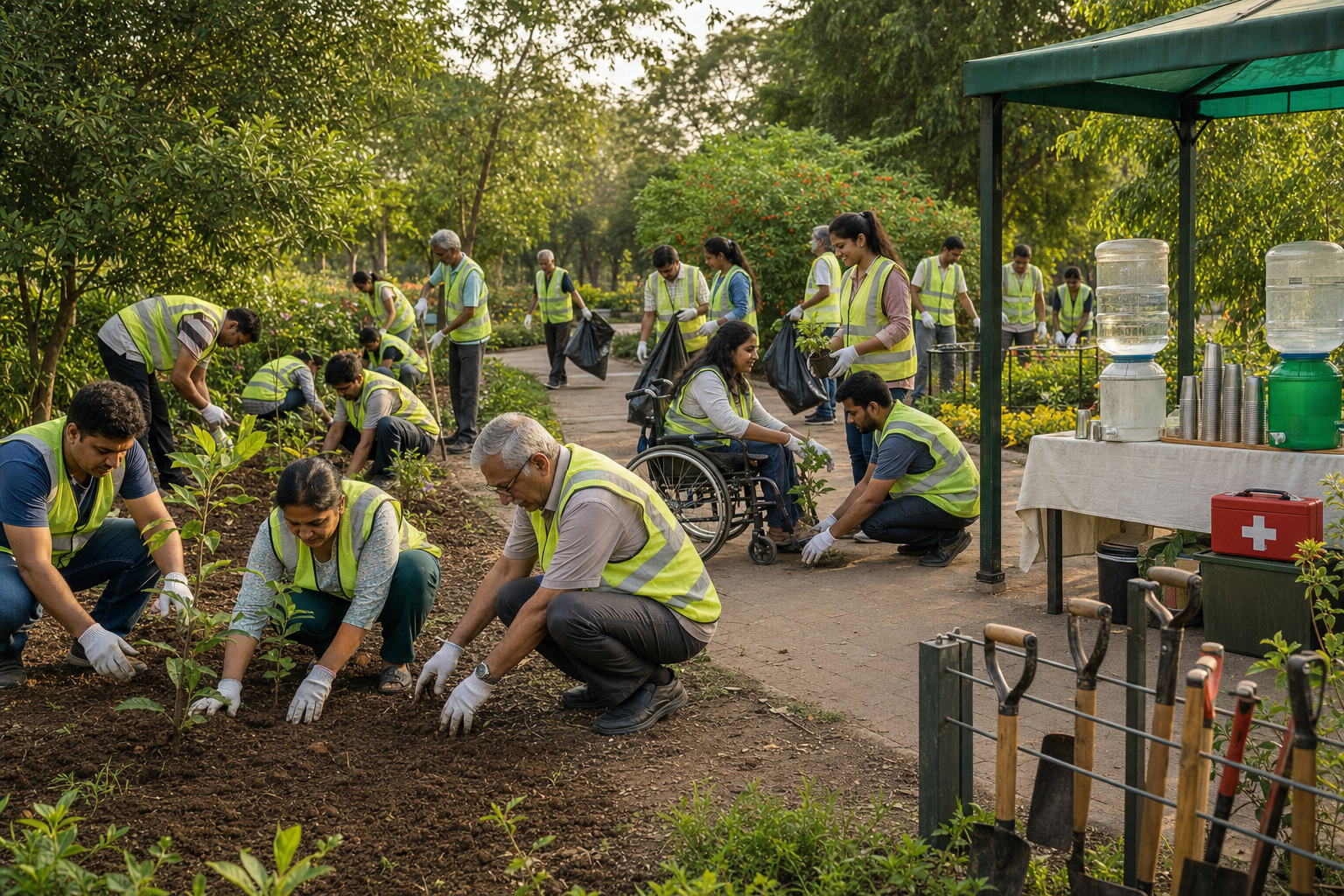
Hindu, Buddhist, Jain, and Sikh traditions are not interchangeable, and a credible coalition does not pretend otherwise. Cooperation can rest on an ethical overlap: cleanliness, compassion, disciplined conduct, non-harm, service, respect for elders, care for the environment, and responsibility toward the wider community. Unity here means coordinated work without demanding doctrinal uniformity.
That approach also broadens the campaign’s intelligence. A commuter notices opening hours. A vendor sees recurring maintenance failures. A pilgrim encounters unclear signage. Women and elderly users may identify safety or access problems that other volunteers overlook. Sanitation workers understand where unrealistic public expectations collide with inadequate water, equipment, disposal arrangements, or contract supervision.
Community participation must not become an excuse for the administration to withdraw. Volunteers can inspect, report, educate users, organise feedback, and clean surrounding litter where it is safe to do so. They should not be sent into contact with human waste, unknown chemicals, unsafe wiring, or other hazards. Hazardous cleaning belongs with trained sanitation personnel using appropriate procedures and equipment.
Respect applies to public servants as well as users. Direct the demand to the responsible office, maintenance system, or contract. Do not substitute personal abuse for evidence. Publish the same checklist regardless of the ward or office involved, record a prompt correction when it occurs, and continue to document an unresolved failure when it does not.
This discipline protects Dharmic mobilisation from two weaknesses. The first is spectacle without continuity: a gathering attracts attention, but nobody owns the next action. The second is charity without accountability: volunteers repeatedly compensate for a failed public service while the responsible institution faces no pressure to repair its system. Seva and accountability should reinforce each other.
Key takeaways and your next move
- Begin with an observable civic condition, an affected group, a responsible office, and a verifiable correction.
- Use Sabha-based education to prepare volunteers for documentation, representation, public communication, and follow-up.
- Collect consistent evidence and distinguish what was directly observed from what has merely been inferred.
- Ask for maintenance systems, inspection records, audits, and grievance channels in addition to an immediate repair.
- Give each volunteer a defined role and end every meeting with named ownership of the next action.
- Include the people who use and maintain the service, especially those whose safety, mobility, or dignity is most affected.
- Protect privacy and volunteer safety; community enthusiasm is not a substitute for trained sanitation work.
- Verify the result after the announcement. A campaign is complete when the promised service works and remains accountable.
Before announcing your next Sabha, select the first local issue and prepare its campaign sheet. Bring the exact problem statement, inspection checklist, responsible office, representation draft, and follow-up owner into the gathering. People should leave knowing not only what they believe, but what they are responsible for doing next.
Start with a problem small enough to verify and important enough to matter. When residents can point to a usable facility, an answered grievance, an informed group of young volunteers, and a maintenance promise that was actually kept, Dharmic civic mobilisation has moved from aspiration to public trust.
References
- Hindu Jagruti Samiti – Kolhapur’s Unhygienic Public Toilets: Hindu Vidhidnya Parishad Demands Urgent Civic Action
- Hindu Jagruti Samiti – Kudal’s Hindu Rashtra-Jagruti Sabha: Powerful Call to Strengthen Dharma, Unity, and Education
