
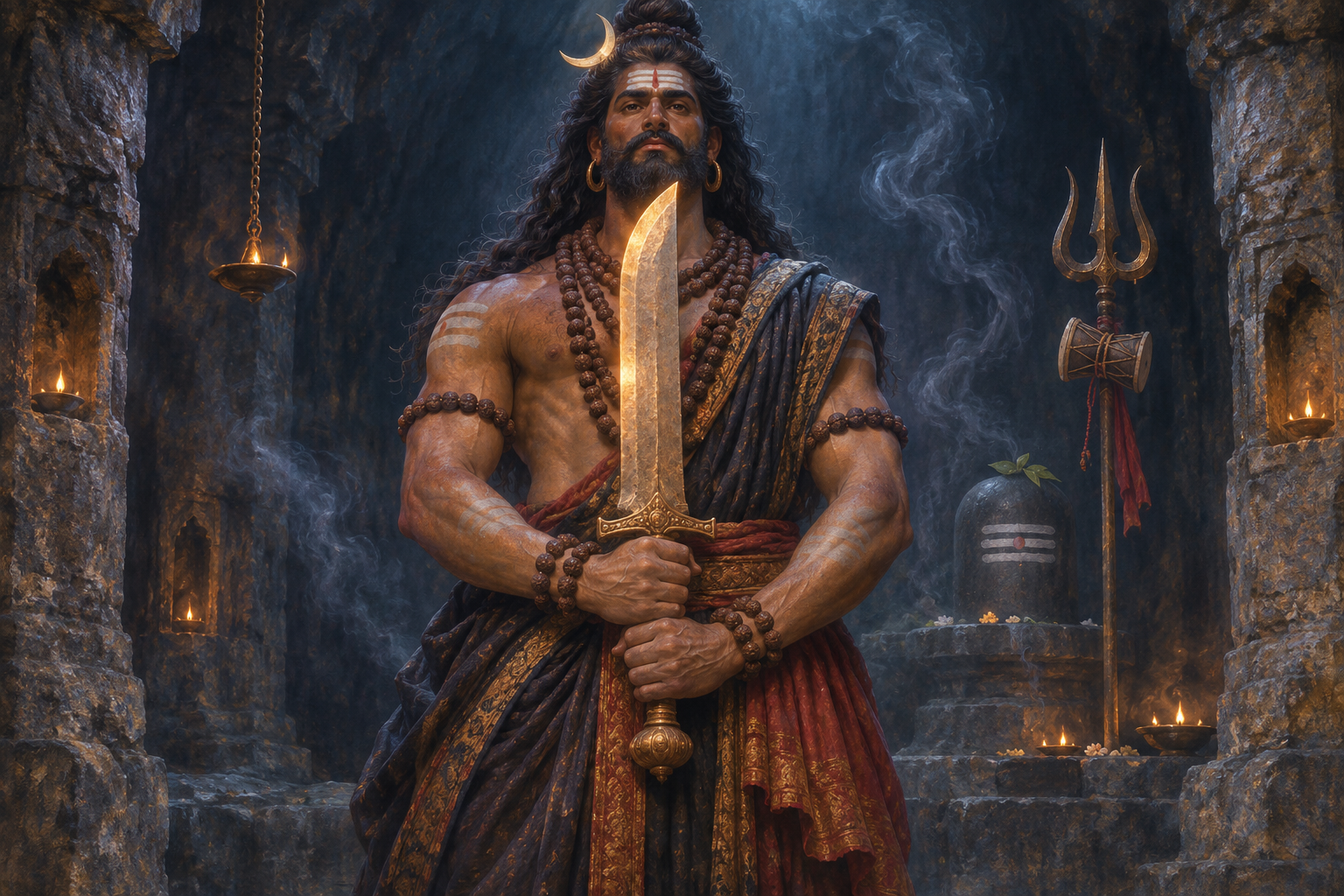
If you found the name Khadga Ravana in a mantra list, an image caption, or a discussion of Tantra, the first challenge is identification. The name looks as though it must refer to Ravana of Lanka. In Shaiva Tantra, it does not. If you miss that distinction, almost everything you infer afterward can go wrong.
What follows is a careful way to understand this fierce deity without turning a short traditional identification into an invented biography or an unauthorized ritual. You will be able to recognize the name, interpret its central imagery, test claims made about it, and know where ordinary study should stop and lineage-based practice must begin.
Begin with the decisive distinction: this is not Lanka’s Ravana
Khadga Ravana, also written Khadgaravana, is a fierce Mantra Vidya deity associated with Shiva and revered in Tantric traditions. His defining origin is Shiva’s terrifying roar. The Ravana of the Ramayana, by contrast, is the king of Lanka. A similar-sounding name does not make the two figures identical.
This correction is more than a matter of spelling. If you identify Khadga Ravana with the Ramayana character, you may import an entire narrative that does not belong here: Lanka, the abduction of Sita, conflict with Sri Rama, Ravana’s ancestry, his boons, and his eventual defeat. None of those elements follows merely from the tantric name.
The Sanskrit element ravana is connected here with a frightening sound or roar. The shared word therefore points to sound, not necessarily to the same person. A useful rule applies whenever you meet an unfamiliar tantric name: establish its ritual and theological setting before matching it to the most famous figure with a similar name.
For Khadga Ravana, the secure identification has four parts: he is fierce, connected with mantra knowledge, associated with Shiva, and manifested through Shiva’s roar. Treat those four points as the boundary of what the name reliably establishes.
Read the name as a theological signal, not a complete biography
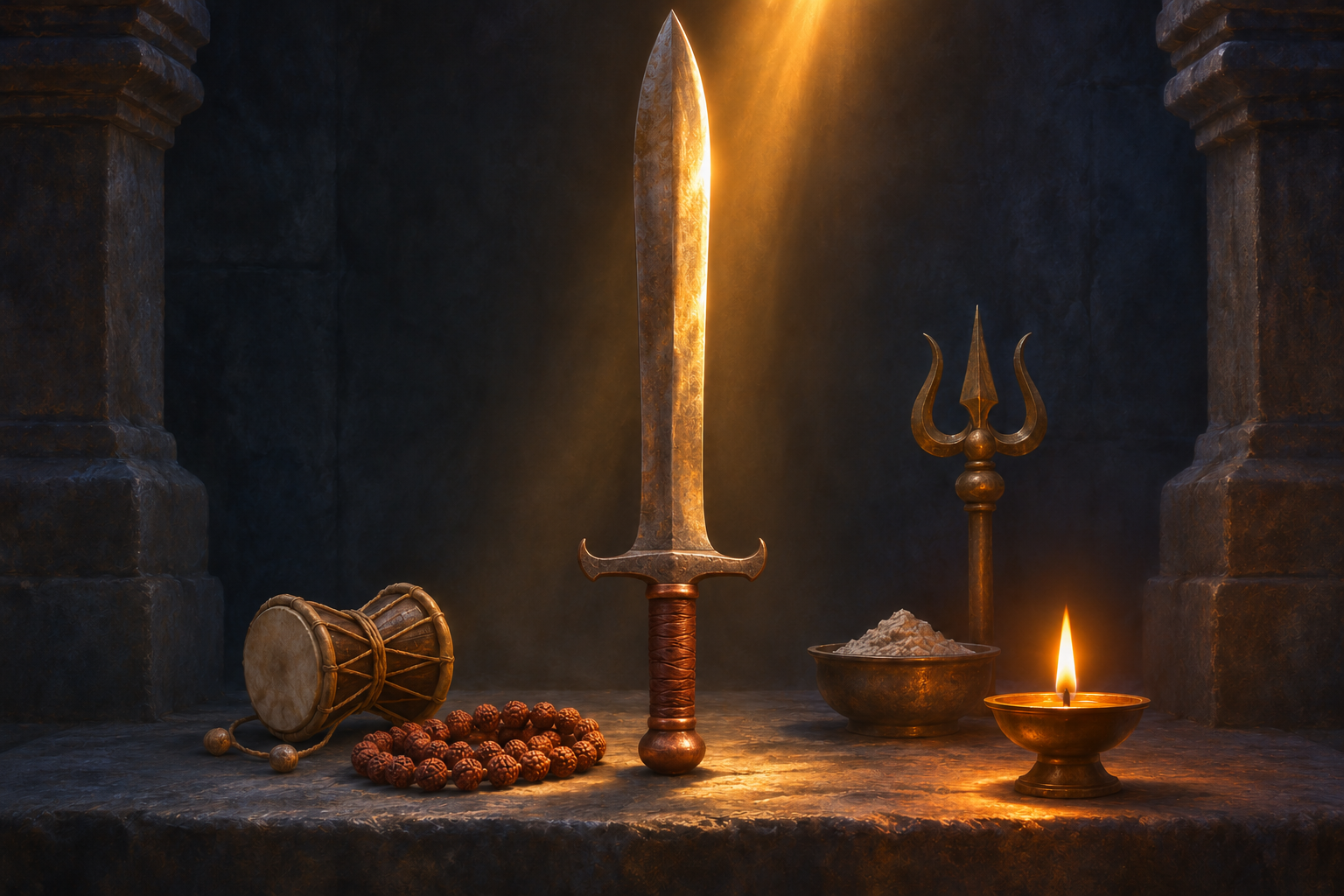
Khadga ordinarily means a sword. Ravana, in this context, evokes a terrible or awe-inducing roar. Those meanings give the name a field of associations: cutting force, formidable sound, and Shiva’s sovereign sacred power. They do not, by themselves, supply a complete iconography, mantra, ritual procedure, or life story.
The distinction matters because tantric names are dense. A name may indicate a deity’s power, function, mode of manifestation, weapon, sound, or ritual relationship without narrating a conventional story. Etymology can help you face in the right direction, but it cannot replace textual or lineage evidence.
- Do not infer an image from the name alone. The word khadga makes a sword association reasonable, but it does not establish the deity’s number of arms, posture, colour, attendants, vehicle, or other attributes.
- Do not build a mantra by combining familiar syllables. A deity’s name is not permission to invent a bija, mantra sequence, or ritual formula.
- Do not convert the roar into ordinary anger. In this account, Shiva’s roar is the deity’s manifestation point. It marks sacred force rather than an episode of uncontrolled human emotion.
- Do not equate fierceness with evil. Within Hindu sacred imagery, a fierce form can express divine sovereignty and the capacity to confront dangerous or disordering powers. Fierce appearance is not the same as adharmic character.
Khadga Ravana’s association with Shiva as lord of spirits and sacred power also gives you a better interpretive frame. You are dealing with a manifestation situated within Shiva’s domain, not an independent demon whose name happens to include Ravana. The correct question is therefore not, “Which episode of the Ramayana is this?” It is, “What aspect of Shiva’s mantra-power does this fierce form embody?”
“Mantra Vidya deity” changes how you should approach the figure

The description “Mantra Vidya deity” places Khadga Ravana within the sphere of sacred utterance and ritual knowledge. In tantric settings, a deity is not always approached primarily through narrative. The relationship may instead be organized through mantra, visualization, ritual placement, disciplined repetition, and transmission within a lineage.
This gives you three levels that should never be collapsed into one another:
<!– wp:list {
Leave a Reply
You must be logged in to post a comment.