
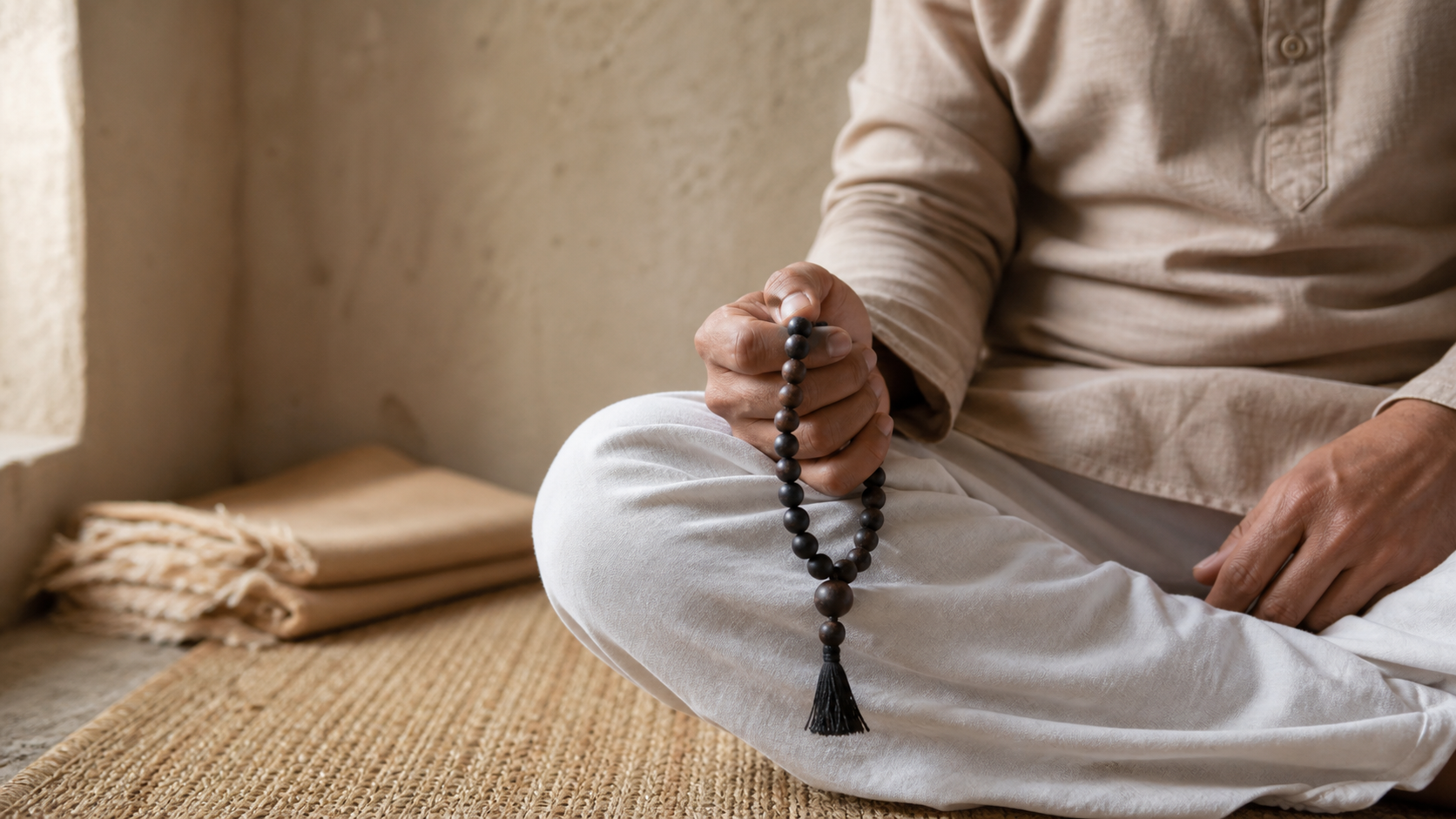
You may be holding a black Karungali mala and wondering whether it is spiritually suitable, whether you are handling it correctly, or whether its reputation has overtaken its real value. The answer that matters is practical: the mala can support meditation and japa when its weight, texture, and beads help you keep a steady practice. It cannot do the practice for you.
Give the mala one clear job. Use it to count a chosen mantra, steady your hand, and reveal when your attention has wandered. Then observe what happens over a defined period. This approach keeps devotion and discernment together.
Put practice before promises about the wood
In South Indian usage, Karungali commonly refers to deep-black hardwoods identified with ebony. The wood is valued for its density, durability, dark appearance, and restrained beauty. Its traditional associations include steadiness, protection, inward attention, and groundedness.
Those associations should be understood as sacred symbolism, not an automatic guarantee. A meaningful symbol can shape how you enter practice without proving that the material possesses a measurable invisible power. Reports of grounded calm are personal experiences, not medical evidence, and a mala should not be treated as a remedy for a health condition.
The most observable value is simpler. Beads relieve you of repeatedly calculating the count. The wood gives the fingers a stable tactile point. Taking out a dedicated mala also marks a transition from ordinary activity to deliberate remembrance. These small functions can make it easier to begin, remain with, and complete a practice.
- Choose Karungali when the beads feel comfortable, move cleanly, and help you practise without distraction.
- Do not buy it solely because someone promises guaranteed protection, spiritual advancement, or a particular inner experience.
- If another mala already supports a stable practice, do not assume that changing to dark wood will automatically strengthen your japa.
- If you wear the mala, remember that wearing and practising are different acts. Daily wear may remind you of your sankalpa, but it does not replace recitation or meditation.
The mala also does not erase the distinctions among Dharmic paths. Hindu japa, Buddhist and Jain contemplative recitation, Sikh simran, and breath-led meditation retain their own meanings and disciplines. A shared implement does not make their mantras or teachings interchangeable. If a guru, acharya, sampradaya, or established lineage has given you a method, that instruction should take precedence over a general technique.
Build a japa routine that you can repeat without guesswork
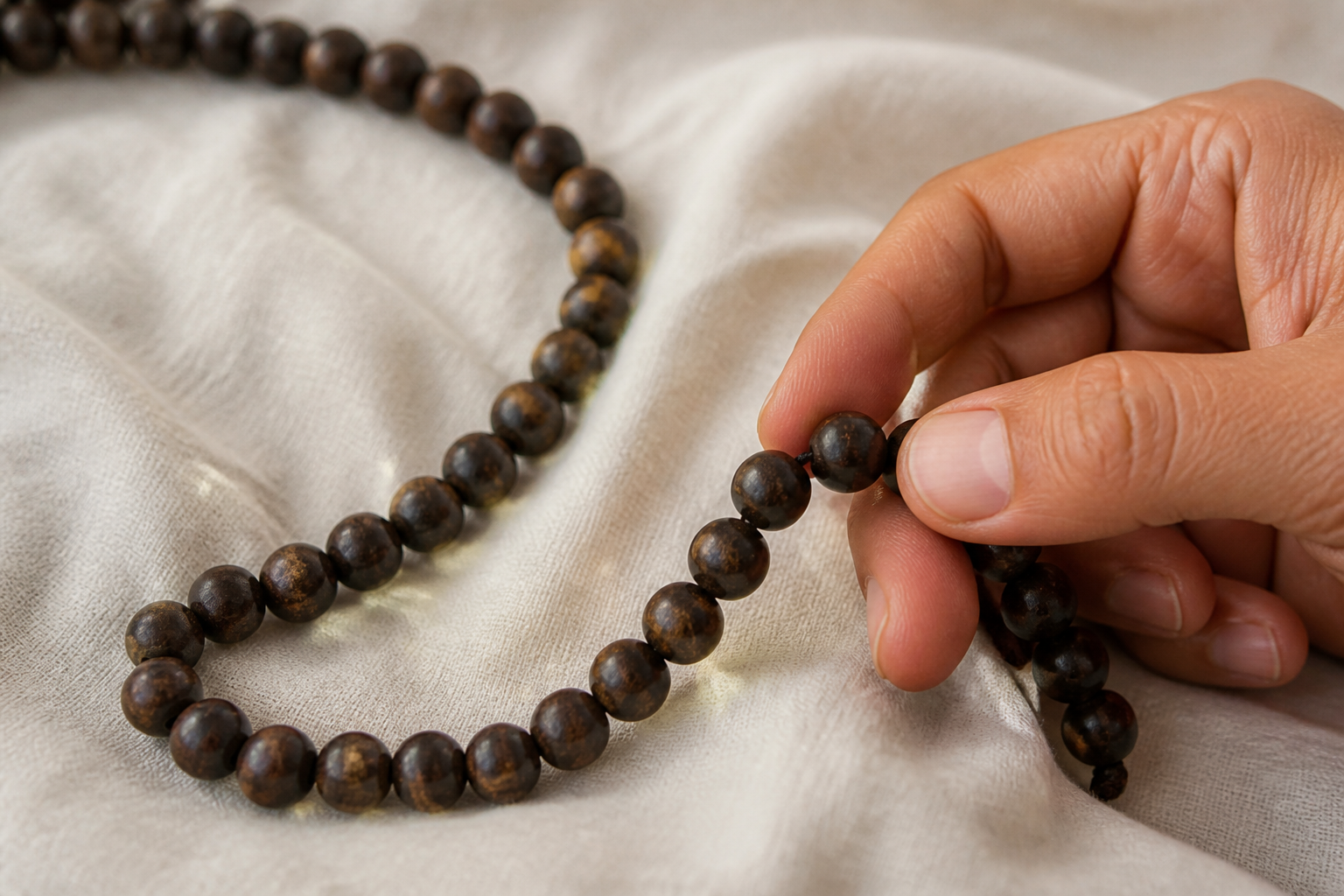
A good session removes unnecessary decisions. Decide on the mantra, the intended count, and the handling method before you begin. Once recitation starts, your task is to remain with sound, meaning, and awareness rather than redesigning the ritual.
- Verify the bead count. A full mala commonly has 108 beads, while a 54-bead mala provides a half-mala count. If your sankalpa is 108 recitations and you use 54 beads, complete two passes according to your lineage’s turning convention.
- Choose one mantra. Use the mantra given within your tradition when you have one. Familiar Hindu examples include Om Namah Shivaya and Om Namo Narayanaya, but they are examples rather than interchangeable decorations.
- Prepare a clean place. You may place the mala on a clean cloth near a lamp, incense, or a sacred text. These elements are supports for intention, not requirements that should prevent you from practising.
- Settle the body and breath. Sit in a position you can maintain without repeatedly adjusting. Let the breath become gentle rather than making it artificially deep or dramatic.
- Hold the mala consistently. A common method advances each bead with the thumb and middle finger. Many lineages avoid using the index finger. Follow your own tradition if its convention differs.
- Recite once per bead. Complete the mantra before moving to the next bead. Let the hand confirm the recitation rather than racing ahead of it.
- Complete the intended round. Do not add recitations merely because the session feels pleasant or abandon the count because attention was imperfect. Consistency makes observation possible.
- Close deliberately. Pause in gratitude, then return the mala to its reserved pouch or place. A simple, repeatable ending helps keep the practice distinct from casual handling.
One complete, attentive round is more useful than several hurried rounds performed to satisfy a number. The count provides form, but it is not a substitute for presence. If your hand reaches the next bead while the mouth is still finishing the mantra, slow the fingers first.
Let the bead, mantra, and breath perform different jobs
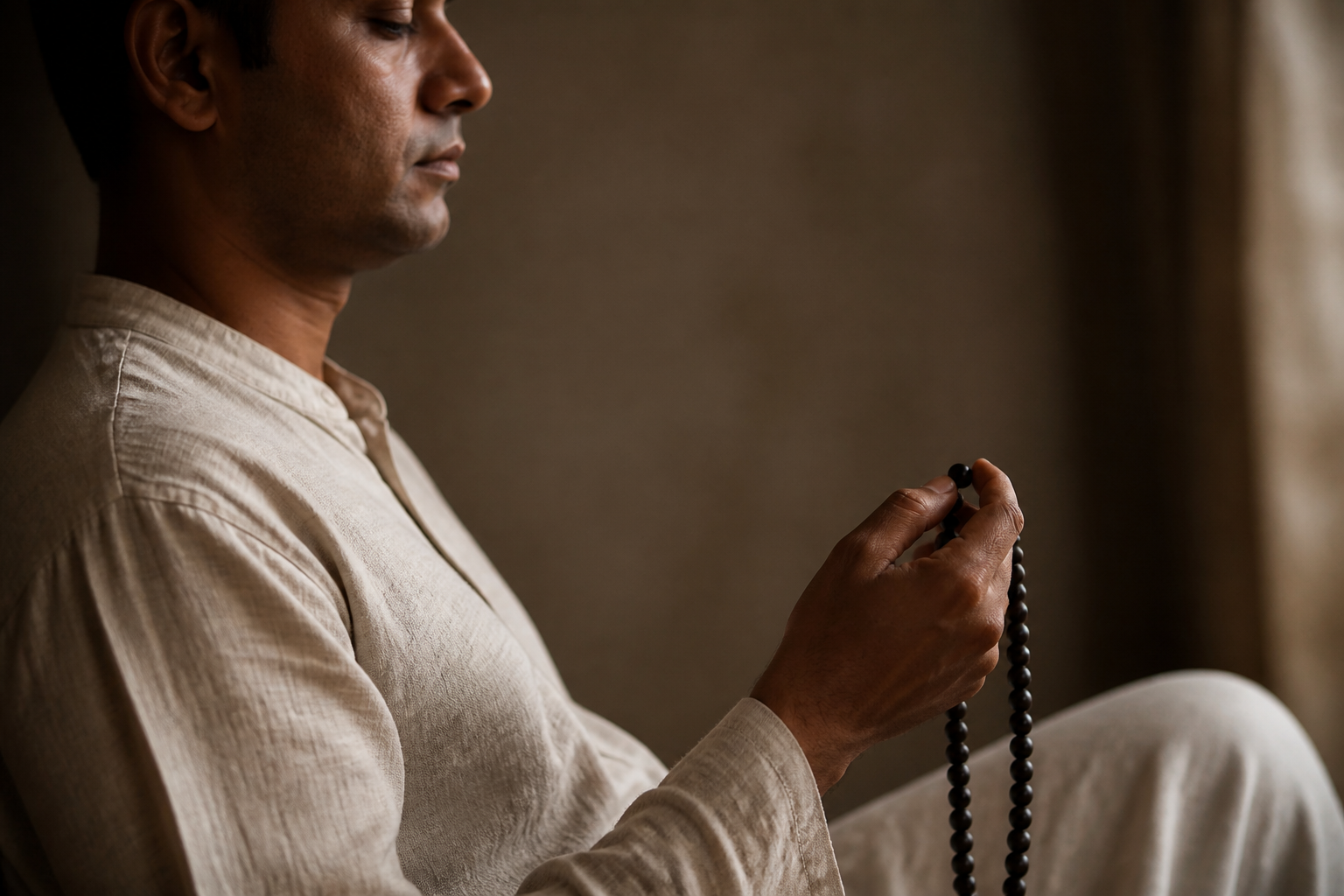
Japa becomes less confusing when you stop asking one element to control everything. Each part has a distinct function:
- The bead marks place. It tells the hand that one recitation has been completed.
- The mantra carries the sacred content. Sound, remembrance, meaning, and devotion belong here.
- The breath regulates effort. Gentle diaphragmatic breathing can soften the pace and reduce the urge to rush.
One mantra per bead does not necessarily mean one mantra per breath. A short formula may fit naturally within a breath; a longer one may not. Do not hold, stretch, or force the breath merely to make the two lengths match. Preserve a comfortable breath and let the mantra proceed steadily.
Use distraction as information
The mala does not prevent the mind from wandering. It makes wandering easier to notice. Your fingers may stop, skip ahead, tighten around the cord, or continue mechanically while attention follows another thought. The useful moment is not the disappearance of all thought; it is the moment you recognise that sound, hand, and awareness have separated.
- If the fingers move before the mantra is complete, finish each recitation and then advance the bead.
- If the breath becomes strained, reduce the pace or intensity instead of forcing a rhythm.
- If you become preoccupied with reaching the final bead, return attention to the recitation presently in front of you.
- If the sound becomes mechanical, pause briefly and recollect the mantra’s meaning, deity, teaching, or devotional intention.
- If you lose the count, follow the recovery convention taught by your lineage. When you have no established convention and accuracy matters to your sankalpa, beginning the round again is clearer than pretending certainty.
Silent, breath-led meditation need not imitate mantra japa. If your tradition does not prescribe bead movement for that practice, hold the mala lightly and use its weight or texture as a point of return. This keeps the mala from becoming an extra counting problem when the actual object of attention is the breath.
Test the mala for 21 or 40 days before judging it
A short impression can tell you that a mala is attractive, heavy, or pleasant to touch. It cannot tell you whether the mala improves your discipline. A 21- or 40-day trial gives you a practical observation window. Treat the number as the length of an experiment, not as a magical deadline by which an experience must occur.
- Select the window. Choose either 21 or 40 days before the first session.
- Fix the routine. Keep the same mantra, intended count, general setting, and handling method unless discomfort requires a change.
- Record completion. After each session, mark whether you completed the intended practice. This measures adherence without relying on memory.
- Record focus. Note whether returning from distraction felt easier, unchanged, or harder than usual.
- Record mood plainly. Use one or two words for your state before and after practice. Do not convert every ordinary fluctuation into a spiritual message.
- Record physical friction. Note snagging cord, rough beads, excessive weight, slipping fingers, or any other feature that drew attention away from the mantra.
- Judge the pattern at the end. Compare the full run rather than allowing one unusually calm or restless session to decide the result.
Changing the mantra, count, schedule, and mala at the same time makes the result difficult to interpret. Keep the routine stable enough to answer one question: did this particular mala help you return and adhere to the practice?
If completion became more regular, returning from distraction became easier, and the beads remained comfortable, the mala is serving its purpose. If the results were neutral but the object holds genuine devotional meaning, you may still choose to keep it. If its cord, weight, finish, or promised powers became a recurring distraction, repair it, change the handling method, or use a simpler mala. Discernment is not disrespect.
Choose carefully, consecrate simply, and care for the wood
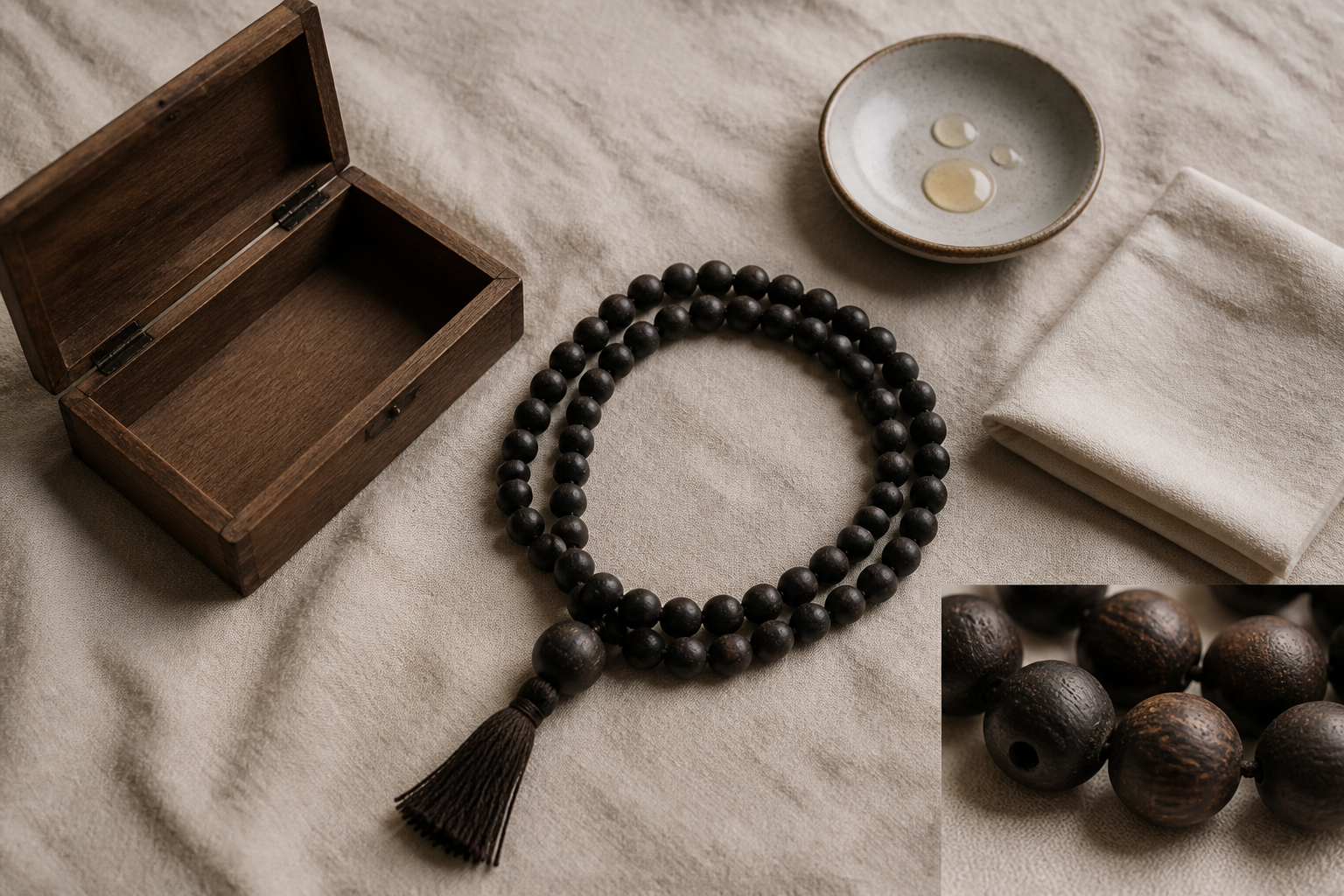
Karungali is a regional name rather than a complete verification of botanical identity. Dark colour alone cannot authenticate the material. When buying, ask the seller to identify the wood and explain its sourcing. Ethical sourcing matters because a contemplative object should not separate spiritual intention from responsibility toward nature and craft.
- Count the beads yourself. Confirm whether you are buying a 108- or 54-bead mala rather than relying only on the listing.
- Assess the material. Ebony and closely related dark hardwoods should feel dense, smooth, and moderately heavy for wood, although touch alone is not conclusive authentication.
- Inspect the finish. Look for a consistent surface that will not scratch the fingers or interrupt movement.
- Move several beads. They should advance freely rather than catch on one another or bind against the cord.
- Check the cord. It should feel durable and comfortable under the actual grip you will use for japa.
- Ask about origin. Prefer a seller who can answer basic questions about material, craft, and sourcing without relying entirely on spiritual claims.
Consecration can be quiet
You do not need an elaborate ceremony before beginning. Place the mala on a clean cloth, sit near a lamp, incense, or a sacred text if that belongs to your practice, and offer a brief expression of gratitude. Then begin the mantra. The essential act is setting the mala apart for sincere use.
Protect the cord and finish
- Keep the mala dry and do not soak it.
- Avoid harsh chemical cleaners that may affect the wood or cord.
- Do not leave it in prolonged direct sunlight.
- Store it in a gomukhi bag or a clean cloth pouch reserved for spiritual items.
- If the wood needs refreshing, apply natural oil very sparingly and allow it to absorb fully before using the mala again.
- If daily wear repeatedly exposes the mala to water or rough handling, keep a separate practice mala dry and protected.
Regular handling may gradually give the beads a natural sheen. That change is not damage by itself; it can simply reflect steady use. Examine the cord as well as the wood, because a beautiful set of beads is not useful if the string repeatedly catches or is close to failing.
Key takeaways
- Karungali’s grounding and protective qualities are traditional associations, not guaranteed effects.
- Use one mantra per bead, with gentle breathing and a consistent handling method.
- A 108-bead mala supports a full count; a 54-bead mala provides a half-mala count.
- Judge usefulness through a 21- or 40-day record of adherence, focus, mood, and physical friction.
- Verify count and workmanship, seek ethical sourcing, keep the wood dry, and store it in a dedicated pouch.
For your next session, choose one mantra and one intended round. Put the mala in your hand, move only after each recitation is complete, and write one line afterward about attention and completion. Continue for the observation window you selected. If the beads keep helping you return, the mala has earned its place in your sadhana through use rather than reputation.
References
