
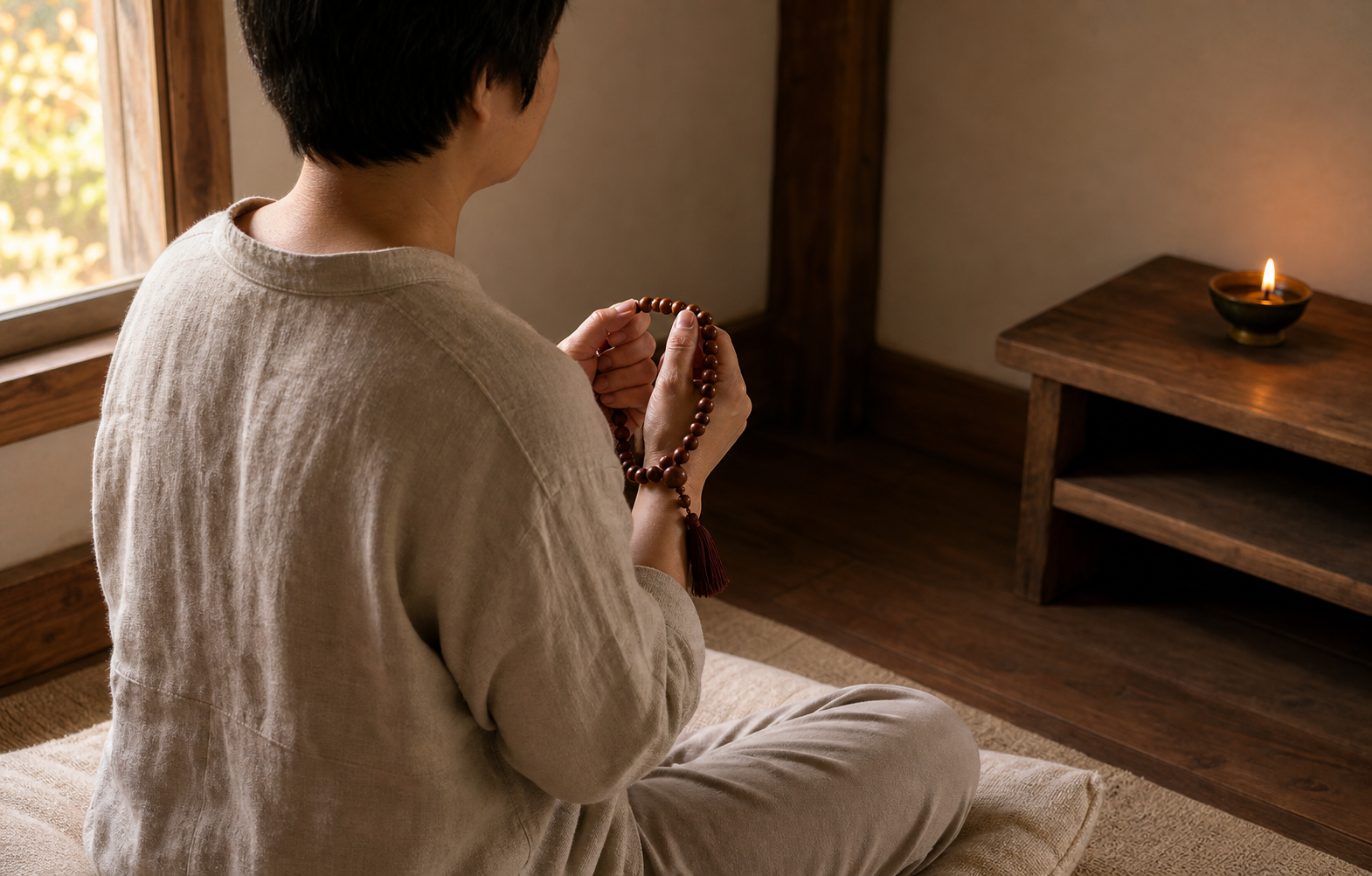
Your first mala can make a simple practice look complicated. There are 108 beads, a larger guru bead, several ways to hold the strand, and conflicting advice about voice, speed, timing, breath, and bead material. If you are wondering whether you can begin without getting every detail perfect, you can.
Choose one mantra appropriate to your tradition and level of instruction. Complete one unhurried round at a consistent daily time. Protect the quality of your attention more carefully than the size of your count. The method below gives you enough structure to begin respectfully without turning japa into either a shopping exercise or a spiritual performance.
What changes when sacred sound becomes a practice
Japa is deliberate repetition of a mantra or Divine Name. A mala gives that repetition a tactile rhythm and a definite boundary. With every bead, touch, speech, hearing, memory, and intention are invited into the same act. That is why the beads can steady attention even though they do not create devotion by themselves.
A mantra is not merely a positive sentence repeated until you believe it. Its meaning comes from a sacred tradition, and its use joins sound to remembrance, contemplation, refuge, praise, purification, or devotion. The Yoga Sutra I.27-I.29 joins the japa of Om to contemplation of its meaning, while the Bhagavad Gita 10.25 presents japa as a foremost sacrificial act. Attention to meaning is therefore not an optional decoration added after the sound. It protects repetition from becoming vacant.
In many Vaishnava schools, sacred sound carries an even stronger theological claim: the Divine Name does not function only as a sign pointing toward Krishna. Through nama-nami abheda, the Name and the Named are understood as non-different in potency. Hearing or repeating the Name is thus a form of association, not merely a reminder of an absent person. The broader idea of shabda-brahman places sacred sound within reality itself rather than treating it as a human label pasted onto reality.
This insight appears in distinct forms across Dharmic traditions, but those forms should not be flattened into one interchangeable theory. Sikh practice reveres Shabad as Guru and cultivates Naam simran, frequently without any need for a mala. Buddhist communities recite mantras, dharanis, and paritta within their own frameworks of refuge, compassion, protection, and awakening. Jain practice gives a central place to the Navkar Mantra, which honors spiritually perfected beings rather than petitioning a creator deity. These practices share confidence in the formative power of disciplined sound while preserving different accounts of what the sound reveals and how it acts.
Before selecting a count, ask three questions:
- What reality, deity, quality, refuge, or awakened state does this mantra direct you toward?
- What does the mantra mean within the tradition that preserves it?
- Do you know its pronunciation and method well enough to repeat it without continual uncertainty?
If you cannot yet answer those questions, seek instruction from a teacher or trusted community in that tradition. Collecting unfamiliar mantras from unrelated lineages may feel expansive, but it prevents any one practice from becoming deep enough to shape memory and conduct.
Choose one mantra and a mala you can actually use
Let tradition narrow the mantra choice
If your family, guru, sampradaya, or sangha has already given you a practice, begin there. Familiarity is not a weakness. A mantra that links you to living teaching, worship, and ethical discipline has more context than a phrase chosen only because it promises a dramatic result.
Hindu practitioners may encounter Om, the Gayatri Mantra, Om Namah Shivaya, the Hare Krishna Mahamantra, and many other nama or bija mantras. Buddhists may practice Om Mani Padme Hum or Namo Amitabha. Jains may recite the Navkar Mantra. Sikhs may repeat Waheguru in Naam simran. These are not competing products with interchangeable benefits. Each belongs to a particular understanding of the path.
If you are beginning without an inherited practice, choose a well-established mantra whose meaning you understand and whose form is appropriate for open recitation. Mantras associated with specialized initiation, ritual procedures, or tightly defined lineage instructions should be learned within that setting. The useful question is not which mantra is most powerful in the abstract. It is which mantra you can repeat faithfully, understand honestly, and integrate with the life it asks you to live.
Read the mala’s structure before judging its appearance
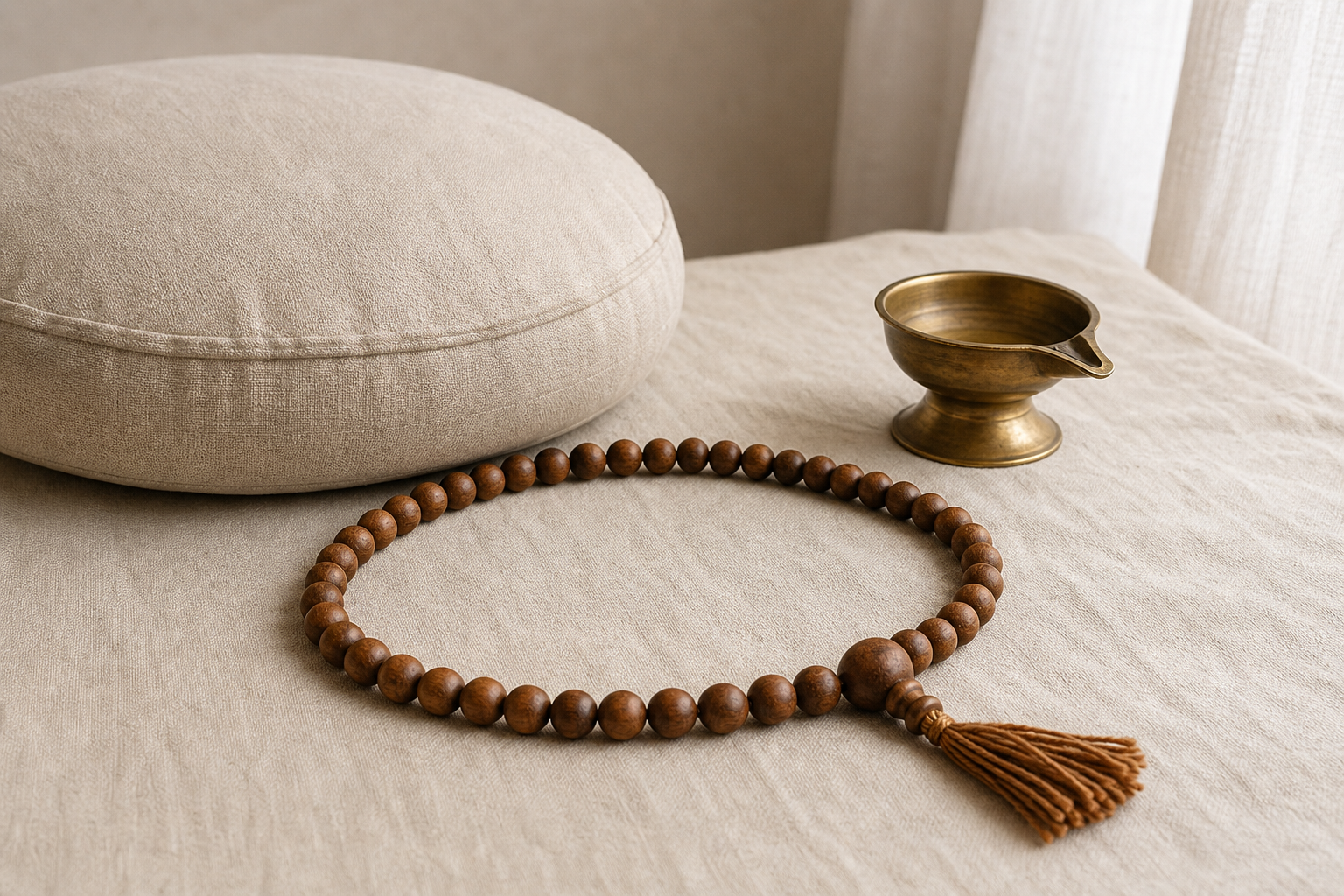
A common full mala contains 108 counting beads and one larger meru or guru bead. One circuit of the counting beads gives you a complete round. When you return to the meru, you turn the strand and reverse direction rather than crossing over it. The gesture makes the guru or Divine orientation the summit of the round, not another object to be passed over.
The number 108 has several traditional interpretations. It has been related to 27 lunar mansions with four padas each, 12 Adityas multiplied by nine grahas, 108 nadis associated with the heart, and the conventional number of major Upanishads. You do not have to choose one explanation before you can practice. For daily japa, the most immediate value of 108 is practical: the strand supplies a complete unit without requiring mental arithmetic.
Material can express lineage and devotional relationship:
- Tulsi is especially associated with Vaishnava bhakti.
- Rudraksha is strongly associated with Shaiva practice and is traditionally linked with steadiness and protection.
- Sandalwood offers a smooth, cooling feel and is used across several forms of practice.
- Crystal, or sphatik, is valued for clarity and relative neutrality.
- Lotus seed recalls purity arising within the conditions of the world.
- Bodhi seed and other regional materials appear in Buddhist malas, while Jain practitioners commonly favor materials consistent with ahimsa.
Choose lineage first, comfortable handling second, and ornament last. Beads should move cleanly without cutting the fingers, catching the skin, or demanding visual attention. Knots between beads improve spacing, help preserve the count, and limit damage if the cord breaks. A beautiful strand that is too fragile or distracting for daily use is not the better practice tool.
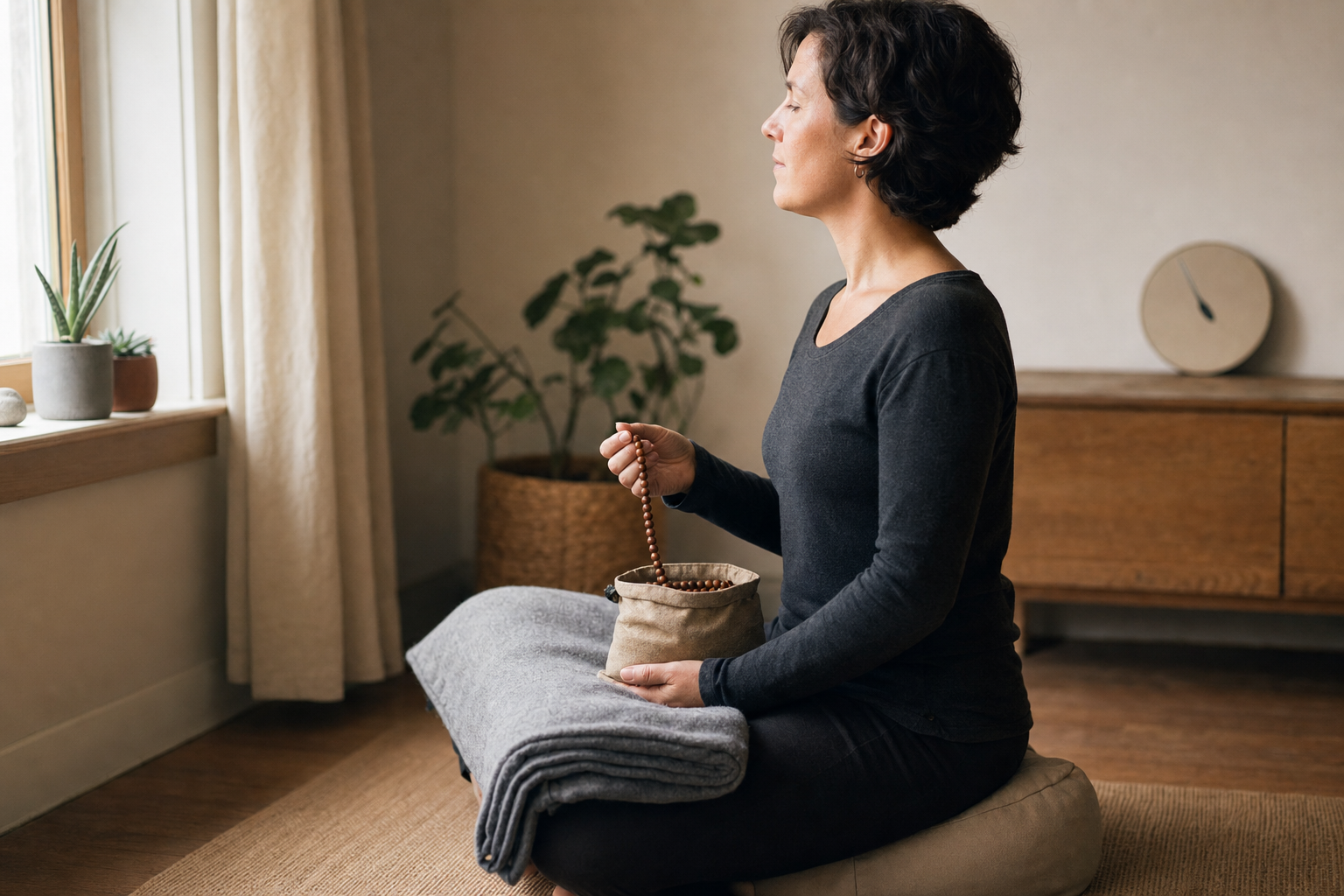
A japa bag, often called a gomukhi, can keep the mala clean and reduce visual distraction. When the mala is not in use, store it respectfully rather than dropping it on the floor or carrying it casually into unclean spaces. Avoid treating a dedicated japa mala as display jewelry. Wooden beads may occasionally need a trace of suitable natural oil, while seeds and crystal should be protected from harsh chemicals and prolonged moisture.
Complete one round without forcing breath or speed
A good routine removes decisions after you sit down. Use the same basic sequence until it becomes familiar:
- Keep a consistent daily place and time. Brahma muhurta is traditionally valued, and a quiet evening can also work. Consistency matters more than repeatedly postponing practice until ideal conditions appear. Sit on a clean, dedicated seat if possible.
- Settle the body without making posture the main event. Keep the spine naturally upright, relax the face and shoulders, and soften or close the eyes. The posture should support alertness without creating strain.
- State a concise sankalpa. Name the mantra and the round you are about to complete. Let the intention concern remembrance, devotion, clarity, or refuge rather than a display of achievement.
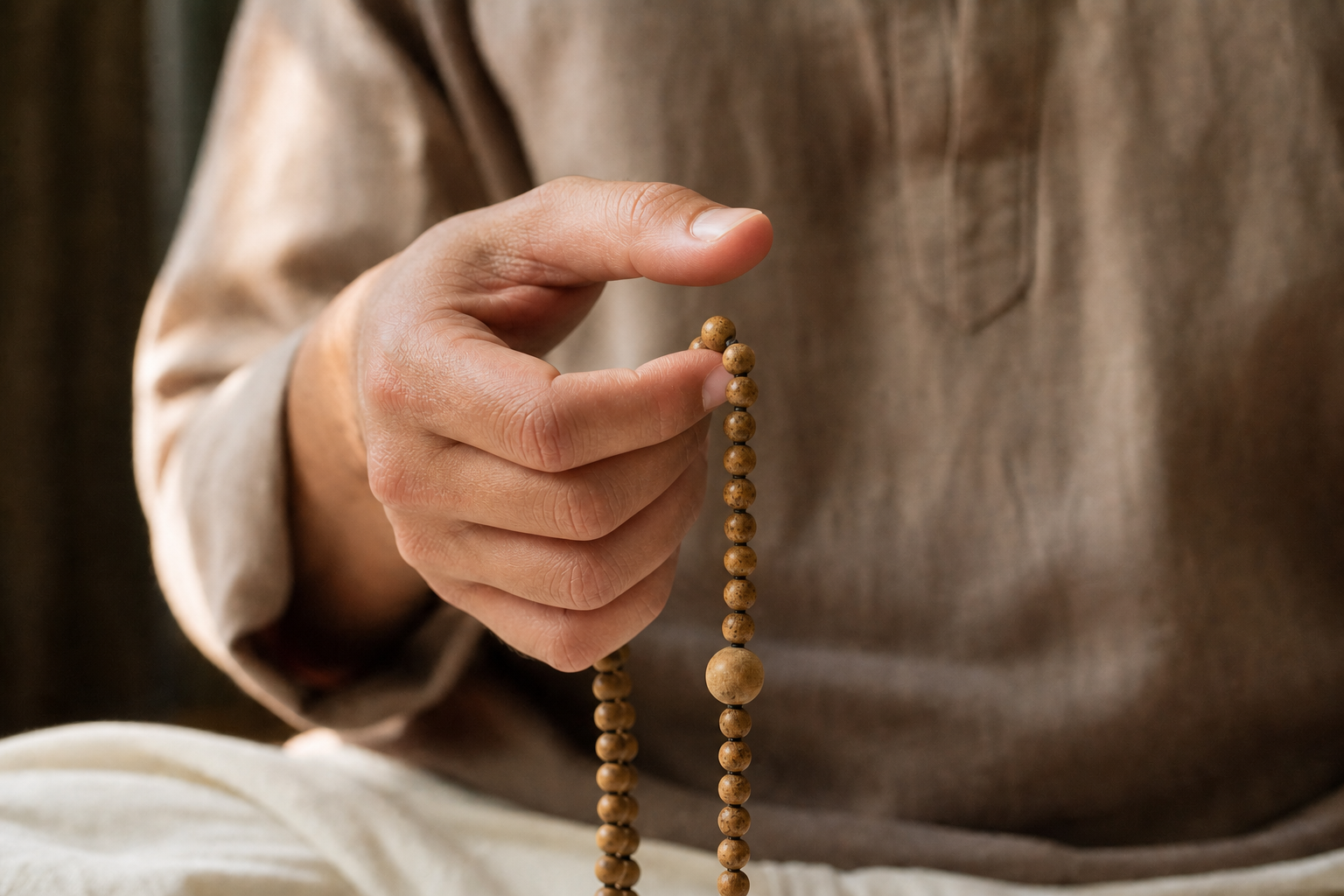
- Begin beside the guru bead. Start with the first counting bead after the meru. In many Hindu lineages, the mala is held in the right hand, the thumb draws each bead toward the practitioner over the middle or ring finger, and the index finger is kept apart. Follow your own lineage when its convention differs.
- Give one complete recitation to each bead. Hear the sound you are producing, or attend clearly to the mental form if practicing silently. Move the bead only when the mantra is complete. Do not race to keep up with the fingers.
- Let breathing remain natural. You may allow a short mantra to rest gently on an exhalation or relaxed breath cycle, but do not squeeze a long mantra into a breath that cannot hold it comfortably. Do not force breath retention without qualified instruction.
- Turn at the meru. After the final counting bead, do not cross the guru bead. Rotate the mala, reverse direction, and continue only if you have deliberately chosen another round.
- Close before reaching for the phone. Sit briefly in silence, offer gratitude or dedication, and notice the condition of the mind. A short note about steadiness, agitation, clarity, or emotional tone can reveal patterns over weeks without turning the practice into a scorecard.
One round practiced attentively is a sound beginning. Additional rounds can be added when your time, instruction, and capacity support them. Traditional purashcharana disciplines may prescribe large counts related to a mantra, but those commitments belong within their full ritual and ethical context. A large total is not evidence of transformed attention, compassion, or character.
There are three common modes of recitation. Vachika japa is audible and gives a beginner clear rhythm and auditory feedback. Upamshu japa is whispered or barely voiced, drawing attention inward while preserving a trace of sound. Manasa japa is entirely mental and requires finer concentration. Silent practice is not automatically superior if the mantra disappears into daydreaming. Use the mode that keeps the sound-current distinct, then allow practice to become subtler as attention genuinely matures.
Diagnose friction before you abandon the practice
Most difficulties in japa do not require a new mantra or a more expensive mala. They require a smaller correction at the point where attention is being lost.
| What you notice | What may be happening | What to change next |
|---|---|---|
| The mind races while the mantra becomes indistinct | Mental recitation may be too subtle for your present level of attention, or the pace may be too fast | Return to audible vachika japa, articulate every recitation, and slow the bead movement |
| The mouth continues but the meaning vanishes | The count has replaced remembrance | Pause at the end of the round, recall the mantra’s meaning and relationship, and begin again only with renewed intention |
| You become fatigued or drowsy | The voice, posture, or pace is no longer supporting alertness | Sit more steadily, use audible recitation, and adopt a softer pace rather than pushing through mechanically |
| The number creates pressure | Completion has become a test of worth | Alternate count-based sessions with a simple timed period, while keeping attention and sincerity as the measure of practice |
| The beads catch, clatter, or dominate attention | The tool is creating more sensory friction than rhythm | Use a smoothly finished, securely knotted mala that fits the hand comfortably |
| Breathing feels compressed | You are forcing the mantra to match a breath pattern | Uncouple mantra and breath immediately, breathe naturally, and restore a pace that does not strain the body |
| You feel proud of the count but harsher with people | Repetition is not reaching conduct | Reconnect japa with ahimsa, truthfulness, contentment, generosity, and service |
The mala works as a modest but sophisticated attention aid. Moving a bead provides a recurring tactile cue. Audible or subvocal repetition supplies a stable sound pattern. Rhythm gives wandering attention a place to return. A limited body of meditation research associates repetitive contemplative practices with improved attentional control, emotional regulation, and stress reduction. Work involving paced recitation and neuroimaging has also reported changes associated with vagal regulation and reduced activity in networks linked with self-referential mind-wandering.
Those findings can help explain why the form supports concentration, but they do not prove a tradition’s metaphysical claims. Nor does japa replace medical or psychological care. If you are dealing with persistent distress, serious symptoms, or impaired daily functioning, use appropriate professional support rather than treating mantra as a substitute. Sacred practice and clinical care answer different needs and can be approached without confusing one for the other.
The more searching test is ethical. After regular practice, do you interrupt anger sooner? Is speech becoming more truthful and less injurious? Does remembrance return during ordinary work, conflict, and service? Dharmic disciplines place non-harming, self-restraint, contentment, discipline, compassion, and generosity around contemplative practice because a divided life continually scatters the attention that japa gathers.
Key takeaways for a durable japa practice
- Begin with one mantra that you understand and can practice with integrity inside its tradition.
- Use a comfortable, ethically sourced mala suited to the lineage; a common full mala has 108 counting beads plus a guru bead.
- Start beside the guru bead, recite once per bead, and reverse direction when you return to the meru.
- Choose audible, whispered, or mental japa according to what keeps attention clear, not according to a hierarchy you are trying to climb.
- Coordinate sound and breath only gently. Never compress the breath or force retention to finish a recitation.
- Judge progress by steadier remembrance and better conduct, not by speed, unusual sensations, or an impressive count.
At your next quiet daily slot, use the mantra and mala you already have, complete one attentive round, and stop cleanly. Keep that appointment across the coming weeks before adding another mantra, purchasing another strand, or increasing the count. Depth begins when returning to the same sacred sound is no longer a fresh decision every day.
References
- DharmaRenaissance Blog – Japa Mala’s Sacred Power: Practice, Science, and Dharmic Unity to Cultivate Focus and Peace
- DharmaRenaissance Blog – Omnipotence and Sacred Sound: Why Krishna’s Words Remain a Living Presence Across Traditions