

You may know the stories of Prahlada, Dhruva, Gajendra, and Bali, yet still wonder what they ask of you when you are insulted, frightened, attached, or entrusted with power. The difficulty is rarely a lack of inspiration. It is learning to read a sacred narrative as a diagnosis of your own choices.
Bhagavata narratives become practical when you follow the movement from pressure to remembrance, and from remembrance to dharmic conduct. Their distinctive strength is the integration of bhakti, spiritual insight, and righteous action. Devotion changes what rules the heart; dharma reveals what that change should look like in the world.
The question every Bhagavata story asks under pressure

The Bhagavata Purana unfolds across twelve Skandhas, but its framing gives the whole work unusual urgency. King Parikshit learns that he has seven days to live. He relinquishes royal comfort, sits beside the Ganga, and listens to Shuka while asking what a person should hear, remember, and do in the face of death. Mortality turns listening from entertainment into sadhana.
You do not have to wait for a final crisis to adopt Parikshit’s seriousness. Every lesser crisis reveals the same basic fact: something already governs your attention. It may be resentment, status, fear, appetite, duty, or remembrance of the Divine. The stories help you identify that ruler before it becomes your next action.
Bhakti, jnana, and dharma perform different but connected work. Bhakti reorders love and loyalty. Jnana exposes mistaken identity and attachment. Dharma gives the transformed heart a truthful form in conduct. Remove any one of the three and the reading becomes distorted: emotion without discernment, analysis without surrender, or rule-following without inward renewal.
- What holds the character’s attention? Look beneath the visible conflict for fear, pride, attachment, compassion, or remembrance.
- What breaks the character’s self-deception? It may be instruction, suffering, disciplined practice, grace, or the failure of worldly strength.
- What changes after the encounter? Look for a different ambition, a repaired relationship, restrained power, truthful speech, or surrender of something the ego wanted to keep.
Vyasa’s dissatisfaction offers an early example. Accomplishment does not cure his inner incompleteness; Narada directs him toward the glories of Krishna and a form of teaching centered on devotion. The practical warning is sharp: when achievement leaves you restless, producing more of the same may deepen the problem. First ask whether the work serves love, clarity, and liberation, or merely enlarges the identity built around being accomplished.
Kapila’s teaching to Devahuti supplies the complementary discipline. Analysis of prakriti and purusha is joined to meditation, mental purity, and bhakti. If you are naturally devotional, examine the attachment hidden inside your emotion. If you are naturally analytical, ask whether your insight has made you more compassionate and less governed by ego. In either case, understanding must become visible in how you treat another being.
After reading an episode, do not stop at “That was beautiful.” Write down the pressure, the attachment it exposed, and the next dharmic act. If you cannot name the act, remain with the story. You may have understood its plot without yet receiving its instruction.
Grace interrupts the fall, but it does not excuse it

Several beloved Bhagavata narratives begin with motives that are wounded, compromised, or desperate. This is important. Bhakti is not reserved for people who arrive with perfectly purified intentions. It can receive an imperfect beginning and redirect it. The evidence of grace, however, is transformation rather than permission to remain unchanged.
Dhruva: let discipline purify the goal
Dhruva begins from humiliation and seeks an unsurpassed position. His tapas is unwavering, but the decisive change is not simply that effort wins a reward. The encounter with Vishnu redirects wounded ambition toward devotion, and Dhruva becomes associated with the steadfast pole star.
If hurt is driving your ambition, do not disguise it with spiritual language. Name the injury and the recognition you want. Then place that desire under a discipline that does not feed resentment. Work, pray, and keep your commitments, but allow the goal itself to be corrected. Dhruva’s steadiness is worth imitating; his initial hunger for status is the material to be transformed, not the final ideal.
Gajendra: surrender begins with an accurate limit
Gajendra struggles against a crocodile before his strength is exhausted and his prayer becomes complete. His cry receives an immediate divine response. The lesson is not that practical effort is useless. It is that effort becomes delusion when you refuse to acknowledge what strength, wealth, expertise, or control cannot accomplish.
When you feel trapped, separate what remains yours to do from what you cannot command. Take the responsible action that is still available. Ask for human help where pride has delayed it. Offer the uncontrollable remainder to the Divine without bargaining. Surrender becomes clear when it removes pretence, not responsibility.
Ajamila: remembrance must lead to reform
At death, Ajamila calls for his son Narayana and thereby utters the divine Name. Vishnu’s messengers intervene, revealing the extraordinary accessibility of nama-smarana. Yet the power of the Name is joined to ethical renewal; grace is not a technique for keeping vice while escaping its consequences.
You can apply this before the dramatic final moment. Bring the Name you already revere into the instant between impulse and action: before sending the angry message, repeating the lie, indulging the harmful habit, or protecting your pride. Once remembrance has interrupted the pattern, repair what the pattern damaged. If spiritual practice makes accountability feel less necessary, the ego has turned grace into an alibi.
| Narrative | Pressure revealed | Devotional turn | Your practical test |
|---|---|---|---|
| Dhruva | Humiliation and the desire for status | Tapas culminates in a transformed ambition | Can discipline purify what hurt made you want? |
| Gajendra | Strength fails in a life-threatening struggle | Unreserved surrender and prayer | Can you distinguish responsible effort from imagined control? |
| Ajamila | A compromised life reaches its final crisis | The divine Name interrupts the fall | Does remembrance produce reform and repair? |
| Prahlada | Persecution by worldly authority | Steady devotion, fearlessness, and goodwill | Can you resist wrongdoing without becoming inwardly shaped by it? |
| Vritrasura | An outwardly adversarial role conceals inner depth | Devotion becomes luminous at death | Can you judge character by its fruits rather than its label? |
Prahlada and Vritrasura correct two further mistakes. Prahlada shows that devotion can remain fearless under persecution without surrendering humility or goodwill. His example does not require you to remain exposed to preventable harm; it requires you not to let an oppressor determine your inner allegiance. Vritrasura, meanwhile, appears as an adversary yet speaks with profound devotion. Outer role, social label, and spiritual condition do not always align.
This gives you a reliable test when appearances are confusing. Look for the fruits of orientation: truthfulness, humility, compassion, steadiness, and restraint. Do not call someone righteous merely because the person occupies the expected camp, and do not assume the Divine is absent from someone whose outward role unsettles your categories.
Dharma measures power by the limits placed upon it
Bhagavata devotion is not confined to private feeling. It governs land, wealth, promises, punishment, and authority. The question is not merely whether power achieves an intended result. Dharma asks what power protects, what restrains it, who bears its cost, and whether its holder can relinquish it.
King Prithu embodies responsible rulership by stabilizing the earth and drawing forth prosperity without separating abundance from reverence for nature. His example turns an ecological principle into a governance test. If you control a budget, institution, household resource, team, or piece of land, ask what has been entrusted to you, what is being depleted, and who receives the benefits. Extraction may look efficient while merely transferring the cost to the vulnerable or to the future.
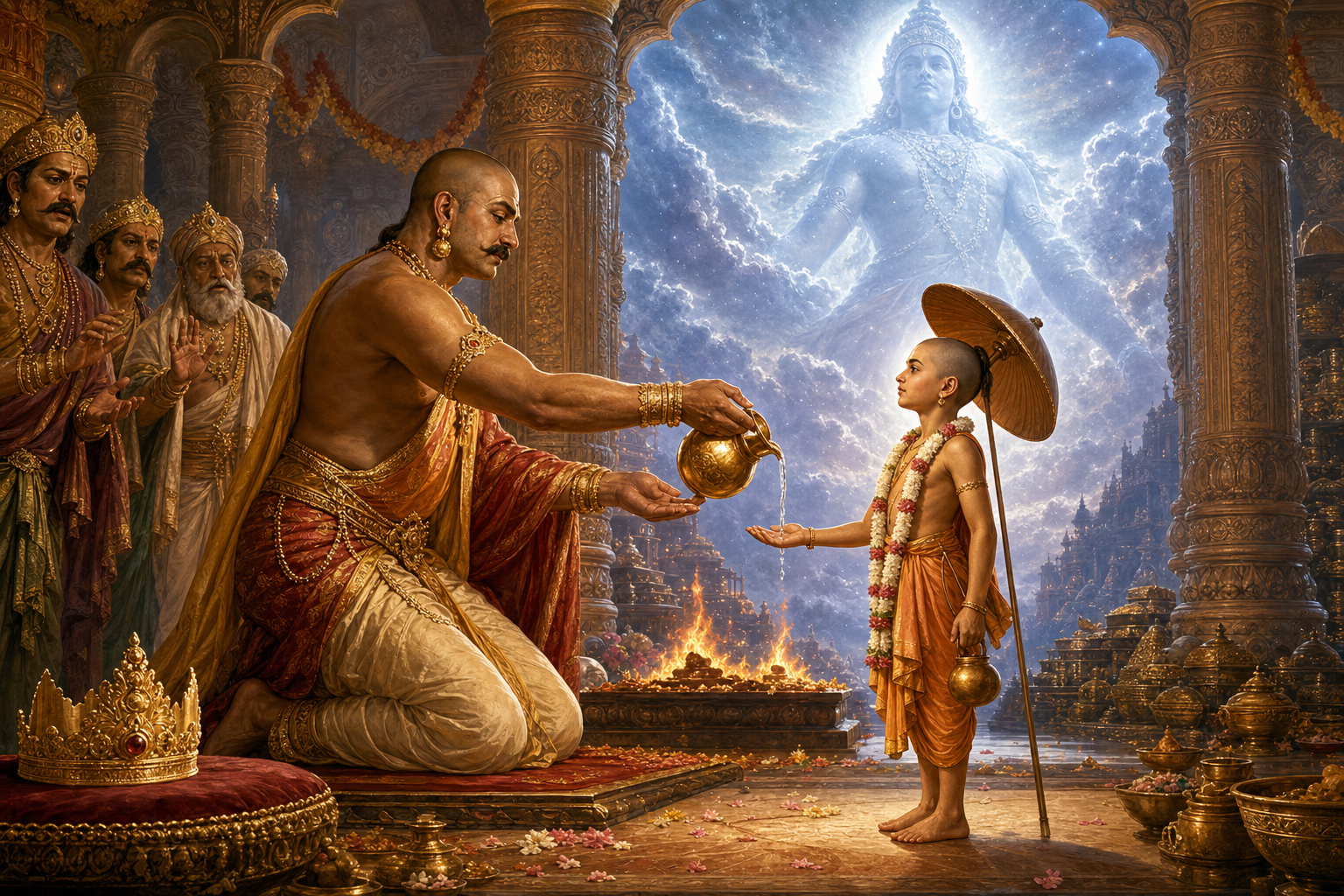
Mahabali is tested through a promise. Vamana asks for three steps of land, expands to encompass the cosmos, and reveals the depth of Bali’s commitment to truthfulness and surrender. The practical point is not that every request must be granted without discernment. It is that a promise becomes spiritually serious precisely when keeping it threatens possession, prestige, or control. Before giving your word, examine the obligation carefully. After giving it, do not treat inconvenience as proof that the obligation has vanished.
Ambarisha reveals another kind of strength. When Durvasa reacts with destructive anger, divine protection does not turn the king vindictive. Ambarisha waits, remains disciplined, and offers respect. Forbearance here is not passivity. It is the refusal to convert being protected into a license for humiliation or revenge. You can pursue accountability and maintain a boundary without feeding the appetite to make another person suffer.
Parashurama presents the most severe test of interpretation. His campaigns arise in a setting where royal and military authority has become predatory and Jamadagni has been murdered. Read carelessly, the violence can be detached from its ethical restraints and turned into a slogan for vengeance. Read within its full sequence, corrective strength is followed by expiation, the transfer of sovereignty to Kashyapa, and withdrawal to Mahendra Parvat for tapas. The decisive sign is that power remains answerable to dharma and relinquishes what it has no right to keep.
This is not permission to direct hostility at a varna, community, or inherited identity. The moral target is abusive power. Parashurama’s fierceness is bounded by purpose, penance, non-possession, and an end point. Once order is restored, domination cannot be renamed duty and prolonged for the victor’s benefit.
- Name the entrusted good. State exactly what you are responsible for protecting: a person, process, promise, resource, institution, or boundary.
- Identify the breach precisely. Describe the harmful conduct without turning an entire identity or group into the enemy.
- Separate correction from appetite. Ask whether your proposed response protects the good or mainly satisfies anger, pride, or the desire to be seen winning.
- Set the stopping condition before acting. Decide what restoration would look like. If you cannot say when the intervention ends, ambition may already have exceeded duty.
- Accept review and repair. Corrective action does not make you infallible. Be prepared to account for excess, repair avoidable harm, and submit your decision to wiser judgment.
- Return what is not yours. Relinquish emergency authority, attention, territory, or control when the purpose has been fulfilled.
The same self-limiting ethic can be recognized, without erasing doctrinal differences, in Buddhist compassion, Jain insistence on ahimsa, and the Sikh union of devotion, service, and protective courage. These resonances matter because they prevent strength and non-violence from becoming empty opposites. Dharmic restraint asks you to protect without hatred, act without possession, and seek a peace that does not abandon the vulnerable.
A seven-day practice for reading the stories into your life

Parikshit’s seven-day horizon can become a simple household discipline. The schedule below is a modern reading practice, not a claim that the episodes must be approached in this order. Read or retell the named narrative each day, sit with the question, and complete the action before moving on.
- Parikshit: recover urgency. Ask what you would stop postponing if you could no longer assume abundant time. Set down one needless distraction for the rest of the practice and give that attention to listening, prayer, or an unfulfilled duty.
- Dhruva: expose wounded ambition. Complete the sentence, “I want this because this hurt.” Do one disciplined action toward the legitimate part of your goal without seeking recognition or rehearsing the insult.
- Ajamila: place the Name before the habit. Use the divine Name you already honor at the moment a recurring harmful impulse appears. After the pause, make one repair connected to that pattern rather than treating remembrance as the end of the work.
- Gajendra: identify the real limit. Write what remains within your influence and what does not. Act on the first, seek appropriate help where it is needed, and offer the second without pretending that anxiety is control.
- Ambarisha: practise non-retaliatory strength. Identify an offence you keep mentally replaying. Fulfil the duty or boundary the situation actually requires, but refrain from the extra word or act whose only purpose would be to wound. Forbearance does not require silence when safety or accountability is at stake.
- Prithu and Parashurama: audit your power. Choose one relationship in which you approve, allocate, teach, discipline, withhold, or decide. State what the authority is for, what limits it, and when it should return to another person or to the normal process.
- Govardhan: protect what sustains the community. Krishna redirects attention toward Govardhan Hill and shelters the community when the storm comes. Make one concrete act of reverence toward your shared support system: conserve a resource, reduce avoidable waste, honor overlooked labor, or help the person carrying a common burden. End by stating the duty you will carry into your next ordinary decision.
This method prevents two common failures. The first is consuming many stories without allowing any one of them to question you. The second is extracting an isolated moral while ignoring the narrative’s inner sequence. A Bhagavata episode is often about how a motive, identity, or use of power changes through contact with the Divine. Follow that change all the way to conduct.
Key takeaways
- Read each narrative by tracing pressure, attachment, remembrance, and the resulting action.
- Bhakti is not an escape from dharma; genuine remembrance should make truthfulness, compassion, and accountability more visible.
- Grace can receive a compromised beginning, but its fruit is reform rather than permission to continue the same harm.
- Do not judge spiritual character by outward role alone; examine humility, steadiness, truth, and restraint.
- Dharmic power protects a specific good, accepts limits, stops when restoration is achieved, and relinquishes control.
- Turn every reading into one named action, repair, boundary, surrender, or act of service.
Begin with the narrative that resembles your present pressure, not necessarily the one you find most comforting. At your next consequential choice, pause long enough to name what is ruling your attention. Remember the Divine, identify the duty that remains yours, and let the next act show whether the story has moved from memory into life.
References
- DharmaRenaissance Blog – 15 Timeless Tales from Srimad Bhagavatham: Devotion, Dharma, and Transformative Wisdom
- DharmaRenaissance Blog – Bhagavan Parashurama: Warrior-Sage Avatar of Vishnu Who Restored Dharma and Balance