
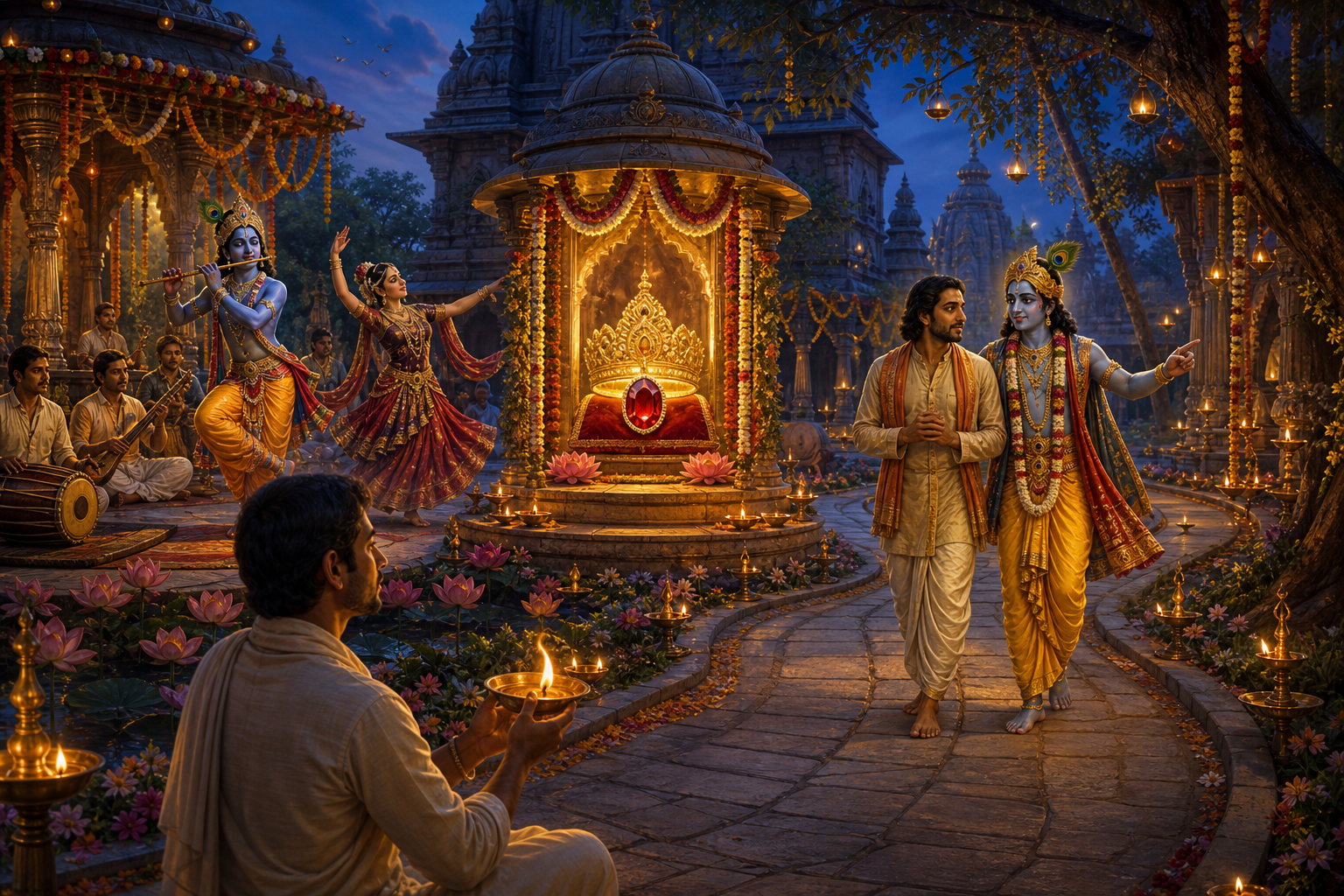
You may recognise Vishnu’s crown, enjoy Krishna’s leelas on stage, and revere the friendship at the heart of the Bhagavad Gita, yet still wonder how these belong to one devotional life. The connection becomes practical when you stop treating them as separate cultural objects.
Performance trains your attention. Sacred symbols train your judgement. Friendship with Krishna trains your response when duty becomes difficult. Bring the three together, and bhakti moves from admiration into conduct.
Begin with the obstacle in front of you
Vaishnava devotion does not depend on producing one particular emotion. Some days you need beauty to gather a scattered mind. At other times, you need an ethical test for a decision or the assurance that divine guidance is close enough to address honestly. Performance, symbolism, and friendship meet these different needs without fragmenting devotion.
- If your attention wanders during prayer, begin with Krishna-lila in a sacred performance. Gesture, music, costume, and story give the mind several ways to remain present.
- If you face responsibility without moral clarity, contemplate Vishnu’s Kirita Mukuta and Kaustubha. The crown directs you toward disciplined judgement; the jewel directs you toward compassion.
- If you feel paralysed by conflict, approach Krishna through sakha-bhava, the mood of sacred friendship embodied by Arjuna. Friendship makes room for perplexity, counsel, and responsible action.
- If devotion has become private and self-absorbed, return to a temple festival, devotional community, or act of service. Bhakti matures when it changes how you participate in the lives of others.
These are not ranks on a spiritual ladder. A person can understand iconography while avoiding a difficult duty, or enjoy a performance without allowing its dharma to enter daily life. Choose the doorway that addresses your present weakness, then carry its lesson into action.
Receive sacred performance as worship, not spectacle
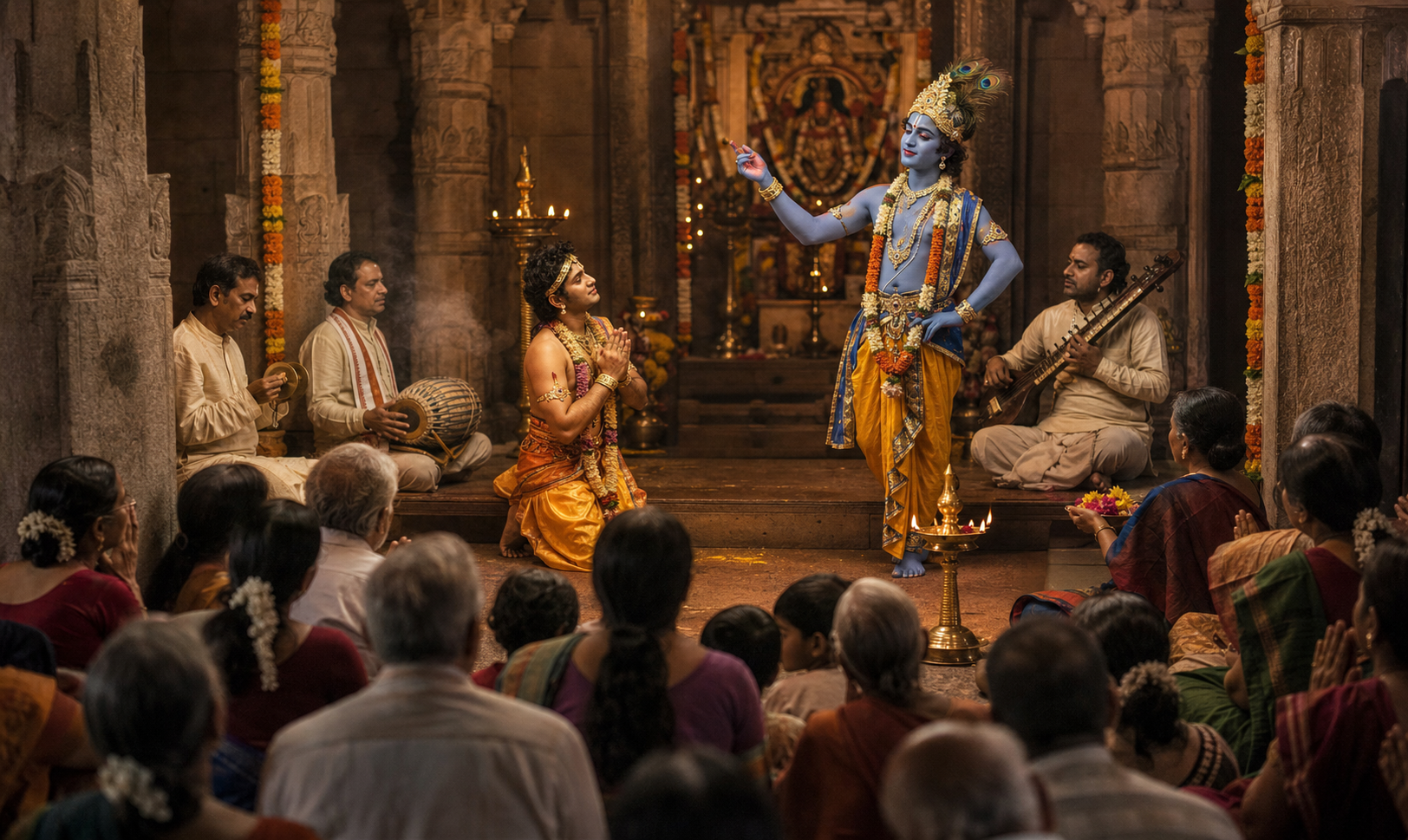
When Krishna’s leelas enter ritual theatre, the body becomes an interpreter of sacred memory. Meaning is carried not only by words but also by movement, rhythm, facial expression, costume, music, and the devotional concentration of the assembled community. The first discipline for a viewer is therefore simple: do not reduce the event to plot.
Bhagavata Mela shows how a village community can hold theology in living form. Centred especially around Melattur in the Thanjavur region of Tamil Nadu, it is tied to temple festivals and sustained by scholar-performers traditionally known as bhagavatars. Its Carnatic music, Sanskrit and Telugu compositions, expressive abhinaya, and codified dance passages allow devotion to be seen as well as heard.
Krishnattam places the same devotional purpose inside Kerala’s temple ecology. It crystallised at Guruvayur in the seventeenth century and is traditionally attributed to Manaveda, who composed the Krishnagiti cycle as an offering. Presented as temple service and as a votive offering, its extended sequence follows Krishna from birth through the major episodes of his sacred biography. Sopana-oriented music, Sanskrit verses, elaborate headgear, and colour-coded make-up create a visual and sonic language suited to that setting.
The regional differences matter. They preserve the integrity of each tradition and prevent Indian sacred art from being flattened into a generic devotional style. Yet both forms ask the viewer to do something deeper than consume a story: remain present while divine action, human choice, surrender, danger, and grace become visible.
How to make a performance part of your sadhana
- Enter with a question. Ask which quality you need to notice: courage, surrender, protection, loyalty, compassion, or fidelity to dharma. A question gives your attention a direction without forcing a predetermined answer.
- Read every channel. Notice movement, facial expression, music, costume, ritual setting, and the response of the community. If you follow only the dialogue, you miss much of what the form is designed to communicate.
- Follow the moral movement. When the language is unfamiliar, watch who serves, who protects, who resists rightful counsel, and who changes. This keeps the performance intelligible without pretending that every gesture has been mastered.
- Carry one quality home. Translate what you witnessed into a specific act of integrity, service, restraint, or compassion. The performance becomes devotional practice when its bhava survives beyond the stage.
Resist the urge to score the production immediately by modern entertainment standards. Technical excellence matters, but ritual theatre asks an additional question: did you become more attentive to divine presence and more capable of dharmic action? That question changes the way you watch.
Let Vishnu’s crown and jewel examine your decisions
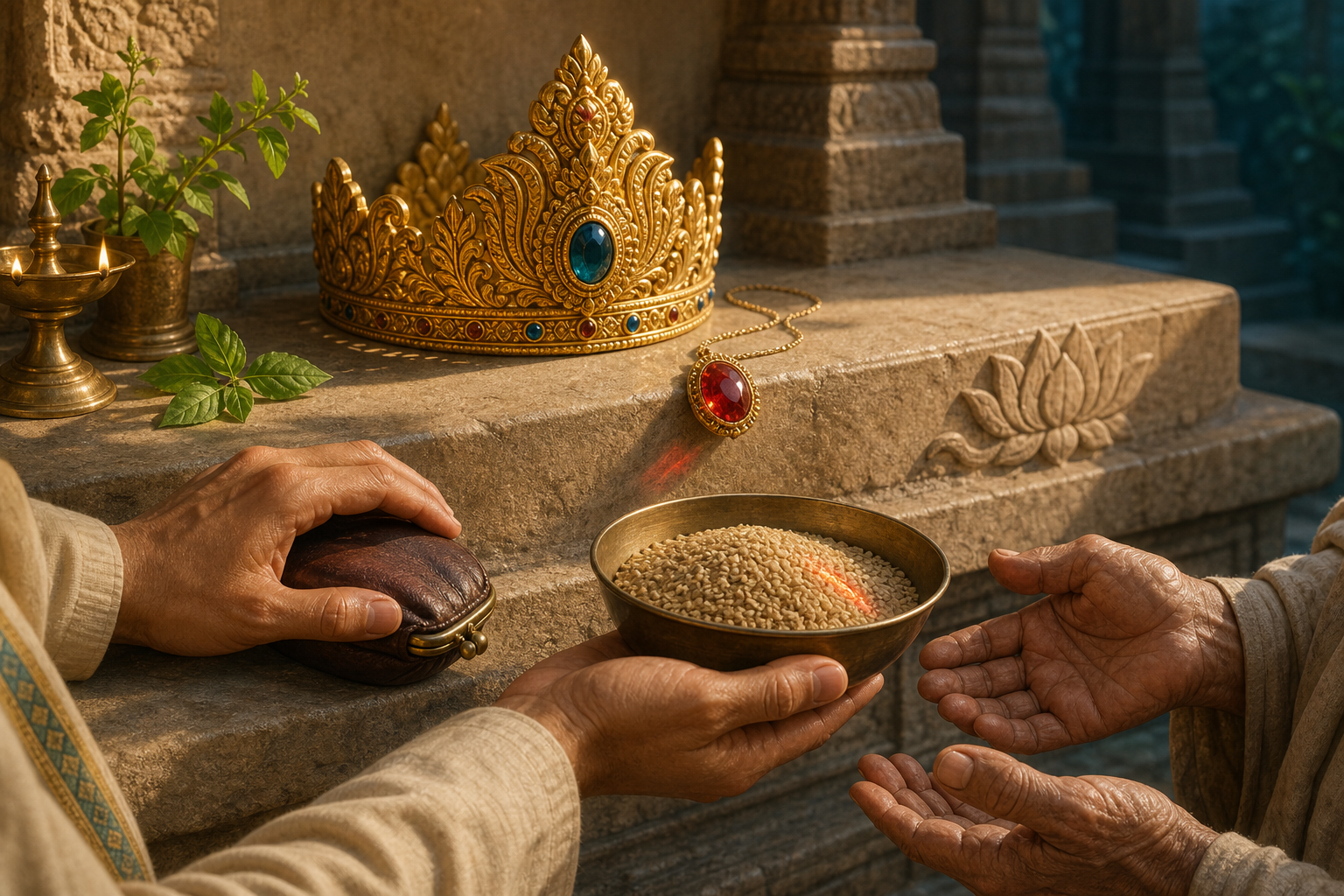
A sacred symbol is useful when it corrects perception. Vishnu’s Kirita Mukuta is not merely decorative shorthand for high status. Its theological force lies in sovereignty governed by dharma: power is legitimate when it protects order and is disciplined by self-mastery. The crown therefore asks you to examine how you use whatever authority you possess, including authority within a family, workplace, institution, or community.
The Kaustubha rests near Vishnu’s heart and is associated in Puranic narration with the Samudra Manthana, the churning of the ocean. It is often read as stainless purity, self-luminous consciousness, and compassionate presence. The location matters devotionally: the emblem of inward luminosity stands close to the heart of the Preserver.
Do not confuse the Kaustubha with the Shrivatsa. The Kaustubha is a jewel, while the Shrivatsa is a distinct sign or whorl on the chest. Learning that difference is more than iconographic housekeeping. It teaches you to look carefully rather than turning every sacred detail into an interchangeable token of auspiciousness.
Crown and jewel form a practical head-and-heart discipline. The Kirita tests clarity, responsibility, and restraint. The Kaustubha tests motive, empathy, and the human consequences of a choice. Use them together during darshan or whenever you must make a consequential decision:
- While attending to the crown, ask: What is my actual responsibility here, and which principle must govern it?
- While attending to the jewel, ask: Who will carry the cost of my choice, and what would compassionate presence require?
- Hold the answers together. Firmness that ignores suffering becomes harshness; sympathy that refuses judgement cannot reliably protect anyone.
- State your decision as a duty you are prepared to perform, not merely as an outcome you would like to obtain.
This contemplation also guards against a common distortion of devotion. Admiring divine kingship while excusing irresponsible human power misses the symbol’s point. Vishnu’s crown does not sanctify domination; it places authority under moral law. The heart-jewel then prevents moral law from becoming a cold abstraction.
Approach Krishna as the friend who guides action

Sakha-bhava brings divine closeness into moments when abstract belief is not enough. Arjuna does not meet Krishna as an impersonal principle. He meets him as friend and guide amid a crisis of duty. Their intimacy does not eliminate moral seriousness; it makes honest questioning possible within a relationship of trust.
The name Partha-sarathi captures the relationship with unusual force. Krishna becomes the charioteer of Partha, placing divine guidance in a role of active service while preserving Arjuna’s responsibility to choose and act. This cooperation between human effort, or purushartha, and divine compassion, or kripa rules out two evasions: self-sufficient pride and passive resignation.
When your own Kurukshetra is a conflict at home, a difficult obligation, or a choice between comfort and integrity, use the chariot image as a decision practice:
- Name the field. Describe the conflict plainly, without casting yourself automatically as the righteous party.
- Name your duty. Separate the responsibility attached to your role from the result you personally prefer.
- Inspect the reins. Identify the fear, attachment, resentment, or desire for approval that is pulling judgement away from dharma.
- Ask for counsel. Speak to Krishna directly and honestly. Friendship does not require polished language; it requires willingness to hear an answer that may demand courage.
- Act without making reward your master. Nishkama karma does not mean indifference to consequences. It means refusing to make personal gain the condition for doing what is right.
If your prayer asks Krishna to remove every demand for agency, return to the image of Partha-sarathi. The charioteer steadies and guides, but Arjuna still has to face his duty. Grace accompanies effort; it does not turn avoidance into surrender.
Divine friendship should also improve human friendship. Test your sakha-bhava by its social fruit. Are you more willing to listen, serve, offer truthful counsel, accept correction, and treat another person’s dignity as real? Empathy, service, fairness, and accountability are not secular additions to devotion. They are ways the inner relationship becomes visible.
Build a devotional rhythm that joins all three
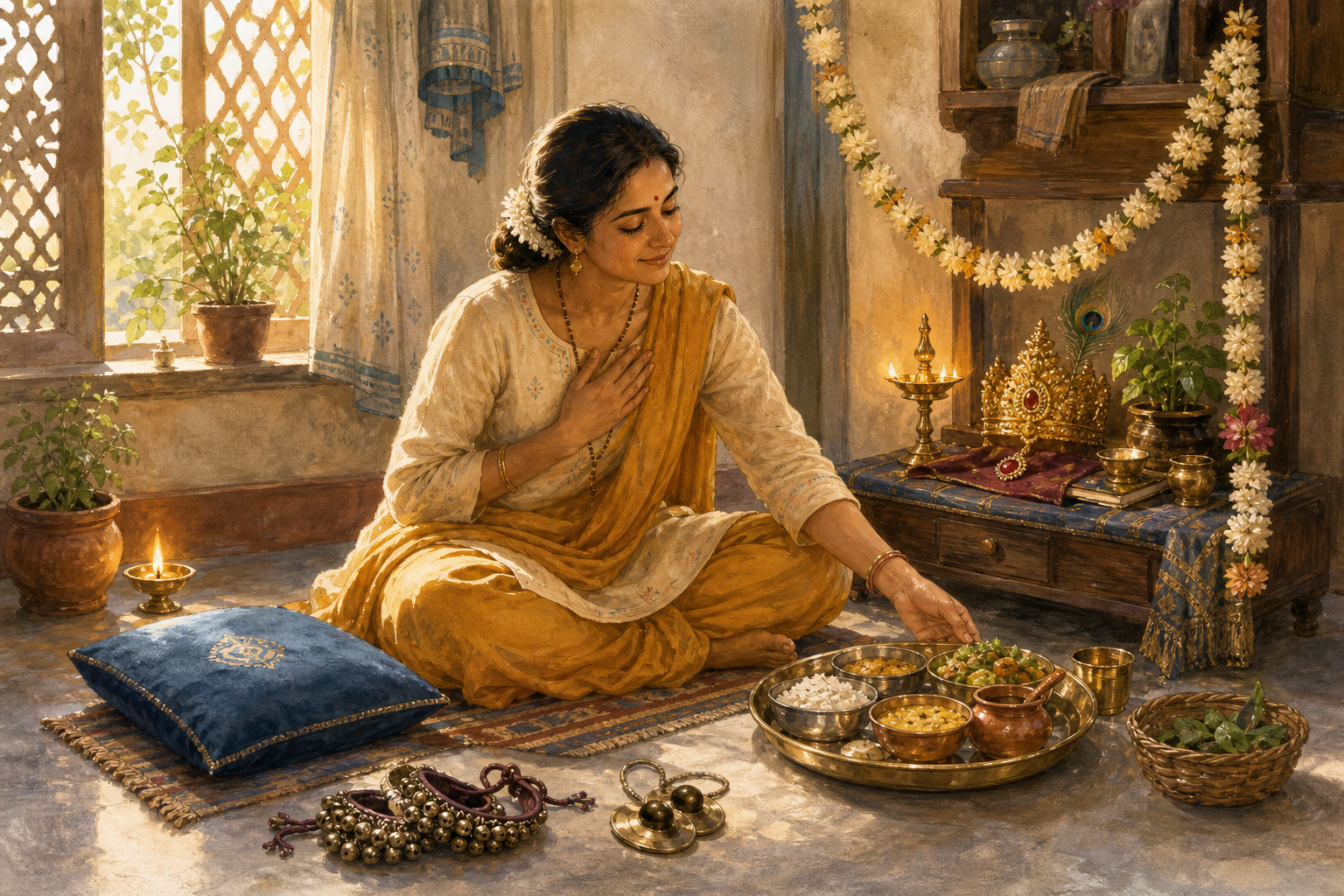
You do not need to force performance, symbolism, and friendship into every prayer session. Use them as a repeatable cycle. Witness a leela, contemplate a symbol, speak to Krishna as friend, and perform the duty that becomes clear. Then examine the result with honesty.
- Witness. Attend a sacred performance when possible, or read a Krishna episode with attention to action, relationship, and bhava. A reading at home does not reproduce a temple theatre’s ritual setting, so respect the distinction.
- Contemplate. Select a visible attribute of Vishnu and ask what it teaches about your present responsibility. With the Kirita and Kaustubha, keep clarity and compassion in the same field of attention.
- Converse. Address Krishna as trusted guide. State the dilemma, your motive, and the duty you are reluctant to accept.
- Enact. Convert devotion into a proportionate act: keep a promise, offer service, repair an avoidable wrong, make a fair decision, or exercise needed restraint.
- Review. Ask whether the action united clear judgement with care for others. If it did not, return to the crown and jewel rather than defending the choice merely because it was yours.
This rhythm can also strengthen respect across the dharmic family without erasing important distinctions. Buddhist maitri and karuna cultivate friendliness and compassion. Jain devotion is joined to ahimsa and self-discipline, while the Shrivatsa has its own place in Jina imagery. Sikh remembrance and seva connect spiritual life with service, and miri-piri holds temporal responsibility beside spiritual authority. These resonances do not make the traditions identical. They give Hindus, Buddhists, Jains, and Sikhs a serious vocabulary for discussing how inward discipline should shape outward conduct.
Key takeaways
- Do not wait for a devotional mood to appear. Choose the mode of practice that meets the obstacle you actually face.
- Watch sacred theatre for ethical movement as well as aesthetic beauty: who serves, protects, resists, surrenders, and changes?
- Use the Kirita Mukuta and Kaustubha as a joint test of disciplined clarity and compassionate motive.
- Let sakha-bhava make prayer honest, but do not use divine friendship to avoid responsibility.
- Measure the depth of devotion partly by its fruit in service, fairness, restraint, courage, and community life.
At your next darshan, performance, or difficult decision, choose the doorway that speaks most directly to your need. Watch Krishna’s leela with disciplined attention, let Vishnu’s insignia test your judgement, or speak plainly to Partha-sarathi before you act. Carry the answer into service. That is where cultural inheritance becomes sadhana and reverence begins to shape a life.
References
- DharmaRenaissance Blog — Complete Comparative Guide: Discover Bhagavata Mela vs Krishnattam and Their Unified Spirit
- DharmaRenaissance Blog — Discover the Complete Sacred Symbolism of Vishnu’s Kirita Mukuta and Kaustubha Gem
- Dandavats — Complete Guide to Divine Friendship: Arjuna-Krishna Insights to Transform Dharmic Unity
