
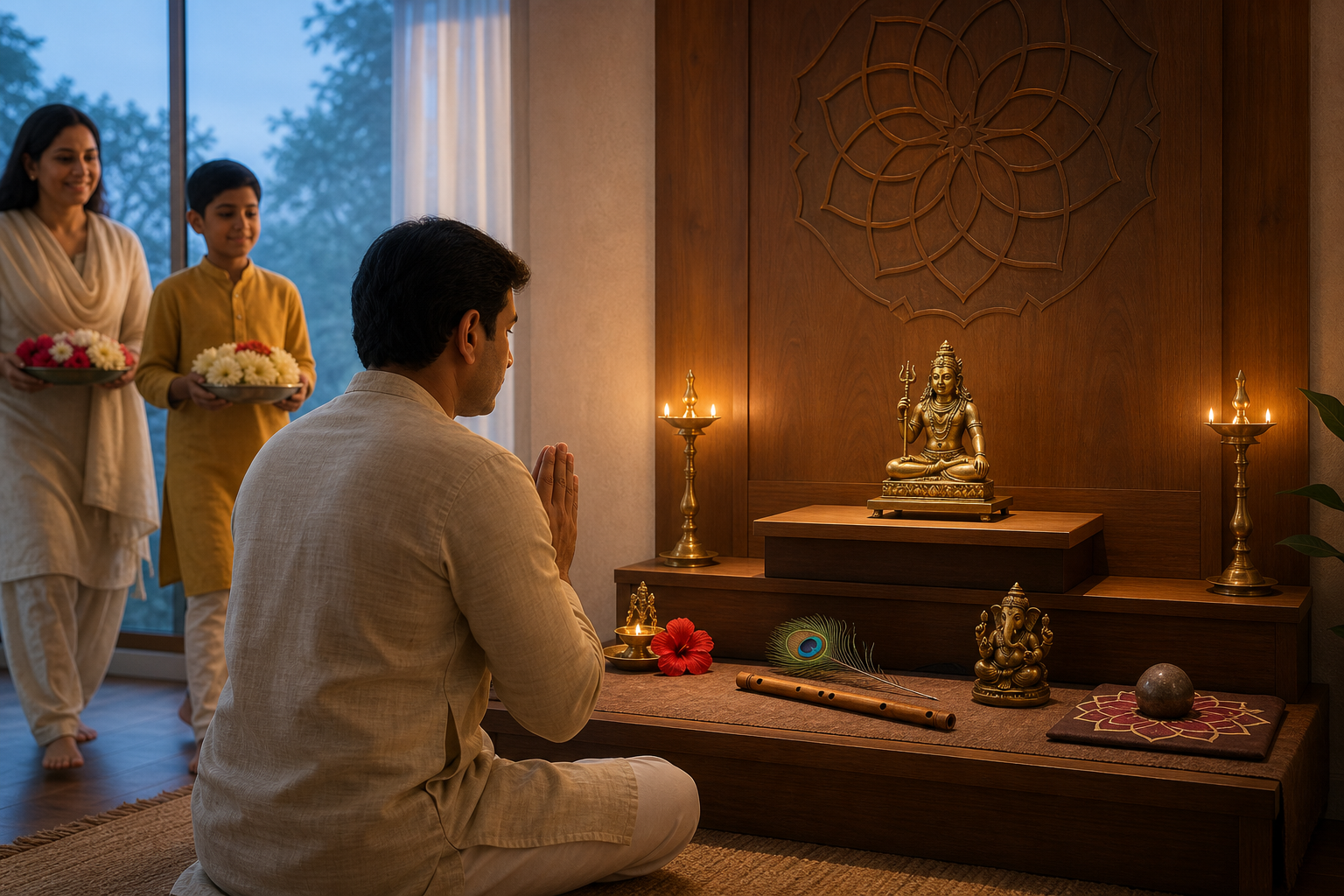
You may feel deeply drawn to Shiva while your family worships Devi. You may keep Krishna at the centre of your altar yet wonder whether choosing one form disrespects the others. Or you may want guests from different Hindu and Dharmic traditions to feel welcome without turning worship into a vague mixture of everything.
You do not have to choose between committed devotion and spiritual openness. Hindu worship can be particular in practice, expansive in vision, and respectful in public conduct. The key is to give your daily sadhana a clear centre while refusing to turn that centre into a claim of divine monopoly.
Choose a centre without shrinking the Divine
Begin by correcting a common misunderstanding: invocation need not mean calling an absent supernatural being into the room. It can be understood as attuning your attention, emotion, breath, and intention to sacred presence. This inward orientation does not make devotion imaginary. It prepares you to enter a real relationship of reverence rather than merely recite words while your mind is elsewhere.
The Ishta-devata principle gives that relationship a recognisable form. Your chosen deity is not the only doorway through which the Divine may be approached. It is the doorway through which you are prepared to enter consistently. Concentration needs a centre; inclusivity needs a horizon. Ishta-devata supplies the centre without closing the horizon.
If you are unsure where to begin, make three decisions:
- Choose the form that evokes reverence rather than novelty. This may be the deity honoured by your family, the form associated with your sampradaya, or the form toward which devotion has arisen naturally.
- Choose one practice you can repeat. A short puja, nama-japa, mantra, quiet contemplation, or devotional song is more useful than an elaborate sequence performed only when enthusiasm happens to appear.
- Name the quality your worship should cultivate. Ask whether you are seeking clearer judgement, courage, compassion, steadiness, gratitude, or freedom from self-centred conduct. This keeps devotion connected to dharma.
You do not need to invoke every deity in every observance to prove that you respect them. A household altar may contain several forms while daily practice remains centred on one. A brief salutation to the other forms can express honour without making the ritual unwieldy. On a family observance or sacred festival, the centre can shift appropriately without turning spiritual life into a competition among deities.
Nor must you force bhakti and non-dual insight into opposition. Advaita Vedanta can interpret worship as a movement toward recognition that Atman and Brahman are not separate. Devotional paths can retain the living relationship between devotee and deity. Hindu practice has room for both orientations. Let your own tradition determine the theological emphasis, and let humility prevent that emphasis from becoming contempt for another path.
Use a simple invocation sequence you can sustain
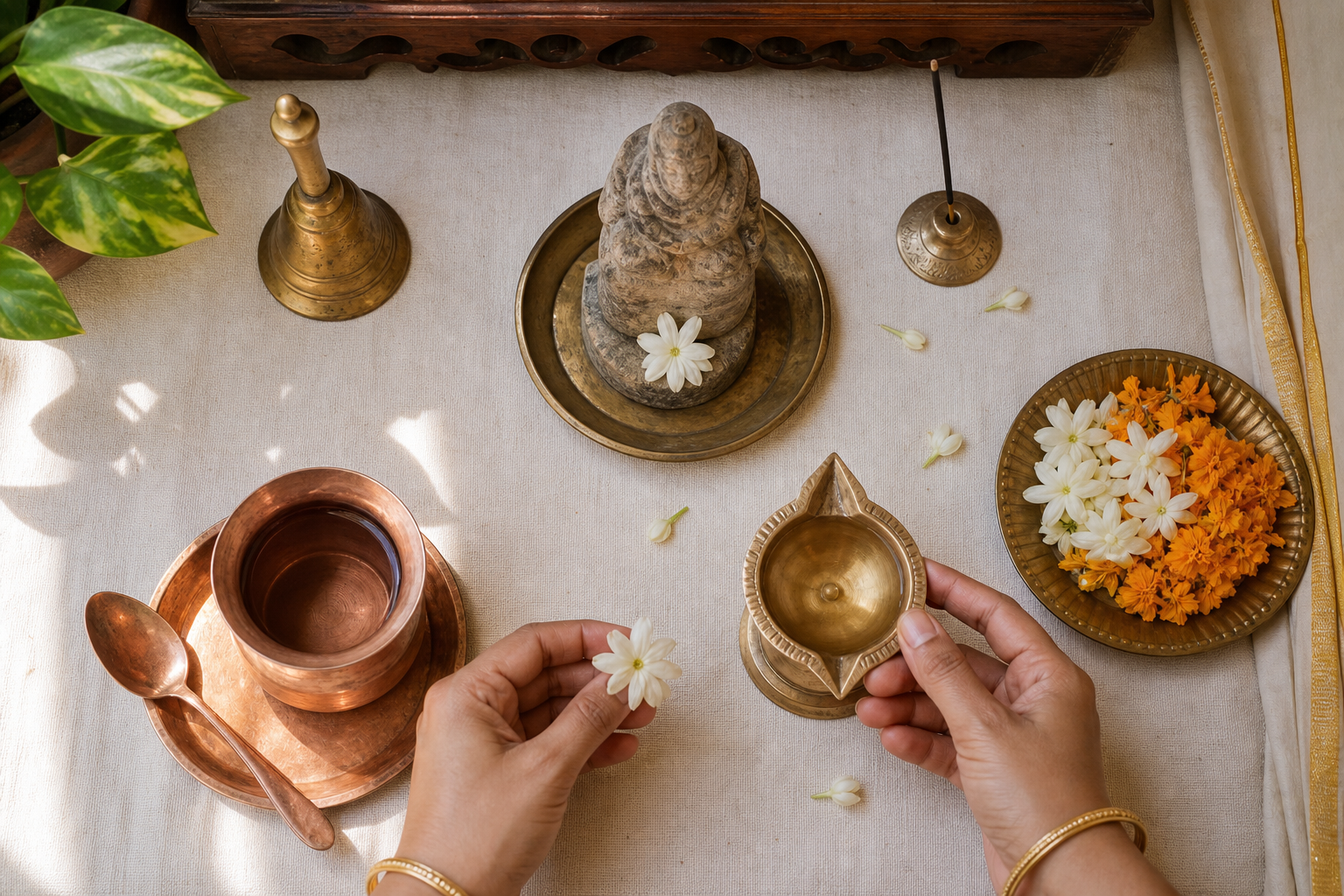
A temple may employ an elaborate liturgy, and prana-pratishtha ritually establishes sacred presence in a consecrated murti. A brief household practice does not need to imitate the full temple sequence. It needs order, attention, cleanliness, and sincerity.
Use this sequence as a practical framework, adapting it to your family or sampradaya where a received practice already exists:
- Prepare one stable place. Clean the surface and arrange the murti or image without crowding it. Place only the offerings you will actually use. Preparation should reduce distraction, not create a display you must manage.
- Settle the body and breath. Sit or stand steadily. Take a few unhurried breaths, allowing the transition from ordinary activity to worship to become conscious. If purification or pranayama forms part of your tradition, perform the form you have been taught rather than improvising a complicated technique.
- State your sankalpa. Make the intention concrete. A useful form is: May this worship steady my mind, guide my conduct, and be offered without selfishness. A specific sankalpa gives the practice direction; a vague wish for general spirituality does not.
- Turn toward the deity. Look at the murti or image with attention. Recite the name or mantra you know, or offer a plain invocation in the language in which devotion is natural to you. Do not make unfamiliar pronunciation the centre of the experience.
- Make a few deliberate offerings. Water, a lamp, incense, flowers, and food are traditional upacharas, but you need not use all of them. Offer fewer items with attention rather than many items mechanically. Where a flame or smoke is unsafe or prohibited, omit it; reverence does not require creating a hazard.
- Receive darshan and become quiet. The murti is not merely an object in front of which tasks are completed. It is a sacred focus for the experience of seeing and being seen by the Divine. After the active offerings, leave room for silence.
- Conclude with gratitude. Aarti or circumambulation may be included according to your custom. Receive offered food as prasada and share it where appropriate. This movement from offering to receiving teaches that grace is not private possession.
- Carry the sankalpa into action. Decide on one act of seva or one correction in conduct before leaving the altar. Invocation is incomplete if its effects never reach your speech, work, family relationships, or treatment of a stranger.
The most important design choice is repeatability. If the sequence is too large for ordinary days, reduce it before abandoning it. Keep the same basic arc: prepare, intend, invoke, offer, become still, give thanks, and serve. Regularity allows each gesture to acquire meaning that novelty cannot supply.
Make every ritual gesture correct something in your day
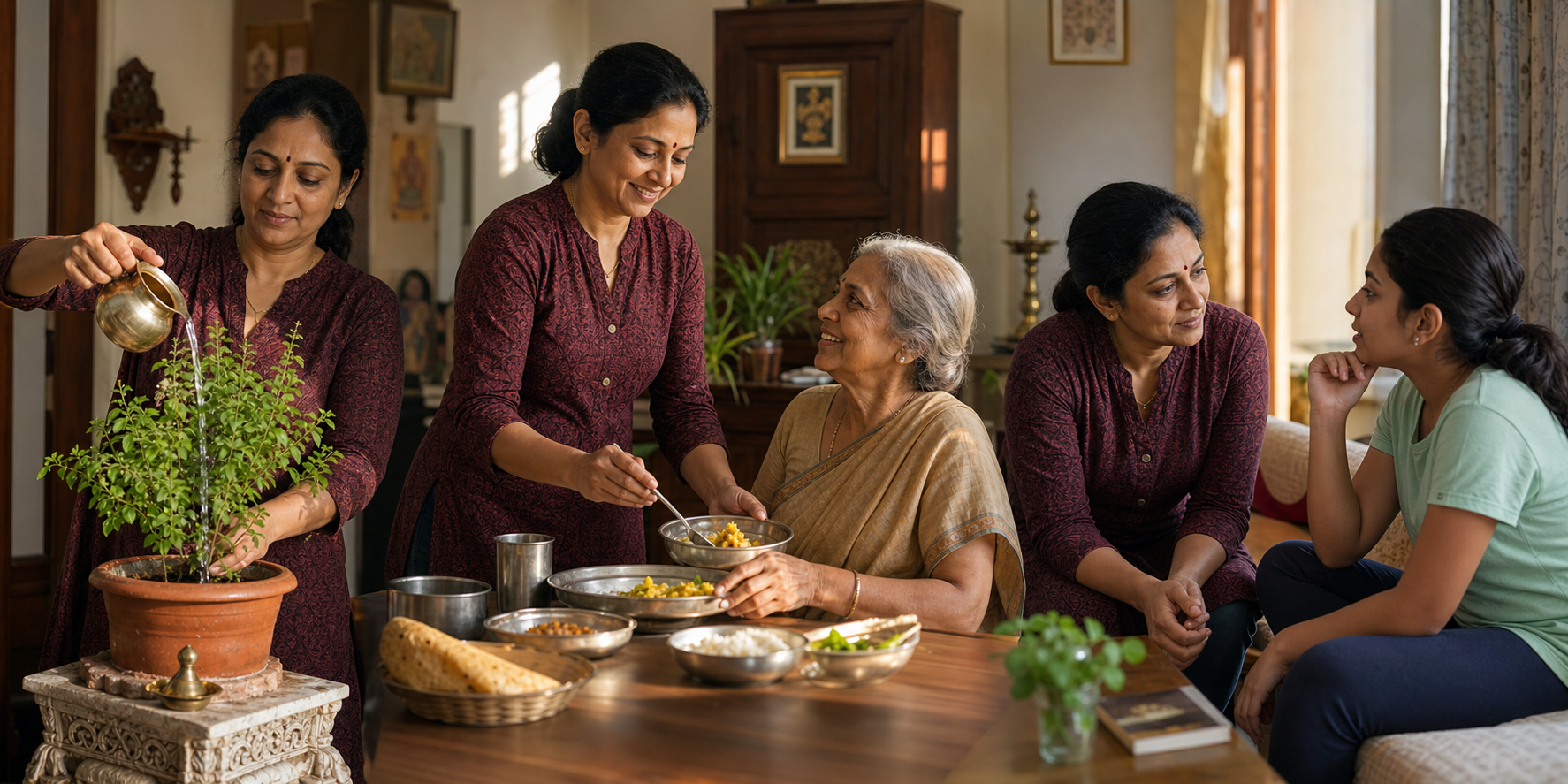
Ritual becomes hollow when the objects remain on the altar and their meanings never enter your life. The offerings are not a divine shopping list. They train attention through the body and senses. Use each gesture as a practical test of what you will do after worship.
| Offering or action | Spiritual meaning | A practical test after worship |
|---|---|---|
| Lamp | Wisdom and inner awakening | Before a reactive reply, ask whether your words bring clarity or add heat. |
| Water | Purification | Correct one careless word, motive, or action instead of merely wishing to feel pure. |
| Incense or fragrance | Refinement of the senses | Notice what you allow to occupy your attention, especially immediately after sadhana. |
| Flowers | Gratitude and beauty offered without possession | Name something you have received and respond without entitlement. |
| Food or naivedya | Hospitality and the sanctification of sustenance | Receive and share prasada carefully rather than treating food as disposable. |
| Bell | Clearing distraction | Silence the device or thought that repeatedly pulls you away, then return without irritation. |
| Circumambulation | Life oriented around the Divine | Place one dharmic duty ahead of convenience when the two compete. |
These meanings explain why light, water, fragrance, flowers, food, prasada, and circumambulation belong to one coherent spiritual movement. Attention is gathered, the senses are refined, ordinary sustenance is offered, grace is received, and the devotee returns to life with a different centre of gravity.
The language of the gunas offers a useful diagnostic. Rajas appears as agitation, grasping, and compulsive activity. Tamas appears as inertia, confusion, and avoidance. Sattva appears as clarity, proportion, empathy, and steadiness. Do not try to measure your worship by the number of offerings completed. Notice whether it is softening agitation and inertia while supporting clearer conduct.
At a regular point in your week, ask:
- Did invocation make my speech less careless?
- Did I become more patient in one difficult relationship?
- Did my sankalpa influence an actual decision, or did I forget it at the altar?
- Did devotion make me more willing to serve, share, apologise, or restrain harm?
If nothing outside the ritual changes, do not immediately add more ritual. Shorten the distance between symbol and conduct. One consciously repaired relationship may reveal more spiritual movement than a longer sequence performed for display.
Practise inclusion without turning every path into the same path
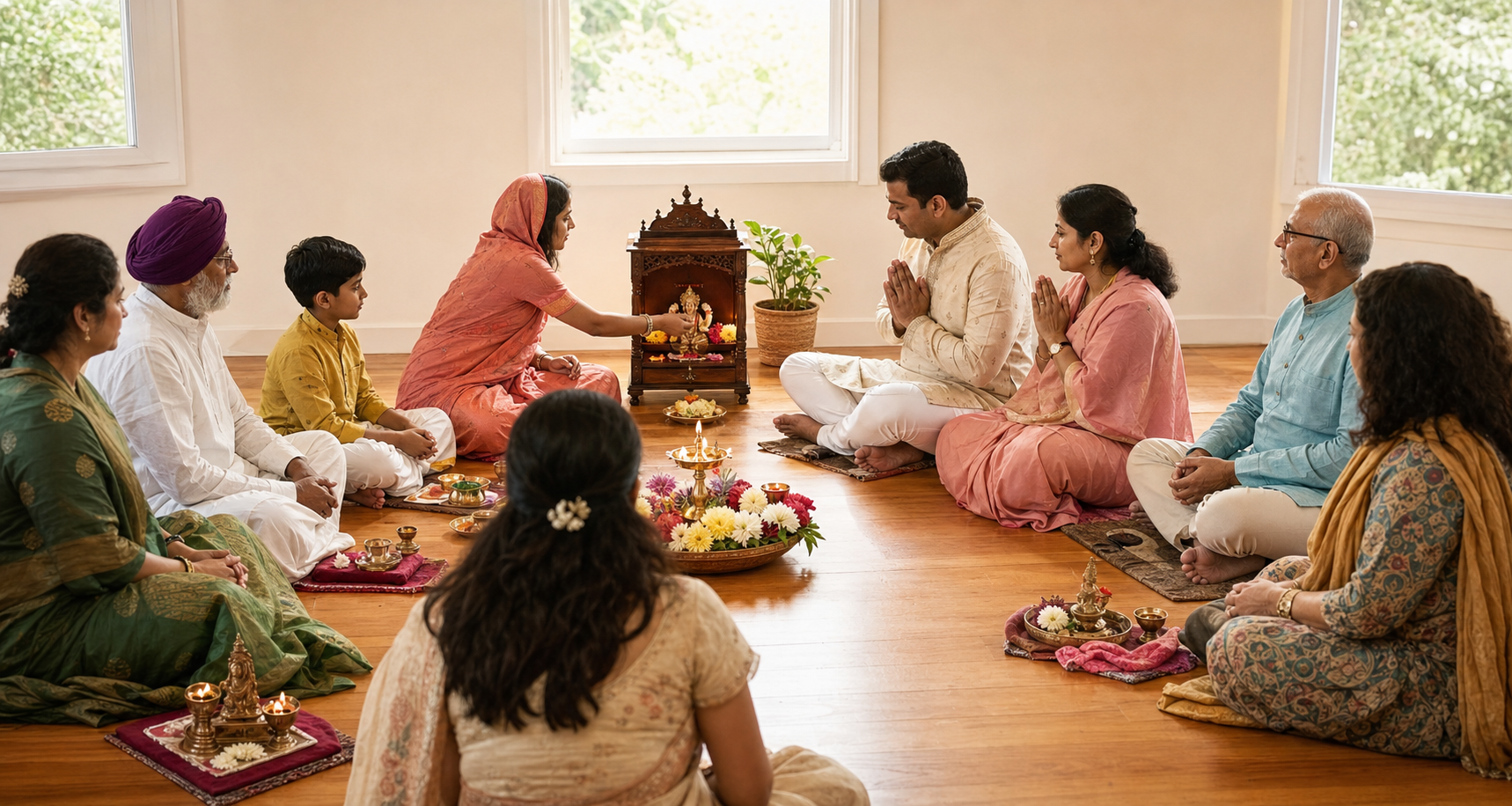
Inclusive worship does not require an altar containing every deity, a ceremony combining every tradition, or a claim that all doctrines are interchangeable. Those approaches often produce confusion rather than respect. Inclusion works when you keep three levels distinct:
- Spiritual horizon: the Divine or ultimate truth is not exhausted by the form you personally worship.
- Devotional centre: you may still give one name, image, mantra, or relationship sustained attention.
- Community conduct: you protect the dignity of practices and identities that are not your own, including when you do not adopt them.
The maxim Ekam sat vipra bahudha vadanti expresses an expansive vision of truth approached through many names. It does not require you to pretend that every school makes identical philosophical claims. Unity that survives real difference is stronger than unity purchased by erasing difference.
In a mixed Hindu household, establish a primary daily centre and explain it without ranking the family’s other forms as lower or false. Honour inherited observances when they arise. If a relative follows a different sampradaya, ask how a sacred object or mantra should be treated instead of assuming that every Hindu custom works in the same way.
When guests attend your puja, tell them what is happening before asking them to participate. Give them the respectful option to observe silently rather than pressuring them to repeat a mantra they do not know. In a temple, follow the temple’s ritual order and local discipline; being welcomed into a sacred space is not permission to redesign its worship around yourself.
The same discipline matters across the wider Dharmic family. Buddhist mindfulness and karuna, Jain ahimsa and samayik, and Sikh naam simran and seva each connect disciplined inner life with compassionate action. These shared ethical and contemplative orientations create genuine ground for solidarity. They do not give anyone permission to relabel Buddhist, Jain, or Sikh practice as merely another form of Hindu puja.
A shared Dharmic gathering can therefore centre on mutually understood acts: silence, hospitality, reflection on compassion or non-harm, and seva chosen together. Participants may then pray, chant, or contemplate according to their own discipline. This is not weak inclusivity. It is a form of unity strong enough to tell the truth about difference.
Watch your speech as closely as your altar. Do not mock a deity you do not worship, present your mantra as a universal requirement, or use philosophical unity to overrule another community’s account of itself. The clearest sign of inclusive devotion is not how many symbols you collect. It is whether another person can remain fully rooted in a different path without becoming the target of your insecurity.
Key takeaways
- Choose one Ishta-devata or primary sacred form so that daily attention has a stable centre.
- Keep invocation sustainable: prepare, state a sankalpa, invoke, offer, become still, give thanks, and carry the practice into seva.
- Treat the murti as a sacred focus for darshan, not as a decorative object or as a finite object that exhausts the Divine.
- Translate each offering into conduct: light should clarify, water should purify, food should deepen gratitude, and prasada should encourage sharing.
- Respect many deities and paths without pretending that all rituals, philosophies, or community identities are interchangeable.
- Judge the fruit of worship by changes in speech, restraint, gratitude, compassion, and decisions rather than by ritual complexity.
At your next observance, write one sentence of sankalpa before you begin. Choose only the offerings you can present attentively. When the worship ends, name one act of seva or one correction in conduct and do it before the intention becomes abstract. That is how invocation moves from an altar arrangement into a way of living with the Divine in all beings.
References
