
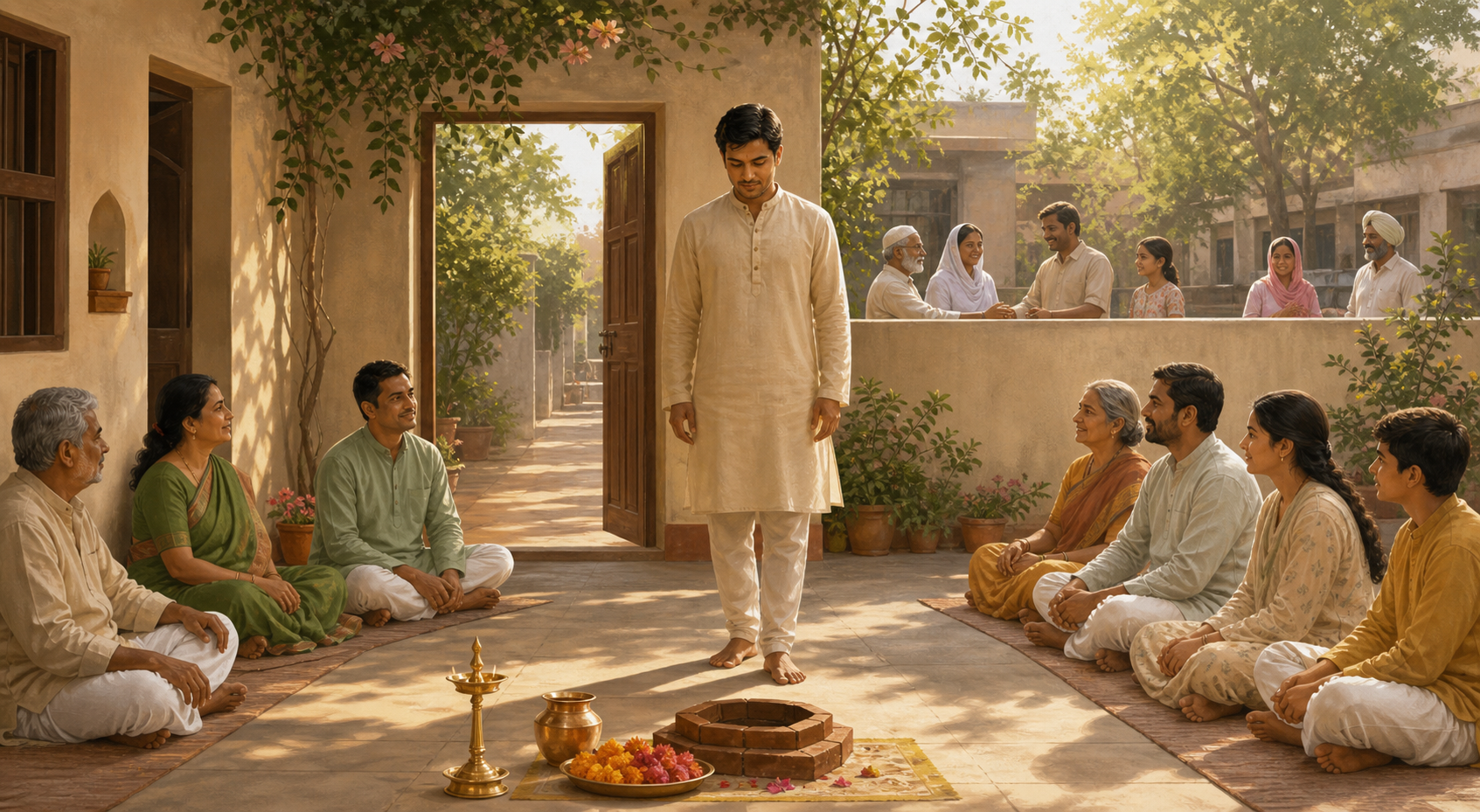
If you are considering Gharwapsi for yourself or helping a family return to its ancestral Hindu tradition, the hardest question is not which ritual to perform. It is whether every participant can freely say yes, safely say no, and continue living with dignity among relatives and neighbors afterward.
That is the standard that turns a homecoming into an expression of Dharma rather than a contest for numbers. The practical work is clear: establish individual consent, choose a ceremony that reflects the family’s own tradition, verify the applicable legal process, protect privacy, and plan for community relations after the gathering is over.
Freedom of conscience is the first test
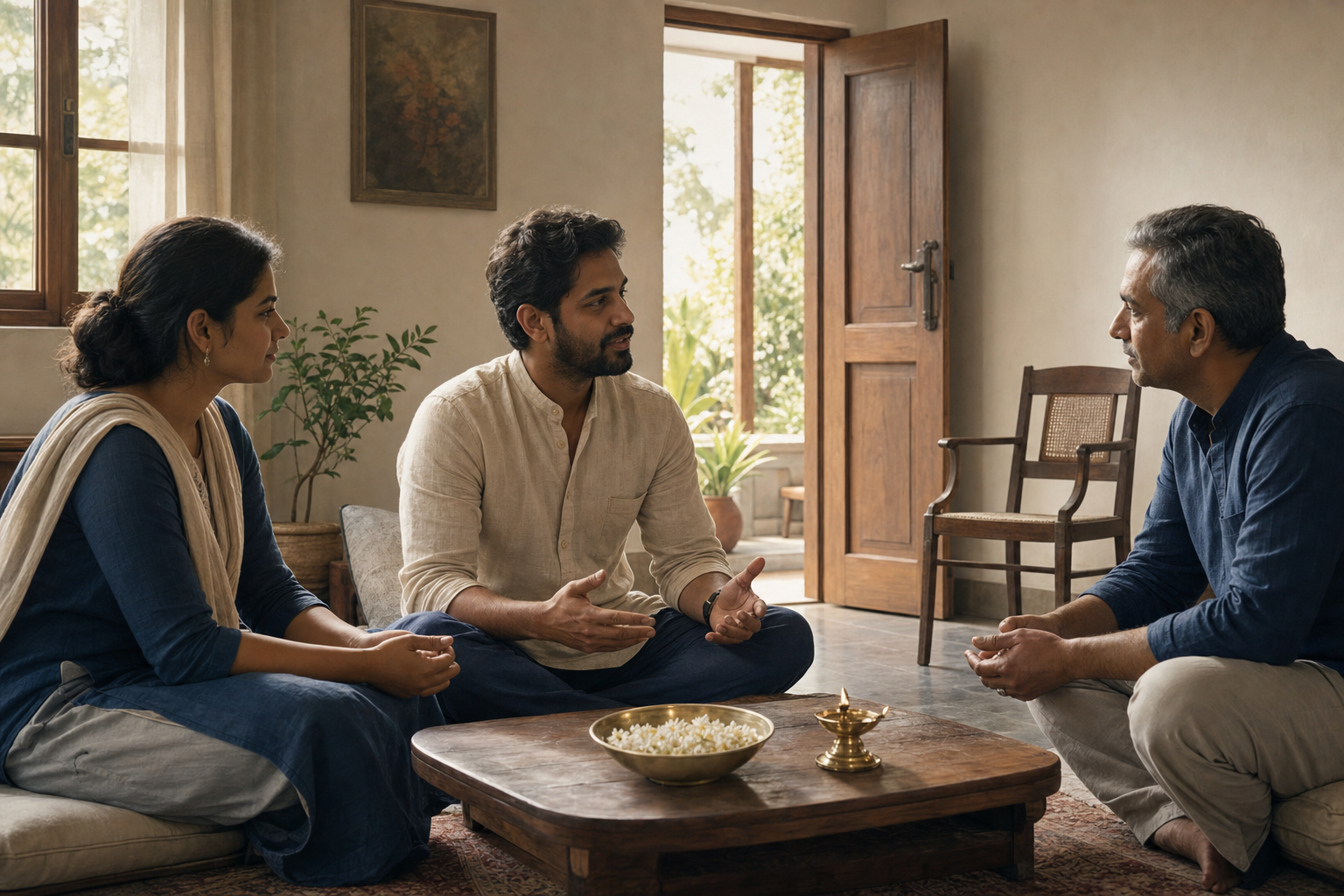
Gharwapsi literally carries the idea of returning home. In religious and cultural life, it generally refers to a person’s return to an ancestral Hindu or Dharmic path. That return may be spiritual, cultural, familial, or some combination of the three. It cannot be reduced to a public ceremony, because the real decision occurs within the conscience of the person returning.
India’s constitutional protection of freedom of conscience and religion supplies both the foundation and the limit. The freedom that permits one person to return to Hindu practice is the same freedom that permits another person to remain in a different faith, decline a ceremony, or reconsider a decision. Defending only the choice we prefer is not a defense of religious freedom.
Families often have understandable reasons for contemplating a return. They may want to observe familiar festivals, resume inherited customs, participate fully in community rituals, or restore continuity between grandparents, parents, and children. Belonging, cultural participation, familiar ritual life, and intergenerational cohesion are affirmative motives. They can be discussed without attacking another religion or questioning the dignity of those who follow it.
A shared family intention does not erase individual conscience. One outspoken relative cannot answer on behalf of every adult in the household. A person may agree with the family’s cultural direction while feeling uncertain about a religious rite, a public declaration, or the release of photographs. Treat those as separate decisions.
Before arranging a ceremony, use this consent process:
- Speak privately with each participating adult. Ask what the person wants, why the person wants it, and what concerns remain. Group answers can conceal hesitation.
- Ask open questions. A person should be able to explain the choice in his or her own words. Do not supply a script and then treat its repetition as proof of conviction.
- Make the right to decline explicit. Say plainly that refusal will not affect family affection, community assistance, employment, access to services, or personal safety.
- Allow time for reconsideration. Urgency created by an organizer, a visiting religious figure, a political calendar, or a planned media appearance is a reason to slow down.
- Separate consent to return from consent to participate publicly. A person may welcome a private homecoming while refusing a stage appearance, interview, photograph, or social-media announcement.
- Reconfirm the decision before the rite. Consent given during an early conversation should not be treated as permanent if circumstances or feelings have changed.
Signs that the process should stop
Do not proceed merely because invitations have been sent or guests have arrived. Pause the process if you notice any of the following:
- A participant looks to an elder, organizer, or spouse before answering every question.
- Money, material help, employment, protection, or community benefits are made conditional on participation.
- A participant fears punishment, ostracism, humiliation, or violence for refusing.
- The family is asked to sign something it has not read or does not understand.
- An organizer dictates the family’s reasons or adds claims the family did not make.
- Names, images, or personal histories are scheduled for publication without specific permission.
- Children are placed before cameras or crowds as proof that the entire household agrees.
A red flag is not an inconvenience to manage around. It is a reason to halt the event, speak with the affected person privately, and obtain qualified local advice where safety or legal rights may be at risk. A delayed ceremony can be rearranged. A coerced decision can damage a family and its neighborhood for years.
Make the ritual serve the choice, not manufacture it
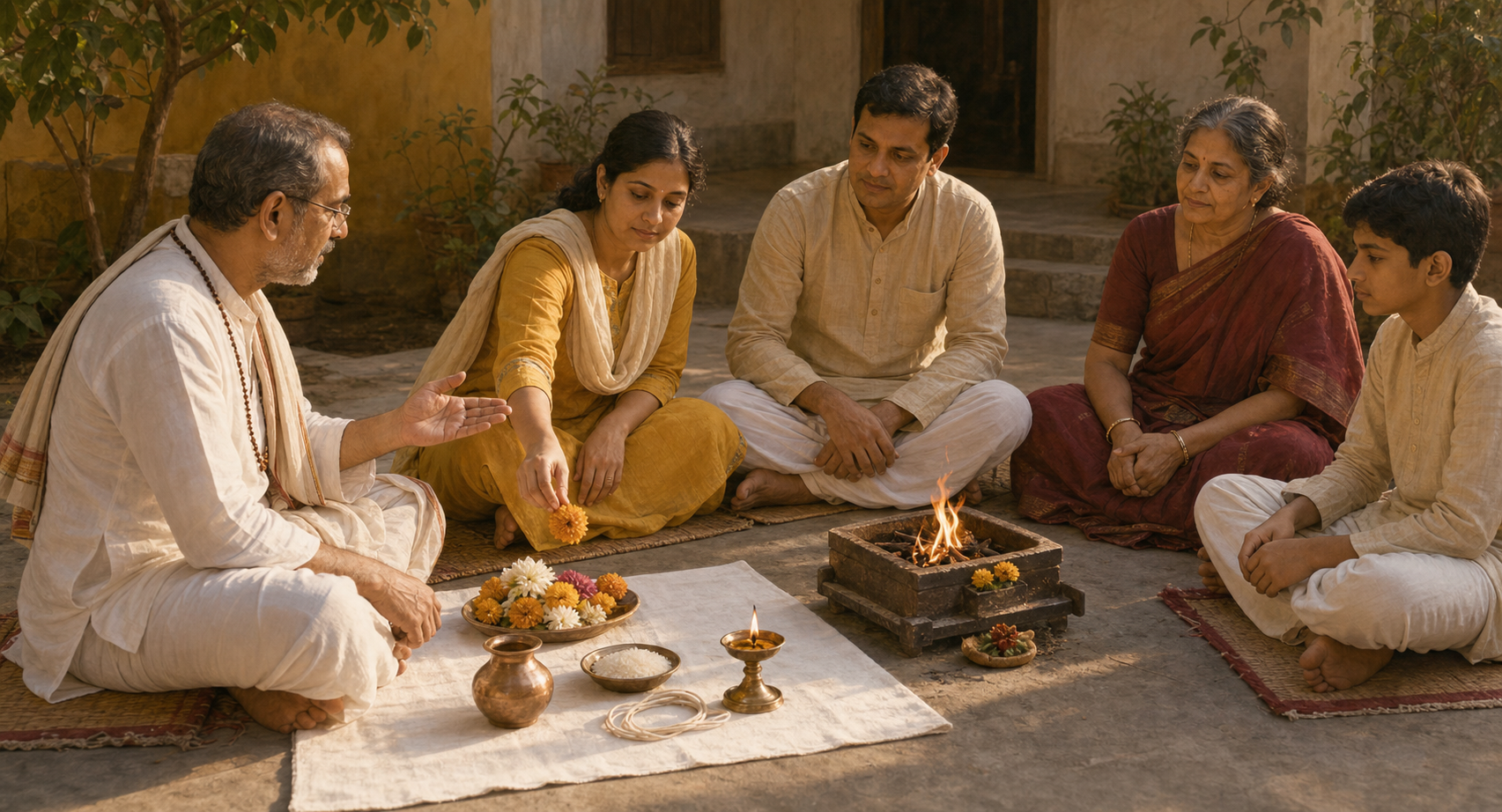
Some communities use a Shuddhi Yajna to mark a return to inherited tradition. It is a customary form used by certain communities, not a universal test of sincerity. The family’s own lineage, regional customs, sectarian practice, and comfort should guide the rite. A facilitator should explain the meaning of each step and avoid presenting an unfamiliar ceremony as the only valid form of homecoming.
Three permissions must remain distinct:
- Religious permission: the person freely chooses to resume a Hindu or Dharmic identity and practice.
- Ceremonial permission: the person agrees to the particular rite, officiant, setting, and people in attendance.
- Publicity permission: the person agrees to the use of a name, image, testimony, family history, or identifying location.
Agreement to the first does not imply agreement to the second or third. This distinction matters because publicity is difficult to reverse. Once names and photographs circulate through messaging groups, news coverage, or social media, the family may lose control over who sees them and how they are used. When there is doubt, keep the gathering private.
Plan the ceremony with the family, not merely for the family. Confirm which practices they recognize, who they want present, which language they understand best, and whether they want any public statement. Explain every declaration before it is made. Do not surprise participants with political representatives, media personnel, slogans, banners, or a larger crowd than they approved.
The message should remain affirmative: the family is resuming the traditions it freely chooses. Avoid victory language, ridicule, accusations against former co-religionists, or claims that people outside the ceremony are enemies. A homecoming does not need another community’s humiliation to acquire meaning.
Numbers do not prove freedom. In one regional example, ten families in Amabeda and Piprod in Kanker district were reportedly involved in homecomings on or around 28 December 2025, with related activity also identified in Purnea. The useful standard is not how large a gathering appears. It is whether each participant’s decision remains voluntary, informed, lawful, and consistent with the family’s actual convictions.
Complete the legal and privacy work before making announcements

Freedom of conscience is the starting principle, but it is not a substitute for checking the law that applies in the relevant state and district. Religious-conversion procedures and administrative requirements can be jurisdiction-specific and can change. Do not assume that a process followed elsewhere in Bharat applies automatically to your location.
Before fixing a public date, ask a lawyer familiar with the current local rules, or the relevant public authority, to clarify these questions:
- Does any declaration, notice, form, appearance, witness, or official acknowledgment apply to the proposed action?
- Which responsibilities belong to the individual, which belong to a religious facilitator, and which can be performed only by a public authority?
- What evidence of free consent should be created, who may retain it, and how should sensitive information be protected?
- Are religious affiliation, participation in a ceremony, and changes to government or institutional records separate processes?
- What privacy obligations apply to names, signatures, identity documents, photographs, recordings, and information about children?
- What should organizers do if a participant, relative, neighbor, or official raises a complaint?
Do not promise that a religious ceremony automatically changes an official record or legal status. Verify every administrative change the family actually wants. Avoid collecting identity documents merely because they might be useful later, and never circulate copies through informal groups. Keep only what the applicable process genuinely requires, restrict access, and obtain advice about secure retention or disposal.
Documentation should protect the participant, not become publicity material. A plain and accurate record of what was explained, what was chosen, and what permissions were granted is more useful than a dramatic declaration. Do not backdate forms, exaggerate attendance, combine several kinds of consent into one vague signature, or insert political language that the participant did not request.
If someone alleges pressure or withdraws consent, stop the relevant activity immediately. Do not answer the person through a crowd, a threatening visit, or an online campaign. Preserve accurate records, protect the family from unwanted contact, and seek qualified legal help. Where there is an immediate threat to anyone’s safety, contact the appropriate local emergency or public-safety authority.
Protect community harmony after the ceremony

A homecoming is not complete when the yajna ends. The real social test begins when the family returns to ordinary life. If organizers disappear after the photographs, the family may be left to manage strained relationships, rumors, practical questions, or unwanted attention alone.
Prepare a simple aftercare plan before the gathering:
- Name one responsible contact. The family should know whom to call about religious practice, unwanted publicity, community tension, or procedural questions.
- Set a conduct rule for supporters. No threats, abusive slogans, harassment, triumphal processions, or disparagement of neighbors and their faiths should be tolerated.
- Support ordinary practice. Help the family reconnect with the festivals, customs, worship, and community relationships it actually sought. Do not turn the family into a permanent symbol for someone else’s campaign.
- Correct rumors narrowly. Use the minimum verified information needed to address a false claim. Do not expose private details in an attempt to win an argument.
- Maintain normal neighborly relations. Courtesy, shared civic responsibilities, help during hardship, and respect for places of worship should continue across religious lines.
- Check consent again in private. Ask whether the family experienced pressure before or after the event and whether any published material should be removed where removal remains possible.
The wider Dharmic family includes traditions that are distinct and should not be flattened into one system. Hindu, Buddhist, Jain, and Sikh communities nevertheless offer a powerful ethical vocabulary for public conduct: ahimsa, seva, respect for multiple paths, and concern for human dignity. Applied practically, ahimsa rules out intimidation, seva rules out assistance made conditional on conversion, and respect for multiple paths rules out humiliating a neighbor for choosing differently.
Harmony does not require silence about religious differences. It requires a disciplined way of handling them. You can affirm Hindu continuity, teach inherited customs, and welcome a voluntary return without denying another person’s civil dignity. When disagreement arises, use a small conversation with trusted representatives or a neutral mediator. Do not summon a crowd to a home, place of worship, or public office as a show of strength.
A voluntary decision must remain voluntary after the ceremony. If a participant later questions the choice, the community should respond with conversation rather than punishment. Freedom of conscience is continuous; it does not expire once a photograph has been taken or a ritual completed.
Key takeaways: the go-or-stop test
- Go only when every participating adult can explain the decision independently and can decline without losing safety, affection, services, money, work, or community standing.
- Go only after separating consent to the religious return, the chosen ritual, and public identification.
- Go only after verifying the current state- and district-specific procedure with a qualified local professional or relevant authority.
- Go with a family-centered rite and affirmative language about inherited practice, not accusations or humiliation directed at another faith.
- Stop when testimony is scripted, benefits are conditional, a participant appears afraid, required information is not understood, or privacy permissions are unclear.
- Stop public communication when a dispute emerges. Protect the family, preserve accurate records, and move the matter into a lawful, small, and accountable process.
Your next step should be a private consent conversation, not an event announcement. Write down the family’s own wishes, list the permissions that still need to be clarified, and obtain current local legal guidance before choosing a date. If any answer remains uncertain, postpone the public act. A careful homecoming can strengthen belonging without weakening the freedom and peace that make belonging worth protecting.
References
