

If you came looking for the goddess associated with the Tamil month of Aippasi, the concise answer is Goddess Manthai. The qualification matters: Manthai is Aippasi’s presiding Devi within a Tamil Shaiva system that understands every month as a distinct expression of divine feminine power.
That answer gives you a reliable devotional starting point. It does not, by itself, establish a universal icon, mantra, festival procedure, or temple ritual. Knowing that boundary will help you honour Manthai without turning an unfamiliar but meaningful tradition into an invented one.
The direct answer: Manthai in the Masa Devi system
Masa means month, while Devi means goddess. In this Tamil Shaiva framework, each of the twelve Tamil months has a presiding goddess, with Manthai identified as the sacred form belonging to Aippasi.
This monthly association is more than a calendar label. Time is treated as a sacred continuum animated by Shakti, not as an empty container through which religious festivals happen to pass. Aippasi therefore becomes a particular occasion for approaching the Divine Feminine as Manthai.
It also helps to clarify what you mean when you ask, “Who is the Aippasi goddess?” You may be asking three different questions:
- Which Devi corresponds to Aippasi in the twelve-month Masa Devi system? The answer is Manthai.
- Which goddess receives special attention at a particular temple during Aippasi? That depends on the temple and its established observances.
- Which goddess should your family worship during Aippasi? Your inherited practice, family deity, guru, or temple custom remains the proper guide.
These answers can coexist. Recognising Manthai as the month’s Devi does not require you to abandon a family or temple tradition already rooted in Shaiva practice.
Key takeaways
- Goddess Manthai is the sacred form associated with Aippasi in the Tamil Shaiva system of twelve Masa Devis.
- The teaching presents time itself as permeated by divine feminine energy.
- A month-goddess correspondence does not automatically prove a standard iconography, mantra, or separate festival.
- Your temple, guru, or family practice should determine any lineage-specific worship.
- If no special procedure is available, retain your regular worship and add a simple, explicit remembrance of Manthai.
What the month-goddess teaching asks you to notice

A calendar normally tells you when something begins or ends. The Masa Devi vision asks a deeper question: how should your awareness change as one sacred period gives way to another?
The twelve goddesses give the year a devotional rhythm. The form changes from month to month, but divine presence does not disappear between major holy days. That distinction matters in practice. If worship is reserved only for prominent festivals, much of ordinary time can feel spiritually neutral. The month-goddess framework refuses that division. The month itself becomes an opportunity for remembrance.
For Aippasi, the name Manthai gives that remembrance a definite focus. You need not manufacture an elaborate story around her to make the association meaningful. Begin with what the correspondence actually teaches: this portion of the Tamil year can be encountered as Devi’s time.
You can turn that principle into a useful monthly discipline. At the beginning of Aippasi, pause before filling the month with appointments and obligations. Mark Manthai’s name on your calendar. Identify one recurring duty that you have been treating carelessly, and perform it with greater attention throughout the month. This is not a claim about a prescribed Manthai vow; it is a practical way to let the sacred understanding of time affect your conduct.
What not to assume about Manthai
A presiding goddess is not necessarily the same thing as a widely installed temple deity with one universally recognised image. The identification of Manthai as Aippasi’s Devi does not, on its own, tell you her colour, posture, weapons, vehicle, hand gestures, seed syllable, or preferred offering.
This is where devotional curiosity can outrun dependable knowledge. An image found online may portray a different goddess, a local form, or an artist’s interpretation. A Sanskrit-looking sequence of syllables is not made authentic by being labelled a mantra. Do not assign either one to Manthai merely because it appears beside her name.
Before adopting a detailed practice, ask a knowledgeable priest, teacher, or elder three precise questions:
- Does our temple or sampradaya recognise Manthai as the Masa Devi of Aippasi?
- Is there an approved image, description, or form of contemplation associated with her?
- Is she named within an existing Shaiva worship sequence, or observed through a separate procedure?
A clear “we do not have that practice here” is useful information. It does not disprove the Masa Devi framework; it tells you that the correspondence is not part of that community’s active ritual inheritance. Tamil Shaiva life contains temple, family, textual, and local forms of practice, and they need not all preserve the same emphasis.
How to honour Aippasi without inventing a ritual
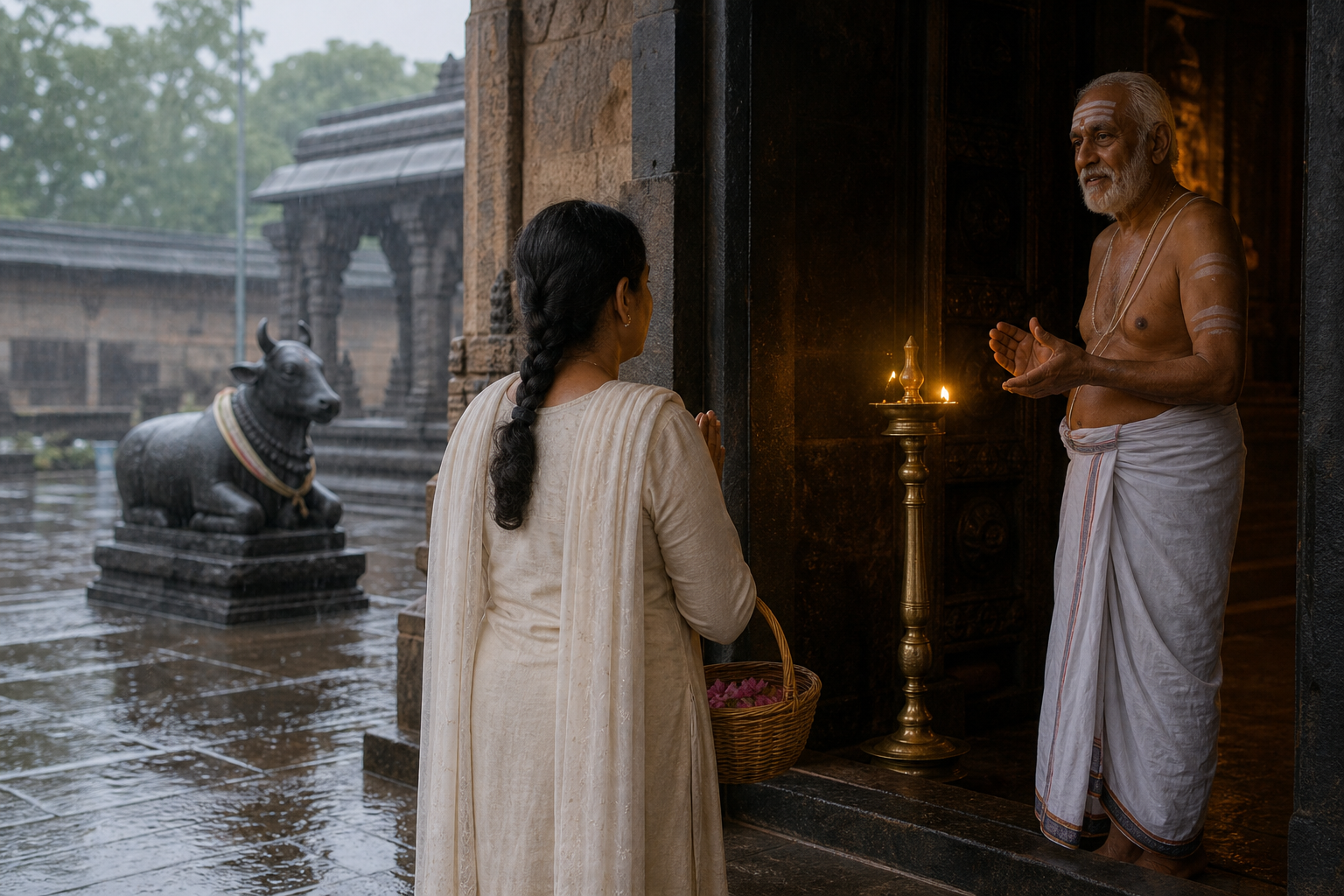
If you have no lineage-specific instructions but still want to acknowledge Manthai, use a conservative household approach. Its purpose is remembrance, not the construction of a supposedly ancient ceremony.
- Keep your established altar intact. Use the Shiva or Devi image through which you already worship. Do not relabel an unfamiliar figure as Manthai merely to obtain a separate icon.
- Continue your regular practice. Your daily prayer, recitation, or family observance should remain the foundation. Remembering a Masa Devi can be added without displacing what you have received.
- Name the occasion plainly. At the start of worship, acknowledge that it is Aippasi and remember the Divine Mother as Manthai. Ordinary, sincere words are preferable to an unverified mantra.
- Offer only what is already familiar. If a safely lit lamp, clean water, or flowers normally belong to your household worship, you may use them. Do not describe any such item as Manthai’s special offering unless your tradition actually teaches that association.
- Give the month an ethical consequence. Choose one neglected recurring duty and perform it faithfully through Aippasi. This makes reverence for sacred time visible in the way you use time.
If your temple provides a specific dhyana, archana, or other observance, follow that instruction instead of this general form. Ritual precision comes from transmission. Simplicity is the sounder choice when transmission is absent.
Your next step can be small and exact: write “Manthai” beside Aippasi in your calendar, ask whether your temple preserves a corresponding practice, and carry only what is confirmed into worship. A sacred calendar becomes meaningful when it changes your attention and conduct, not when it merely enlarges your collection of deity names.
References
