
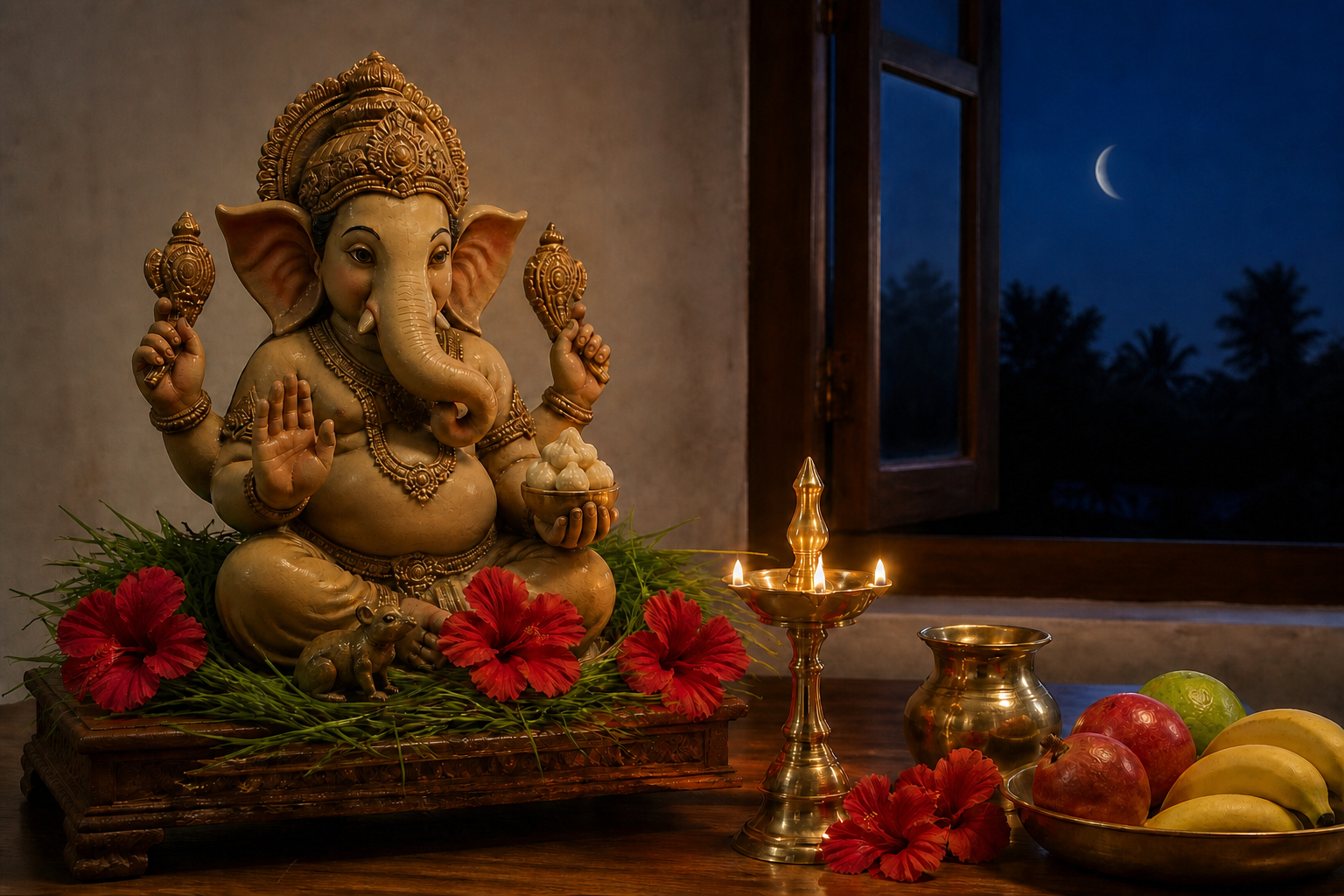
If you want to observe Sankashti but are unsure what to do – or whether fasting is the whole point – begin with a more useful question: what obstacle are you asking Ganesha to help you meet wisely? Naming that obstacle turns a general act of devotion into a disciplined monthly practice.
You do not need an elaborate home ritual to begin. You need the correct lunar day, a form of worship consistent with your household or lineage, and one concrete change in conduct. Ganesha’s symbolism tells you how to make that change; Sankashti gives you a recurring time to practise it.
Read Ganesha’s form as a discipline, not decoration
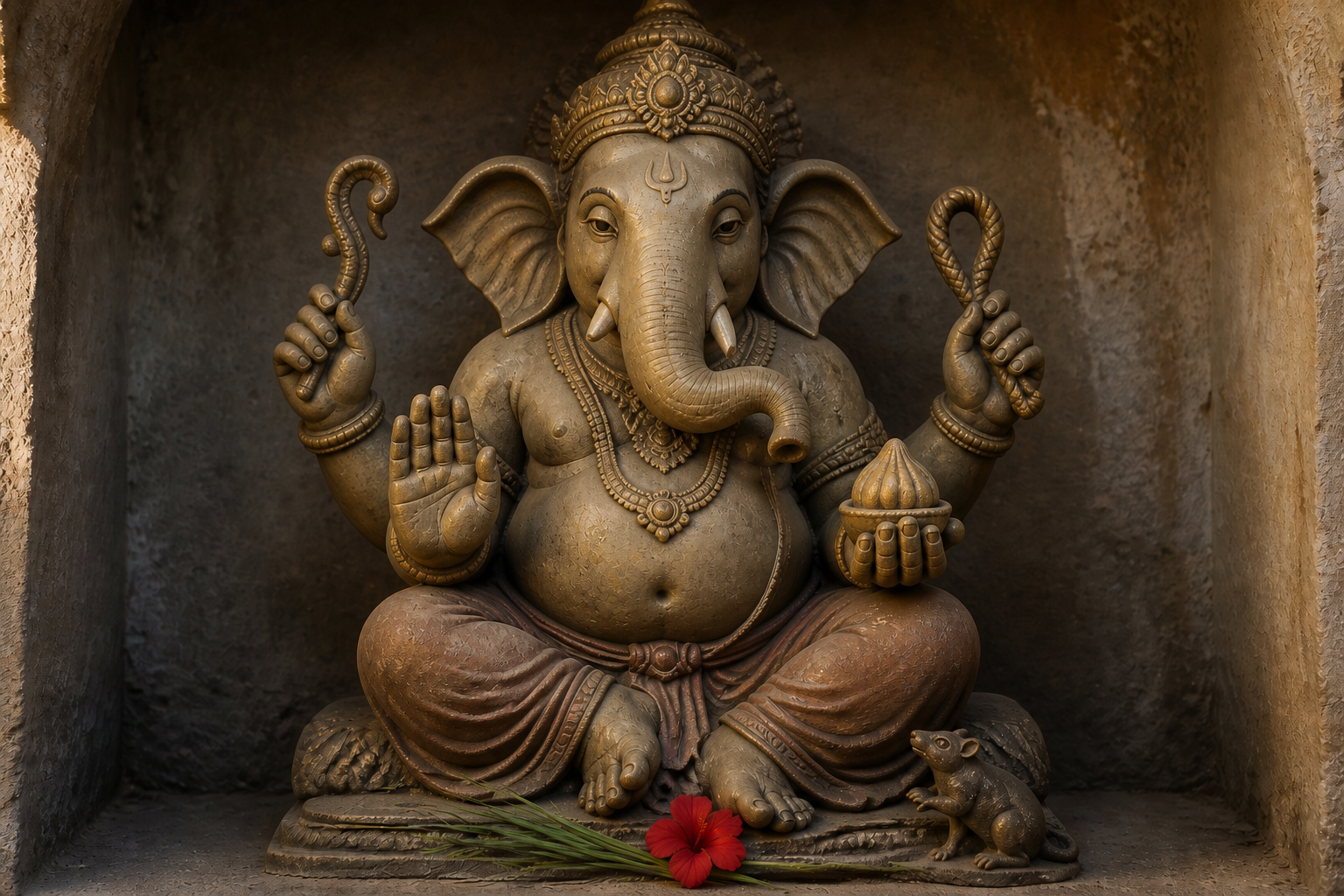
Ganesha is commonly invoked as Vinayaka, lord of auspicious beginnings, and Vighnaharta, remover of obstacles. Yet obstacle removal should not be reduced to getting an inconvenient problem out of your way. Sometimes the obstacle is confusion, wounded trust, impulsive speech, inflexibility, or your reluctance to correct a mistake.
In a prevalent account of Ganesha’s birth and restoration, Pārvatī creates a guardian who faithfully protects her privacy. Ganesha prevents Śiva from entering, and Śiva, acting in anger and misunderstanding, severs the child’s head. Pārvatī’s grief forces the gravity of the act into view. Śiva then accepts responsibility, restores Ganesha with an elephant’s head, and gives him an honoured place at the beginning of sacred and worldly undertakings.
The important movement is not from inconvenience to convenience. It is from rupture to recognition, from recognition to repair, and from repair to a wiser beginning. Ganesha therefore represents more than success at the start of a project. He represents the quality of mind required to begin again without denying what went wrong.
- The broad ears ask you to listen before deciding. When an obstacle involves another person, first determine whether you have understood the concern, boundary, or duty at stake. Listening is not passive when it prevents a second error.
- The small mouth points toward measured speech. Say what is true and necessary without adding the sentence spoken only to wound, dominate, or defend your pride.
- The trunk signifies adaptable strength. A trunk can perform forceful and delicate work. In practice, this means preserving a dharmic purpose while changing an ineffective method.
- The single tusk represents disciplined continuity despite loss. You may not recover the original plan, reputation, opportunity, or ease. You can still preserve the lesson and act well from the situation that remains.
Use these features as questions, not merely as admired attributes: What have you not heard? What should remain unsaid? Where must your method change? What wisdom must continue even if something has already been lost? That is how an image in the shrine becomes guidance in a meeting, a family disagreement, a period of study, or a difficult new beginning.
Find the correct Sankashti day before planning the vow

Sankashti Chaturthi is the monthly observance associated with Krishna Paksha Chaturthi, the fourth lunar day in the waning half of the lunar month. A tithi does not necessarily begin and end with the civil date printed on your wall calendar. It can change during the day or evening, which is why the date alone is not enough.
Consult a current Panchang for your city or region. Record when Krishna Paksha Chaturthi is active and when it gives way to Panchami. If you are keeping a tithi-specific observance, complete its central act of worship before the stated Chaturthi endpoint. A Panchang date can contain both Chaturthi and Panchami, so a generic festival label without timings may leave out the detail you need most.
- Check the location. Use the city for which you will observe the vrata rather than reusing a timing circulated by someone elsewhere.
- Check the tithi interval. Note both the applicable date and the time at which Chaturthi ends.
- Check your lineage or household custom. Rules concerning the form of worship, food, and the closing of the vrata can vary. Do not turn one regional practice into a universal rule.
- Treat other Panchang elements as refinements. Nakshatra, Rashi, Rahu Kaal, and Shubh Muhurat can add detail when your tradition uses them, but the identifying condition for the monthly observance remains Krishna Paksha Chaturthi.
This calendar check should take place before you decide when to cook, gather the family, perform aarti, or end a fast. The most common planning error is to build the whole day around a civil date and look up the tithi only afterward.
A simple Sankashti routine you can actually maintain
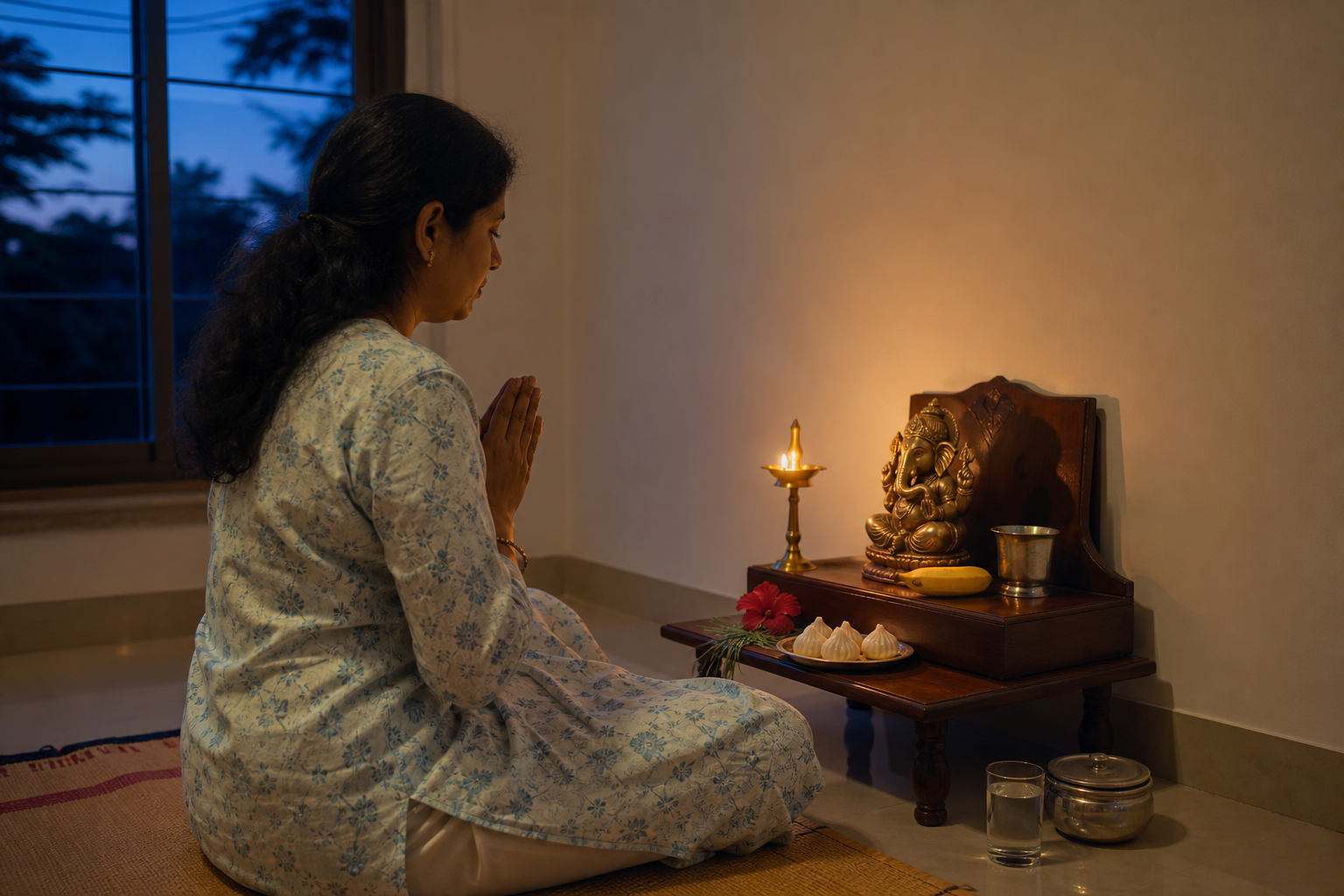
A sustainable observance is better than an ambitious routine you abandon after one month. If your family, guru, or sampradaya has given you a specific vrata procedure, follow that instruction. If you are beginning without such a prescribed routine, the following structure keeps the focus on Ganesha, self-discipline, and obstacle-clearing conduct without pretending to be a universal puja manual.
- The previous evening, name one sankata. Write the obstacle in one sentence. Avoid a vague intention such as “remove all difficulties.” Name the stalled decision, recurring reaction, damaged relationship, neglected duty, or fear that requires attention.
- Choose one symbolic discipline. Select listening, measured speech, adaptability, or perseverance. Make it behavioural: listen fully during a difficult exchange, postpone an angry reply, change one failed method, or complete one repeatedly avoided duty.
- Begin the day with a clear resolve. Offer a short prayer to Ganesha and state what you intend to practise. Keep the wording honest. You are not promising that the obstacle will disappear; you are committing to meet it with greater clarity and steadiness.
- Keep the daytime practice simple. Depending on your custom, this may include japa, quiet study, prayer, mindful speech, an act of kindness, and light or restricted eating where appropriate. Let ordinary conduct carry the vrata beyond the shrine.
- Worship while Chaturthi is active. Sit before the form of Ganesha your household uses. Offer your customary prayer or aarti, recall the obstacle without dramatizing it, and ask for the discernment to see your part in it. Leave a period of silence in which you examine the next right action.
- Close according to health and tradition. End the food discipline at the time and in the manner followed by your household or lineage. Eat calmly and appropriately rather than treating the closing meal as compensation for deprivation. If Panchami has begun, carry the chosen discipline forward instead of treating the tithi change as the end of your responsibility.
Choose the level of fasting that your health, family tradition, and sound counsel permit. If restricting food would create a health risk, interfere with medication, or conflict with professional medical advice, do not force it. You can retain the non-food disciplines: prayer, japa, study, restraint in speech, kindness, and a concrete act of repair. Sankashti practice should cultivate steadiness, not turn preventable harm into a test of devotion.
The monthly rhythm matters. Abhyasa, steady practice, allows you to revisit an obstacle after the emotion surrounding it has changed. At the next Sankashti, do not automatically choose a new problem. First ask whether you carried out the action chosen last month. Repetition reveals whether your devotion is changing conduct or merely refreshing intention.
Turn the obstacle into a specific piece of dharmic work
Before asking for an obstacle to be removed, identify what kind of work it requires from you. This prevents a spiritual practice from becoming an attempt to avoid an uncomfortable but necessary response.
- If the obstacle is incomplete understanding, use the ears. Gather the missing facts and hear the other person’s position before choosing a remedy.
- If the obstacle is escalating conflict, use the mouth. Reduce the reply to what is accurate, necessary, and proportionate. Measured speech can interrupt a cycle that another argument would intensify.
- If the obstacle is a failed method, use the trunk. Change the route without abandoning the dharmic purpose. Adaptability is not surrender when the principle remains intact.
- If the obstacle is disappointment or loss, use the tusk. Decide what lesson, duty, or relationship can still be carried forward. Do not make restoration of the original situation a condition for right action.
- If the obstacle follows from your own mistake, use the entire restoration narrative. Recognize the harm, accept your share without deflection, make a proportionate repair, and renew the commitment that was broken.
The last case is especially important. Asking Ganesha to clear consequences while refusing accountability reverses the meaning of his restoration. The movement toward a new beginning requires recognition, responsibility, meaningful amends, and renewed conduct. An apology can begin that work, but it does not complete it when practical repair remains possible.
Use this three-line examination during worship:
- The obstacle I am facing is: ______.
- My responsibility within it is: ______.
- Before the next Sankashti, I will: ______.
Make the final line observable. “Be more patient” is difficult to test. “Hear the full concern before replying,” “offer a specific apology,” or “complete the delayed first step” gives you something to examine when the lunar cycle returns.
Key takeaways for your next Sankashti
- Sankashti Chaturthi is observed on Krishna Paksha Chaturthi, so verify the city-specific tithi timing rather than relying only on a civil date.
- Ganesha’s ears, mouth, trunk, and single tusk can guide listening, measured speech, adaptable action, and disciplined continuity.
- A workable observance can combine prayer or aarti, japa, study, mindful conduct, and one concrete action directed at a named obstacle.
- Food restriction should follow health needs and authentic family or lineage guidance; it should never be forced when it would cause harm.
- When your own action contributed to the difficulty, obstacle-clearing begins with accountability and repair rather than escape from consequences.
For your next Sankashti, arrive with one sentence naming the obstacle and leave with one action you can complete. When the next Krishna Paksha Chaturthi comes, place that action before Ganesha again. The clearest sign of practice is not that life became obstacle-free, but that you met the obstacle with better listening, cleaner speech, greater adaptability, and the courage to make things right.
References
- DharmaRenaissance Blog – Ganesha’s New Head and the Grace of Correction: A Dharmic Meditation on Second Chances
- DharmaRenaissance Blog – December 8, 2025 Panchang: Krishna Paksha Chaturthi to Panchami Timings and Insight
