
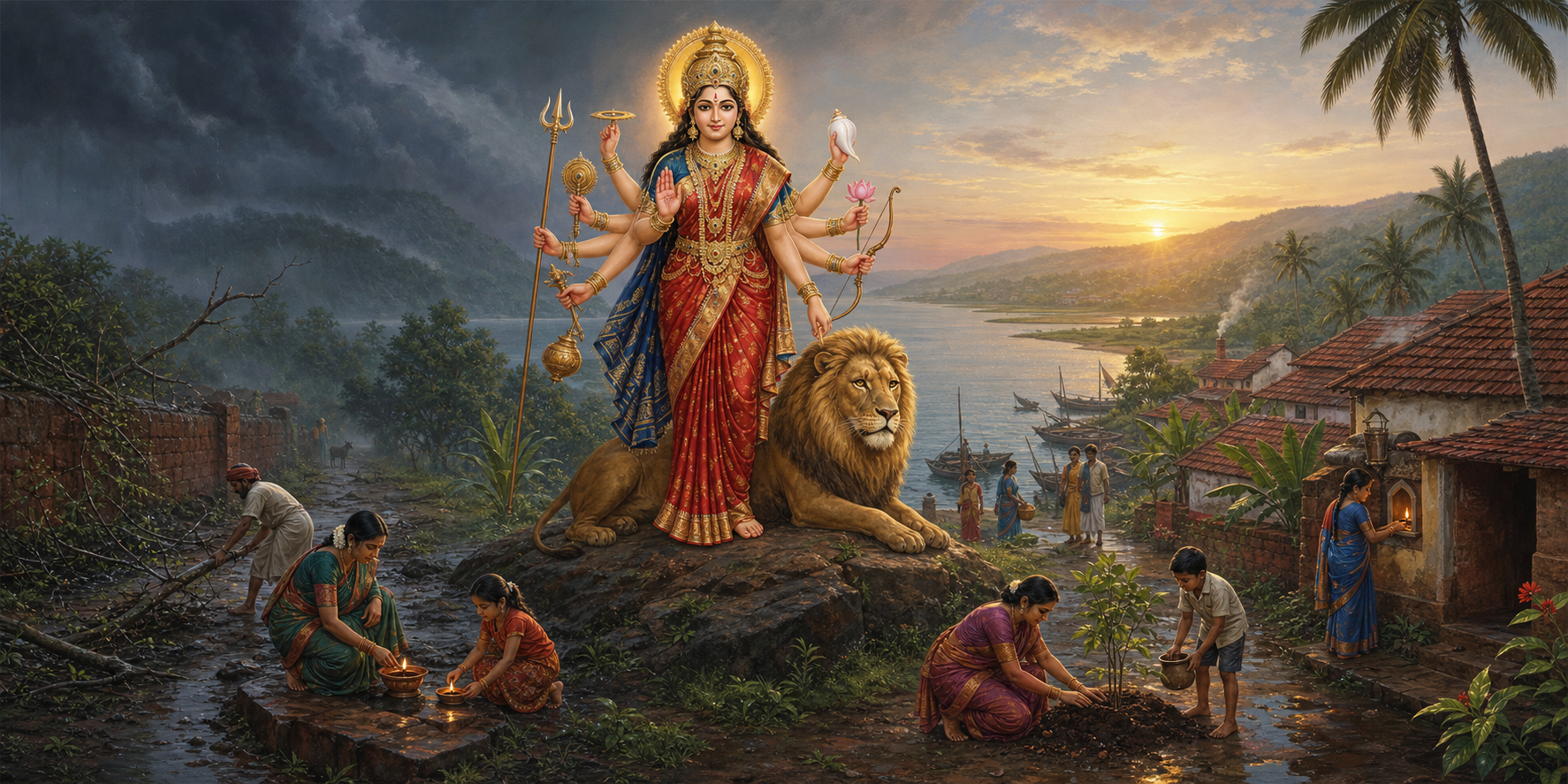
If Durga’s many-armed form leaves you wondering whether its central message is combat or peace, look beyond the instant of victory. Ask what her power is meant to restore. That question keeps devotion from collapsing into either aggression or a vague ideal of gentleness.
Two expressions of the Goddess make the answer concrete. The shankha in Durga’s hand announces the return of dharmic order. Shantadurga of Kelshi embodies the peace that must follow once disorder has been restrained. Together, they give you a practical sequence: awaken, discern, protect, reconcile, and preserve.
Restoration is the measure of Durga’s strength
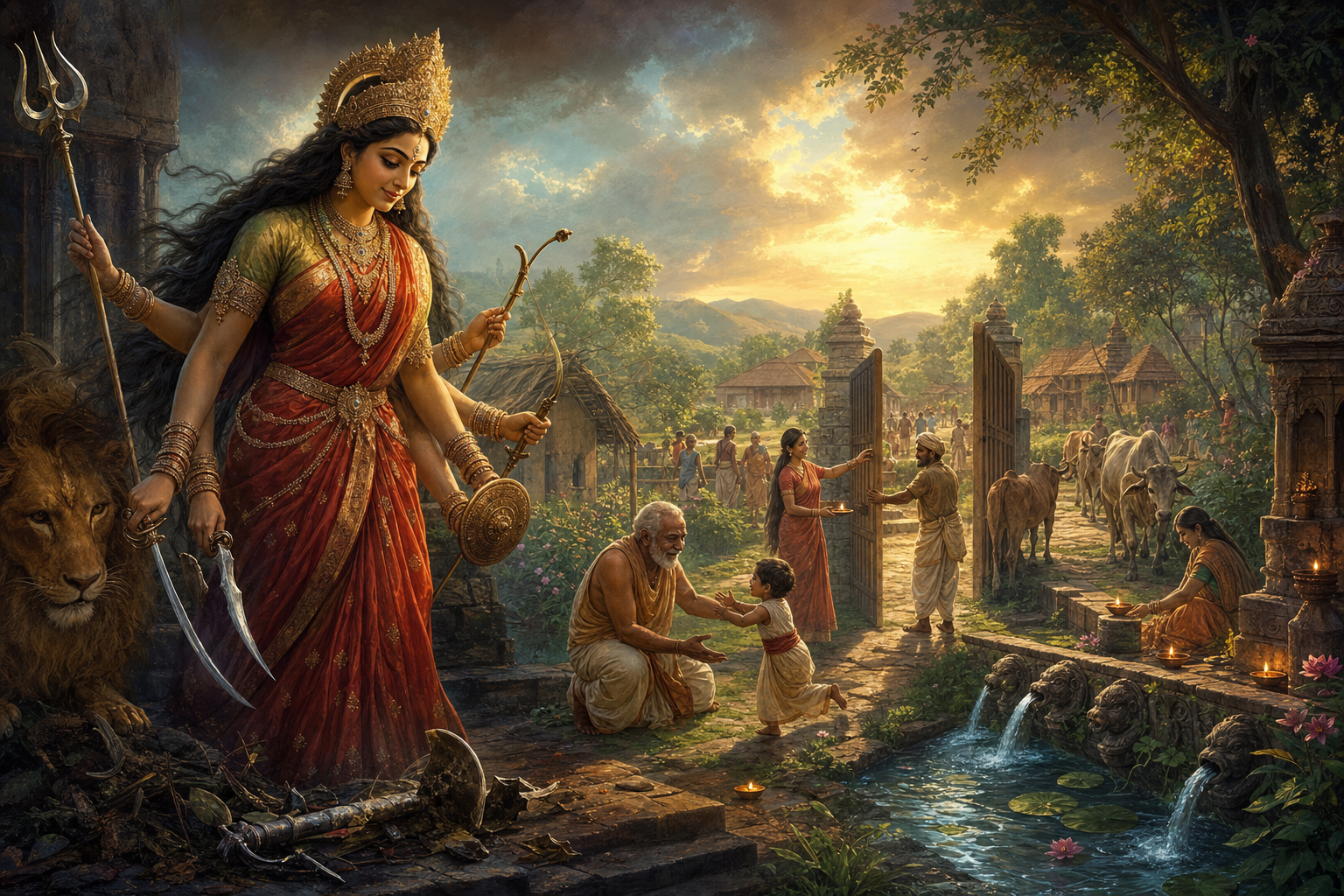
In the Devi Mahatmyam, Durga’s confrontation with Mahishasura is not violence presented as an end in itself. Her victory ends the ascendancy of adharma, protects the vulnerable, and re-establishes rightful order. Her implements therefore belong to a moral drama, not merely to a display of force.
This distinction matters whenever you invoke Durga in personal, family, or public life. Defeating an opponent is not the same as correcting an injustice. Silencing a disagreement is not the same as resolving it. Even a necessary boundary is incomplete if nothing is done to repair the conditions that allowed disorder to grow.
A Durga-centred response can be tested with three questions:
- What must be stopped? Name the conduct, falsehood, exploitation, or fear clearly. Do not substitute a disliked person for the actual adharma.
- Who or what must be protected? Identify the vulnerable person, sacred obligation, truthful account, or shared institution at risk.
- What must exist afterward? Describe the just relationship, trustworthy practice, or stable order that victory is supposed to make possible.
If you can answer only the first question, anger may be driving the response. If you can answer only the second, good intentions may lack the strength to protect anything. The third question turns resistance into restoration.
The image of Durga does not license you to treat every adversary as an asura. It places your own conduct under dharma. Strength remains worthy of the Goddess only when it is truthful, restrained, proportionate, and directed toward protection rather than humiliation.
The shankha announces what victory is for
The shankha gives Durga’s restorative power a voice. Traditional accounts identify it as a gift from Varuna, the deity associated with cosmic waters and universal order. That connection brings together purity, life-giving water, sacred sound, and the rhythms that sustain creation.
Its meaning becomes clearer when you distinguish three functions of the conch:
- It awakens. Shabda and nada turn attention away from confusion and toward discernment. The association with the primordial vibration of Om places sound at the beginning of inward reorientation.
- It declares. In dharma-yuddha, the blast publicly announces righteous intent. It reminds both the bearer and the listener that force must remain accountable to dharma.
- It consecrates a threshold. In Durga Puja and Navaratri settings, the conch can mark dawn, invocation, and consecration. Water offered from it carries the symbolism of sanctification.
The shankha therefore does more than celebrate a winner. Its sound interrupts fear, gathers attention, and declares the moral purpose of action. Its connection with water then points beyond confrontation to cleansing, renewal, and the return of life to a proper rhythm.
You can apply that symbolic sequence before a difficult conversation or community decision without pretending to invent a new ritual:
- Pause before answering, especially if anger is urging you to speak immediately.
- State the disorder in one sentence without turning the sentence into an attack on someone’s identity.
- Name the person, duty, or common good that your response must protect.
- Choose words that are truthful enough to confront the problem and restrained enough to leave restoration possible.
This is ethical reflection, not a substitute for inherited puja or temple procedure. Its purpose is to let the shankha discipline your speech. Loudness alone is not sacred sound. A voice driven by vanity or rage can reproduce the very disorder it claims to oppose. The better test is whether your words awaken clarity, defend what is right, and make responsible action possible.
Shantadurga makes peace an active form of power
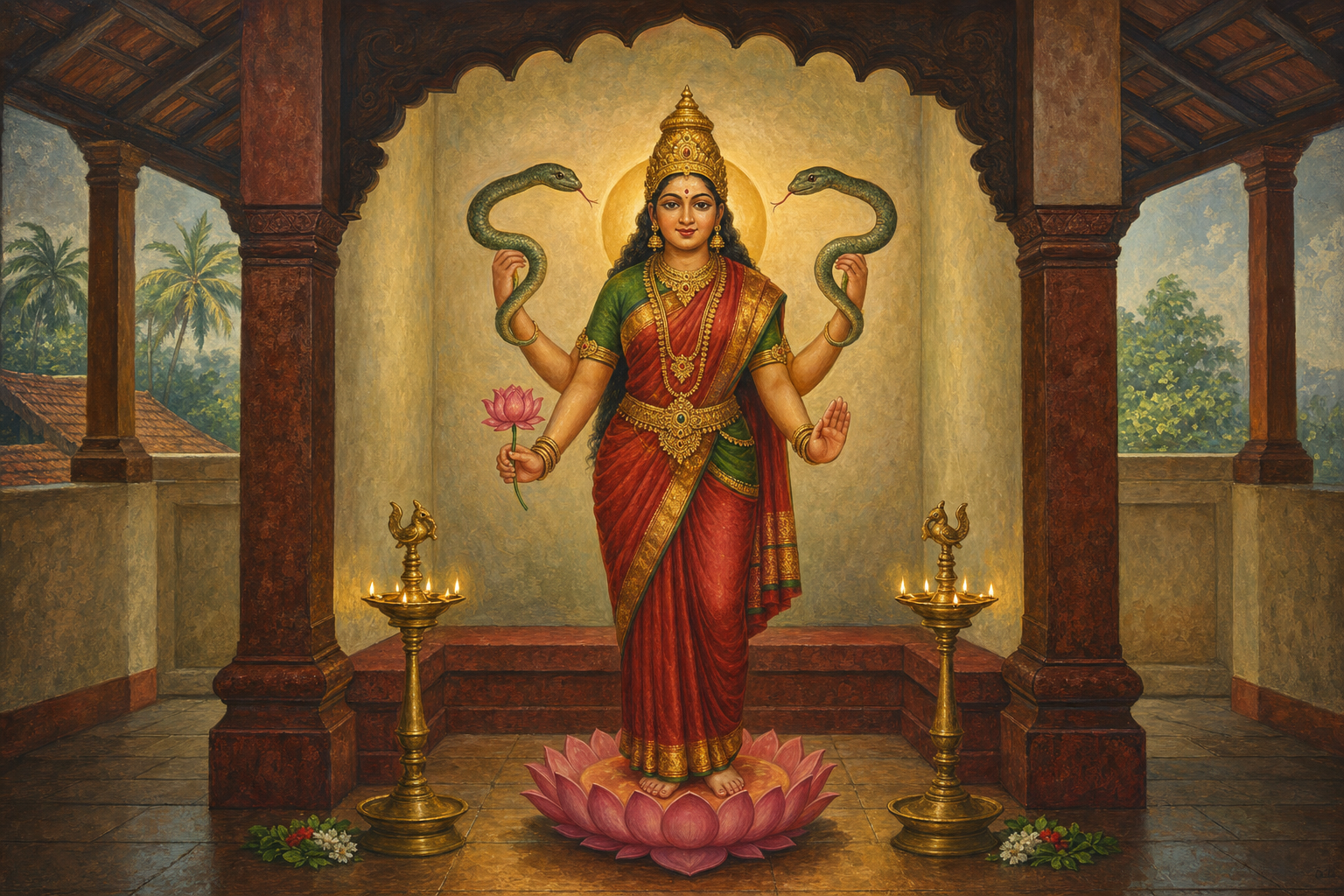
Shantadurga corrects the assumption that the Goddess is present only in confrontation. In the Konkan’s theological imagination, she appears as a peacemaker who brings concord between Shiva and Vishnu. Her name joins shanti, or peace, with Durga’s protective strength.
This is not peace purchased through surrender. Shantadurga represents gentleness that has not abandoned power and power that does not need permanent conflict. Her symbolism refuses the false choice between passive avoidance and uncontrolled escalation.
When you face a family or community dispute, write three lines before proposing a settlement:
- The boundary: What conduct cannot be allowed to continue?
- The protection: Which person, principle, or relationship must be kept safe?
- The concord: What arrangement would permit truthful cooperation after the boundary is established?
A boundary without protection can become punishment for its own sake. Compassion without a boundary can leave adharma untouched. Reconciliation proposed too early can pressure the vulnerable to accept an unsafe or dishonest peace. Shantadurga’s order is more exacting: restrain what is harmful, preserve what is worthy, and then rebuild concord on dharmic terms.
This also explains why peace should not be confused with silence. A household can be quiet because everyone is afraid to speak. A community can appear united because difficult truths have been suppressed. Shanti becomes restorative only when truth, restraint, protection, and mutual obligation can coexist.
Konkan tradition turns restoration into continuity
Shantadurga’s meaning cannot be separated from the place that carries her memory. In Puranic sacred geography, the Konkan is understood as Parashurama-kshetra, the coastal land revealed when Parashurama caused the sea to recede. Between the western coast and the Sahyadri, Devi shrines became anchors of worship, identity, and community continuity.
At Kelshi in Maharashtra’s Ratnagiri district, Shantadurga is present in household rites, seasonal observances, festivals, and the devotional life of the surrounding community. Sacred geography here does more than locate a temple on a map. It tells devotees how land, sea, work, worship, family memory, and dharma belong together.
Four layers of continuity are worth noticing:
- Place: Kelshi grounds devotion in a particular coastal landscape rather than an interchangeable religious setting.
- Household: Repeated observances carry the Goddess from the public shrine into ordinary family duty.
- Season: Festivals and recurring vows prevent remembrance from depending on occasional enthusiasm.
- Community: Shared worship sustains language, music, crafts, sacred names, and social memory around the shrine.
Many Gaur Saraswat Brahmin families revere Shantadurga as Kuladevata. Her memory travelled with families moving through the Konkan, Goa, and the wider western coast, carried through household shrines, inherited observances, sacred names, and festival vows. This is restoration across generations: belonging survives displacement because practice gives memory a durable form.
If you are tracing your own family’s relationship with a Konkan Devi, begin with lineage rather than assumption:
- Ask the oldest accessible relatives for the deity’s exact name, the associated place, and the household observances they personally remember.
- Record remembered practice, family inference, and unanswered questions separately. Do not turn uncertainty into a confident legend.
- Distinguish a family custom from a temple custom and both from a practice common across Hindu traditions.
- Confirm temple-specific details with an appropriate temple or community custodian before teaching or publishing them as established tradition.
- Preserve regional names and ritual vocabulary alongside any translation. A generic label may lose the relationship encoded in the original term.
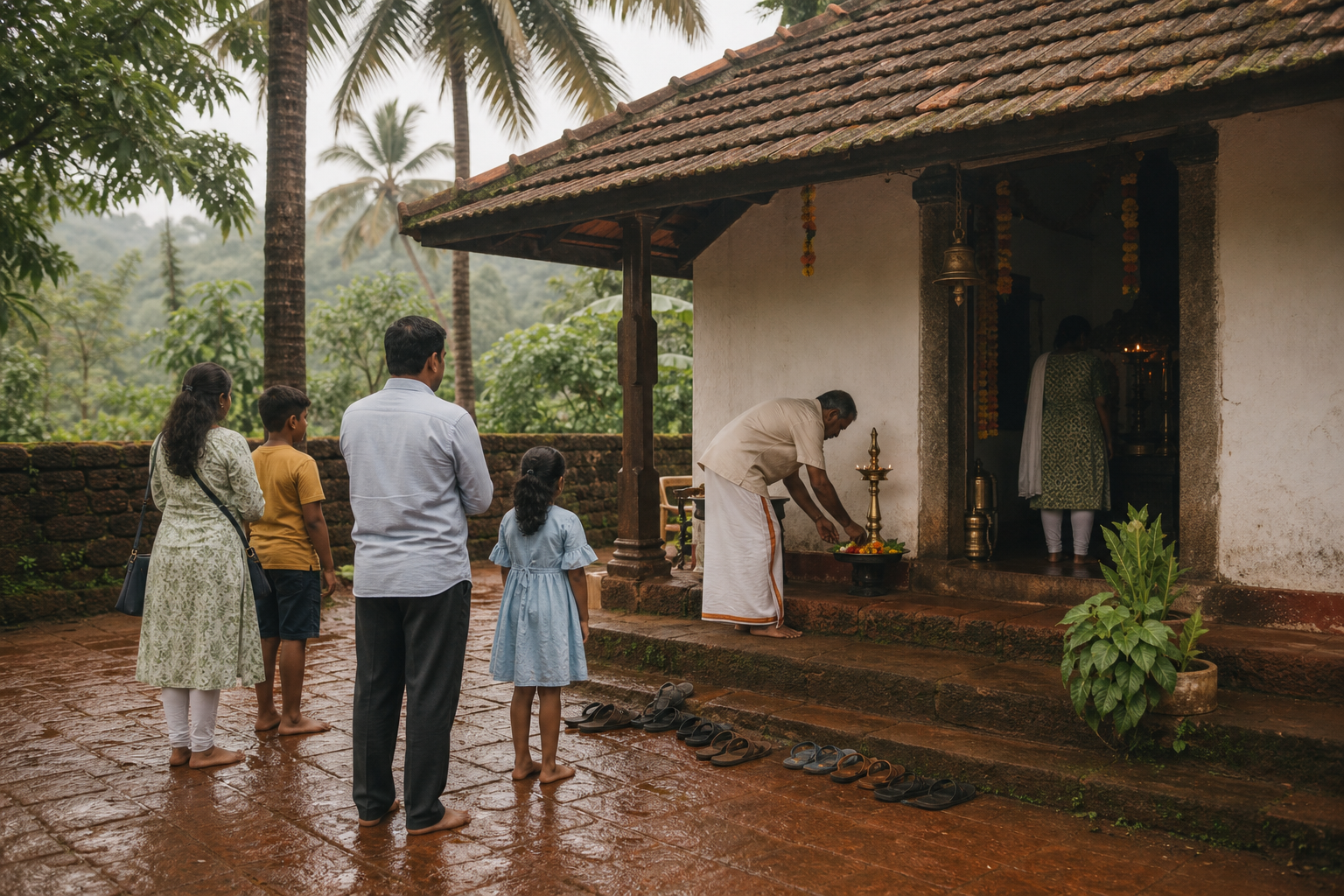
If Kelshi is not part of your lineage, you can still approach its tradition respectfully as a guest. Notice how bells, mantra-japa, fragrance, offerings, and the surrounding coastal setting form one devotional environment. The point is not to collect an exotic experience. It is to understand how repeated, place-bound worship teaches people to join inner quiet with household responsibility and communal care.
The conch’s association with water also acquires special force in the Konkan. Water is not merely decorative imagery, and the coast is not merely scenery. Together they place stewardship within the moral horizon of worship. A vow to restore order remains incomplete if it ignores the land, water, and shared surroundings on which community life depends.
Key takeaways: five tests for restorative action
- The outcome test: Will your action merely defeat an opponent, or will it help restore a just and stable order?
- The protection test: Can you name the vulnerable person, sacred obligation, or common good your strength is meant to defend?
- The speech test: Do your words awaken clarity and responsible action, or do they amplify anger, fear, and humiliation?
- The peace test: Does reconciliation follow truth and protection, or is peace being used to avoid a necessary boundary?
- The continuity test: Are you preserving a living tradition accurately through place, family memory, recurring practice, and accountable transmission?
At your next darshan or household observance, do not stop at asking what Durga’s symbols represent. Name one disorder that must end, one person or duty that must be protected, and one relationship or practice that should be restored afterward. If your connection is to the Konkan, follow that reflection with one careful conversation about the traditions your family has actually inherited. That is how sacred symbolism moves from admiration into dharma.

References
- DharmaRenaissance Blog – Maa Durga’s Shankha: Sacred Sound of Liberation, Dharma, and Victory Over Evil
- DharmaRenaissance Blog – Shantadurga of Kelshi: Sacred Konkan Legacy from Parashurama to Gaur Saraswat Devotion
