
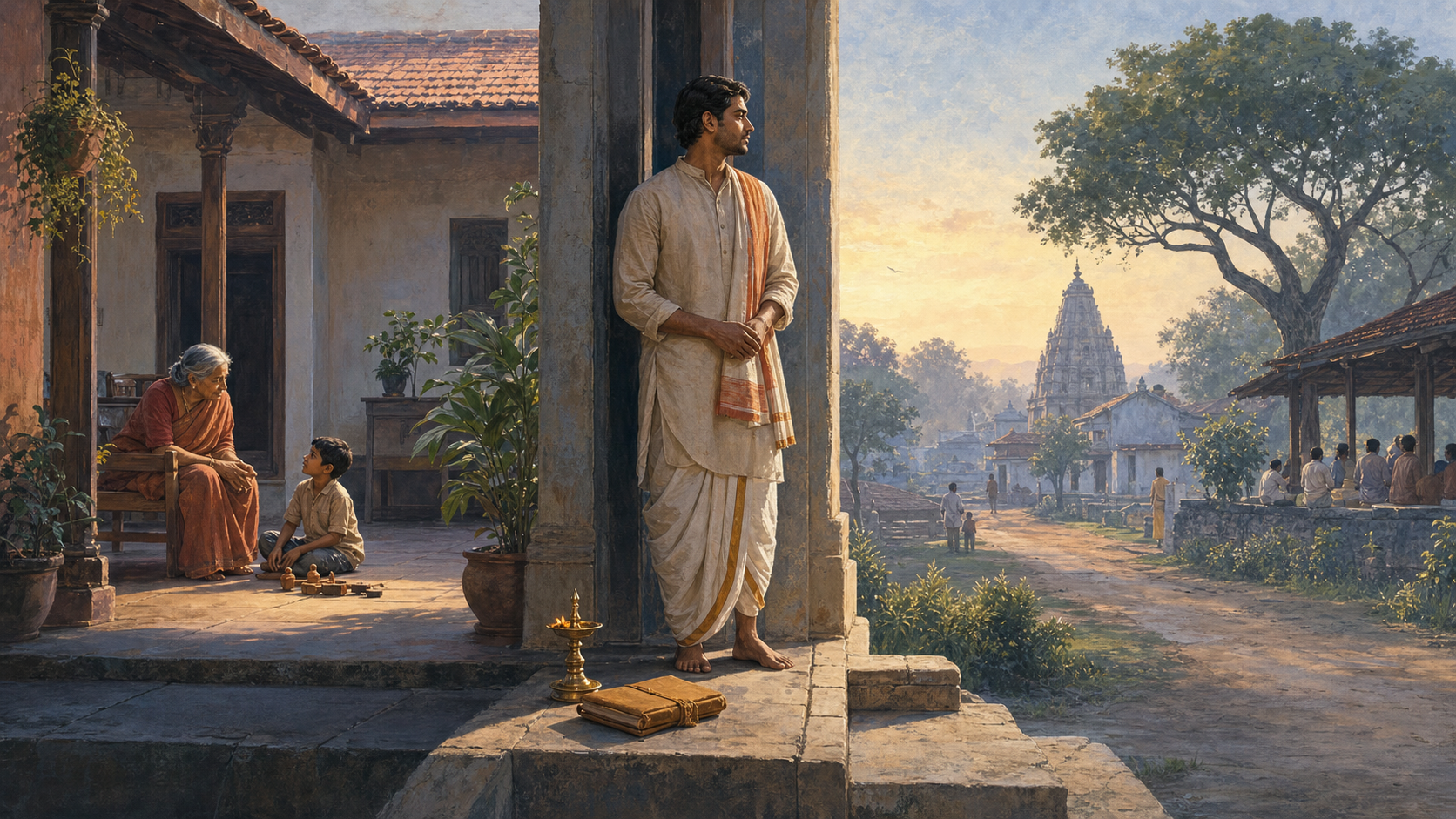
You have made a promise, but keeping it will hurt someone who depends on you. Your family expects loyalty, but your conscience says that loyalty has crossed into complicity. You want to surrender the outcome to Bhagavan, but you still have to decide what to do.
These are not failures of faith. They are precisely the situations for which Hindu scripture develops a mature account of dharma. The practical question is not simply, “What is my duty?” It is: “Which duty serves dharma here, what must constrain it, and how can devotion keep ego from corrupting the answer?”
Dharma, duty, and devotion must correct one another
Dharma is larger than obedience. It includes the moral order that sustains life, relationships, justice, and spiritual growth. A duty is a concrete obligation arising from your role, relationship, capacity, or circumstances. Devotion is the orientation that offers action to the Divine instead of using action to enlarge the self.
The distinction matters because a duty can be real without being absolute. A parent, teacher, employee, ruler, friend, and devotee each carries obligations, but none of those roles grants permission to abandon truthfulness, compassion, dignity, or restraint. Sva-dharma is not whatever feels personally authentic, nor is it automatic obedience to whatever your group demands. It is the discipline of acting rightly from your actual place in the world.
The dice game in the Mahabharata makes this distinction painfully clear. Yudhishthira accepts a rigged invitation under the pressure of royal convention, yet his compliance exposes his dependants to foreseeable ruin. Draupadi then challenges the legitimacy of what has happened: after losing himself, did he retain the authority to stake her? Her question forces the assembly to distinguish custom from justice and formal procedure from human dignity.
Bhishma’s vow reveals the same danger from another direction. A sacrifice made for a noble reason becomes a chain binding him to a throne even when silence assists adharma. Karna’s gratitude and loyalty possess genuine moral beauty, but they cannot cleanse his participation in Draupadi’s humiliation or in plots against the Pandavas. Intention, loyalty, and personal virtue matter; none can make an unjust end righteous.
This gives you a first rule: a duty receives its moral authority from dharma. It does not become dharma merely because it is ancient, solemn, difficult, or praised by your community. Without dharma, duty hardens into compliance. Without duty, devotion can dissolve into sentiment. Without devotion, even correct action can become an instrument of pride.
Sort the five layers of duty before choosing

Confusion often begins because several different kinds of obligation are compressed into the single word “duty.” The Mahabharata’s moral world becomes easier to navigate when you separate five layers:
- Samanya dharma: norms with broad human force, including truthfulness, compassion, dignity, fairness, and restraint from needless harm.
- Sva-dharma: obligations arising from your role, temperament, competence, and place in a particular situation.
- Kula-dharma: responsibilities associated with family, lineage, and community continuity.
- Raja-dharma: the public responsibilities of authority, including protection, prudent counsel, justice, and care for those affected by power.
- Apaddharma: exceptional conduct permitted by a genuine emergency when ordinary options cannot preserve the greater demands of dharma.
These layers are not a mechanical ladder. Samanya dharma supplies a moral floor, but roles affect how its demands must be carried out. A ruler and a renunciant may respond differently to aggression because their responsibilities differ. Family loyalty deserves serious weight, but it cannot automatically defeat another person’s dignity. An emergency may alter the permitted means, but it does not turn self-interest into righteousness.
To apply this framework, write the decision in one sentence before trying to solve it. Then list every duty making a claim on you and place each under one of the five layers. This prevents the loudest obligation from masquerading as the only one.
Suppose a relative asks you to conceal conduct that harms another person. “Protect the family” is a claim of kula-dharma. Honesty and protection from harm belong to samanya dharma. Your particular responsibility toward the affected person may also create a role-specific duty. Once the claims are separated, family loyalty can no longer close the argument by itself. The question becomes how to protect people, tell the necessary truth, and avoid vindictiveness at the same time.
Vibhishana provides a scriptural model of this sorting. He repeatedly counsels Ravana to release Sita and restore justice. When that counsel fails, he places dharma above kinship and seeks refuge with Rama. His choice does not teach contempt for family. It teaches that kula-dharma loses its protective force when it is invoked to perpetuate adharma.
Test a claimed duty with six hard questions

Once you have named the competing duties, do not ask only which option feels pure. Ask questions that expose hidden ego, displaced costs, and false emergencies.
- What is this duty meant to protect? Name the person, relationship, institution, truth, or common good at stake. If the honest answer is merely your status, comfort, reputation, or control, the language of duty may be disguising attachment.
- Who will bear the cost? Include people absent from the decision. Yudhishthira’s error is not exhausted by what gambling does to him; his dependants bear the consequence. A choice that displays your virtue by transferring the danger to someone weaker requires another look.
- Have correction, counsel, and peaceful means been tried? Krishna’s embassy and the Pandavas’ reduced request for five villages establish that war follows the exhaustion of serious peace efforts. The Lanka campaign likewise proceeds through counsel and Angada’s diplomatic mission before force. Conciliation, concession, and strategic division precede punishment. In your own conflict, this means stating the problem clearly, seeking correction, documenting refusal where appropriate, and escalating only as far as protection requires.
- Are the means bounded by the purpose? A good aim does not authorize every method. Ask what you will not do, whom you will not dehumanize, and when the exceptional measure must stop. If the exception has no boundary or end condition, it is becoming a new form of adharma.
- Would the choice still appear righteous without the names attached? Remove “my family,” “my leader,” “my side,” and “my enemy” from the description. Karna’s loyalty feels different when assessed apart from his gratitude to Duryodhana. This test does not erase relationships; it reveals whether partiality has displaced first principles.
- What moral residue will remain? An action may be necessary without becoming morally costless. Yudhishthira’s half-truth about Ashvatthama helps disarm Drona, yet the narrative marks a loss of moral stature. If you must take an exceptional action, plan how you will acknowledge the harm, accept accountability, repair what can be repaired, and prevent the exception from becoming a habit.
Apaddharma therefore has a demanding threshold. Ordinary remedies must be inadequate; the purpose must be restoration rather than private gain; the means must remain limited; and the actor must accept responsibility for the consequences. Calling a situation an emergency because patience is inconvenient does not satisfy that threshold.
Watch especially for anyone who uses sva-dharma to forbid ordinary moral scrutiny. “Know your place” is not a complete dharmic argument. The assembly’s elders possess rank, learning, and formal authority, but Draupadi’s question carries the greater moral force because it confronts the injustice their status has allowed them to evade.
Bhakti should clarify judgement, not replace it

Arjuna’s crisis is not solved by being told to stop thinking. He is led through a synthesis of action, knowledge, and devotion. Action must accord with sva-dharma, but it must also be freed from possessiveness and directed toward loka-sangraha, the sustaining of a just social order. The Bhagavad Gita’s answer to paralysis is discernment without ego-driven attachment, not obedience without examination.
This changes what devotion looks like in a difficult decision. Bhakti is not measured by the intensity of your feeling or by your certainty that Bhagavan favours your preferred outcome. It is visible in whether you can act without hatred, hear unwelcome counsel, relinquish personal credit, and remain accountable if your judgement proves incomplete.
Devotion and disciplined inquiry reinforce each other. Before deciding, distinguish what you have directly observed from what you have inferred and what you have accepted from trustworthy testimony. This threefold discipline of perception, inference, and reliable testimony prevents rumour, fear, or convenient authority from entering the decision under a sacred label. Shabda is not a licence to stop reasoning; authentic testimony belongs in a conversation with facts and sound inference.
You can bring bhakti into action at three points. Before acting, ask, “Whom am I really serving?” While acting, refuse needless humiliation, cruelty, and self-display. After acting, examine the consequences without defending your image. Offering the fruits of action does not mean becoming indifferent to those fruits for other people. It means relinquishing possessiveness while remaining fully responsible for service.
Hanuman embodies this union of devotion and competence. When Lakshmana is wounded, service requires urgency, courage, and the mobilization of every available resource. The Sanjivani episode presents bhakti as effective service under pressure, not passive expectation. Vibhishana’s counsel, Krishna’s diplomacy, and Hanuman’s exertion all point in the same practical direction: surrender of ego increases responsible action; it does not excuse you from it.
That is why “Bhagavan will take care of it” can be either faith or avoidance. If you lack control over an outcome after doing what dharma requires, surrender is appropriate. If you still possess the capacity and obligation to protect, speak, repair, or serve, invoking surrender prematurely is an abandonment of duty.
Use a repeatable practice for your next dharma-sankata
For an important decision, put the following sequence on paper. Writing matters because the mind can quietly change the description of a problem to protect the answer it already wants.
- State the choice plainly. Write the actual action under consideration, not a flattering abstraction such as “honour” or “loyalty.”
- Name the universal floor. Identify the truth, dignity, compassion, fairness, or restraint from needless harm that must not disappear from the decision.
- Classify the competing duties. Separate role, family, public, and emergency claims. Do not let one duty speak for all the others.
- Check the facts. Mark what is observed, what is inferred, and whose testimony you are trusting. Seek missing information before treating uncertainty as permission.
- Choose the least ego-serving effective action. Prefer the option that protects those who depend on you, advances justice, and uses no more force or exposure than the purpose requires.
- Set boundaries on any exception. Record why ordinary conduct is inadequate, what remains prohibited, and what condition will end the exceptional measure.
- Act, review, and repair. Do not confuse decisiveness with infallibility. Examine the result, accept the karmic and relational consequences, and correct avoidable harm.
If uncertainty remains, consult a teacher, elder, or wise friend who can hear the full facts and has no direct interest in securing your obedience. Do not ask only, “What would you do?” Ask which duty they believe is primary, which principle constrains it, and what cost their answer assigns to other people. A trustworthy adviser should be able to explain all three.
Key takeaways
- Dharma is the moral ground of duty; a role, vow, custom, or relationship is not automatically absolute.
- Separate samanya dharma, sva-dharma, kula-dharma, raja-dharma, and apaddharma before deciding which obligation governs.
- A genuine emergency exception requires exhausted alternatives, a just purpose, bounded means, and accountability for the cost.
- Bhakti should reduce ego and increase truthful, competent service; it should never be used to suspend judgement.
- A necessary action can still leave moral residue, so review, repair, and learning belong to dharmic action itself.
Bring one unresolved decision to this practice. Write its competing duties in separate lines, identify the person most exposed to harm, and name the principle you will not violate. Then act with enough humility to remain correctable. Hindu scripture does not promise that every dharma-sankata will feel clean; it teaches you how to become responsible for choosing within it.
References
- DharmaRenaissance Blog — Why the Mahabharata’s Grey Shades Matter: Navigating Dharma, Dilemma, and Duty Today
- DharmaRenaissance Blog — Lanka Kanda in Tulsidas’s Ramcharitmanas: Dharma, Strategy, and Enduring Bhakti
- Dandavats — Unlocking Complete Knowledge: Krishna and the Five Realities in a Dharmic, Unified Perspective
