
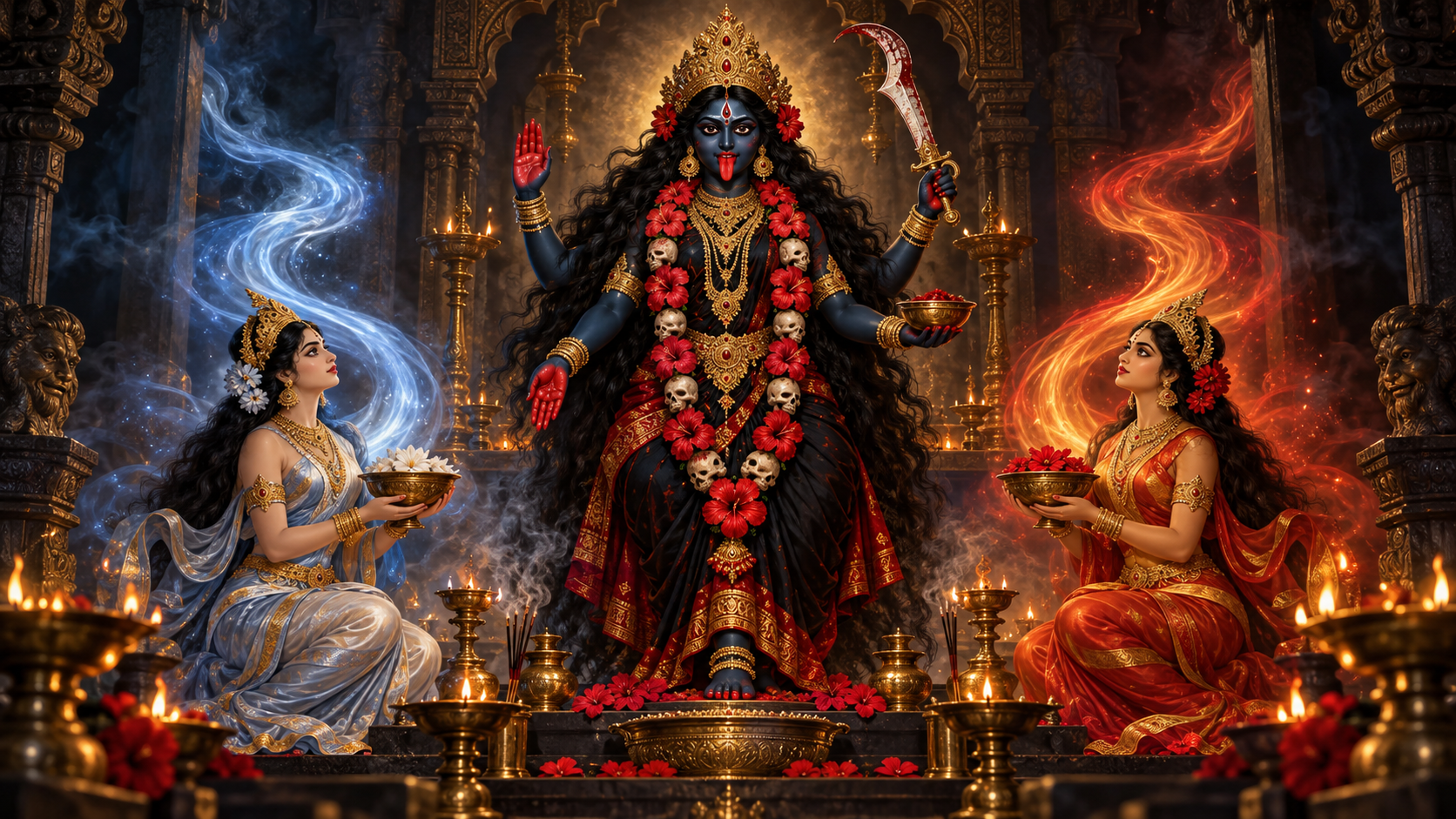
You may know how to approach Kali at the centre of a puja and still be unsure what to make of Dakini and Varnini. Are they secondary deities to acknowledge briefly, decorative companions, or part of the spiritual teaching carried by the whole arrangement?
Their pairing offers a practical way to read Kali Puja from within the subtle-body language of yoga. It directs your attention to complementary currents, the danger of identifying with either extreme, and the need to bring both under the unifying presence of Shakti.
Read the attendants as part of Kali’s teaching
A sacred arrangement is not merely a collection of divine personalities. Position, pairing, scale, gesture, and relation can all contribute to its meaning. Kali occupies the centre, while Dakini and Varnini appear in relation to her. If you look only at the central form, you can miss what that relationship is teaching.
In the subtle-energy interpretation, Dakini and Varnini represent ida and pingala, the two complementary channels familiar from yogic accounts of the subtle body. They therefore should not be dismissed as background figures. Their paired presence turns the worshipper’s attention toward polarity: inward and outward movement, receptivity and expression, quietness and force.
That does not reduce two goddesses to spiritual plumbing. Personification changes how you meet the teaching. A diagram can make energy seem mechanical and available for manipulation; a divine form asks for reverence, discrimination, and restraint. The currents are not presented as possessions of the ego. They belong within the greater field of Shakti represented by Kali.
When you encounter the figures in a shrine, image, or ritual setting, begin with three visual questions: Who stands at the centre? Which figures form a pair? What changes when you read the pair in relation to the centre? Those questions will usually reveal more than isolating each figure and searching for a one-line definition.
Use ida and pingala as complementary currents, not rival sides

Ida and pingala belong to the traditional vocabulary of subtle anatomy. They are commonly described through complementary associations: ida with lunar, cooling, and inward qualities; pingala with solar, warming, and outward qualities. These are contemplative correspondences, not anatomical nerves that medicine can expose and measure.
The first common mistake is to turn complementarity into competition. The symbolism does not ask you to choose a supposedly superior channel. Inwardness without expression can become withdrawal. Activity without reflection can become agitation. A disciplined life needs the capacity to receive and the capacity to act.
The second mistake is to convert a flexible teaching into fixed labels. Ida is not simply “good” while pingala is “bad,” or the reverse. Nor should the pair be treated as a crude division between women and men, emotion and reason, or spiritual people and worldly people. Such equations flatten a dynamic yogic map into social stereotypes.
The third mistake is self-diagnosis. A passing mood, a single meditation, or the dominance of one nostril does not by itself justify declaring that you have mastered or blocked a subtle channel. Use the symbolism to examine the quality of your attention and conduct, not to award yourself an esoteric status.
You may also be tempted to conclude that Kali simply equals the central channel, sushumna, because Dakini and Varnini signify the two side currents. That equation may belong to a particular lineage or teaching, but the image alone does not establish it. The sounder conclusion is narrower: the two currents appear within Kali’s greater power and are not the final objects of worship by themselves.
A practical contemplation for Kali Puja
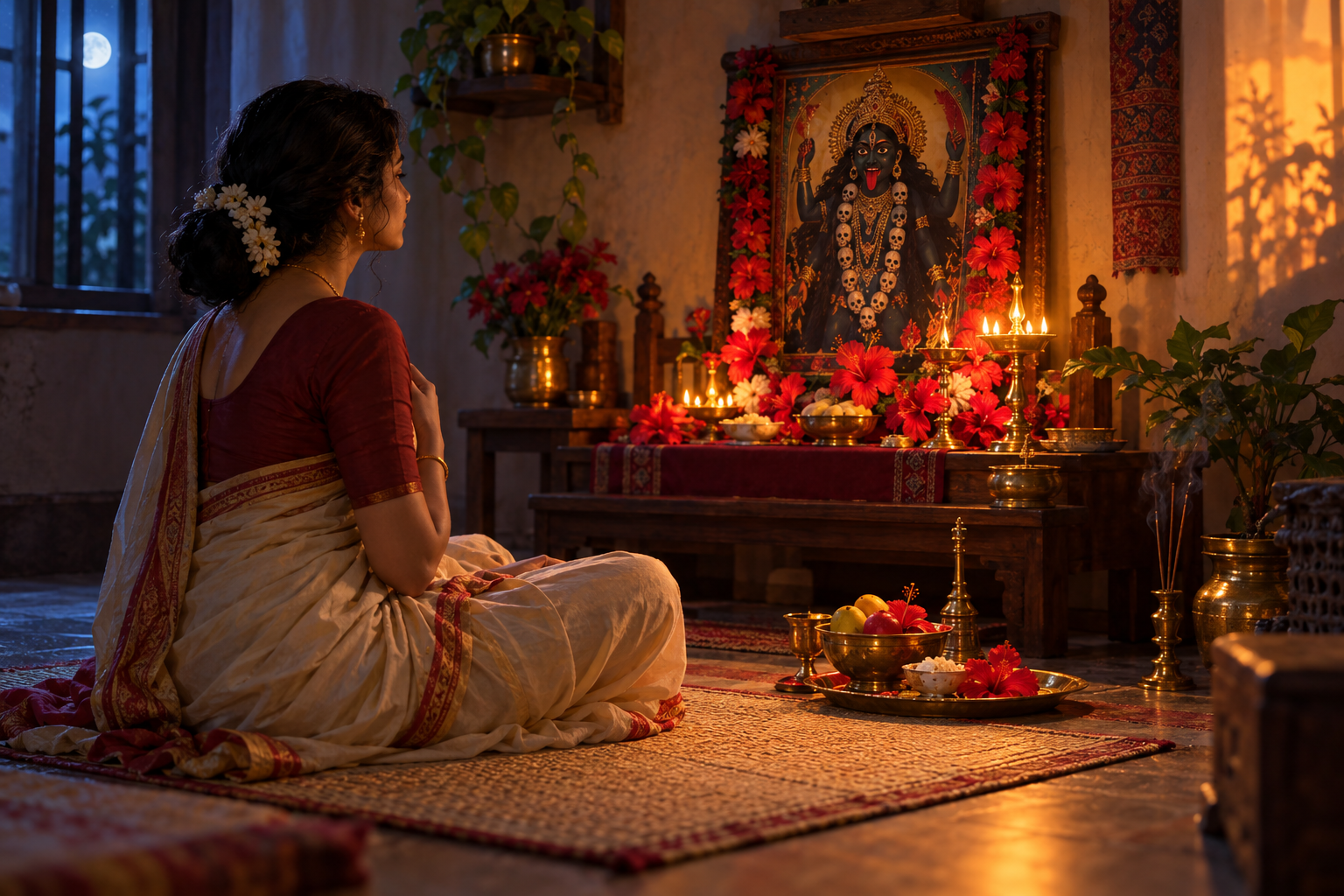
You do not need to replace devotion with an improvised energy exercise. Let the symbolism deepen the puja you actually practise. If your family or lineage has a prescribed method, retain its sequence, mantra, and ritual authority.
- Begin with Kali at the centre. Offer your attention to the Mother before analysing the attendant forms. This preserves the hierarchy communicated by the arrangement.
- Notice Dakini and Varnini as a pair. Hold the ida-pingala correspondence in mind without inventing an individual assignment that your tradition has not given you.
- Examine your present imbalance. Ask where you are reflecting without acting, or acting without reflection. Keep the question tied to conduct rather than imagined occult achievement.
- Return both tendencies to the centre. Resume the prayer, mantra, or silent attention you were taught. The point is not to glorify either pole but to place both before Kali.
- End with one corrective action. If force has outrun discernment, pause before the next consequential word or decision. If contemplation has become avoidance, complete one duty you have postponed.
This contemplation is deliberately modest. Formal pranayama may involve prescribed sequences, retentions, locks, or ratios, but an image’s symbolism does not tell you how to perform them. Learn such methods through competent instruction rather than constructing a breathing regimen from iconography.
The test comes after worship. If the symbolism remains an attractive theory but never changes how you speak, decide, rest, or fulfil a responsibility, you have understood the vocabulary without receiving the instruction. Kali Puja should make the two movements of life more visible: the movement that gathers awareness and the movement that spends energy in the world.
Key takeaways
- Dakini and Varnini are meaningful participants in the sacred arrangement, not merely decorative attendants.
- Within the subtle-energy reading, their pairing represents ida and pingala, two complementary yogic currents.
- The symbolism concerns relationship and balance; it does not declare one current spiritually superior to the other.
- Kali remains central. The paired currents belong within Shakti’s larger reality rather than serving as separate techniques for the ego to control.
- Use the image for self-examination and disciplined conduct, but do not derive unsupervised pranayama instructions from it.
Let the symbolism change your next act
At your next Kali Puja, do not rush past Dakini and Varnini on the way to the central form. Notice the pair, recognise the twofold movement they signify, and then return your gaze to Kali. That movement of attention is itself the lesson: acknowledge polarity without becoming captive to it.
Before you leave the shrine, choose one place where your life needs a better union of awareness and action. Make the needed pause, speak the needed truth, or complete the neglected duty. The symbolism becomes useful when the balance honoured in puja begins to shape what you do next.
References

Leave a Reply
You must be logged in to post a comment.